


HELP! Stuck stem adapter
 12-07-24 | 12:55 AM
#1
Thread Starter
Newbie
Joined: Jul 2012
Posts: 57
Likes: 6
HELP! Stuck stem adapter
So there's a million videos on how to take off a stuck/seized stem, but does anyone have any suggestions on how to take off a seized stem adapter? This one in particular is a 1inch to 1 1/8. Unsure of brand, but it looks like Origin 8.
So far, I've done the following:
-Insert the bolt and hammer with a rubber mallet for 10 minutes straight
-Insert Allen wrench on top of bolt and go to town with steel hammer for 10 minutes
-Sprayed a lot of WD40 on the outside and inside of adapter.
-Hammer more.
No luck.
A few ideas I thought of:
-Find a bigger bolt wide and long enough to put inside the adapter and hammer (assuming this will have more impact than the tiny bolt it came with)
-Unscrew top nut of headset using breaker bar to loosen the stem in hopes that it'll pop out or at least budge. I don't plan on keeping the headset so if it gets ruin it won't bother me.
-Drill through the sides of the stem adapter, put a 1/4 bolt through it, tie the frame down and use something like an F40 to pull out the adapter.
As mentioned, I don't plan on keeping the headset nor adapter so if they're damaged I could careless. That said, this is a fairly rare fork so I can't afford to damage it.
If you've had success pulling one of these out, please do share. Cheers!


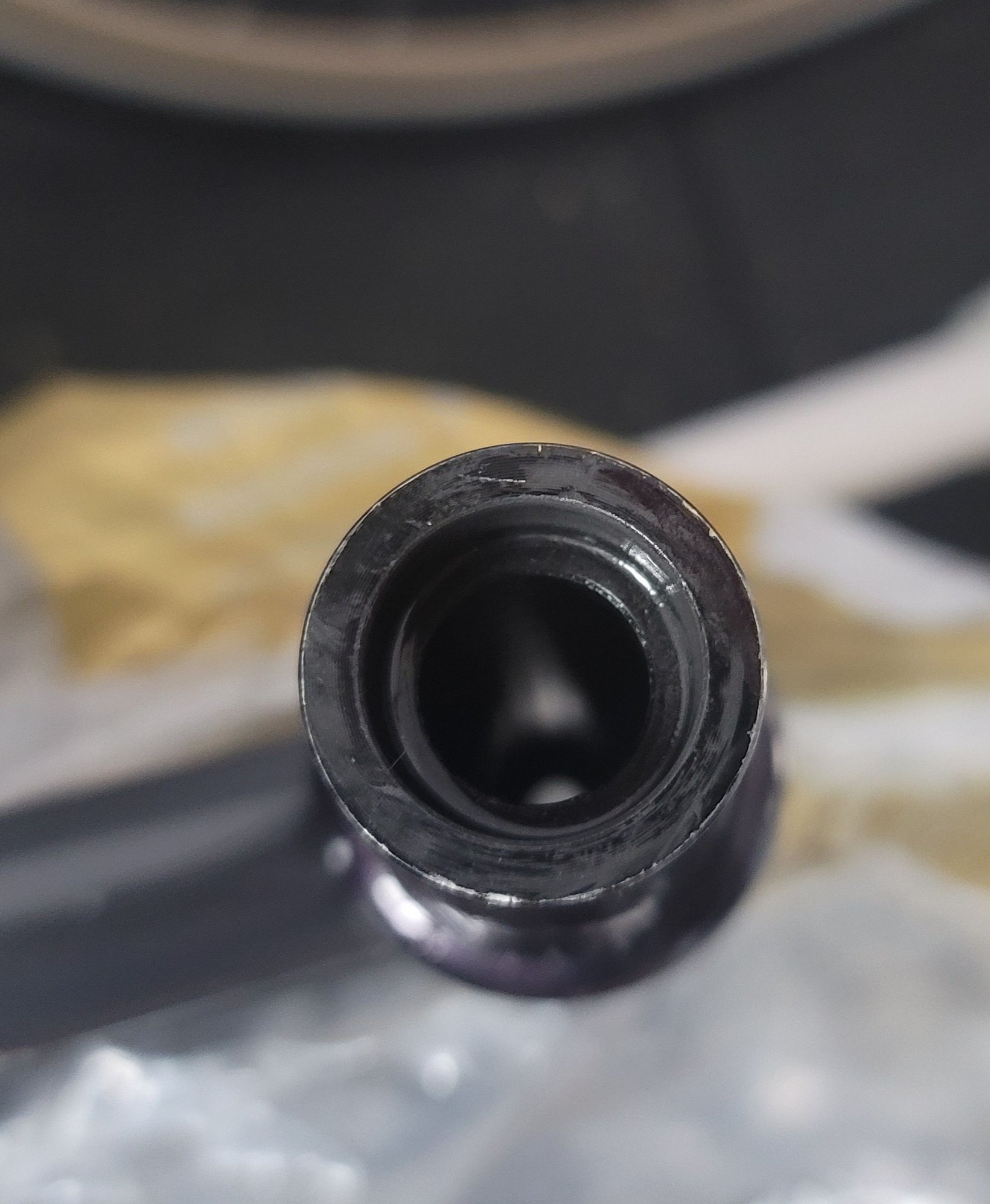
So far, I've done the following:
-Insert the bolt and hammer with a rubber mallet for 10 minutes straight
-Insert Allen wrench on top of bolt and go to town with steel hammer for 10 minutes
-Sprayed a lot of WD40 on the outside and inside of adapter.
-Hammer more.
No luck.
A few ideas I thought of:
-Find a bigger bolt wide and long enough to put inside the adapter and hammer (assuming this will have more impact than the tiny bolt it came with)
-Unscrew top nut of headset using breaker bar to loosen the stem in hopes that it'll pop out or at least budge. I don't plan on keeping the headset so if it gets ruin it won't bother me.
-Drill through the sides of the stem adapter, put a 1/4 bolt through it, tie the frame down and use something like an F40 to pull out the adapter.
As mentioned, I don't plan on keeping the headset nor adapter so if they're damaged I could careless. That said, this is a fairly rare fork so I can't afford to damage it.
If you've had success pulling one of these out, please do share. Cheers!
 12-07-24 | 01:00 AM
#2

Senior Member


Joined: Jul 2015
Posts: 7,476
Likes: 3,287
From: NW Oregon
Bikes: 1982 Trek 930R Custom, '91 Diamondback Ascent w/ XT, XTR updates, Fuji Team Pro CF road flyer, Specialized Sirrus Gravel Convert, '09 Comencal Meta 5.5 XC, '02 Marin MBX500, '84 Gitane Criterium bike
have you tried to unscrew it from the fork threads yet?? and if it's shouldered down onto that top nut, the Nut ITSELF might force the stem loose...
if that doesn't work, get out the pipe wrench and go all animal on it.. twisting will free it quicker than all the hammering in the world, usually.
and then, there's a keyhole hack saw... cut it just above the top nut, then start wearing some blisters into your hand sawing it in two places until you see steel chips.......then hit the sides, and then twist it.
another thing to try.. find a Cheapo Steel Stem to clamp onto it.. one that you can sacrifice.... then use it for leverage to TWIST until the extender rotates........
and if the top nut will come off separately.. Shock the extender Sideways with a Dead Blow hammer of 3 to 4 lb. weight.. IE: A BIG Soft Face Plastic Hammer. this will loosen the bonds that are defeating you, so far.
if that doesn't work, get out the pipe wrench and go all animal on it.. twisting will free it quicker than all the hammering in the world, usually.
and then, there's a keyhole hack saw... cut it just above the top nut, then start wearing some blisters into your hand sawing it in two places until you see steel chips.......then hit the sides, and then twist it.
another thing to try.. find a Cheapo Steel Stem to clamp onto it.. one that you can sacrifice.... then use it for leverage to TWIST until the extender rotates........
and if the top nut will come off separately.. Shock the extender Sideways with a Dead Blow hammer of 3 to 4 lb. weight.. IE: A BIG Soft Face Plastic Hammer. this will loosen the bonds that are defeating you, so far.
Last edited by maddog34; 12-07-24 at 01:17 AM.
12-07-24 | 06:03 AM
#3

Bianchi Goddess


Joined: Apr 2009
Posts: 28,967
Likes: 4,236
From: Shady Pines Retirement Fort Wayne, In
Bikes: Too many to list here check my signature.
THis may sound stupid but you are hammering from below yes?
The largest diameter rod or pipe you can easily slide into the steerer is what want to use.
A penetration oil may work to loosen any corrision better than WD40
The largest diameter rod or pipe you can easily slide into the steerer is what want to use.
A penetration oil may work to loosen any corrision better than WD40
__________________
“One morning you wake up, the girl is gone, the bikes are gone, all that's left behind is a pair of old tires and a tube of tubular glue, all squeezed out"
Sugar "Kane" Kowalczyk
“One morning you wake up, the girl is gone, the bikes are gone, all that's left behind is a pair of old tires and a tube of tubular glue, all squeezed out"
Sugar "Kane" Kowalczyk
12-07-24 | 07:35 AM
#4

Edumacator

Joined: Jan 2018
Posts: 9,699
Likes: 5,188
From: Goose Creek, SC
Bikes: More than the people who ride them...oy.
__________________
1987 Crest C'dale, 1987 Basso Gap, 1992 Rossin EL, 1990 Van Tuyl, 1985 Trek 670, 2003 Pinarello Surprise, 1990ish MBK Atlantique, 1987 Peugeot Isoard, 1987 Nishiki Tri-A, 1981 Faggin, 1996 C'dale M500, 1984 Mercian Pro, 1982 AD SuperLeicht, 1985 Massi ?, 1988 Daccordi Griffe , 1989 Fauxsin MTB, 1981 Ciocc Mockba, 1992 Bianchi Giro, 1977 Colnago Super, 1971 Raleigh Internat'l, 1998 Corratec U+D, 1991 Peugeot Slimestone, 1987 Bianchi Volpe, 1995 Trek 750
1987 Crest C'dale, 1987 Basso Gap, 1992 Rossin EL, 1990 Van Tuyl, 1985 Trek 670, 2003 Pinarello Surprise, 1990ish MBK Atlantique, 1987 Peugeot Isoard, 1987 Nishiki Tri-A, 1981 Faggin, 1996 C'dale M500, 1984 Mercian Pro, 1982 AD SuperLeicht, 1985 Massi ?, 1988 Daccordi Griffe , 1989 Fauxsin MTB, 1981 Ciocc Mockba, 1992 Bianchi Giro, 1977 Colnago Super, 1971 Raleigh Internat'l, 1998 Corratec U+D, 1991 Peugeot Slimestone, 1987 Bianchi Volpe, 1995 Trek 750
12-07-24 | 10:01 AM
#5

Ride, Wrench, Swap, Race
Joined: Jan 2010
Posts: 9,834
Likes: 1,809
From: Northern California
Bikes: Cheltenham-Pedersen racer, Boulder F/S Paris-Roubaix, Varsity racer, '52 Christophe, '62 Continental, '92 Merckx, '75 Limongi, '76 Presto, '72 Gitane SC, '71 Schwinn SS, etc.
Firstly, lets not damage the F/F at all, so do not impose large concussive compression loads into the head tube while hammering from North, South, Etc, and Etc...
Is the steel bolt still stuck inside of this alloy adapter?
If not stuck, perhaps the ID can be re-sized with a drill up to perhaps 3/4", then a slender (or slenderized at the grinding wheel) Sawzall blade inserted such that the upward limit of the blade's travel will not come up over the top edge of the steer tube.
A "Sawzall" blade will from my experience not start cutting into the steel steerer unless the working edge of the blade gets leaned over so as to contact the inside edge of the opening in the steerer, so from there, only one full/clear cut down to the steel surface inside of the steerer is needed to fully de-compress the extremely compacted layer of corrosion that otherwise still acts like a highly-compressed clutch pack (after the bond is broken by applying reversing twist and/or torch heat). The heat does wonders for stuck stems I've found, as the lengthwise expansion of the aluminum inside of the steel steerer forcibly breaks the bond (but still doesn't free the remaining, fierce "clutch" grip unless the slot is fully cut through the inserted stem, post, adapter or whatever.
I advise cutting gently enough so as not to have the blade digging into the aluminum with such resistive force so as to force the tip of the reciprocating blade above the top end of the steerer.
Alternately, I have freed regular quill stems using only the application of a "starting to smoke" level of torch heat to the quill, followed by cooling and application of penetrant from both ends as final cooling takes place. This, followed by applying an ice block to the quill for ten minutes allowed me to twist most of them out.
If using heavy twisting force, be sure to grip the fork crown (not the front wheel) to resist the twisting, I once broke a dropout free doing the latter (and you don't want to compromise the fork's alignment).
Is the steel bolt still stuck inside of this alloy adapter?
If not stuck, perhaps the ID can be re-sized with a drill up to perhaps 3/4", then a slender (or slenderized at the grinding wheel) Sawzall blade inserted such that the upward limit of the blade's travel will not come up over the top edge of the steer tube.
A "Sawzall" blade will from my experience not start cutting into the steel steerer unless the working edge of the blade gets leaned over so as to contact the inside edge of the opening in the steerer, so from there, only one full/clear cut down to the steel surface inside of the steerer is needed to fully de-compress the extremely compacted layer of corrosion that otherwise still acts like a highly-compressed clutch pack (after the bond is broken by applying reversing twist and/or torch heat). The heat does wonders for stuck stems I've found, as the lengthwise expansion of the aluminum inside of the steel steerer forcibly breaks the bond (but still doesn't free the remaining, fierce "clutch" grip unless the slot is fully cut through the inserted stem, post, adapter or whatever.
I advise cutting gently enough so as not to have the blade digging into the aluminum with such resistive force so as to force the tip of the reciprocating blade above the top end of the steerer.
Alternately, I have freed regular quill stems using only the application of a "starting to smoke" level of torch heat to the quill, followed by cooling and application of penetrant from both ends as final cooling takes place. This, followed by applying an ice block to the quill for ten minutes allowed me to twist most of them out.
If using heavy twisting force, be sure to grip the fork crown (not the front wheel) to resist the twisting, I once broke a dropout free doing the latter (and you don't want to compromise the fork's alignment).

 12-07-24 | 10:29 AM
#6

Senior Member
Joined: Aug 2015
Posts: 4,198
Likes: 2,944
I would put the stem and bars back on, clamp the fork securly, soak with penetrating oil will help. Clamp your fork with wood to a heavy bench is probably best.
I’ve done as little as a J-clamp to the fork crown straddling the downtube, then twist for release.
I’ve done as little as a J-clamp to the fork crown straddling the downtube, then twist for release.
12-07-24 | 10:57 AM
#7

Senior Member
Joined: Apr 2011
Posts: 12,760
Likes: 4,873
You might also tap on the extension front and back to try and get it to wiggle loose of the wedge.
You could remove the bolt and cut a pipe that fits into the hole at the correct angle to get good contact with the wedge, then hammer on that rather than the bolt.
Or, put nut/pair of locked nuts on the bolt and tighten that into the wedge to make you hammer blows more direct. Nut could go above or below the wedge, depending.
Try striking the wedge with the extension clamped in a bench vice so the wedge and bike are free to move down away from the extension shaft. Wiggle the bike as you hammer to get the effect of my first suggestion.
You could remove the bolt and cut a pipe that fits into the hole at the correct angle to get good contact with the wedge, then hammer on that rather than the bolt.
Or, put nut/pair of locked nuts on the bolt and tighten that into the wedge to make you hammer blows more direct. Nut could go above or below the wedge, depending.
Try striking the wedge with the extension clamped in a bench vice so the wedge and bike are free to move down away from the extension shaft. Wiggle the bike as you hammer to get the effect of my first suggestion.
12-07-24 | 12:51 PM
#8

Not so New
Joined: Oct 2007
Posts: 504
Likes: 410
From: Libertyville, IL.
Bikes: I haven't counted lately
If that is a smaller frame size I'll bet the stem adaptor/wedge got jammed down too low bottomed in the tapered or re-enforced interior of the steerer. You need to clamp a donor stem on there and whack from underneath the stem.
12-07-24 | 01:02 PM
#9
Ride, Wrench, Swap, Race
Joined: Jan 2010
Posts: 9,834
Likes: 1,809
From: Northern California
Bikes: Cheltenham-Pedersen racer, Boulder F/S Paris-Roubaix, Varsity racer, '52 Christophe, '62 Continental, '92 Merckx, '75 Limongi, '76 Presto, '72 Gitane SC, '71 Schwinn SS, etc.
Perhaps first "loosening" the headset nut might free it or assist with additional efforts.
Might also explain why the wedge can't be knocked free(???).
I once had a stem quill pull free of the steer tube while accelerating from a stop light, while I was test-riding someone's very small-framed Schwinn Circuit.
The stem quill couldn't even be inserted to the point where the limit line wasn't visible, so some previous owner had filed a taper on the lower expanding end of the quill.
I had to cut the quill shorter, reduce the wedge cone diameter and extend the expansion slot in order to use the factory-original Cinelli 1A stem safely.
Last edited by dddd; 12-07-24 at 01:06 PM.
12-07-24 | 01:03 PM
#10

Tinker-er
Joined: Oct 2007
Posts: 1,627
Likes: 1,580
From: Mid-Atlantic
Bikes: 1956 Rudge; 1981 Miyata; 1994 Breezer; 1987 Raleigh Mtn Trials; 1952 R.O. Harrison; 1994 Concorde; 1949 Rotrax; 1964 A.S. Gillott; Early 60s Frejus; ~1979 RRB track; Unknown Interwar track
Remember to get the top part of the stem out of the fork before you start hammering the wedge from below. If not, all you're doing is tightening the stem and possibly splitting your steerer tube.
Phil
Phil
12-07-24 | 09:58 PM
#11
Thread Starter
Newbie
Joined: Jul 2012
Posts: 57
Likes: 6
Thank you for your advice everyone. I was able to take it off with a LOT of time and patience by first hitting from the top to move the cone a few cm (this after spraying wd-40 before I went to bed). Then I woke up and hit around the top of the adapter to "loosen" it up before turning it upside down and knocking away from the bottom of the fork using an 8-inch metal bar and striking for about 15 minutes. Eventually, I felt the stem moving little by little. Once that happened, I really went to town with a couple of hard strikes then BAM! out came the adapter.
Now the real fun begins with the removal of rust in the fork.
Now the real fun begins with the removal of rust in the fork.
12-08-24 | 05:12 AM
#12
Senior Member
Joined: Feb 2020
Posts: 4,039
Likes: 2,356
Oxalic acid ("wood bleach" in DIY-type shops) bath - a fork could fit in a wall-paper tray.
Put it in and leave it for a day - rust gone.
Dry and clean it well as soon as it comes out, and give the raw metal a wipe with a light oil to keep the rust from starting again, which it WILL DO and it this case right away.
Or paint the metal right away - if later remember to remove whatever you used to keep it bright.
Put it in and leave it for a day - rust gone.
Dry and clean it well as soon as it comes out, and give the raw metal a wipe with a light oil to keep the rust from starting again, which it WILL DO and it this case right away.
Or paint the metal right away - if later remember to remove whatever you used to keep it bright.
