


Mystery tubesets. Why not measure them?
 12-30-24 | 10:57 PM
#1

Thread Starter
Senior Member


Joined: Apr 2011
Posts: 12,778
Likes: 4,884
Mystery tubesets. Why not measure them?
All the big names had the equivalent of Bianchi Formula Columbus tubing - butted frames of unknown specification.
While you can't tell SL from Champion 2 with a caliper, you can tell the center and butt thickness difference between SL and Cromor. The water bottle holes give us access the the center wall of the down tube once you account for paint. And you may get some okay butt dimensions from the inside of the BB or head tube.
Has anyone tried this?.
While you can't tell SL from Champion 2 with a caliper, you can tell the center and butt thickness difference between SL and Cromor. The water bottle holes give us access the the center wall of the down tube once you account for paint. And you may get some okay butt dimensions from the inside of the BB or head tube.
Has anyone tried this?.
 12-31-24 | 05:36 AM
#2
Mike J

Joined: Sep 2020
Posts: 296
Likes: 491
From: Jacksonville Florida
Bikes: 1974 Peugeot UO-8 1962 Peugeot PL-10, 1974 Motobecane Grand Record
I understand what you're getting at, but wouldn't access to measuring the thickness at the "water bottle holes" be blocked by the brazed-on bosses in the holes? Unbraze them, drill them out, how would you measure it? (Just my 6:30 a.m. brain trying to think about it.)
12-31-24 | 06:34 AM
#3
Must be symmetrical
Joined: Sep 2018
Posts: 480
Likes: 351
From: Germany
Bikes: ... but look, they're all totally different!
Aren't there machines that do this?
https://en.m.wikipedia.org/wiki/Ultr...ss_measurement
No need to poke around.
https://en.m.wikipedia.org/wiki/Ultr...ss_measurement
No need to poke around.
12-31-24 | 06:37 AM
#4
Must be symmetrical
Joined: Sep 2018
Posts: 480
Likes: 351
From: Germany
Bikes: ... but look, they're all totally different!
The other thing though, i highly doubt these specs are not really known. Maybe not by us, but i bet tube manufacturers cut open each others tubes all the time and look what's inside.
Last edited by Frkl; 12-31-24 at 06:57 AM.
12-31-24 | 07:32 AM
#5

Senior Member


Joined: Dec 2004
Posts: 15,427
Likes: 8,344
From: Seattle area
Bikes: Bikes??? Thought this was social media?!?
My Bianchi with Formula One Columbus tubing sure rides like SL (to me), butt.... who knows each tube?
No destructive testing planned for this sweet thing.

I was not particularly impressed with Tange Champion #2 tubeset on a Centurion I owned many years.
No destructive testing planned for this sweet thing.
I was not particularly impressed with Tange Champion #2 tubeset on a Centurion I owned many years.
__________________
Vintage, modern, e-road. It is a big cycling universe.
Vintage, modern, e-road. It is a big cycling universe.
Last edited by Wildwood; 12-31-24 at 07:40 AM.
12-31-24 | 08:06 AM
#7

Senior Member
Joined: Feb 2008
Posts: 5,321
Likes: 4,834
From: Peoria, IL
The only mechanical method of measurement that comes to mind is to use a micrometer, and stick the shaft through the braze-on. This allows you to measure the thickness of the tube on the side opposite of the braze-on. There are a couple of issues with this technique that come to mind... and probably many that don't....
1. the interior of the tube is concave and the micrometer shaft has a flat end. You'd have to stick something convex (like a ball bearing) onto the end of the shaft.
2. the shaft on my 1" mic is a bit over 5mm, and the shaft on my 2" mic is a bit over 6mm. Not going to fit into the braze-on. You could attach a piece of smaller rod to the end of the mic shaft, though. Might be a bit fiddly. The length of the rod could be subtracted from the final measurement to yield the tube thickness.
Just some early morning thoughts...
Steve in Peoria
1. the interior of the tube is concave and the micrometer shaft has a flat end. You'd have to stick something convex (like a ball bearing) onto the end of the shaft.
2. the shaft on my 1" mic is a bit over 5mm, and the shaft on my 2" mic is a bit over 6mm. Not going to fit into the braze-on. You could attach a piece of smaller rod to the end of the mic shaft, though. Might be a bit fiddly. The length of the rod could be subtracted from the final measurement to yield the tube thickness.
Just some early morning thoughts...
Steve in Peoria
12-31-24 | 08:12 AM
#8
Thread Starter
Senior Member
Joined: Apr 2011
Posts: 12,778
Likes: 4,884
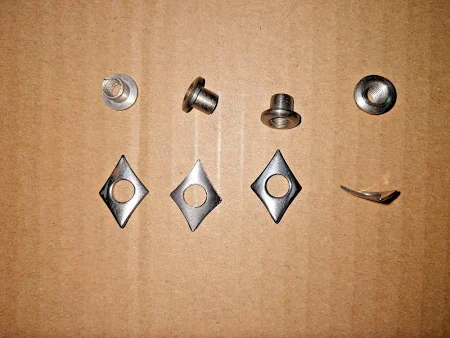
You would place something like a thick nail in the hole, measure the height of the nail starting at the bottom of the tube, then subtract the height of the nail on its own. That would give you a wall thickness including the paint. If it is a 28.6 tube, then measure the outside of the tube, subtract 28.6 and divide the result by 2 - that's your paint thickness on one side.
12-31-24 | 08:16 AM
#9
Thread Starter
Senior Member
Joined: Apr 2011
Posts: 12,778
Likes: 4,884
Champion #2 is pretty much the same as SL, so a lighter downtube than SP.
12-31-24 | 08:19 AM
#10

The investigation into the minute specification details of pedestrian volume manufactured frames is even if comprehensive and accurate, of only of esoteric value.
the series produced lugged steel frame is gone.
it is going to be just less effort and work to purchase an example and make one’s own assessment.
there is some merit perhaps to weighing a bare frame and fork, easy enough to do, but only if noting the frame size and basic dimensions. After enough measures perhaps a trend can be found.
the series produced lugged steel frame is gone.
it is going to be just less effort and work to purchase an example and make one’s own assessment.
there is some merit perhaps to weighing a bare frame and fork, easy enough to do, but only if noting the frame size and basic dimensions. After enough measures perhaps a trend can be found.
12-31-24 | 08:19 AM
#11
Full Member

Joined: Nov 2013
Posts: 296
Likes: 585
Some years back Reed Kennedy came up with a method for using an ultrasonic measuring device to reliably estimate tubing thicknesses. His spreadsheet is here
https://docs.google.com/spreadsheets...ARDJWyGps/edit
https://docs.google.com/spreadsheets...ARDJWyGps/edit
12-31-24 | 09:06 AM
#12
Senior Member
Joined: Aug 2010
Posts: 10,383
Likes: 10,130
From: Utah
Bikes: Paletti,Pinarello Monviso,Duell Vienna,Giordana XL Super,Lemond Maillot Juane.& custom,PDG Paramount,Fuji Opus III,Davidson Impulse,Pashley Guv'nor,Evans,Fishlips,Y-Foil,Softride, Tetra Pro, CAAD8 Optimo,
The only thing I've ever tried is using an Endoscope to look inside the tubes for rifling and such. Can also help spot any rust and tell you if the tubing is seamed or not. Not a lot of help is most cases but some.

__________________
Steel is real...and comfy.
Steel is real...and comfy.
12-31-24 | 09:14 AM
#13
Senior Member
Joined: Dec 2004
Posts: 15,427
Likes: 8,344
From: Seattle area
Bikes: Bikes??? Thought this was social media?!?

My Tange #2 framed bike rode nothing like a couple of SL tubed bikes in same frame size. Maybe geo was to blame.
__________________
Vintage, modern, e-road. It is a big cycling universe.
Vintage, modern, e-road. It is a big cycling universe.
Last edited by Wildwood; 12-31-24 at 09:25 AM.
12-31-24 | 09:54 AM
#14
Thread Starter
Senior Member
Joined: Apr 2011
Posts: 12,778
Likes: 4,884
You cannot tell the difference between SL and #2 and 022 by feel. So it is something else.
12-31-24 | 09:57 AM
#15
Thread Starter
Senior Member
Joined: Apr 2011
Posts: 12,778
Likes: 4,884
The investigation into the minute specification details of pedestrian volume manufactured frames is even if comprehensive and accurate, of only of esoteric value.
the series produced lugged steel frame is gone.
it is going to be just less effort and work to purchase an example and make one’s own assessment.
there is some merit perhaps to weighing a bare frame and fork, easy enough to do, but only if noting the frame size and basic dimensions. After enough measures perhaps a trend can be found.
the series produced lugged steel frame is gone.
it is going to be just less effort and work to purchase an example and make one’s own assessment.
there is some merit perhaps to weighing a bare frame and fork, easy enough to do, but only if noting the frame size and basic dimensions. After enough measures perhaps a trend can be found.
The reason to do it would be to have a better idea how different frames are likely to ride, since diameter and wall thickness are the only parts that determine ride from the tubes, while alloy and seams do not.
From there you could make some educated guesses about the specific tubes selected.
Last edited by Kontact; 12-31-24 at 10:48 AM.
12-31-24 | 10:11 AM
#16
Randomhead
Joined: Aug 2008
Posts: 25,930
Likes: 4,825
From: Happy Valley, Pennsylvania
I was a little disappointed how short the list of tubes was in the ultrasonic tube measurement project. Tbh, that told me people lost interest. You have to get the speed of sound right, but I'm not sure how much it varies among frame steel. The cheap thickness measuring devices won't do it, you need something that knows it might see paint and look for multiple returns because tubing is thin.
I would like to be able to measure new tubes, but not enough to set up my ultrasonic system.
I would like to be able to measure new tubes, but not enough to set up my ultrasonic system.
12-31-24 | 01:03 PM
#17

But I'm not sure if it's 100% accurate for every (Italian made) Bianchi for all time, but widely enough repeated to make it sort of "common knowledge"...and so that's knowledge FWIW!
12-31-24 | 04:32 PM
#18
framebuilder
Joined: Dec 2009
Posts: 1,795
Likes: 2,723
From: Niles, Michigan
There are a couple of twists to knowing tubing thickness. 1st is manufacturing inconsistencies. I used to always weigh Columbus SL chain stays because they varied between 140 to 175 grams. I weighted them to find equal weight pairs and also to put lighter ones with lighter riders and so forth. 2nd manufacturing spaces and actual specs are often not the same. For example old SL had .9/.6/.9 wall thicknesses in their top and down tube. While generally correct, they weren't exactly those dimensions. So when looking at a tubing spec chart, it might appear that different brands had the same wall thickness for a particular model but I'm reality were a bit different.


 12-31-24 | 06:01 PM
#19

Senior Member
Joined: Apr 2009
Posts: 3,810
Likes: 5,682
From: Seattle
There are a couple of twists to knowing tubing thickness. 1st is manufacturing inconsistencies. I used to always weigh Columbus SL chain stays because they varied between 140 to 175 grams. I weighted them to find equal weight pairs and also to put lighter ones with lighter riders and so forth. 2nd manufacturing spaces and actual specs are often not the same. For example old SL had .9/.6/.9 wall thicknesses in their top and down tube. While generally correct, they weren't exactly those dimensions. So when looking at a tubing spec chart, it might appear that different brands had the same wall thickness for a particular model but I'm reality were a bit different.
One other framebuilder, whose name you know for sure, told me in a private email that he found the same thing, also back then. I don't know if this has any relevance to tubes made in the current millennium, probably not.
12-31-24 | 06:32 PM
#20
Randomhead
Joined: Aug 2008
Posts: 25,930
Likes: 4,825
From: Happy Valley, Pennsylvania
I suggest measuring everything on columbus tubes. I haven't had any that were bowed, but I had some spirit tubes where the seat tube wasn't properly drawn. I guess measuring the seat tube is always a good idea that most builders skip.
When I worked at Trek, I wasn't particularly happy with Reynolds, because their tubes were never the same OD. With the fixtures we used at the time, having a tube that was too small could be a real pain. And sometimes they were too big to fit in the lugs. Seems to me that newer tubes are better, but my old prejudices mean that I don't use Reynolds unless I have to. And their new prices are a little out of hand.
When I worked at Trek, I wasn't particularly happy with Reynolds, because their tubes were never the same OD. With the fixtures we used at the time, having a tube that was too small could be a real pain. And sometimes they were too big to fit in the lugs. Seems to me that newer tubes are better, but my old prejudices mean that I don't use Reynolds unless I have to. And their new prices are a little out of hand.
12-31-24 | 07:28 PM
#21

Senior Member
Joined: Jul 2006
Posts: 11,510
Likes: 4,929
From: San Jose (Willow Glen) Ca
Bikes: Kirk Custom JK Special, 86 De Rosa Pro, '84 Team Miyata,(dura ace old school) 80?? SR Semi-Pro 600 Arabesque
This may be of interest, dave kirk measures tube prior to a build.....
partial quotes
"While it’s true that tubing quality is for the most part very good it’s still possible for a simple mistake to be made that results in failure of the frame."
At Serotta I learned that we needed to confirm specs. Measuring the outer diameter was easy but we also needed to be able to measure the wall thickness of the tube over its entire length, and the location of the butts. Without knowing that we were effectively blind.
partial quotes
"While it’s true that tubing quality is for the most part very good it’s still possible for a simple mistake to be made that results in failure of the frame."
At Serotta I learned that we needed to confirm specs. Measuring the outer diameter was easy but we also needed to be able to measure the wall thickness of the tube over its entire length, and the location of the butts. Without knowing that we were effectively blind.
__________________
Life is too short not to ride the best bike you have, as much as you can.
Life is too short not to ride the best bike you have, as much as you can.
12-31-24 | 07:52 PM
#22
Senior Member
Joined: Apr 2009
Posts: 3,810
Likes: 5,682
From: Seattle
I have a butt sniffer, which is basically very long thin calipers that can reach over halfway* down a bike frame tube. I was about to make my own when I googled it and found Farr was selling his at a discount, blowout price really, I couldn't have bought the raw materials to make one for less. They're pretty easy to make though, lots of people have DIY versions. The Farr one is pretty deluxe, but other than looking spiffy, it works the same as even a barely-competent DIY would.
*They could be made longer, but they only have to reach halfway 'cuz you can flip and measure from the other end. (Duh.)
They can be used on a seat tube of a finished frame but only from the top, so you won't be able to reach the butt at the bottom unless you make it longer. They're usually used only for checking raw tubes before tacking up the frame.
*They could be made longer, but they only have to reach halfway 'cuz you can flip and measure from the other end. (Duh.)
They can be used on a seat tube of a finished frame but only from the top, so you won't be able to reach the butt at the bottom unless you make it longer. They're usually used only for checking raw tubes before tacking up the frame.
12-31-24 | 08:09 PM
#23

Bike Butcher of Portland
Joined: Jul 2014
Posts: 12,492
Likes: 8,059
From: Portland, OR
Bikes: It's complicated.
Years ago I was at one of Peter Weigle's French Fender Days, a fellow brought a device that did exactly this. Of course, you'd have to cut frame in half to check how accurate it was. I do remember it was something like a $5k tool.
__________________
If someone tells you that you have enough bicycles and you don't need any more, stop talking to them. You don't need that kind of negativity in your life.
If someone tells you that you have enough bicycles and you don't need any more, stop talking to them. You don't need that kind of negativity in your life.
12-31-24 | 08:10 PM
#24
Bike Butcher of Portland
Joined: Jul 2014
Posts: 12,492
Likes: 8,059
From: Portland, OR
Bikes: It's complicated.
I have a butt sniffer, which is basically very long thin calipers that can reach over halfway* down a bike frame tube. I was about to make my own when I googled it and found Farr was selling his at a discount, blowout price really, I couldn't have bought the raw materials to make one for less. They're pretty easy to make though, lots of people have DIY versions. The Farr one is pretty deluxe, but other than looking spiffy, it works the same as even a barely-competent DIY would.
__________________
If someone tells you that you have enough bicycles and you don't need any more, stop talking to them. You don't need that kind of negativity in your life.
If someone tells you that you have enough bicycles and you don't need any more, stop talking to them. You don't need that kind of negativity in your life.
12-31-24 | 08:12 PM
#25
Bike Butcher of Portland
Joined: Jul 2014
Posts: 12,492
Likes: 8,059
From: Portland, OR
Bikes: It's complicated.
You would place something like a thick nail in the hole, measure the height of the nail starting at the bottom of the tube, then subtract the height of the nail on its own. That would give you a wall thickness including the paint. If it is a 28.6 tube, then measure the outside of the tube, subtract 28.6 and divide the result by 2 - that's your paint thickness on one side.
__________________
If someone tells you that you have enough bicycles and you don't need any more, stop talking to them. You don't need that kind of negativity in your life.
If someone tells you that you have enough bicycles and you don't need any more, stop talking to them. You don't need that kind of negativity in your life.