


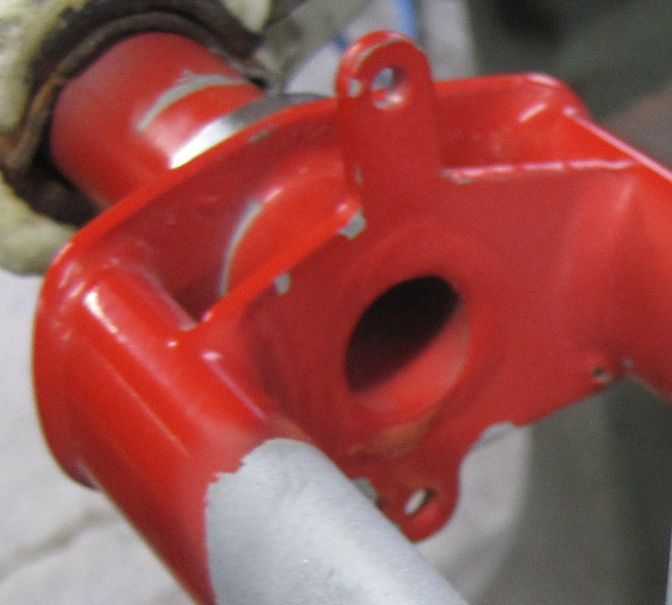
What are these forks?
 08-02-25 | 09:01 PM
#1
Thread Starter
Senior Member


Joined: Jul 2022
Posts: 3,965
Likes: 3,982
From: Pac NW
Bikes: several Eddy Merz (ride like Eddy, braze like Jim!)
What are these forks?
I thought they were doubled up, like Ritchie’s.
but the flying bridge is only a facade.
Are they special?
tange
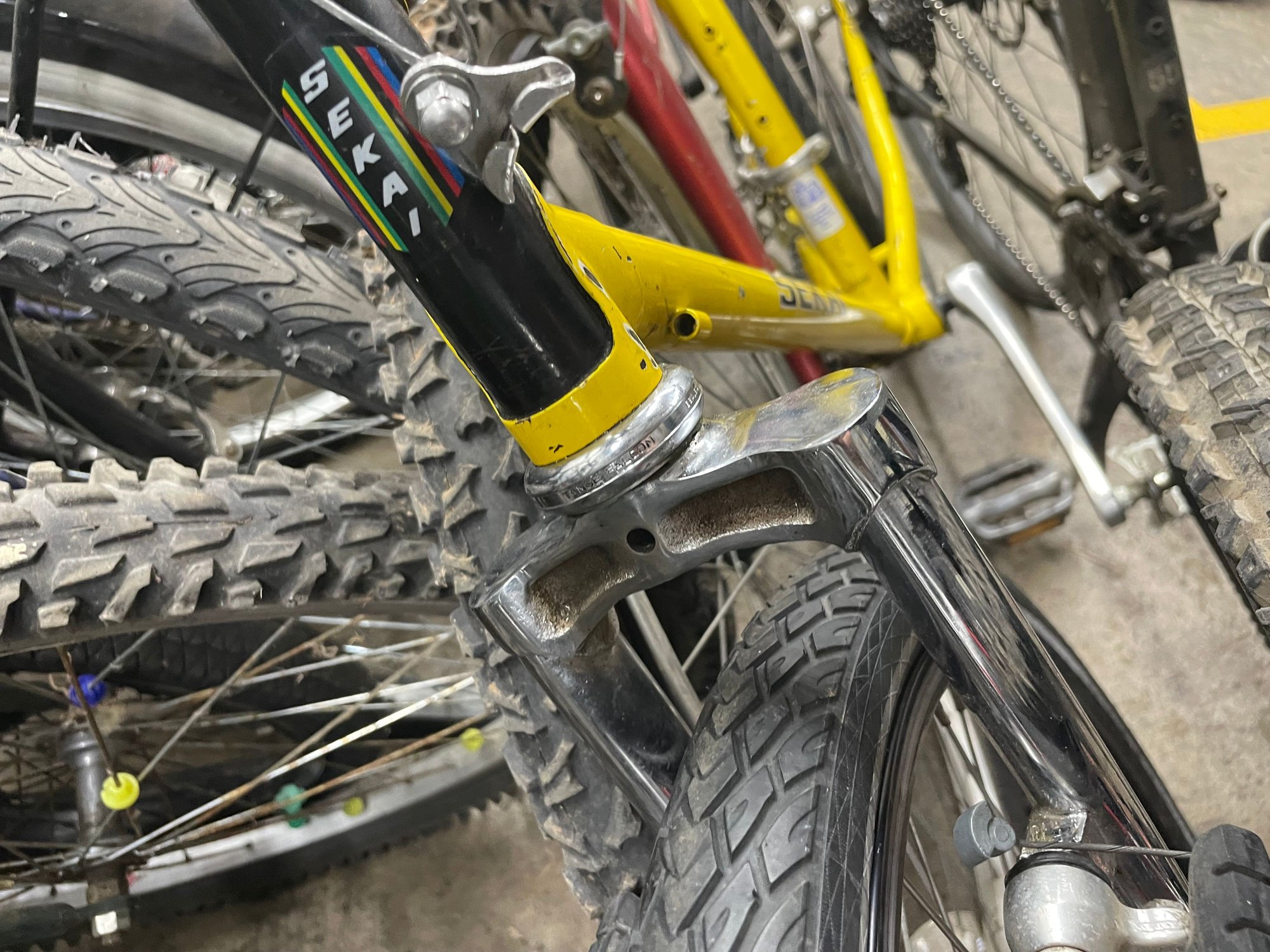
but the flying bridge is only a facade.
Are they special?
tange
__________________
"Leave the gun. Take the Colnagos."
"Leave the gun. Take the Colnagos."
 08-02-25 | 09:11 PM
#2

Senior Member

Joined: Mar 2021
Posts: 1,980
Likes: 1,600
From: Beaverton, OR
Bikes: You had me at rusty and Italian!!
I have those on my Diamond Back Meanstreak but don’t know if mine are original to the bike or “special”. They’re purdy so I kept them with the bike.
Perhaps used a couple of years on early mass produced MTBs?
Perhaps used a couple of years on early mass produced MTBs?
08-02-25 | 11:00 PM
#3

Senior Member

Joined: Apr 2009
Posts: 3,787
Likes: 5,636
From: Seattle
The forks were made by Tange. The crowns were sold as Tange too, but I assume they were not cast in-house but rather contracted out to some Japanese foundry.
Good strong forks. The blades are oversized compared to typical road forks. Steerer is inch, but "superbutted", my word for when they start with a normal butted steerer and then ram a stout additional reinforcement up in the bottom. Look underneath to see if yours has the reinforcement, it's pretty easy to see. I believe they all got it but I'm not 100% sure.
Good strong forks. The blades are oversized compared to typical road forks. Steerer is inch, but "superbutted", my word for when they start with a normal butted steerer and then ram a stout additional reinforcement up in the bottom. Look underneath to see if yours has the reinforcement, it's pretty easy to see. I believe they all got it but I'm not 100% sure.

 08-03-25 | 10:47 AM
#4

and since this fork (I use the singular for it, not a plural term like a "pair of pants"...but I digress...) has been ID'd as made by Tange then it's likely that as done by many mass-produced bicycle brands BITD, they stopped building their own forks but sourced and spec'ed them from Tange.
Which is why you might find the "same fork" with cast crown on both Sekai and Diamondback (plus betting also on a few more makes and models)
Tange had a variety of "MTB" specific tubing (some were plain vanilla, some "seamless", some "OS") that had different color decals/stickers
Here's one for the fork blades with a pink background that was fairly common:

Which is why you might find the "same fork" with cast crown on both Sekai and Diamondback (plus betting also on a few more makes and models)
Tange had a variety of "MTB" specific tubing (some were plain vanilla, some "seamless", some "OS") that had different color decals/stickers
Here's one for the fork blades with a pink background that was fairly common:
Last edited by unworthy1; 08-03-25 at 10:56 AM.
 08-03-25 | 12:00 PM
#5

Tinker-er
Joined: Oct 2007
Posts: 1,626
Likes: 1,580
From: Mid-Atlantic
Bikes: 1956 Rudge; 1981 Miyata; 1994 Breezer; 1987 Raleigh Mtn Trials; 1952 R.O. Harrison; 1994 Concorde; 1949 Rotrax; 1964 A.S. Gillott; Early 60s Frejus; ~1979 RRB track; Unknown Interwar track
I think I have that same crown on my Univega Alpina Uno.
Phil
Phil
 08-03-25 | 12:26 PM
#6
Amateur Member
Joined: Mar 2021
Posts: 5,253
Likes: 8,722
From: SoCal
Bikes: Cuevas & Cimmaron are my full time riders, small MB-3 and large Competition GS are my sometimers
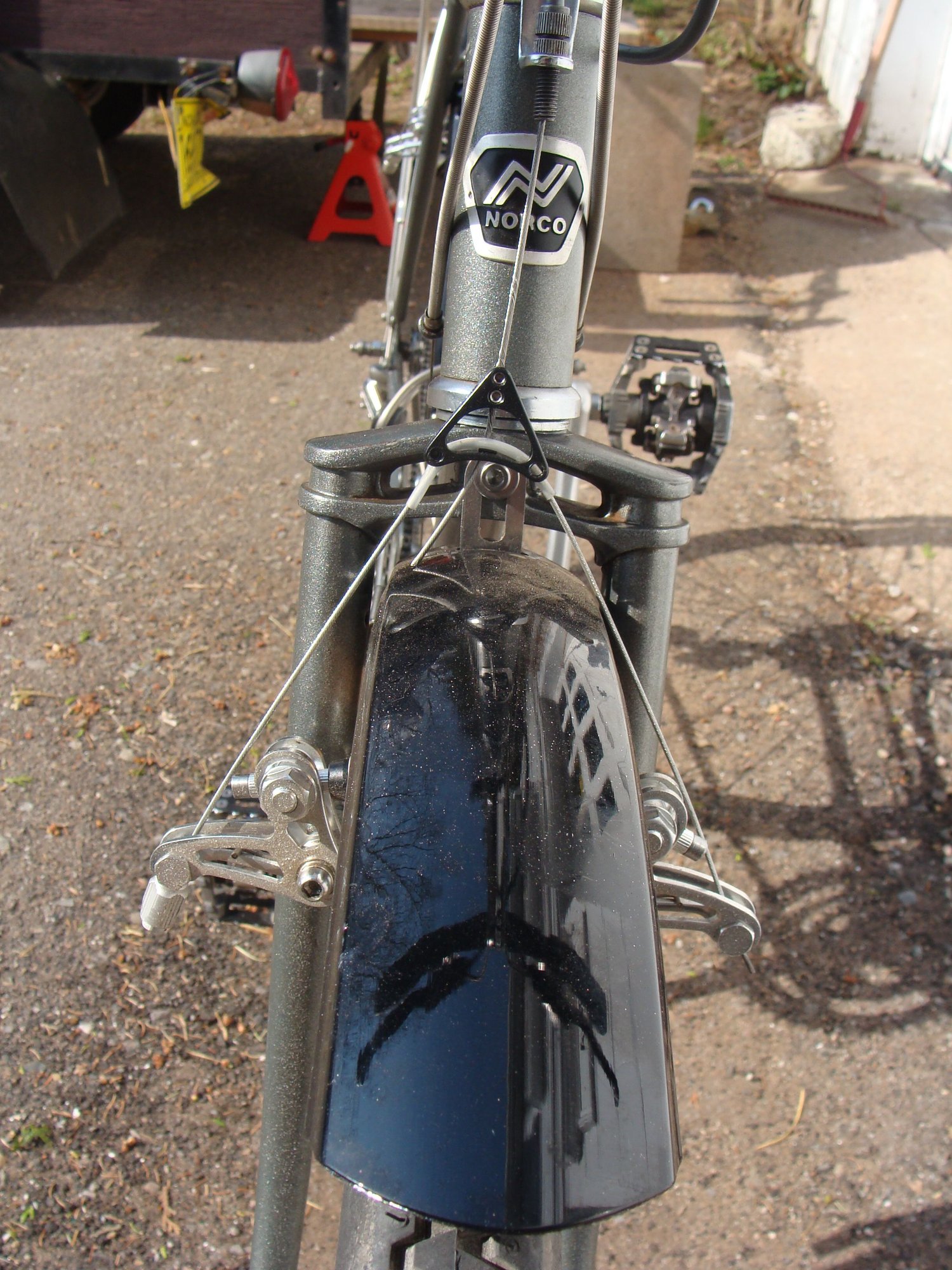
Have one on a Peugeot that must weigh 50 lbs, I was questioning whether the blades were solid! Don't know if there were different versions/grades?
edit: my steerer tube says Tange 5.I. assuming that is Tange #5? was there a Tange #1 version
edit: my steerer tube says Tange 5.I. assuming that is Tange #5? was there a Tange #1 version
Last edited by SoCaled; 08-03-25 at 12:31 PM.

 08-04-25 | 06:41 AM
#9

Old fart

Joined: Nov 2004
Posts: 26,402
Likes: 5,333
From: Appleton WI
Bikes: Several, mostly not name brands.
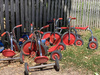
Yes, as previously identified as Tange. Tange is a big enough operation that I believe casting was done in-house. Also, as previously noted, those cast, off-road fork crowns were heavy as sin, and were only in production for a couple years before somebody had the bright idea of making a "unicrown" fork, where the blades attach directly to the steer tube. The result is both lighter and stronger than using a separate crown. What's not to like?
 08-04-25 | 07:12 AM
#10
Yes, as previously identified as Tange. Tange is a big enough operation that I believe casting was done in-house. Also, as previously noted, those cast, off-road fork crowns were heavy as sin, and were only in production for a couple years before somebody had the bright idea of making a "unicrown" fork, where the blades attach directly to the steer tube. The result is both lighter and stronger than using a separate crown. What's not to like?
08-04-25 | 12:12 PM
#11
Senior Member
Joined: Apr 2009
Posts: 3,787
Likes: 5,636
From: Seattle
I'm not so sure. No numbers to prove it, but I think an optimized crown-type fork can be both lighter and stronger than a unicrown.
When you make the blade heavy enough to be strong as the "crown", it's heavier than it needs to be all the rest of the way down. And they were mostly round tubing, which is suboptimal for forks, whose main loading is fore-and-aft, not side-to-side -- oval is better there. (Fork blades are oval for a very good reason.) Unicrowns eventually were made with oval tube, but then your "crown" is oval too, which is not optimal in that area, where forces switch from bending (down below) to twisting (torsion) in the crown area.
Both types can bend in a crash, but I don't like the way unicrowns bend, with the "crown" area collapsing, so that its strength rapidly diminishes. The bend in a crashed crown-type fork is generally more gradual and distributed. Only rarely do they kink or collapse, in fact I don't think I've ever seen one that did, other than from a disk brake on a too-thin blade. They bend in a correct way that optimizes the amount of energy absorbed, which can mean that YOU fly off the bike with less kinetic energy, some of your KE having been absorbed by the "crumple zone" in the blades.
Another point of difference is the ability to straighten a bent fork. Yes (sometimes) with crown-type, but no (almost never) with unicrown, due to the way the tube collapses in a smallish area when they bend. Straightening it will not remove the distortion in the collapsed area, it'll only put another opposite bend somewhere else, leaving the fork seriously weak.
Optimized crowns are hollow or basically as close to tubular as possible. Good examples include Nervex Pro (as used on PX-10 and a hundred others), and the faux-tubular Raleigh "thimble" crown. Even some crude-looking sand-cast crowns from the olden days were cast with a large hollow area inside, between the steerer and blades.
The crown on the fork in question (see the OP) is not hollow AFAIK but I never cut one open to see. I think it's solid and thus it is far from optimized. Definitely strong enough, just heavy from its inefficient shape. Two-plate crowns, and some faux two plates, are better than a solid chunk of steel, but still not as good as a hollow crown.
One more thing to say, I wish people would stop attributing the idea to Tom Ritchey. It was used in BMX and cruisers long before Tom ever made one. Tom doesn't claim to be the inventor (that I know of). He deserves credit for being the first to use it on relatively lightweight MTBs, just don't call him the inventor.
When you make the blade heavy enough to be strong as the "crown", it's heavier than it needs to be all the rest of the way down. And they were mostly round tubing, which is suboptimal for forks, whose main loading is fore-and-aft, not side-to-side -- oval is better there. (Fork blades are oval for a very good reason.) Unicrowns eventually were made with oval tube, but then your "crown" is oval too, which is not optimal in that area, where forces switch from bending (down below) to twisting (torsion) in the crown area.
Both types can bend in a crash, but I don't like the way unicrowns bend, with the "crown" area collapsing, so that its strength rapidly diminishes. The bend in a crashed crown-type fork is generally more gradual and distributed. Only rarely do they kink or collapse, in fact I don't think I've ever seen one that did, other than from a disk brake on a too-thin blade. They bend in a correct way that optimizes the amount of energy absorbed, which can mean that YOU fly off the bike with less kinetic energy, some of your KE having been absorbed by the "crumple zone" in the blades.
Another point of difference is the ability to straighten a bent fork. Yes (sometimes) with crown-type, but no (almost never) with unicrown, due to the way the tube collapses in a smallish area when they bend. Straightening it will not remove the distortion in the collapsed area, it'll only put another opposite bend somewhere else, leaving the fork seriously weak.
Optimized crowns are hollow or basically as close to tubular as possible. Good examples include Nervex Pro (as used on PX-10 and a hundred others), and the faux-tubular Raleigh "thimble" crown. Even some crude-looking sand-cast crowns from the olden days were cast with a large hollow area inside, between the steerer and blades.
The crown on the fork in question (see the OP) is not hollow AFAIK but I never cut one open to see. I think it's solid and thus it is far from optimized. Definitely strong enough, just heavy from its inefficient shape. Two-plate crowns, and some faux two plates, are better than a solid chunk of steel, but still not as good as a hollow crown.
One more thing to say, I wish people would stop attributing the idea to Tom Ritchey. It was used in BMX and cruisers long before Tom ever made one. Tom doesn't claim to be the inventor (that I know of). He deserves credit for being the first to use it on relatively lightweight MTBs, just don't call him the inventor.


 08-06-25 | 11:30 AM
#13
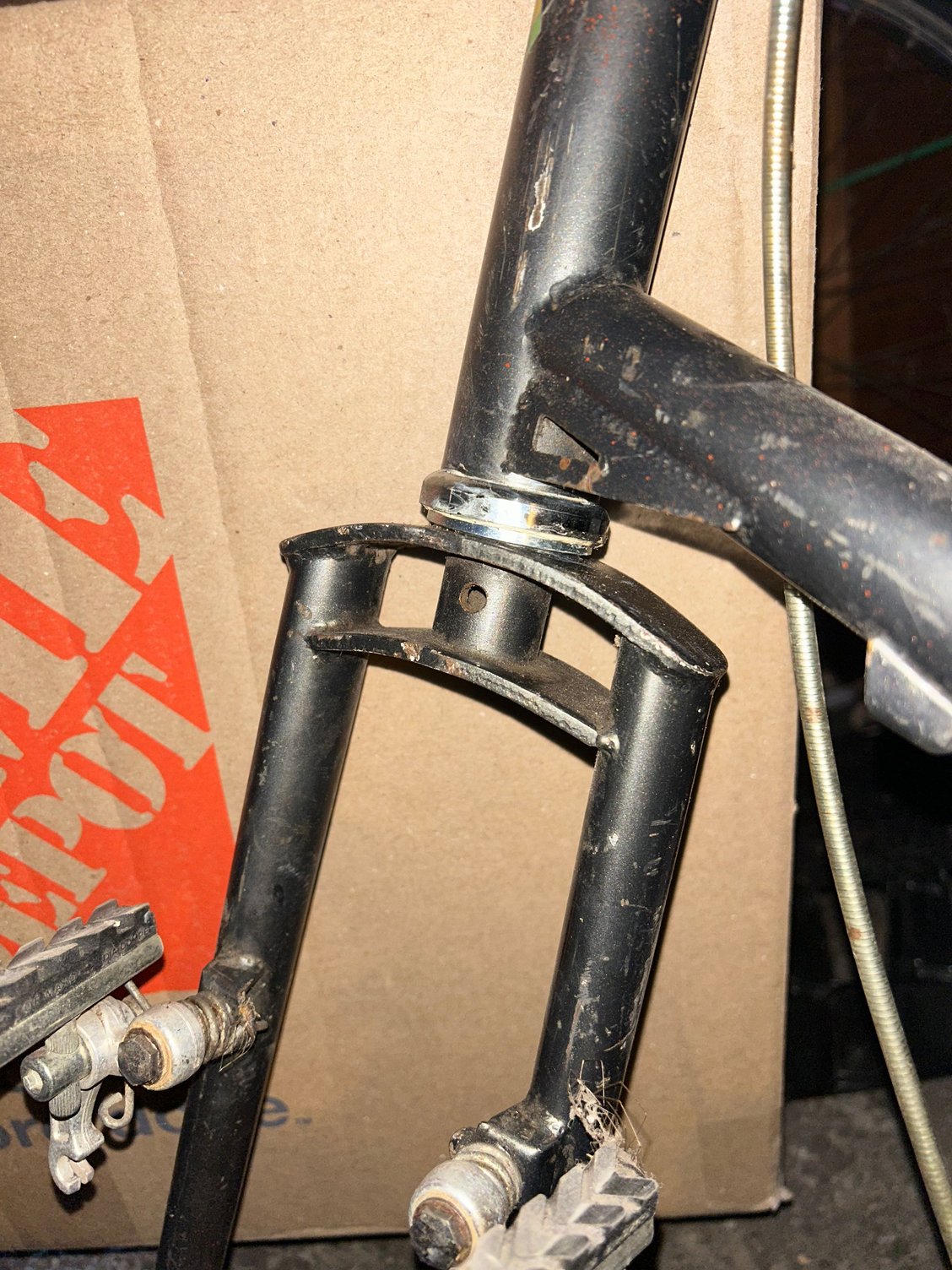
crude ^ but maybe effective?
sort of like the simple stamped gussets they used to reinforce the headtube>downtube joint, this is a sort of tech that a shop with only basic manufacturing abilities can pull off, but if the welding is really first-rate...
maybe
sort of like the simple stamped gussets they used to reinforce the headtube>downtube joint, this is a sort of tech that a shop with only basic manufacturing abilities can pull off, but if the welding is really first-rate...
maybe
08-06-25 | 01:32 PM
#14
Francophile

Joined: Nov 2015
Posts: 4,828
Likes: 2,147
From: Seattle
Bikes: Lots
[QUOTE=SoCaled;23577564}
edit: my steerer tube says Tange 5.I. assuming that is Tange #5? was there a Tange #1 version[/QUOTE]
Sure was. It was a very light tubing comparable to Columbus EL. The Tange 2 tubing was similar to SL. For an example, the Centurion Ironman bikes were made with Tange 1.
edit: my steerer tube says Tange 5.I. assuming that is Tange #5? was there a Tange #1 version[/QUOTE]
Sure was. It was a very light tubing comparable to Columbus EL. The Tange 2 tubing was similar to SL. For an example, the Centurion Ironman bikes were made with Tange 1.
__________________
Keeping Seattle’s bike shops in business since 1978
Keeping Seattle’s bike shops in business since 1978
08-06-25 | 01:51 PM
#15
Amateur Member
Joined: Mar 2021
Posts: 5,253
Likes: 8,722
From: SoCal
Bikes: Cuevas & Cimmaron are my full time riders, small MB-3 and large Competition GS are my sometimers
08-07-25 | 10:06 AM
#16
Senior Member
Joined: Apr 2009
Posts: 3,787
Likes: 5,636
From: Seattle
08-07-25 | 10:25 AM
#17
Senior Member
Joined: Apr 2009
Posts: 3,787
Likes: 5,636
From: Seattle
And this design has proven plenty strong for tandems, even loaded for touring. So probably fine for MTBs, short of extreme air

The French also usually angled the lower plate to follow the angle of the tire as it passes under, angle due to the fork offset. Mostly for fenders, not usually found on MTBs
Last edited by bulgie; 08-07-25 at 10:45 AM.
