


Sizing of bottom Bracket on classic Motobecane
 10-17-25 | 09:56 AM
#1
Thread Starter
Newbie
Joined: Oct 2025
Posts: 22
Likes: 14
From: Northern Colorado
Bikes: 1978 motobecane Super Mirage, 1980 Motobecane Le Champion
Sizing of bottom Bracket on classic Motobecane
HI all:
I am looking for advice while I rebuild a 1980(?) Motobecane "Le Champion" frame, specifically how to size the bottom bracket I need to get.
I know the bb is french threaded, so i can either get a phil wood/ ebay loose cup/bearing type, or a velo orange sealed unit. My questions are:
How do I know what spindle length I need? I am wanting to get a "correct" campy crankset, should I get the crank first and then measure something on it to size? Is the spindle size well known for these bikes?
Is there anything I am missing to get myself a correctly fitting bb?
Thanks all
Hank

I am looking for advice while I rebuild a 1980(?) Motobecane "Le Champion" frame, specifically how to size the bottom bracket I need to get.
I know the bb is french threaded, so i can either get a phil wood/ ebay loose cup/bearing type, or a velo orange sealed unit. My questions are:
How do I know what spindle length I need? I am wanting to get a "correct" campy crankset, should I get the crank first and then measure something on it to size? Is the spindle size well known for these bikes?
Is there anything I am missing to get myself a correctly fitting bb?
Thanks all
Hank


 10-17-25 | 02:51 PM
#3
Full Member
Joined: Apr 2025
Posts: 265
Likes: 638
From: PNW
10-17-25 | 04:29 PM
#4

Senior Member


Joined: Apr 2012
Posts: 21,823
Likes: 5,781
From: Middle Earth (aka IA)
Bikes: A bunch of old bikes and a few new ones
Have you thought about your gear ratios? A campy means you are stuck with a small of 42 (a 41 was made but not exactly easy to find). If you go with a stronglight 93, you can (a) fairly easily track down a stronglight French threaded BB with the correct axle and (b) track down a 37 tooth inner chainring: https://www.redclovercomponents.com/..._37_Teeth.html. Or you could run a Stronglight 99 and easily run a compact set up (say a 50/34). I have no idea what kind of gearing you need but you may want to consider a Stronglight crank even if going all campy on this bike.
Also Campy crank is ISO and the modern French threaded BBs you will find are JIS. I dunno how much that matters in real life but it is something you will want to consider:
https://www.sheldonbrown.com/bbtaper.html
If you're willing to pay the money, Phil Wood will have what you need:
https://philwood.com/collections/squ...ottom-brackets
Also Campy crank is ISO and the modern French threaded BBs you will find are JIS. I dunno how much that matters in real life but it is something you will want to consider:
https://www.sheldonbrown.com/bbtaper.html
If you're willing to pay the money, Phil Wood will have what you need:
https://philwood.com/collections/squ...ottom-brackets
Last edited by bikemig; 10-17-25 at 04:33 PM.

 10-17-25 | 05:47 PM
#7

Senior Member
Joined: Jan 2015
Posts: 5,836
Likes: 3,421
From: Los Angeles
Bikes: 82 Medici, 85 Ironman, 2011 Richard Sachs
Hank? Are you certain the BB is French threaded?
__________________
I don't do: disks, tubeless, e-shifting, or bead head nymphs. But I do hate all e-bikes.
I don't do: disks, tubeless, e-shifting, or bead head nymphs. But I do hate all e-bikes.
10-17-25 | 06:46 PM
#9

señor miembro
Joined: Dec 2018
Posts: 3,524
Likes: 8,927
From: Pac NW
Bikes: '70s - '80s Campagnolo
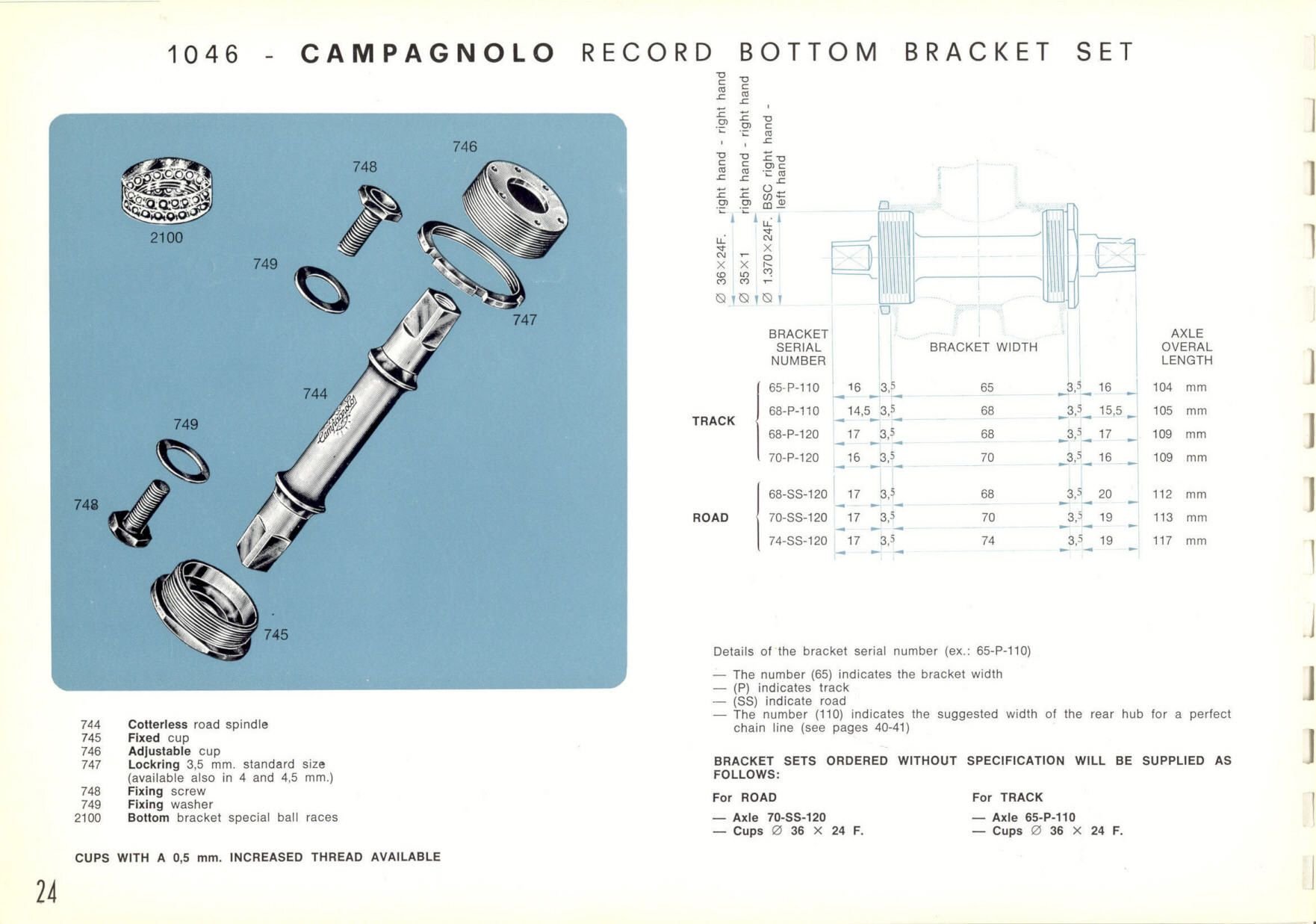
Moto bb shell should at least be Swiss by 1980. Not sure the year of the frameset, but looks around '81. Here's the '81 Catalog catalog page.

Check out the catalogs hosted by our bulgie , here:
https://bulgier.net/pics/bike/Catalogs/Motobecane/
Regardless of year, the Le Champion always seemed to have mostly Record/Nuovo Record group. If a Gran Sport crank was used, it was the 5-arm Nuovo Gran Sport, not the 3-arm one, which would look weird with this '80s looking paint scheme. Velobase says that 5-bolt crank takes a 120mm spindle.
Check out the catalogs hosted by our bulgie , here:
https://bulgier.net/pics/bike/Catalogs/Motobecane/
Regardless of year, the Le Champion always seemed to have mostly Record/Nuovo Record group. If a Gran Sport crank was used, it was the 5-arm Nuovo Gran Sport, not the 3-arm one, which would look weird with this '80s looking paint scheme. Velobase says that 5-bolt crank takes a 120mm spindle.
10-17-25 | 08:30 PM
#10
Senior Member
Joined: Apr 2012
Posts: 21,823
Likes: 5,781
From: Middle Earth (aka IA)
Bikes: A bunch of old bikes and a few new ones
Going with a Stronglight might help with the BB. A French threaded Stronglight BB won't be that hard to find but Swiss will be harder. Also I *think* Stronglight is JIS and it will be easier to find a JIS French or Swiss modern BB than an ISO one assuming that difference matters. Maybe it doesn't matter much but it's something you need to think about.
https://www.sheldonbrown.com/bbtaper.html
https://www.renehersecycles.com/bottom-brackets-demystified/
Bottom line is that you may be totally happy with the gear ratios you get with a campy NR crank and/or really like the idea of restoring the bike to original spec. But gearing is worth thinking about before you build the bike up.
Last edited by bikemig; 10-18-25 at 06:16 AM.
10-18-25 | 08:48 AM
#11


Whew! I would have to say that sizing spindle lengths for square-taper cranksets is one of the darkest of arts, respecting the outfitting of vintage bikes. The original fit, "standard"used and tolerances of manufacture combined with the low angle of taper (2 degrees), how "thick" the bearing cups are (Campagnolo made both "thick" and "thin" at different times) crankarm socket wear considerations for previously used cranks, whether any lubricant is used, and how tightly the cranks are torqued, make it an extremely "trial and error" proposition. Oh, and did I mention that some spindles are slightly asymmetrical, the crank end being a bit longer than the non-drive end (see Campagnolo cuts above)? Then there's the conundrum of "Campagnolo" taper. Campy tapers were actually somewhat stouter (or larger in dimensions) pre-1993 or so, when Phil Wood did not really manufacture a "Campy" taper, but told folks to use the JIS taper -- after that, Campy slimmed their taper a bit to match ISO taper. Lots of fun there. Phil Wood themselves sort of acknowledge the problematic nature of all this on their square taper page:
"Phil Wood & Co. does not assist in determining which bottom bracket is correct for any particular application. We recommend taking the frame and crank to a local bicycle shop as they should be able to help in selecting the correct bottom bracket that is needed."
Amen.
A useful point of departure would be to get a matching crank and spindle that were originally intended to be used together for a double crankset (and the correct size of bearing balls). Presumably that would give a reasonable chainline (where the midpoint between faces of the two chainrings is located about 43.5 mm* from frame (and presumably the bottom bracket shell) centerline. Failing that, I've found that Campagnolo and Sugino tapers and spindles are fairly interchangeable. Stronglight and T.A. cranks seem to work well enough with JIS taper spindles too. Sticking with JIS for (now only "vintage" where Shimano is concerned) square taper bottom brackets and cranks might be easier, actually, than getting into the weeds with the more C&V European stuff might make things easier, in the long run.
But if you're mixing and matching, trying to determine in advance "what length spindle do I need" is just a crapshoot until you actually try it. I would suggest getting access to Sutherland's Manual 6th edition (apparently available in PDF form online), which has a very good section on bottom brackets dimensioning and compatibility between brands.
What you're looking for are two things basically: achieving a decent chainline, and getting the fit of spindle taper and crank socket sufficiently correct so that the end of the spindle is neither recessed too far into the socket (inadequate support between spindle taper and crank) or projecting out of the socket (can't tighten the crank arm sufficiently). Having the spindle end (when torqued down!) about 2–3 mm from the end of the socket is ideal.
At the very least, make a decision about exactly what cranks you actually want to use, and then people here can be more helpful regarding what has worked for them in that situation.
*43.5 mm is not a hard-and-fast criterion, of course, just the general neighborhood of where a double crank wants to find itself. A prime consideration is whether there's interference (free-spinning, or under pedaling/chain load) between the inner ring and the right chain stay; which also has to do with how large in diameter the inner ring is.
"Phil Wood & Co. does not assist in determining which bottom bracket is correct for any particular application. We recommend taking the frame and crank to a local bicycle shop as they should be able to help in selecting the correct bottom bracket that is needed."
Amen.
A useful point of departure would be to get a matching crank and spindle that were originally intended to be used together for a double crankset (and the correct size of bearing balls). Presumably that would give a reasonable chainline (where the midpoint between faces of the two chainrings is located about 43.5 mm* from frame (and presumably the bottom bracket shell) centerline. Failing that, I've found that Campagnolo and Sugino tapers and spindles are fairly interchangeable. Stronglight and T.A. cranks seem to work well enough with JIS taper spindles too. Sticking with JIS for (now only "vintage" where Shimano is concerned) square taper bottom brackets and cranks might be easier, actually, than getting into the weeds with the more C&V European stuff might make things easier, in the long run.
But if you're mixing and matching, trying to determine in advance "what length spindle do I need" is just a crapshoot until you actually try it. I would suggest getting access to Sutherland's Manual 6th edition (apparently available in PDF form online), which has a very good section on bottom brackets dimensioning and compatibility between brands.
What you're looking for are two things basically: achieving a decent chainline, and getting the fit of spindle taper and crank socket sufficiently correct so that the end of the spindle is neither recessed too far into the socket (inadequate support between spindle taper and crank) or projecting out of the socket (can't tighten the crank arm sufficiently). Having the spindle end (when torqued down!) about 2–3 mm from the end of the socket is ideal.
At the very least, make a decision about exactly what cranks you actually want to use, and then people here can be more helpful regarding what has worked for them in that situation.
*43.5 mm is not a hard-and-fast criterion, of course, just the general neighborhood of where a double crank wants to find itself. A prime consideration is whether there's interference (free-spinning, or under pedaling/chain load) between the inner ring and the right chain stay; which also has to do with how large in diameter the inner ring is.
Last edited by Charles Wahl; 10-18-25 at 02:55 PM.

 10-18-25 | 04:02 PM
#12

aka Tom Reingold

Joined: Jan 2009
Posts: 44,299
Likes: 6,556
From: New York, NY, and High Falls, NY, USA
Bikes: 1962 Rudge Sports, 1971 Raleigh Super Course, 1971 Raleigh Pro Track, 1974 Raleigh International, 1975 Viscount Fixie, 1982 McLean, 1996 Lemond (Ti), 2002 Burley Zydeco tandem
My approach to this, in general, is to have more bottom brackets than I need so I can try several to find one that fits. That's my short version of what Charles wrote above.
__________________
Tom Reingold, tom@noglider.com
New York City and High Falls, NY
Blogs: The Experienced Cyclist; noglider's ride blog
“When man invented the bicycle he reached the peak of his attainments.” — Elizabeth West, US author
Please email me rather than PM'ing me. Thanks.
Tom Reingold, tom@noglider.com
New York City and High Falls, NY
Blogs: The Experienced Cyclist; noglider's ride blog
“When man invented the bicycle he reached the peak of his attainments.” — Elizabeth West, US author
Please email me rather than PM'ing me. Thanks.

 10-18-25 | 06:29 PM
#13
Thread Starter
Newbie
Joined: Oct 2025
Posts: 22
Likes: 14
From: Northern Colorado
Bikes: 1978 motobecane Super Mirage, 1980 Motobecane Le Champion
Hi everyone,
wow, what a plethora of info! Thanks so much for the replies. I will think it over and have updates in the coming week.
As for my double posting of the campy article...I am not the most tech savvy, and I thought the reply didn't go through so I re sent it...oops!
Thanks,
Hank
wow, what a plethora of info! Thanks so much for the replies. I will think it over and have updates in the coming week.
As for my double posting of the campy article...I am not the most tech savvy, and I thought the reply didn't go through so I re sent it...oops!
Thanks,
Hank
10-19-25 | 06:24 PM
#14
the Campagnolo three arm GS cranks originally came in steel, later aluminum.
by the aluminum arms, the spindle will probably be 115, offset about 3 mm more to the drive side. both the 112.5/113 will also be offset to the drive side.
the taper length and overall can get tricky.
the thick cup - thin cup cha cha cha is for most confounding. the thick cups were for the Nuovo Record BB assemblies to use the reverse internal bore threading to expel dirt. the lesser grade units continued with the "thin" cups....
overall a " hot mess" as it has been described.
by the aluminum arms, the spindle will probably be 115, offset about 3 mm more to the drive side. both the 112.5/113 will also be offset to the drive side.
the taper length and overall can get tricky.
the thick cup - thin cup cha cha cha is for most confounding. the thick cups were for the Nuovo Record BB assemblies to use the reverse internal bore threading to expel dirt. the lesser grade units continued with the "thin" cups....
overall a " hot mess" as it has been described.
10-20-25 | 02:01 PM
#15
Thread Starter
Newbie
Joined: Oct 2025
Posts: 22
Likes: 14
From: Northern Colorado
Bikes: 1978 motobecane Super Mirage, 1980 Motobecane Le Champion
I plan on using a campy crankset such as the one here:
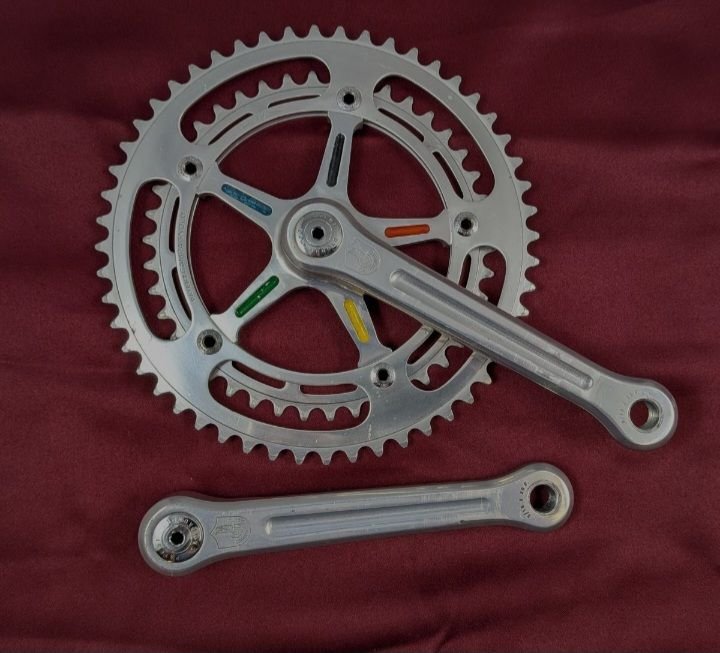
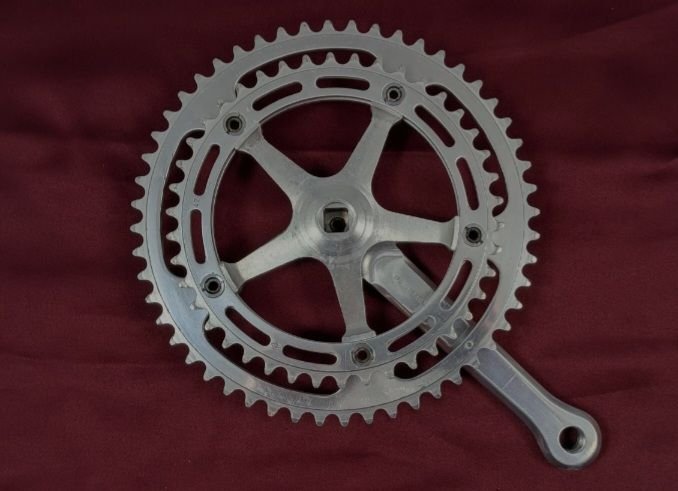
which is a 52/42 tooth campy super record crankset, 170mm arm length with a square taper. I did not realize that there were a 3 and a 5 spoke super record crankset, i want the correct 5-spoke one however.
which is a 52/42 tooth campy super record crankset, 170mm arm length with a square taper. I did not realize that there were a 3 and a 5 spoke super record crankset, i want the correct 5-spoke one however.
Last edited by HankMcStank; 10-20-25 at 06:33 PM. Reason: formatting
 10-20-25 | 02:40 PM
#16
Thread Starter
Newbie
Joined: Oct 2025
Posts: 22
Likes: 14
From: Northern Colorado
Bikes: 1978 motobecane Super Mirage, 1980 Motobecane Le Champion
Based off this, looking at velo base I have identified it as this part:

unfortunately the threading is defined in English or Italian only...oh boy.
unfortunately the threading is defined in English or Italian only...oh boy.
Last edited by HankMcStank; 10-20-25 at 06:33 PM. Reason: formatting
10-20-25 | 07:55 PM
#17
Thread Starter
Newbie
Joined: Oct 2025
Posts: 22
Likes: 14
From: Northern Colorado
Bikes: 1978 motobecane Super Mirage, 1980 Motobecane Le Champion
Here is the velo page with what I assume is a matching campy record bb (part no 1046, as in the article I posted earlier):
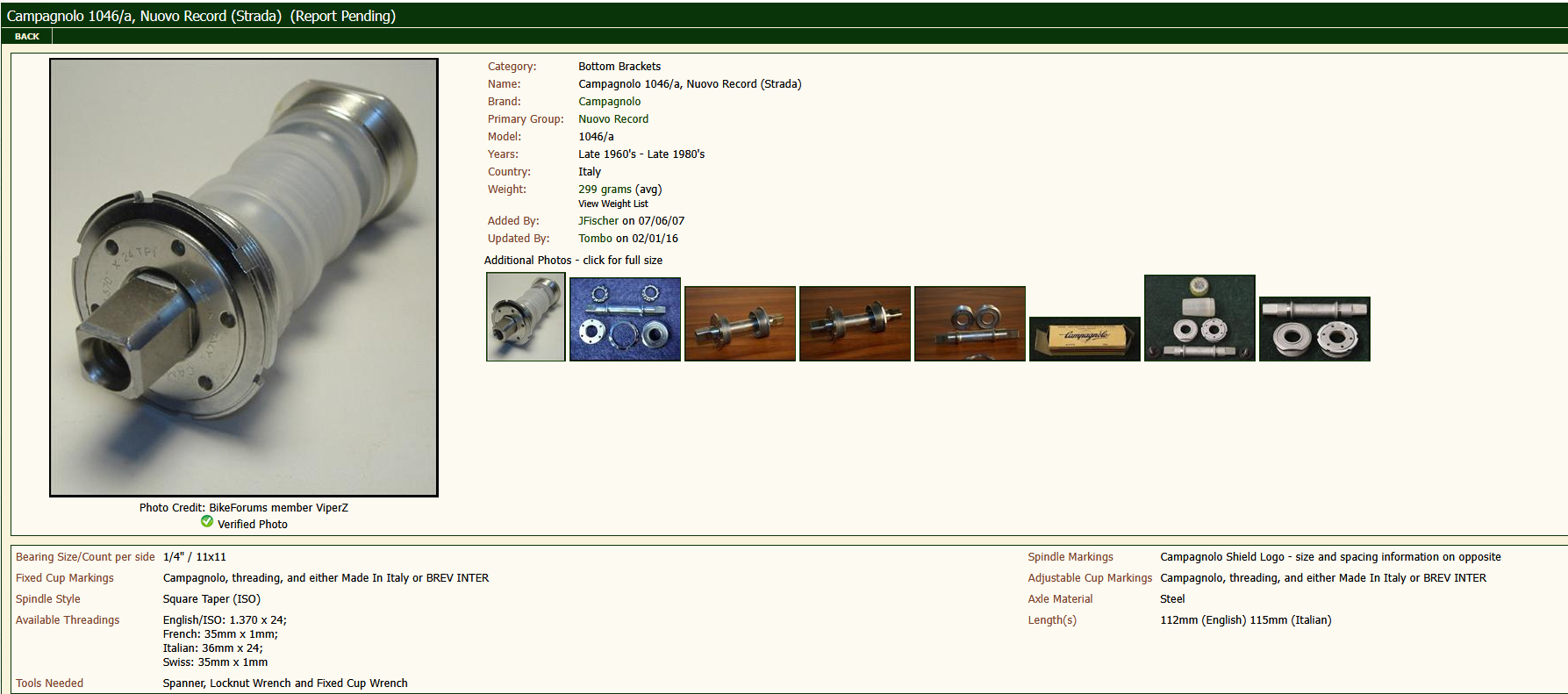
This indicates only two lengths, but the article has many more...still looking like any 68mm long bottom bracket wants a 112mm spindle for road use. Wondering if the database is incomplete, or if the track part is different.
I do have a campy record crankset on the way, then I will get to measuring to really gain confidence.
Although then that begs the question...what dimension of a Crankset determines a good spindle length?
Thanks,
Hank
This indicates only two lengths, but the article has many more...still looking like any 68mm long bottom bracket wants a 112mm spindle for road use. Wondering if the database is incomplete, or if the track part is different.
I do have a campy record crankset on the way, then I will get to measuring to really gain confidence.
Although then that begs the question...what dimension of a Crankset determines a good spindle length?
Thanks,
Hank
10-20-25 | 08:29 PM
#18
señor miembro
Joined: Dec 2018
Posts: 3,524
Likes: 8,927
From: Pac NW
Bikes: '70s - '80s Campagnolo
That's just letting you know the two different spindle lengths for 70mm bb shells (Italian) and 68mm (everything else).
10-20-25 | 08:33 PM
#19
Thread Starter
Newbie
Joined: Oct 2025
Posts: 22
Likes: 14
From: Northern Colorado
Bikes: 1978 motobecane Super Mirage, 1980 Motobecane Le Champion
Does that mean for a specific crankset, the needed spindle length is decided based on bb length?
Last edited by HankMcStank; 10-20-25 at 08:34 PM. Reason: spelling
10-21-25 | 01:32 PM
#20
Here is the velo page with what I assume is a matching campy record bb (part no 1046, as in the article I posted earlier):
This indicates only two lengths, but the article has many more...still looking like any 68mm long bottom bracket wants a 112mm spindle for road use. Wondering if the database is incomplete, or if the track part is different.
I do have a campy record crankset on the way, then I will get to measuring to really gain confidence.
Although then that begs the question...what dimension of a Crankset determines a good spindle length?
Thanks,
Hank
This indicates only two lengths, but the article has many more...still looking like any 68mm long bottom bracket wants a 112mm spindle for road use. Wondering if the database is incomplete, or if the track part is different.
I do have a campy record crankset on the way, then I will get to measuring to really gain confidence.
Although then that begs the question...what dimension of a Crankset determines a good spindle length?
Thanks,
Hank
and beyond will be in post CPSC territory, 115 mm.
the earlier was 112mm. Identifiable by the shape around the spindle port.
1976 could be either...
the way of things.
10-21-25 | 02:24 PM
#21
Thread Starter
Newbie
Joined: Oct 2025
Posts: 22
Likes: 14
From: Northern Colorado
Bikes: 1978 motobecane Super Mirage, 1980 Motobecane Le Champion

hard to read, but it says: " 170 STRADA <4>"...does that indicate 1974?
10-22-25 | 07:03 AM
#22
Thread Starter
Newbie
Joined: Oct 2025
Posts: 22
Likes: 14
From: Northern Colorado
Bikes: 1978 motobecane Super Mirage, 1980 Motobecane Le Champion
Excellent, thanks for the help on that one.
Now...I have not forgotten that several of yall are doubtful that I have a French threaded frame, instead saying it's Swiss.
I see markings 35x1 on the bb housing, but researching bb length indicates both swiss and french threads are this size/marked this way. Is there another way to tell, short of having a bb to try to thread in?
Now...I have not forgotten that several of yall are doubtful that I have a French threaded frame, instead saying it's Swiss.
I see markings 35x1 on the bb housing, but researching bb length indicates both swiss and french threads are this size/marked this way. Is there another way to tell, short of having a bb to try to thread in?
10-22-25 | 09:57 AM
#23
Thread Starter
Newbie
Joined: Oct 2025
Posts: 22
Likes: 14
From: Northern Colorado
Bikes: 1978 motobecane Super Mirage, 1980 Motobecane Le Champion
Thank you, I'll check the frame when I get home.
Funny to me that the French decided to go nonstandard for thread direction of all things...I must get myself some of whatever they were smoking in France at the time
Funny to me that the French decided to go nonstandard for thread direction of all things...I must get myself some of whatever they were smoking in France at the time
10-22-25 | 08:34 PM
#24
Both French (35 mm) and Italian (36 mm) have drive-side (actually, both sides) right-hand thread. English (1.370 inch or 34.78 mm) and Swiss (35 mm) have drive-side left-hand threaded. It wasn't a matter of smoking anything. The French and Italians each had a substantial bicycle industry, and had developed their own standards to support it, evidently deciding that the complexity of having cup and BB threading different on each side wasn't worth it, when the precessional loosening problem could be solved by tightening the fixed cup really tight.
10-22-25 | 08:52 PM
#25
Senior Member
Joined: Jan 2014
Posts: 511
Likes: 411
From: San Francisco - it used to be nice
Bikes: 1970 Alex Singer, 63 Hetchins, 75 Motobecane Townie, more . . .
Sometimes the only reliable way to figure out the French / Swiss mystery is to pull the fixed cup. Total PITA when the cup could have simply been stamped 35x1 L or R (or D and G for the French).
IIRC old Stronglight and TA used a system of ring markings on the fixed cup, or knurling the adjustable cup lockring (of all things) to indicate BB threading.
Good old Sutherlands Guide used to be the source for that info.
Welcome to the bizarre world of bike threading. Next up is Headsets and Freewheels.
IIRC old Stronglight and TA used a system of ring markings on the fixed cup, or knurling the adjustable cup lockring (of all things) to indicate BB threading.
Good old Sutherlands Guide used to be the source for that info.
Welcome to the bizarre world of bike threading. Next up is Headsets and Freewheels.