


odd raleigh fork attachment hardware
 12-13-25 | 11:20 PM
#1
Thread Starter
Senior Member

Joined: Sep 2007
Posts: 505
Likes: 145
From: seoul korea
Bikes: 3Rensho SuperRecord Export, Bridgestones MB1 RB1 XO2, Colnago Super, Medici GranTurismo, Schwinn Paramount, Olmo Competition, Raleigh Portage, Miyata 1000, Stumpjumper, Lotus Competition, Nishiki Maxima, Panasonic DX6000, Zeus Criterium
odd raleigh fork attachment hardware
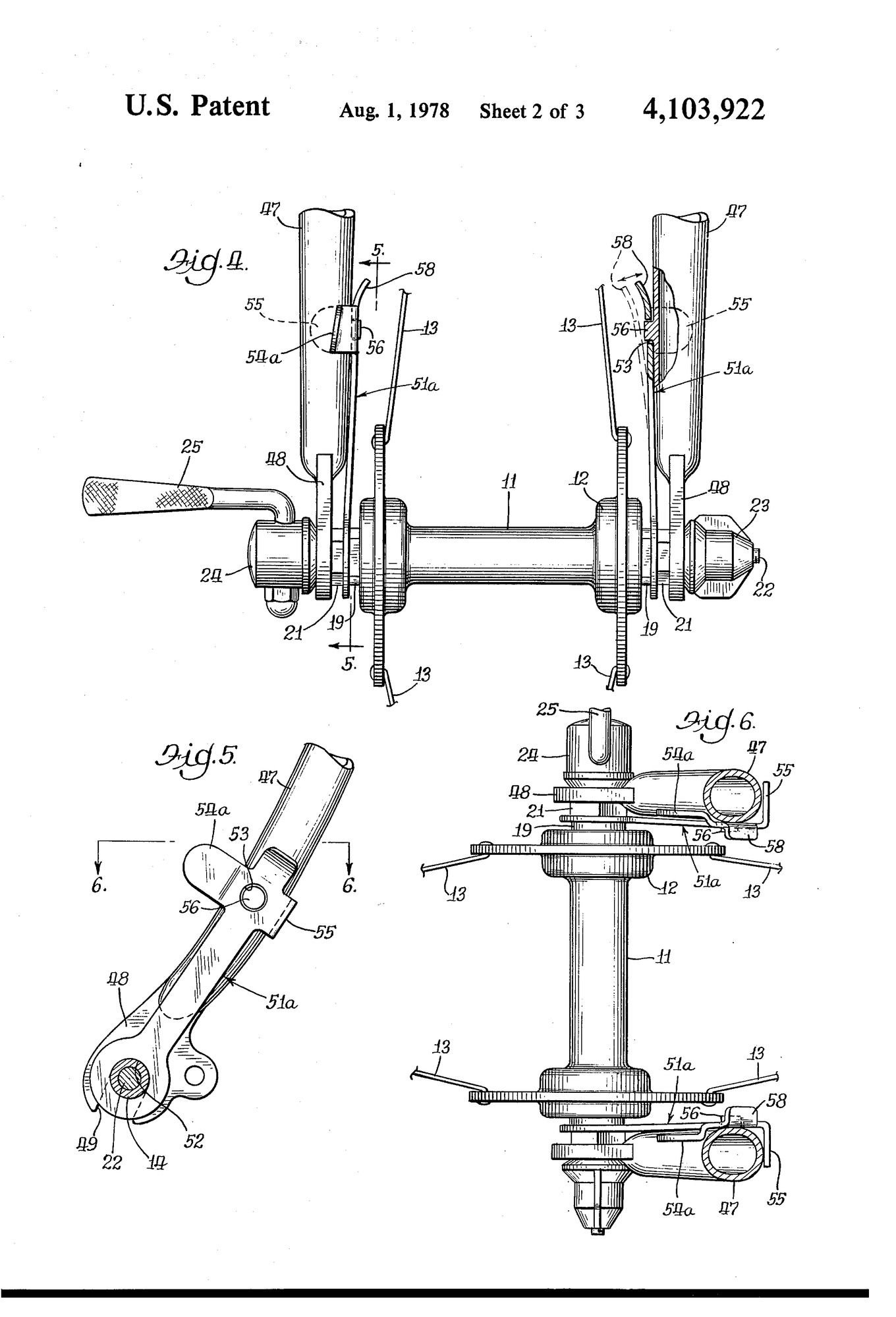
i've been overhauling vintage bikes for a long time. lots of bicycles. i've never encountered this particular fork attachment : looks like a flip down lawyer lip to capture the front axle?

 12-14-25 | 01:44 AM
#3
Senior Member


Joined: Jan 2014
Posts: 511
Likes: 411
From: San Francisco - it used to be nice
Bikes: 1970 Alex Singer, 63 Hetchins, 75 Motobecane Townie, more . . .
Looks like it was influenced by the earlier, and IMHO much better design that Schwinn used as a safety feature.
Manufacturers were clutching for straws in that era to try and lower the number of Product Liability lawsuits.
Manufacturers were clutching for straws in that era to try and lower the number of Product Liability lawsuits.
12-14-25 | 08:32 AM
#4

Old fart

Joined: Nov 2004
Posts: 26,318
Likes: 5,226
From: Appleton WI
Bikes: Several, mostly not name brands.
 12-14-25 | 08:35 AM
#5
Old fart
Joined: Nov 2004
Posts: 26,318
Likes: 5,226
From: Appleton WI
Bikes: Several, mostly not name brands.
All the CPSC-approved front wheel retention devices require user intervention to remove and reinstall the front wheel.
 12-14-25 | 11:11 AM
#7

aka Tom Reingold
Joined: Jan 2009
Posts: 44,124
Likes: 6,341
From: New York, NY, and High Falls, NY, USA
Bikes: 1962 Rudge Sports, 1971 Raleigh Super Course, 1971 Raleigh Pro Track, 1974 Raleigh International, 1975 Viscount Fixie, 1982 McLean, 1996 Lemond (Ti), 2002 Burley Zydeco tandem
I never had difficulty operating QR skewers but a lot of people do. I'm sure many of us have seen people who screw the skewer tight without flipping the lever. I taught a class for adults and was very explicit: "Test to see if it's adjusted right by flipping. It should be hard but possible to close. When you have it adjusted right, do not screw it tight; flip it closed." I showed it very clearly. And half my students screwed it tight anyway. Oy vey. And I suppose this is a reason thru-axles come on new bikes.
Given that we can't change human nature, I'll concede that the change is a good one. I don't wish a falling-off front wheel on anyone.
Given that we can't change human nature, I'll concede that the change is a good one. I don't wish a falling-off front wheel on anyone.
__________________
Tom Reingold, tom@noglider.com
New York City and High Falls, NY
Blogs: The Experienced Cyclist; noglider's ride blog
“When man invented the bicycle he reached the peak of his attainments.” — Elizabeth West, US author
Please email me rather than PM'ing me. Thanks.
Tom Reingold, tom@noglider.com
New York City and High Falls, NY
Blogs: The Experienced Cyclist; noglider's ride blog
“When man invented the bicycle he reached the peak of his attainments.” — Elizabeth West, US author
Please email me rather than PM'ing me. Thanks.


 12-14-25 | 02:57 PM
#8

Senior Member
Joined: Feb 2008
Posts: 5,304
Likes: 4,800
From: Peoria, IL
I never had difficulty operating QR skewers but a lot of people do. I'm sure many of us have seen people who screw the skewer tight without flipping the lever. I taught a class for adults and was very explicit: "Test to see if it's adjusted right by flipping. It should be hard but possible to close. When you have it adjusted right, do not screw it tight; flip it closed." I showed it very clearly. And half my students screwed it tight anyway. Oy vey. And I suppose this is a reason thru-axles come on new bikes.
Given that we can't change human nature, I'll concede that the change is a good one. I don't wish a falling-off front wheel on anyone.
Given that we can't change human nature, I'll concede that the change is a good one. I don't wish a falling-off front wheel on anyone.
The through-axle does seem like a solution that satisfies people's urge to screw things together, but I've wondered if bikes with rim brakes wouldn't be better off with wingnuts? ... at least for those folks who are challenged by QR's? My first 10 speed was equipped with them, and for a Montgomery Ward bike, they were a bit exotic!! There's a bit of a compromise in the wingnuts, though. The wings weren't long enough, on average, to get much torque. OTOH, I still use a Hi-E hub with its little half-wingnut method of attachment. The wing is only a bit under 1" long, and it is adequate to hold the front wheel on.
Steve in frigid Peoria
 12-14-25 | 05:26 PM
#9

Senior Member
Joined: Apr 2009
Posts: 3,701
Likes: 5,481
From: Seattle
*Is it "machining" if you just turn the cutter by hand?

 12-14-25 | 07:05 PM
#10
Senior Member
Joined: Feb 2008
Posts: 5,304
Likes: 4,800
From: Peoria, IL
In Harlan's defense, he also sold a cutter for machining* a circular groove in the face of the dropout, for the slow-release to positively key into. I have the tool (I'm a toolaholic) but I have never used it! The only bike I had with the wing-skewer had chrome-plated dropout faces, and I assume the chrome would dull that cutter, like instantly. Even tool steel properly hardened shouldn't be used on chrome.
*Is it "machining" if you just turn the cutter by hand?
*Is it "machining" if you just turn the cutter by hand?
Or did you have to have some "expertise" just to order his stuff, unlike the random mom and pop that found their way into a Schwinn shop?
Of course, some folks with expertise were not fond of Harlan's work. I recall Larry Black at the 2018 CR gathering giving a talk about Harlan's pedal, with various digressions into some of the unusual things he saw when he visited Harlan's production space. It was quite the talk!

Steve in Peoria
 12-14-25 | 08:59 PM
#11
aka Tom Reingold
Joined: Jan 2009
Posts: 44,124
Likes: 6,341
From: New York, NY, and High Falls, NY, USA
Bikes: 1962 Rudge Sports, 1971 Raleigh Super Course, 1971 Raleigh Pro Track, 1974 Raleigh International, 1975 Viscount Fixie, 1982 McLean, 1996 Lemond (Ti), 2002 Burley Zydeco tandem
Wingnuts didn't work so well on rear wheels of bikes with horizontal dropouts. As you pedal, you can pull the wheel forward and jam it into your seat tube or chain stay. It's hard to get the wing nuts tight enough to prevent this. This, I believe, is why Campagnolo invented the QR skewer.
__________________
Tom Reingold, tom@noglider.com
New York City and High Falls, NY
Blogs: The Experienced Cyclist; noglider's ride blog
“When man invented the bicycle he reached the peak of his attainments.” — Elizabeth West, US author
Please email me rather than PM'ing me. Thanks.
Tom Reingold, tom@noglider.com
New York City and High Falls, NY
Blogs: The Experienced Cyclist; noglider's ride blog
“When man invented the bicycle he reached the peak of his attainments.” — Elizabeth West, US author
Please email me rather than PM'ing me. Thanks.
12-14-25 | 09:53 PM
#12
Senior Member
Joined: Feb 2008
Posts: 5,304
Likes: 4,800
From: Peoria, IL
Wingnuts didn't work so well on rear wheels of bikes with horizontal dropouts. As you pedal, you can pull the wheel forward and jam it into your seat tube or chain stay. It's hard to get the wing nuts tight enough to prevent this. This, I believe, is why Campagnolo invented the QR skewer.
Considering the general popularity of wingnuts for high end bikes for some time(?), I'm guessing that slippage wasn't a serious problem. If it was, it wouldn't have been that hard to just go back to nuts and a wrench. Tullio Campagnolo is said to have invented the quick release because he couldn't loosen a wingnut. No mentions of any slippage issues. If I had to guess, it might be the case that you had to really lean on those wingnuts to avoid slippage, thus making them hard to remove when dealing with cold temperatures??
Looking at Tullio's timeline again, I see that he came up with the idea in 1930. I think wingnuts continued to be used for some time after that, but don't currently have any data to support that hypothesis. I still find them interesting.
Steve in Peoria
12-14-25 | 10:43 PM
#13
Senior Member
Joined: Apr 2009
Posts: 3,701
Likes: 5,481
From: Seattle
Yes pro racers used wingnuts with horizontal dropouts, so it's clearly possible to do them up tight enough for a pro.
The origin story (which might even be true...) of Tullio's QR says it was on Croce D'Aune, a pass in the Dolomites, where his fingers were too cold.
The origin story (which might even be true...) of Tullio's QR says it was on Croce D'Aune, a pass in the Dolomites, where his fingers were too cold.
12-17-25 | 07:49 AM
#14

weapons-grade bolognium
Joined: Dec 2008
Posts: 6,606
Likes: 3,306
From: Across the street from Chicago
Bikes: Battaglin Cromor, Ciocc Designer 84, Schwinn Superior 1981
Wingnuts didn't work so well on rear wheels of bikes with horizontal dropouts. As you pedal, you can pull the wheel forward and jam it into your seat tube or chain stay. It's hard to get the wing nuts tight enough to prevent this. This, I believe, is why Campagnolo invented the QR skewer.
12-18-25 | 02:56 PM
#15


feros ferio

Joined: Jul 2000
Posts: 22,397
Likes: 1,864
From: www.ci.encinitas.ca.us
Bikes: 1959 Capo Modell Campagnolo; 1960 Capo Sieger (2); 1962 Carlton Franco Suisse; 1970 Peugeot UO-8; 1982 Bianchi Campione d'Italia; 1988 Schwinn Project KOM-10;
I've seen people treat QR skewers like wingnuts too, and was a bit amazed. Perhaps I over-estimate the mechanical aptitude of the average person?
The through-axle does seem like a solution that satisfies people's urge to screw things together, but I've wondered if bikes with rim brakes wouldn't be better off with wingnuts? ... at least for those folks who are challenged by QR's? My first 10 speed was equipped with them, and for a Montgomery Ward bike, they were a bit exotic!! There's a bit of a compromise in the wingnuts, though. The wings weren't long enough, on average, to get much torque. OTOH, I still use a Hi-E hub with its little half-wingnut method of attachment. The wing is only a bit under 1" long, and it is adequate to hold the front wheel on.

Steve in frigid Peoria
The through-axle does seem like a solution that satisfies people's urge to screw things together, but I've wondered if bikes with rim brakes wouldn't be better off with wingnuts? ... at least for those folks who are challenged by QR's? My first 10 speed was equipped with them, and for a Montgomery Ward bike, they were a bit exotic!! There's a bit of a compromise in the wingnuts, though. The wings weren't long enough, on average, to get much torque. OTOH, I still use a Hi-E hub with its little half-wingnut method of attachment. The wing is only a bit under 1" long, and it is adequate to hold the front wheel on.
Steve in frigid Peoria
Fortunately, I have four ca. 1960 frames whose forks are devoid of gimmicks.
__________________
"Far and away the best prize that life offers is the chance to work hard at work worth doing." --Theodore Roosevelt
Capo: 1959 Modell Campagnolo, S/N 40324; 1960 Sieger (2), S/N 42624, 42597
Carlton: 1962 Franco Suisse, S/N K7911
Peugeot: 1970 UO-8, S/N 0010468
Bianchi: 1982 Campione d'Italia, S/N 1.M9914
Schwinn: 1988 Project KOM-10, S/N F804069
"Far and away the best prize that life offers is the chance to work hard at work worth doing." --Theodore Roosevelt
Capo: 1959 Modell Campagnolo, S/N 40324; 1960 Sieger (2), S/N 42624, 42597
Carlton: 1962 Franco Suisse, S/N K7911
Peugeot: 1970 UO-8, S/N 0010468
Bianchi: 1982 Campione d'Italia, S/N 1.M9914
Schwinn: 1988 Project KOM-10, S/N F804069
12-18-25 | 09:18 PM
#16

Senior Member

Joined: Jul 2020
Posts: 1,813
Likes: 1,478
From: Oakland, CA
I find that telling people straight out, "It's not a weirdo one-armed half-arsed wingnut." pretty much always works. You have to break through the fact that not only do Q/R skewers not work like how they look like they work, they don't work the way anything else the newbie has ever used works. And I do mean nothing. I can't think of anything that J. Random Larval Cyclist will have used that uses a side-turning camming clamp to pinch a thing into another thing.
We forget it, but quick release skewers are really friggin' weird.
--Shannon
We forget it, but quick release skewers are really friggin' weird.
--Shannon
