Parts ID
 12-29-25 | 11:10 AM
#1
Thread Starter
Senior Member


Joined: Aug 2013
Posts: 770
Likes: 412
From: Eastern PA
Bikes: Trek 4900, Cannondale Cx-4, Falcon San Remo, Peugeot PX-10LE
Parts ID
Wasn’t sure where to ask this so here goes.
1. Why did the spokes get tied up?
2. Any idea why the black loop was left on the hub?
3. What is the black plastic item attached to the spokes, one on each wheel?
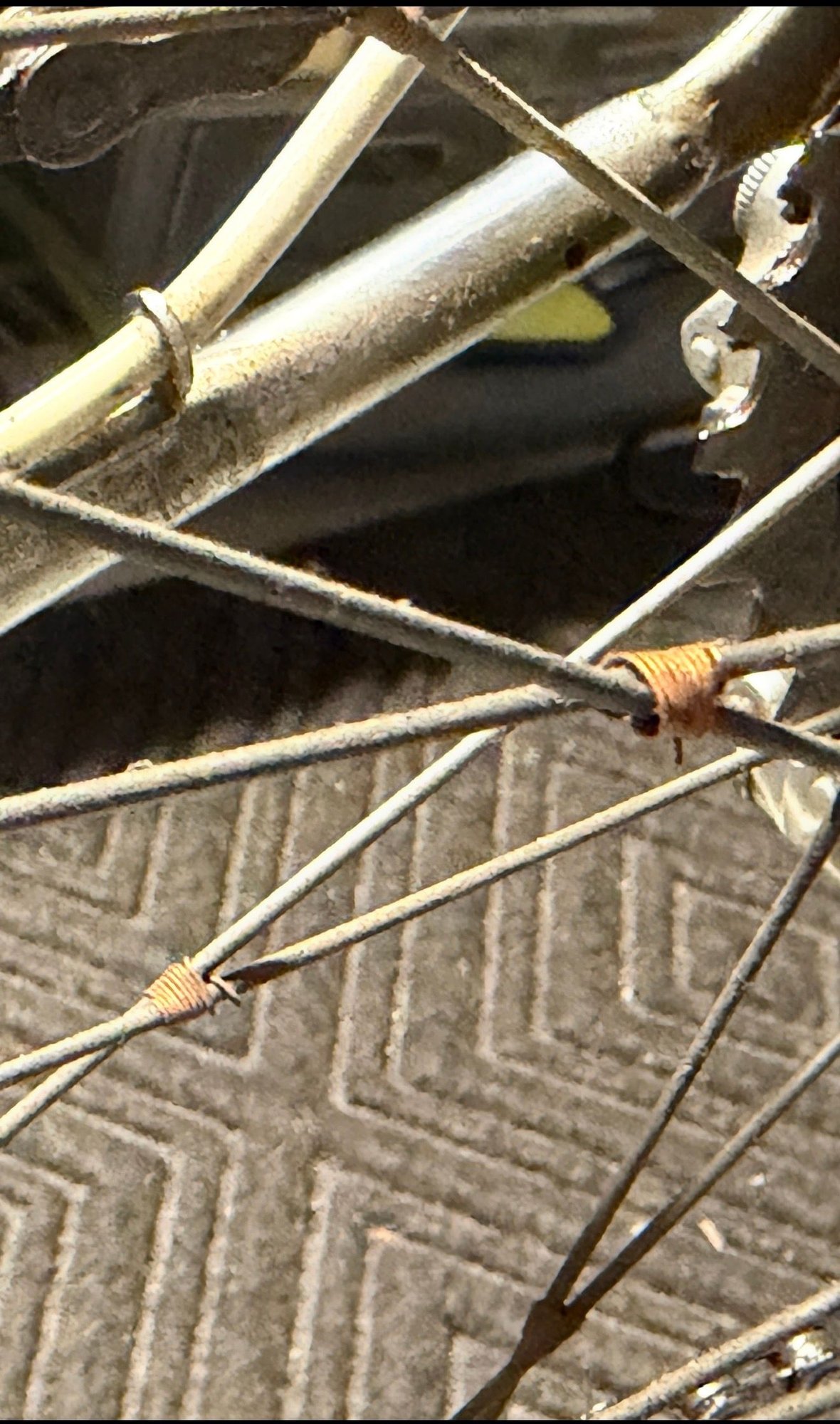
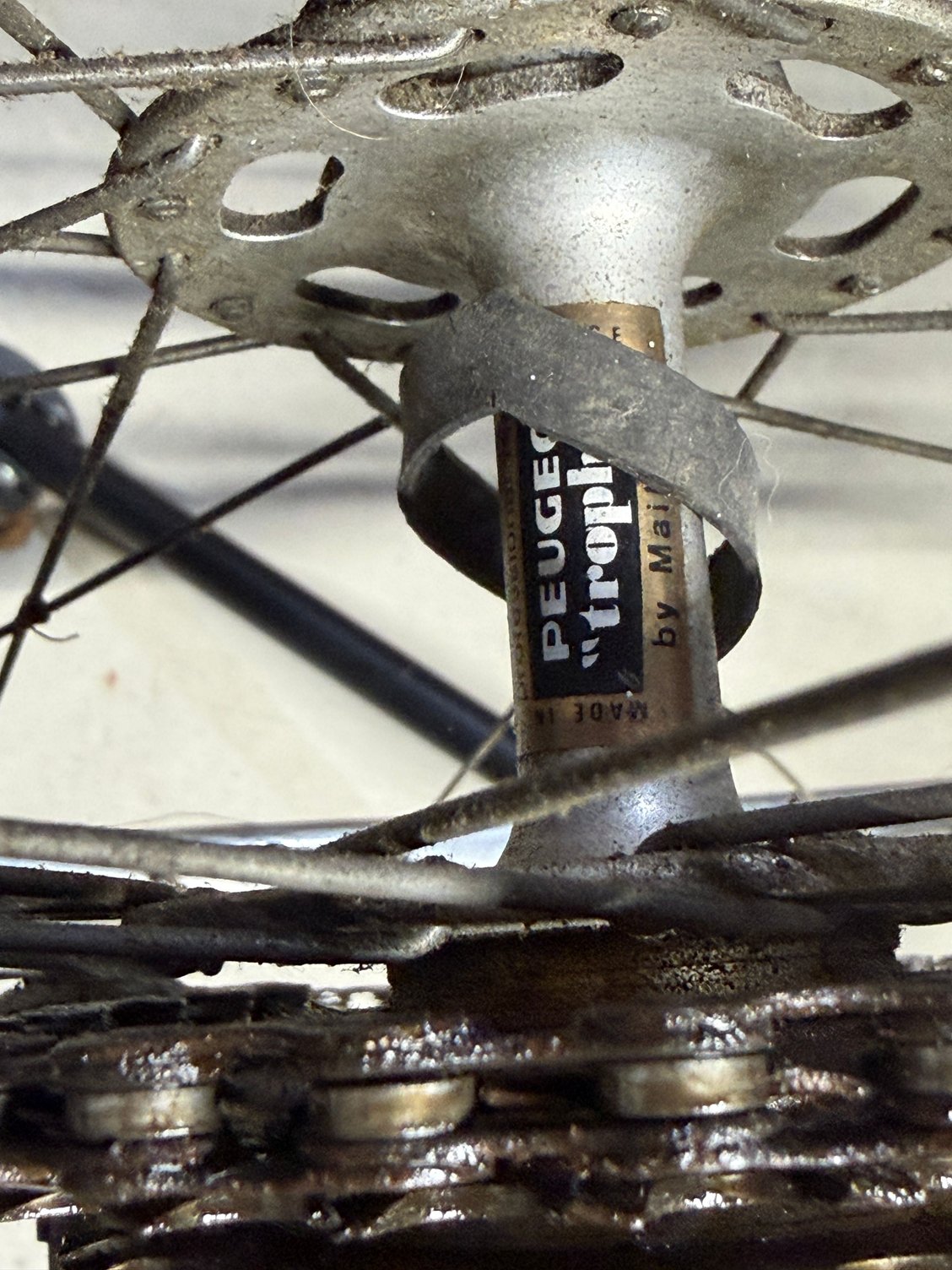
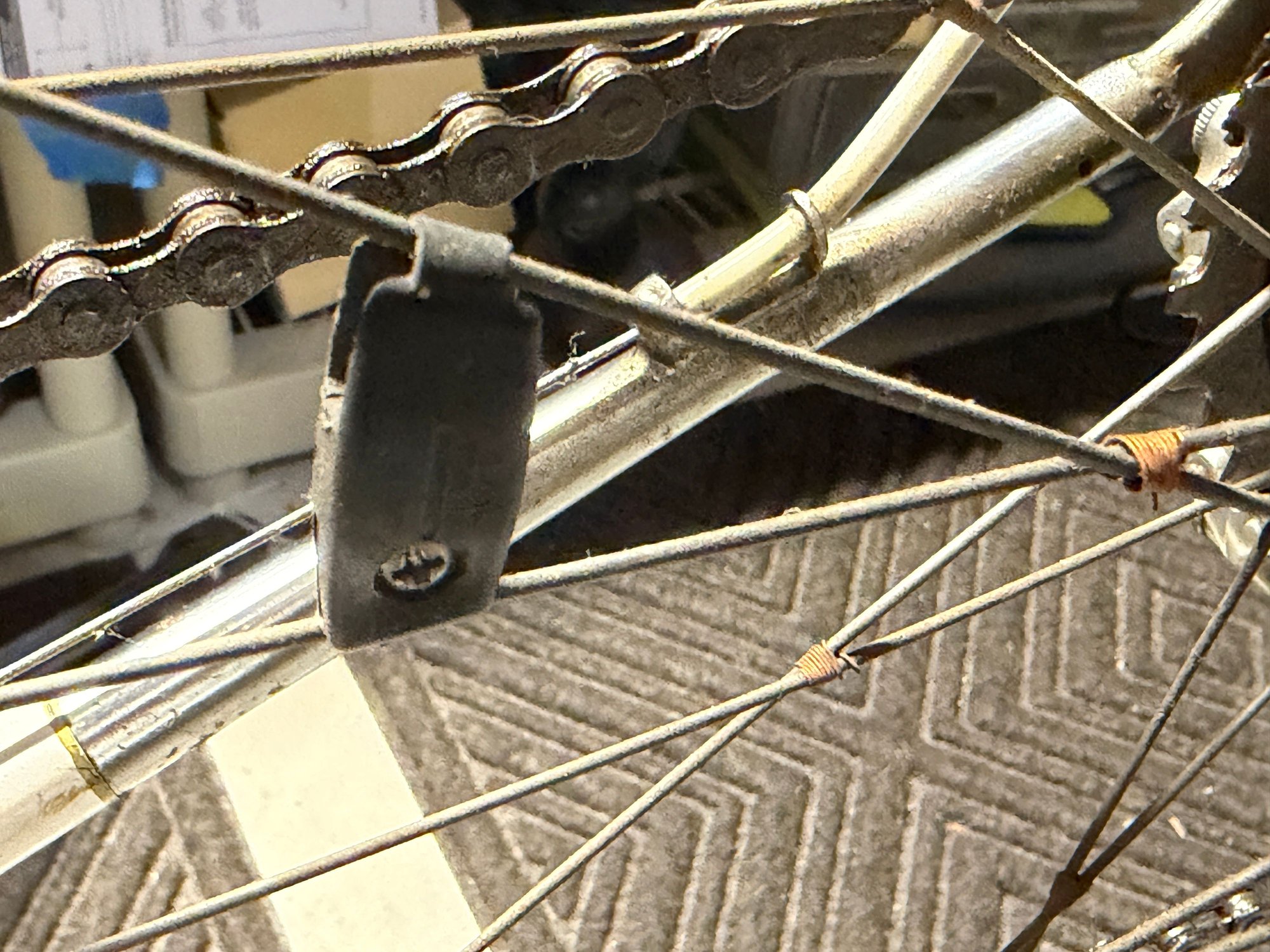
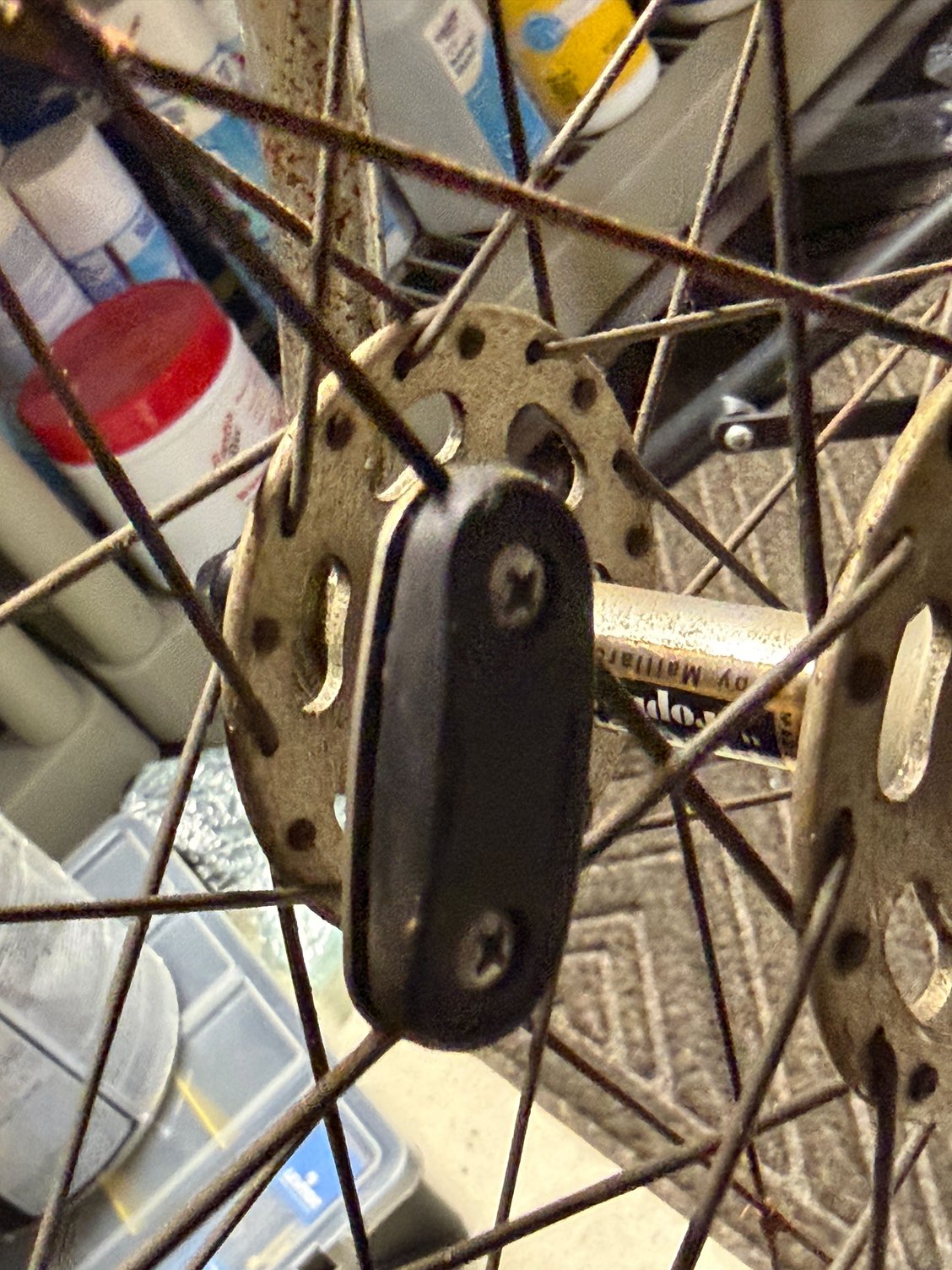
1. Why did the spokes get tied up?
2. Any idea why the black loop was left on the hub?
3. What is the black plastic item attached to the spokes, one on each wheel?
__________________
“Two things are infinite: the universe and human stupidity; and I'm not sure about the former."
― Albert Einstein
“Two things are infinite: the universe and human stupidity; and I'm not sure about the former."
― Albert Einstein
 12-29-25 | 11:13 AM
#2

Tinker-er

Joined: Oct 2007
Posts: 1,602
Likes: 1,559
From: Mid-Atlantic
Bikes: 1956 Rudge; 1981 Miyata; 1994 Breezer; 1987 Raleigh Mtn Trials; 1952 R.O. Harrison; 1994 Concorde; 1949 Rotrax; 1964 A.S. Gillott; Early 60s Frejus; ~1979 RRB track; Unknown Interwar track
Tying and soldering spokes was common practice to make a stiffer wheel.
The black loop is to keep the hub center clean.
The plastic piece is the magnet for a speedometer sensor.
Phil
The black loop is to keep the hub center clean.
The plastic piece is the magnet for a speedometer sensor.
Phil


 12-29-25 | 11:15 AM
#3
Francophile
Joined: Nov 2015
Posts: 4,780
Likes: 2,085
From: Seattle
Bikes: Lots
The spokes were tied and possibly soldered to increase the wheel's stiffness. It was The Thing To Do back in the 70s. Today not so much if at all.
The black loop on the hub is to keep the center of the hub clean.
The black plastic bits on the spokes are magnets for a bike computer.
The black loop on the hub is to keep the center of the hub clean.
The black plastic bits on the spokes are magnets for a bike computer.
__________________
Keeping Seattle’s bike shops in business since 1978
Keeping Seattle’s bike shops in business since 1978
12-29-25 | 11:33 AM
#4
Thread Starter
Senior Member
Joined: Aug 2013
Posts: 770
Likes: 412
From: Eastern PA
Bikes: Trek 4900, Cannondale Cx-4, Falcon San Remo, Peugeot PX-10LE
Thanks.
__________________
“Two things are infinite: the universe and human stupidity; and I'm not sure about the former."
― Albert Einstein
“Two things are infinite: the universe and human stupidity; and I'm not sure about the former."
― Albert Einstein
12-29-25 | 12:37 PM
#5

Bikes are okay, I guess.
Joined: Jan 2015
Posts: 8,001
Likes: 3,766
From: Richmond, Virginia
Bikes: Waterford Paramount Touring, Raleigh Sports 3-speeds in M23 & L23, Schwinn Cimarron oddball build, Marin Palisades Trail dropbar conversion, Nishiki Cresta GT, Jeunet mixte
"Hub shiner" is the generic term, whether the piece is rubber or leather or some other material. An unbroken section of inner tube like the one in your photo has to be installed before the wheel is built.

12-30-25 | 02:53 AM
#6
Senior Member

Joined: Feb 2020
Posts: 3,983
Likes: 2,308
Subject: Tied and Soldered Wheels
From: Jobst Brandt
Date: December 16, 1996
While writing The Bicycle Wheel, to conclusively determine what effect tying and soldering of spoke crossings in a wheel had, I asked Wheelsmith to lend me an untied pair of standard 36-spoke rear wheels, on Campagnolo low and high flange hubs. I had an inner body of a freewheel machined with flats so that a wheel could be clamped into the vise of a Bridgeport milling machine while the left end of its axle was held in the quill.
With the hub rigidly secured, with its axle vertical, dial gauges were mounted at four equally spaced locations on the machine bed to measure rim deflections as a 35lb weight was sequentially hung on the wheel at these positions. The deflections were recorded for each location and averaged for each wheel before and after tying and soldering spokes.
The wheels were also measured for torsional rigidity in the same fixture, by a wire anchored in the valve hole and wrapped around the rim so that a 35-lb force could be applied tangential to the rim. Dial gauges located at two places 90 degrees apart in the quadrant away from the applied load were used to measure relative rotation between the wheel and hub.
Upon repeating the measurements after tying and soldering the spokes, no perceptible change, other than random measurement noise of a few thousandths of an inch, was detected. The spokes were tied and soldered by Wheelsmith, which did this as a regular service. The data were collected by an engineer who did not know what I expected to find. I set up the experiment and delivered the wheels.
12-30-25 | 04:52 AM
#7

Senior Member

Joined: Apr 2009
Posts: 3,688
Likes: 5,461
From: Seattle
Yes, I think it's quite likely that tying and/or soldering* the spokes does nothing to the stiffness of the wheel, or has too small an effect to ever matter in the real world. I've seen no evidence to the contrary. I think it's even less likely that it adds strength or fatigue endurance.
So why do people do it? Or why did they historically do it? Which might be something different from why people do it now. Or the reasons given may have changed more than once over the history of the technique.
I see two main possibilities:
I heard from one bike builder, very knowledgeable and experienced, and an actual engineer, who claims he's seen wheels where the spokes are deeply notched from rubbing against each other where they cross, which shows there's some relative motion there. That means tying & soldering would prevent that relative movement, therefore stiffening the wheel. I think he even said he'd seen the notching proceed so far that a spoke is sawed through and breaks, which tying and soldering could have prevented.
My problem with that is that in 60 years of working on bikes, I've never seen that. Doesn't prove it can't happen, but I think it implies that it's very rare. Too rare for me to worry about it, that's for sure.
Then there's the problem that there's no evidence that stiffening the wheel would even be a good thing. I can easily imagine that it could just as well make the wheel worse in some way, so don't say "it stiffens the wheel" as if that settles why it's good. But that's a whole 'nuther can o' worms, maybe let's not get into that particular religious war! (I'm obviously not a fan of the "stiffer is better" hypothesis.)
* Please note also that some of the proposed benefits of t&s require the soldering part. The OP's wheel has them tired but not soldered. That would not prevent the spokes from sawing against each other, and it seems to me it would reduce even further the possibility that it's stiffening the wheel in any meaningful way.
What tied but not soldered does do however, is restrain a broken spoke from flailing around. I think that adds more credence to my hypothesis that possibility #2 (of the two above) is the "real" reason people did it BITD. Why go to all the trouble of tying them, without also soldering, so that the tied spokes can still move relative to each other? It's got to be because you don't care if the spokes move relative to each other. You're just restraining broken spokes, that's all.
Or you saw it on your favorite pro's bike, and you thought it looked cool.
So why do people do it? Or why did they historically do it? Which might be something different from why people do it now. Or the reasons given may have changed more than once over the history of the technique.
I see two main possibilities:
- People have gotten this idea in their head, not based on evidence, that it increases stiffness (or strength or fatigue endurance). And no one noticed that it wasn't true.
- Spokes break sometimes, and the spoke that's now only connected at one end can come out and flap around, hitting on the frame or the rider's leg, which might make you get off the bike and deal with it before you can keep riding. That can make you lose the race.
I heard from one bike builder, very knowledgeable and experienced, and an actual engineer, who claims he's seen wheels where the spokes are deeply notched from rubbing against each other where they cross, which shows there's some relative motion there. That means tying & soldering would prevent that relative movement, therefore stiffening the wheel. I think he even said he'd seen the notching proceed so far that a spoke is sawed through and breaks, which tying and soldering could have prevented.
My problem with that is that in 60 years of working on bikes, I've never seen that. Doesn't prove it can't happen, but I think it implies that it's very rare. Too rare for me to worry about it, that's for sure.
Then there's the problem that there's no evidence that stiffening the wheel would even be a good thing. I can easily imagine that it could just as well make the wheel worse in some way, so don't say "it stiffens the wheel" as if that settles why it's good. But that's a whole 'nuther can o' worms, maybe let's not get into that particular religious war! (I'm obviously not a fan of the "stiffer is better" hypothesis.)
* Please note also that some of the proposed benefits of t&s require the soldering part. The OP's wheel has them tired but not soldered. That would not prevent the spokes from sawing against each other, and it seems to me it would reduce even further the possibility that it's stiffening the wheel in any meaningful way.
What tied but not soldered does do however, is restrain a broken spoke from flailing around. I think that adds more credence to my hypothesis that possibility #2 (of the two above) is the "real" reason people did it BITD. Why go to all the trouble of tying them, without also soldering, so that the tied spokes can still move relative to each other? It's got to be because you don't care if the spokes move relative to each other. You're just restraining broken spokes, that's all.
Or you saw it on your favorite pro's bike, and you thought it looked cool.

 12-30-25 | 05:28 AM
#8
Thread Starter
Senior Member
Joined: Aug 2013
Posts: 770
Likes: 412
From: Eastern PA
Bikes: Trek 4900, Cannondale Cx-4, Falcon San Remo, Peugeot PX-10LE
Yes, I think it's quite likely that tying and/or soldering* the spokes does nothing to the stiffness of the wheel, or has too small an effect to ever matter in the real world. I've seen no evidence to the contrary. I think it's even less likely that it adds strength or fatigue endurance.
So why do people do it? Or why did they historically do it? Which might be something different from why people do it now. Or the reasons given may have changed more than once over the history of the technique.
I see two main possibilities:
I heard from one bike builder, very knowledgeable and experienced, and an actual engineer, who claims he's seen wheels where the spokes are deeply notched from rubbing against each other where they cross, which shows there's some relative motion there. That means tying & soldering would prevent that relative movement, therefore stiffening the wheel. I think he even said he'd seen the notching proceed so far that a spoke is sawed through and breaks, which tying and soldering could have prevented.
My problem with that is that in 60 years of working on bikes, I've never seen that. Doesn't prove it can't happen, but I think it implies that it's very rare. Too rare for me to worry about it, that's for sure.
Then there's the problem that there's no evidence that stiffening the wheel would even be a good thing. I can easily imagine that it could just as well make the wheel worse in some way, so don't say "it stiffens the wheel" as if that settles why it's good. But that's a whole 'nuther can o' worms, maybe let's not get into that particular religious war! (I'm obviously not a fan of the "stiffer is better" hypothesis.)
* Please note also that some of the proposed benefits of t&s require the soldering part. The OP's wheel has them tired but not soldered. That would not prevent the spokes from sawing against each other, and it seems to me it would reduce even further the possibility that it's stiffening the wheel in any meaningful way.
What tied but not soldered does do however, is restrain a broken spoke from flailing around. I think that adds more credence to my hypothesis that possibility #2 (of the two above) is the "real" reason people did it BITD. Why go to all the trouble of tying them, without also soldering, so that the tied spokes can still move relative to each other? It's got to be because you don't care if the spokes move relative to each other. You're just restraining broken spokes, that's all.
Or you saw it on your favorite pro's bike, and you thought it looked cool.
So why do people do it? Or why did they historically do it? Which might be something different from why people do it now. Or the reasons given may have changed more than once over the history of the technique.
I see two main possibilities:
- People have gotten this idea in their head, not based on evidence, that it increases stiffness (or strength or fatigue endurance). And no one noticed that it wasn't true.
- Spokes break sometimes, and the spoke that's now only connected at one end can come out and flap around, hitting on the frame or the rider's leg, which might make you get off the bike and deal with it before you can keep riding. That can make you lose the race.
I heard from one bike builder, very knowledgeable and experienced, and an actual engineer, who claims he's seen wheels where the spokes are deeply notched from rubbing against each other where they cross, which shows there's some relative motion there. That means tying & soldering would prevent that relative movement, therefore stiffening the wheel. I think he even said he'd seen the notching proceed so far that a spoke is sawed through and breaks, which tying and soldering could have prevented.
My problem with that is that in 60 years of working on bikes, I've never seen that. Doesn't prove it can't happen, but I think it implies that it's very rare. Too rare for me to worry about it, that's for sure.
Then there's the problem that there's no evidence that stiffening the wheel would even be a good thing. I can easily imagine that it could just as well make the wheel worse in some way, so don't say "it stiffens the wheel" as if that settles why it's good. But that's a whole 'nuther can o' worms, maybe let's not get into that particular religious war! (I'm obviously not a fan of the "stiffer is better" hypothesis.)
* Please note also that some of the proposed benefits of t&s require the soldering part. The OP's wheel has them tired but not soldered. That would not prevent the spokes from sawing against each other, and it seems to me it would reduce even further the possibility that it's stiffening the wheel in any meaningful way.
What tied but not soldered does do however, is restrain a broken spoke from flailing around. I think that adds more credence to my hypothesis that possibility #2 (of the two above) is the "real" reason people did it BITD. Why go to all the trouble of tying them, without also soldering, so that the tied spokes can still move relative to each other? It's got to be because you don't care if the spokes move relative to each other. You're just restraining broken spokes, that's all.
Or you saw it on your favorite pro's bike, and you thought it looked cool.
Thanks for the explanation.
__________________
“Two things are infinite: the universe and human stupidity; and I'm not sure about the former."
― Albert Einstein
“Two things are infinite: the universe and human stupidity; and I'm not sure about the former."
― Albert Einstein
12-30-25 | 05:54 AM
#9
Senior Member
Joined: Feb 2020
Posts: 3,983
Likes: 2,308
I heard from one bike builder, very knowledgeable and experienced, and an actual engineer, who claims he's seen wheels where the spokes are deeply notched from rubbing against each other where they cross, which shows there's some relative motion there. That means tying & soldering would prevent that relative movement, therefore stiffening the wheel. I think he even said he'd seen the notching proceed so far that a spoke is sawed through and breaks, which tying and soldering could have prevented.
"Some more back-of-envelope maths; no deliberate errors....
Spokes which are interlaced at their crossings deviate from a straight
line.
The forces resulting from this situation can be calculated.
Assume the following:
a) spoke diameter of 2mm;
b) flange thickness of 3mm;
c) spoke length of 300mm;
d) crossing at 200mm from the rim;
e) spoke tension of 100kgf
f) Young's modulus of 200*10e9 N/m^2
The centre-line of an uncrossed spoke lies at an angle to the line
between the flange centre and the spoke hole at the rim, such angle
having a height at the flange of half the flange thickness plus half the
spoke thickness; given the figures above this is 2.5mm and the angle is
0.48 degrees.
The centre-line of a crossed spoke deviates from the straight line
between the flange centre and the spoke hole (in the rim) at the crossing
point by the spoke thickness plus an amount proportional to half the
thickness of the flange (in this case 2/3rds as the crossing point is at
2/3rds of the spoke length); given the figures above we have a deviation
of 3mm total and an angle of 1.72 degrees at the flange. There is a
second angle calculable from the crossing point between the centre-line
of the spoke to the spoke hole in the rim and the line joining the flange
centre and the spoke hole; given the figures above it is 0.29 degrees.
So we have a triangle; taking the centre-line of an uncrossed spoke as a
reference the angle A (at the flange end) of a crossed spoke is
(1.72-0.48 = 1.24) degrees and angle B at the rim end is (0.48+0.29 =
0.77) degrees.
The orthogonal force at the crossing point can now be calculated as (t
sin A + t sin B); given the figures above it is roughly 3.5kgf.
The difference in length between the centre-line of an uncrossed and a
crossed spoke, given the figures above, is 100 * 1/cos(1.24) plus 200 * 1/
cos(0.77) = 300.04 mm.
The proportion of the tension in the crossed spokes due to their crossing
is calculable: t=(a*e*dl)/l, which given the figures above is about 8.5
kgf.
The point loading at the crossing for perfectly round and incompressible
spokes is infinite, but the actual degree of osculation at the pressure
found above can be estimated. The yield strength of stainless steels can
vary tremendously depending on the alloy and manufacturing; cycle spokes
are typically 314 or similar steel and are cold-worked; a not-
unreasonable estimate for yield strength is 300 MPa, which is about 3000
kgf per cm^2. The load of 3.5kgf found above can therefore be supported
by an area of 1/10 mm^2, which if circular would show on the spoke as a
bright spot 0.05mm in diameter.
The crossing point of the spokes may move as the spokes are unloaded at
the bottom of the wheel. This effect is greatest for lacing patterns of
high cross values, as the spokes join to the rim at points far enough
apart that one spoke is unloaded preferentially. Taking the extreme case
where one spoke is unloaded such that is assumes the line taken by an
uncrossed spoke and given the figures above, the bright spot will move
towards the flange by .0234 mm; this means that should such excursions be
common the bright spot would approximate an ellipse of minor diameter
0.05mm and major diameter 0.0734mm."
12-30-25 | 10:33 AM
#11
Francophile
Joined: Nov 2015
Posts: 4,780
Likes: 2,085
From: Seattle
Bikes: Lots
12-30-25 | 03:07 PM
#12
Senior Member
Joined: Jan 2014
Posts: 511
Likes: 411
From: San Francisco - it used to be nice
Bikes: 1970 Alex Singer, 63 Hetchins, 75 Motobecane Townie, more . . .
The "stiffening effect" effect of tied and soldered spokes might have been much more noticeable back in the days of very light aluminum rims (Scheerens, Nisi, others), wooden rims, and in general much lower spoke tensions.
The soldering also might have gripped the older non-stainless spokes enough to change the "feel" to the rider and the lifespan of the wheel ?
Also BITD most spokes were not as reliable as today, and so there was more of a possibility of having a loose / broken spoke in a race, or on a loaded touring bike.
Jobst was using modern Wheelsmith wheels with the more accepted modern idea of higher spoke tension @90-110kg/f. Think about what the TOTAL tension is on those modern wheels. It would be an interesting comparison if he had also tried it on old equipment.
The only times I've seen the spokes create a "notch" at the final crossing is on truly old, crapped-out and very low tensioned wheels.
Finally - the unsoldered ties on the pictured wheel, especially with the little vestigial piece of wire just hanging out there, looks truly TERRIBLE.
A good T&S job looks much better than that. I actually like the look of a good T&S even if it does nothing structurally. YMMV.
The soldering also might have gripped the older non-stainless spokes enough to change the "feel" to the rider and the lifespan of the wheel ?
Also BITD most spokes were not as reliable as today, and so there was more of a possibility of having a loose / broken spoke in a race, or on a loaded touring bike.
Jobst was using modern Wheelsmith wheels with the more accepted modern idea of higher spoke tension @90-110kg/f. Think about what the TOTAL tension is on those modern wheels. It would be an interesting comparison if he had also tried it on old equipment.
The only times I've seen the spokes create a "notch" at the final crossing is on truly old, crapped-out and very low tensioned wheels.
Finally - the unsoldered ties on the pictured wheel, especially with the little vestigial piece of wire just hanging out there, looks truly TERRIBLE.
A good T&S job looks much better than that. I actually like the look of a good T&S even if it does nothing structurally. YMMV.
Last edited by vintage cellar; 12-30-25 at 03:15 PM.