


What do you know about Mangaloy frames?
 06-21-06 | 12:11 AM
#1
Thread Starter
Senior Member
Joined: Jun 2006
Posts: 470
Likes: 0
From: Denver
What do you know about Mangaloy frames?
Hi folks. I just picked up an 1983 Trek 400 for $65. It's in pretty decent shape. I had to replace both tubes and the back wheel needs to be trued, but practically everything is good to go. I just came back from a ride around town and the things goes pretty quick.
The frame is made of Mangaloy. From what I have researched, it looks like Trek used Tange Mangaloy frames for their 400 model in 83 and 84. Does anyone know anything about these frames? How come they stopped making them? The bike is pretty light....is this material lighter than chromoly? How durable is the material? Any info is appreciated.
The frame is made of Mangaloy. From what I have researched, it looks like Trek used Tange Mangaloy frames for their 400 model in 83 and 84. Does anyone know anything about these frames? How come they stopped making them? The bike is pretty light....is this material lighter than chromoly? How durable is the material? Any info is appreciated.
 06-21-06 | 04:05 AM
#2
Senior Member

Joined: Dec 2005
Posts: 2,245
Likes: 3
From: Auld Blighty
Bikes: Early Cannondale tandem, '99 S&S Frezoni Audax, '65 Moulton Stowaway, '52 Claud Butler, TSR30, Brompton
Mangaloy has similar properties to cro-mo or slightly lower. Durability is fine, as with most steels.
06-21-06 | 06:41 PM
#3
Senior Member
Joined: Nov 2004
Posts: 23,212
Likes: 3,123
Mangaloy is Tange's brand name for their manganese-molybdenum (MnMo)tubesets. These tubesets have tensile strength that is between hi-tensile steels and chromium-molybdenum (CrMo). Consequenty, their weight is also in between the two. However, the real advantage of MnMo tubesets is that they retain a higher percentage of their strength after brazing. As a result, control of the brazing temperature is not as critical as with CrMo and it is more suitable to semi-automated, mass production. Introduction of Mangaloy and similar tubesets was instrumental in lowering the cost of bicycles with butted framesets in the early 1980s.
06-21-06 | 07:00 PM
#4

Originally Posted by T-Mar
Mangaloy is Tange's brand name for their manganese-molybdenum (MnMo)tubesets. These tubesets have tensile strength that is between hi-tensile steels and chromium-molybdenum (CrMo). Consequenty, their weight is also in between the two. However, the real advantage of MnMo tubesets is that they retain a higher percentage of their strength after brazing. As a result, control of the brazing temperature is not as critical as with CrMo and it is more suitable to semi-automated, mass production. Introduction of Mangaloy and similar tubesets was instrumental in lowering the cost of bicycles with butted framesets in the early 1980s.
 06-22-06 | 12:01 AM
#7
Thread Starter
Senior Member
Joined: Jun 2006
Posts: 470
Likes: 0
From: Denver
Originally Posted by T-Mar
Mangaloy is Tange's brand name for their manganese-molybdenum (MnMo)tubesets. These tubesets have tensile strength that is between hi-tensile steels and chromium-molybdenum (CrMo). Consequenty, their weight is also in between the two. However, the real advantage of MnMo tubesets is that they retain a higher percentage of their strength after brazing. As a result, control of the brazing temperature is not as critical as with CrMo and it is more suitable to semi-automated, mass production. Introduction of Mangaloy and similar tubesets was instrumental in lowering the cost of bicycles with butted framesets in the early 1980s.
06-22-06 | 05:44 AM
#9
Senior Member
Joined: Nov 2004
Posts: 23,212
Likes: 3,123
Originally Posted by vinnydelnegro
Thanks for the knowlege T-Mar. A couple more questions though. Does that mean that the joints are stronger? Do you know why they stopped making them?
For Mangalight it starts out at 72 ksi, but it retains about 97% of it's strength after brazing which works out to 70 ksi. So while Manglight retains a higher percentage of it's original tensile strength, it is still slightly weaker than CrMo after brazing, simply because the initial strength is less. .
By comparison, Miyata's hi-tensile steel starts out at 60 ksi and drops to 50 ksi after brazing, retaining only 83% of its strength.
The above figures are for butted tubes and apply to Miyata's particular tube compositions. Results for other manufacturers will vary slightly.
I can only speculate as to why they stopped making the MnMo tubesets. The road bicycle market has shifted upscale and to materials like aluminum, carbon fibre and titianium. Generally, whenever an industry undergoes a major shift or technological change, the old high end technology becomes the new low end technology and the old, low end technology disappears. I think this is what happened with many of the steel tubests. The old, low end stuff disappeared and only the better sets survived, but lost much of their status. Aluminum has pretty much taken over the market. Steel still survives, but mostly as hi-tensile in the department store bicycles were very low cost is the prime factor and weight is not a concern. Even there, it is under the threat of aluminum.
06-22-06 | 08:21 AM
#10

Senior Member
Joined: Mar 2006
Posts: 159
Likes: 0
Bikes: 1979 Trek 510
Originally Posted by vinnydelnegro
Does that mean that the joints are stronger? Do you know why they stopped making them?
Strength - This answer depends on what you mean by strength. Traditional CrMo gets brittle if overheated. Hence the need to handbraze it at low temperatures. Tubesets like Mangalloy, Mangy X and Fuji's Valite (same as Mangy X?) don't get as brittle when heated, so a functional joint could be machine brazed by the robotics of the 80s. I've no data to back it up, but I suspect that the final joint integrity (tubes pulling out of lugs) and final brittleness of the tubes (tubes sheering) would be about the same. Other aspect of strength are the tube's ability to resist dents and to resist being bent. Again, I would expect the tube sets to be roughly equivalant.
Current Production - IMO, lugged frames (which I dearly, dearly love) offer no real value other than aesthetics. [1] And if you are buying a lugged steel frame on the basis of aesthetics, handbuilt frames offer more appeal to most folks. It's no surprise to me lugged bikes continue to flurish among the high end custom and quasi-custom builders. But in terms of factory machine built bikes, machine brazed lugged frames were displaced by internally lugged AL, welded AL and Carbon frames. In particular, the current welded AL frame offers less weight and more stiffness for less money. And, coming back around to the aesthetics thing... I think the majority of recreational riders want to buy bikes that look like racing bikes, which means they need to look like fancy AL or Carbon. People buy with their eyes and hearts, not their heads.
I would be interested in T-Mar's take.
[1] - Some will argue that lugged tubes offer the possibilty of repair, which is true. But, it is very costly and I personally don't see sending a machine brazed frame to a frame builder for repair when a perfectly functional machine made frame could be purchased new for a competitive price.
06-22-06 | 08:07 PM
#11
Senior Member
Joined: Mar 2006
Posts: 159
Likes: 0
Bikes: 1979 Trek 510
Originally Posted by T-Mar
No, but it's closer than many people think. Let's take a look at the figures quoted for the Miyata tubesets. Their CrMo starts out at a tensile strength of 82 ksi. After brazing it drops to 73 ksi, which is about 91% of the original strength.
For Mangalight it starts out at 72 ksi, but it retains about 97% of it's strength after brazing which works out to 70 ksi. So while Manglight retains a higher percentage of it's original tensile strength, it is still slightly weaker than CrMo after brazing, simply because the initial strength is less. .
By comparison, Miyata's hi-tensile steel starts out at 60 ksi and drops to 50 ksi after brazing, retaining only 83% of its strength.
For Mangalight it starts out at 72 ksi, but it retains about 97% of it's strength after brazing which works out to 70 ksi. So while Manglight retains a higher percentage of it's original tensile strength, it is still slightly weaker than CrMo after brazing, simply because the initial strength is less. .
By comparison, Miyata's hi-tensile steel starts out at 60 ksi and drops to 50 ksi after brazing, retaining only 83% of its strength.
Originally Posted by T-Mar
Steel still survives, but mostly as hi-tensile in the department store bicycles were very low cost is the prime factor and weight is not a concern.
09-08-06 | 08:29 PM
#12

Resurrecting this thread: so what exactly is a frame labelled "Mangaloy 2001 Tange 2 CrMo"? Would this frame be a mix of the two in terms of tubing (i.e. main triangle/rear triangle) or some blend?
Last edited by JunkYardBike; 09-08-06 at 08:46 PM.
09-09-06 | 12:22 PM
#13
Senior Member
Joined: Nov 2004
Posts: 23,212
Likes: 3,123
Originally Posted by JunkYardBike
Resurrecting this thread: so what exactly is a frame labelled "Mangaloy 2001 Tange 2 CrMo"? Would this frame be a mix of the two in terms of tubing (i.e. main triangle/rear triangle) or some blend?
02-02-07 | 07:03 PM
#14
joychri
Joined: Jun 2006
Posts: 149
Likes: 1
From: Massachusetts
Bikes: 1973 Raleigh Super Course, 1979 Raleigh Competition GS, 1987 Shogun 300, 1989 Trek 520, 1995 Gary Fisher Wahoo, 1968 Schwinn Super Sport, 1976 Raleigh Gran Sport, 1971 Raleigh Competition, Gunnar Crosshairs
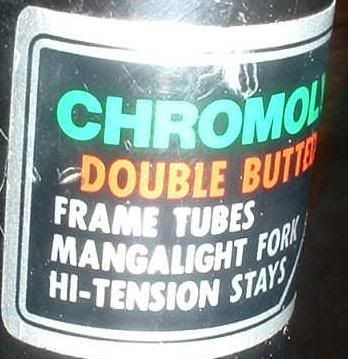
Resurrecting this thread: Is Tangaloy the same as Tange Mangaloy? I have a mid-1980's Shogun with Tange 900 DB tubing with Tangaloy decals on the forks and have always wondered what it was.
02-03-07 | 12:19 AM
#15
Yet another vegan biker
Joined: Dec 2005
Posts: 965
Likes: 6
From: Trapped behind the corn curtain
Bikes: Sakae Prism, Vintage Fuji bike(S), too many bikes, one from scratch bike.
Definitely a mix. Most likely a CrMo main triangle, with Mangaloy for the stays and maybe the forks. It''s fairly common to cut costs by user lesser grades of tubing in the stays and/or forks.
 09-25-14 | 08:30 AM
#16

WoodBadge NE-VI-1
Joined: Oct 2005
Posts: 386
Likes: 2
From: Baltimore
Bikes: 1983 Sequoia by Specialized; 1989 Panasonic
The change in valuation of the Yen and the Japanese recession caused many Japanese manufacturers to stop the expensive crafting of bikes in favor of Taiwanese manufacturing.
09-25-14 | 09:42 AM
#17

Gouge Away

Joined: Nov 2008
Posts: 984
Likes: 12
From: BFOH
09-25-14 | 10:38 AM
#18

Hogosha Sekai

Joined: Jun 2011
Posts: 6,674
Likes: 26
From: STS
Bikes: Leader 725, Centurion Turbo, Scwhinn Peloton, Schwinn Premis, GT Tequesta, Bridgestone CB-2,72' Centurion Lemans, 72 Raleigh Competition
