


Super Vitus 980

 11-30-07 | 07:57 AM
#2

Senior Member


Joined: Aug 2003
Posts: 13,973
Likes: 145
From: Tampa, Florida
Yes, it is good tubing.
How does it compare to 531? I have feeling that arguement will be long and drawn out. By the mid-80's 531 was on its way out.
https://www.classicrendezvous.com/Fra...us_history.htm
How does it compare to 531? I have feeling that arguement will be long and drawn out. By the mid-80's 531 was on its way out.
https://www.classicrendezvous.com/Fra...us_history.htm
11-30-07 | 11:31 AM
#4
Senior Member
Joined: Aug 2003
Posts: 13,973
Likes: 145
From: Tampa, Florida
11-30-07 | 02:25 PM
#8
Thread Starter
Ron Wood is cool.
Joined: Sep 2007
Posts: 114
Likes: 0
From: Midwest
Bikes: 1980 Peugeot PKN10, '82 PSV10, '88PH10 and a 2002 LeMond Alp d'Huez.
On an '82 PSV10, in addition to the 'Brase a la Main' on the top tube, what does it read on the drive side of the tt? My PKN says 'Competition' and i know that PX10s are 'Super Competition'. 'Course'?
 11-30-07 | 08:03 PM
#10
Senior Member

Joined: May 2007
Posts: 1,279
Likes: 69
I have a 1984 Peugeot made with 980 tubing, 60cm, clinchers. First time I rode it I really noticed the 'lively' feel of the frame especially when compared to my long tlme ride, a 1972 PX10. Paid $250 for it on ebay last year. I have seen the same model sell for as much as $450 on ebay.
11-30-07 | 10:21 PM
#12

www.theheadbadge.com


Joined: Sep 2005
Posts: 29,026
Likes: 5,538
From: Southern Florida
Bikes: https://www.theheadbadge.com
Probably one of the lightest, traditional diameter tubesets ever made. I had 980 on my '83 PSV-10 - identical to the catalog photo.
Now, it is also true that it is extremely whippy (at least it was so on my 60cm), but the 980s are also unusually lively. The frame will flex considerably under load, but on the PSV-10, the power transfer feels instant. Perhaps even springlike.
The steep front fork rake of the PSV-10 works against itself at slow speeds, being quite twitchy, but it balances out well once you're up to a fast cruising pace.
The PSV-10 itself is a machine that feels ideal for mostly straight, high-speed settings; mostly uncomfortable or unsuitable for easier riding.
-Kurt
Now, it is also true that it is extremely whippy (at least it was so on my 60cm), but the 980s are also unusually lively. The frame will flex considerably under load, but on the PSV-10, the power transfer feels instant. Perhaps even springlike.
The steep front fork rake of the PSV-10 works against itself at slow speeds, being quite twitchy, but it balances out well once you're up to a fast cruising pace.
The PSV-10 itself is a machine that feels ideal for mostly straight, high-speed settings; mostly uncomfortable or unsuitable for easier riding.
-Kurt
__________________


11-30-07 | 11:26 PM
#13
Senior Member
Joined: May 2007
Posts: 1,279
Likes: 69
No, not better, just different. My PX10 is a 64cm with heavy Weinmann concave 27" rims and a 120mm stem while my PSV10 is much lighter and a more compact bike. Cudak888 nailed it with his description of the ride on his '83.
12-01-07 | 06:10 AM
#14
Senior Member
Joined: Aug 2003
Posts: 13,973
Likes: 145
From: Tampa, Florida
A Kurt pointed out the PSV is straight up race machine. Peugeot didnt typicaly list frame geometries but they do have them listed in the 1985 ctalog.
Geometries for the PZ10 (butted 531) PSN10 (Vitus 980) and PGN10 (501) are identical. (1985 catalog)
Headtube: 72
Seattube: 74 30
Trail?: 40 mm
Chainstays: 412mm
Wheelbase: 39 1/4"* *First time you'll see imperial dimensions in a Peugeot catalog (1986)!!!!
In comparison to a PH501 or PH10LE which have different geometry a PSV (PZ10 and PRN10) would have primarily longer chainstays, taller headtubes and longer top tubes while having the same head/seat tube angles. Its tough to get and exact comaprison because the same sizes werent offered in both categories.
(similar to reynolds tubing does not pertain to the chart)

Geometries for the PZ10 (butted 531) PSN10 (Vitus 980) and PGN10 (501) are identical. (1985 catalog)
Headtube: 72
Seattube: 74 30
Trail?: 40 mm
Chainstays: 412mm
Wheelbase: 39 1/4"* *First time you'll see imperial dimensions in a Peugeot catalog (1986)!!!!
In comparison to a PH501 or PH10LE which have different geometry a PSV (PZ10 and PRN10) would have primarily longer chainstays, taller headtubes and longer top tubes while having the same head/seat tube angles. Its tough to get and exact comaprison because the same sizes werent offered in both categories.
(similar to reynolds tubing does not pertain to the chart)
01-22-19 | 05:31 AM
#15
Junior Member
Joined: Oct 2012
Posts: 7
Likes: 0
From: 捷克布傑約維採
Headtube: 72
Seattube: 74 30
Trail?: 40 mm
Chainstays: 412mm
Wheelbase: 39 1/4"* *First time you'll see imperial dimensions in a Peugeot catalog (1986)!!!!
In comparison to a PH501 or PH10LE which have different geometry a PSV (PZ10 and PRN10) would have primarily longer chainstays, taller headtubes and longer top tubes while having the same head/seat tube angles. Its tough to get and exact comaprison because the same sizes werent offered in both categories.
(similar to reynold
//vi.vipr.ebaydesc.com/ws/eBayISAPI.dll?ViewItemDescV4&item=382583150524s
01-22-19 | 09:14 AM
#16
Full Member

Joined: Sep 2017
Posts: 344
Likes: 489
From: Oklahoma City
Bikes: 1984 Chas Roberts Audax tubing?, 1985 Roberts SLX, Mercian 531, 1984 Torpado SLX, 1981/82 Peugeot PSV-10, 1978 Charlie Roberts full touring, 1970 Charlie Roberts 531 road.
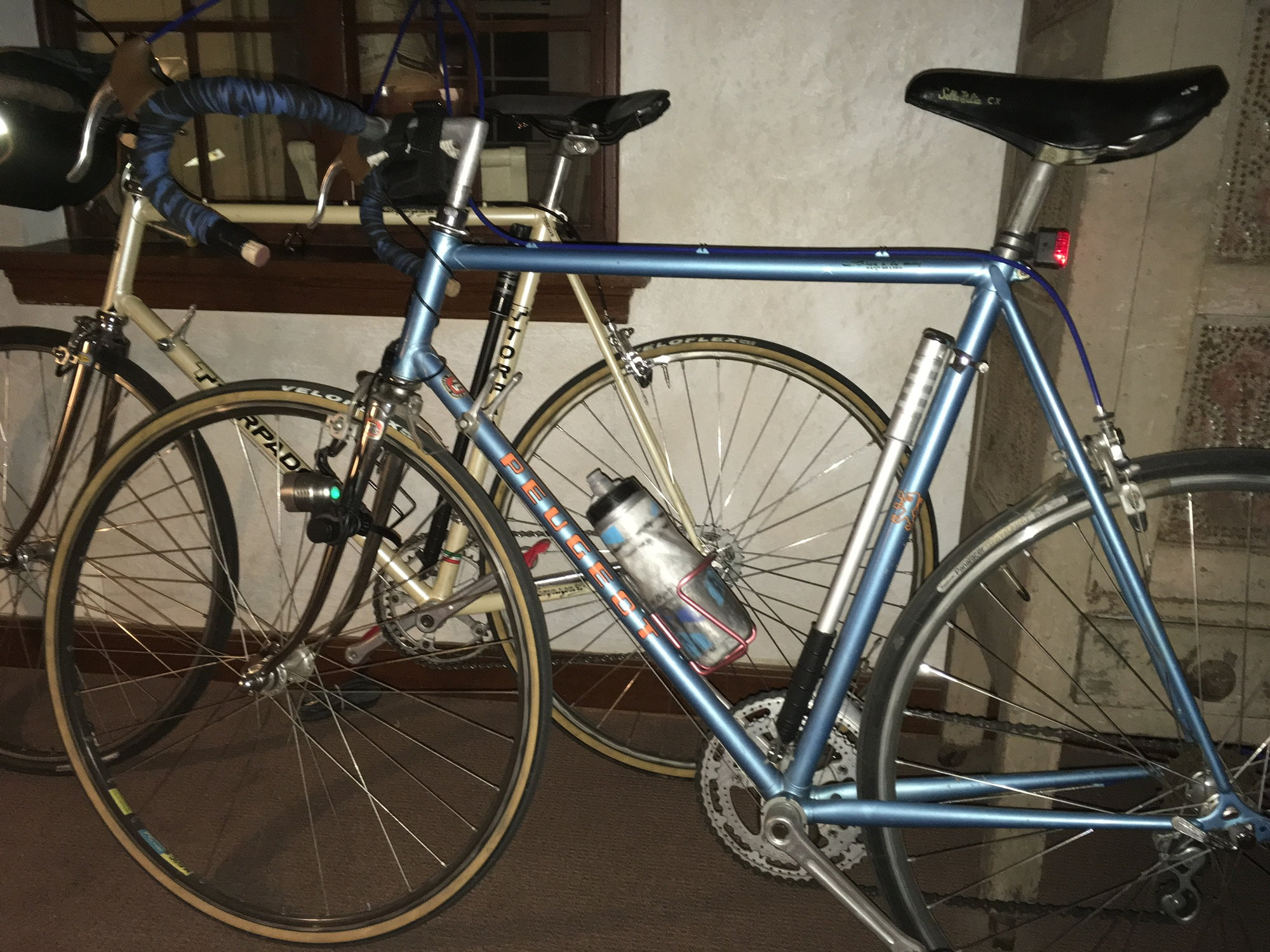
I’ e got a 60 cm c-t from 1981, lovely ride, and I weigh 178. I think it rides very well, and I’m comparing it to my SLX Torpado, SLX Roberts, and 531 Mercian.

01-22-19 | 10:32 AM
#17

Senior Member

Joined: Nov 2015
Posts: 4,900
Likes: 1,126
Actually, SV980 is more like Reynolds 753 per tube set weight schedules I have seen. And IIRC, SV980 is supposed to be heat treated, just like 753 tubing.
I do find my 1984 56cm PSV quite whippy, compared to Columbus SL and SLX steel bikes I own. Doesn't bother me as I'm so used to its riding characteristics after owning and riding it for 35 years now.......
I do find my 1984 56cm PSV quite whippy, compared to Columbus SL and SLX steel bikes I own. Doesn't bother me as I'm so used to its riding characteristics after owning and riding it for 35 years now.......
01-22-19 | 03:42 PM
#18

Bianchi Goddess
Joined: Apr 2009
Posts: 28,978
Likes: 4,252
From: Shady Pines Retirement Fort Wayne, In
Bikes: Too many to list here check my signature.
Most all frames are subject to flex of some degree. I think rider weight and style has more to do with flex than just frame material and of course size. A slender smooth spinning rider may find a 56cm 980 980 tubed frame to be stiff enough for them where a rider the same height but say 3-40 pounds heavier with a tendency to push a bigger gear and struggles to climb may find the same 56cm 980 tubed frame to be flexxy.
__________________
“One morning you wake up, the girl is gone, the bikes are gone, all that's left behind is a pair of old tires and a tube of tubular glue, all squeezed out"
Sugar "Kane" Kowalczyk
“One morning you wake up, the girl is gone, the bikes are gone, all that's left behind is a pair of old tires and a tube of tubular glue, all squeezed out"
Sugar "Kane" Kowalczyk
01-22-19 | 04:38 PM
#19

Ride, Wrench, Swap, Race
Joined: Jan 2010
Posts: 9,835
Likes: 1,816
From: Northern California
Bikes: Cheltenham-Pedersen racer, Boulder F/S Paris-Roubaix, Varsity racer, '52 Christophe, '62 Continental, '92 Merckx, '75 Limongi, '76 Presto, '72 Gitane SC, '71 Schwinn SS, etc.
As far as the flex of this tubing, I can't say I've ridden the Vitus 980 tubing on a Peugeot.
But on my 57cm Limongi (full 580) I can't notice any excess of flex, and the bike is most responsive to any quick, spirited transition to the standing position.
I'm just under 150lbs fwiw, but do ride hard in the hills here.
The geometry chart for the Peugeots of this later era shows an unusual "step function" occurring in the middle of the size range, with the 57cm and larger frames getting a much-steeper 73.5cm headtube angle versus a very shallow 72-degrees on the smaller sizes!
So, just as with the huge "chronologic" geometry shift that occurred between 1972 and 1973 on the PX10 model, again these later model's geometry and handling can't be described at all without stating what frame size we're talking about. In either case, it's likely to create disagreement when describing any of these bikes by model (without including year or frame size).
What I can say though is that many bikes can show either twitchy or stable handling, based on what stem length extension is used, and the resulting weight distribution over the front wheel!
Note that said weight distribution can be severely affected by a rider's tendency to "hang back" while descending at high speed, the worst thing that one can do if there is any tendency toward shimmy or instability.
And yet there is some tendency for many riders to do this, "as if" being fully forward might threaten to put them over the bars(?).
Staying put in a "charging ahead" position in the drops almost guarantees maximum stability (assuming here no extremes in terms of stem extension length).
But on my 57cm Limongi (full 580) I can't notice any excess of flex, and the bike is most responsive to any quick, spirited transition to the standing position.
I'm just under 150lbs fwiw, but do ride hard in the hills here.
The geometry chart for the Peugeots of this later era shows an unusual "step function" occurring in the middle of the size range, with the 57cm and larger frames getting a much-steeper 73.5cm headtube angle versus a very shallow 72-degrees on the smaller sizes!
So, just as with the huge "chronologic" geometry shift that occurred between 1972 and 1973 on the PX10 model, again these later model's geometry and handling can't be described at all without stating what frame size we're talking about. In either case, it's likely to create disagreement when describing any of these bikes by model (without including year or frame size).
What I can say though is that many bikes can show either twitchy or stable handling, based on what stem length extension is used, and the resulting weight distribution over the front wheel!
Note that said weight distribution can be severely affected by a rider's tendency to "hang back" while descending at high speed, the worst thing that one can do if there is any tendency toward shimmy or instability.
And yet there is some tendency for many riders to do this, "as if" being fully forward might threaten to put them over the bars(?).
Staying put in a "charging ahead" position in the drops almost guarantees maximum stability (assuming here no extremes in terms of stem extension length).
Last edited by dddd; 01-22-19 at 04:47 PM.
01-27-19 | 07:17 PM
#21
Full Member
Joined: Sep 2017
Posts: 344
Likes: 489
From: Oklahoma City
Bikes: 1984 Chas Roberts Audax tubing?, 1985 Roberts SLX, Mercian 531, 1984 Torpado SLX, 1981/82 Peugeot PSV-10, 1978 Charlie Roberts full touring, 1970 Charlie Roberts 531 road.
One more thought on the PSV10, the measurement from front axle to center of crank is longer than my Roberts SLX(1985), and as long as my Charles Roberts touring frame. A racing machine, but still carrying French fork genes. Roberts SLX is 57 cm, and the Roberts touring (1978-9) and the PSV10 (1981) are 60 cm.
Last edited by santa fe 2926; 01-27-19 at 07:22 PM.
01-27-19 | 07:38 PM
#22

I have owned Reynolds 531 frames that felt as if my input went into a black hole and did not propel me forward, and some that felt terrific.
Same with Columbus.
I have fewer Vitus 980 frames, and the three are fun. I do not really buy into the "planing" thing, but the flex is not a problem.
Of the three, I would place two as "artisan" one as semi production.
Good chance it is as much of the builder's effort than the tubing.
A wee bit on geometry and maybe a nod to how the chain stays are crimped or not. I prefer not.
Same with Columbus.
I have fewer Vitus 980 frames, and the three are fun. I do not really buy into the "planing" thing, but the flex is not a problem.
Of the three, I would place two as "artisan" one as semi production.
Good chance it is as much of the builder's effort than the tubing.
A wee bit on geometry and maybe a nod to how the chain stays are crimped or not. I prefer not.
01-27-19 | 07:53 PM
#23
Senior Member
Joined: Nov 2015
Posts: 4,900
Likes: 1,126
One more thought on the PSV10, the measurement from front axle to center of crank is longer than my Roberts SLX(1985), and as long as my Charles Roberts touring frame. A racing machine, but still carrying French fork genes. Roberts SLX is 57 cm, and the Roberts touring (1978-9) and the PSV10 (1981) are 60 cm.
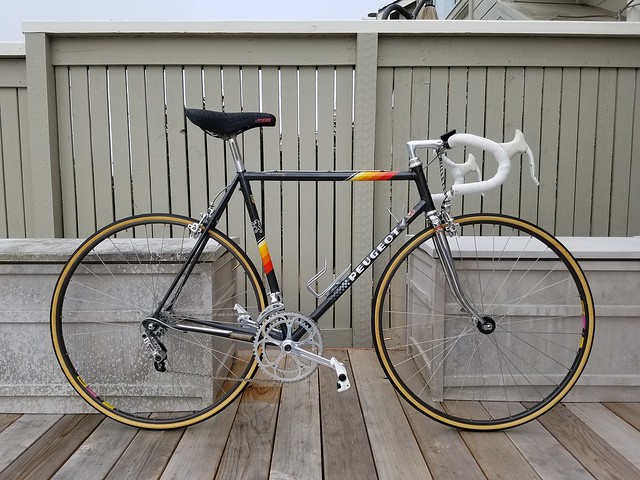
That, plus the relaxed geometry of my 56cm size PSV, results in a very stable, neutral handling bike.
I do find the curve of the fork legs to be a bit weird looking as they have more of a kink than a smooth curve with a short area of bend then a short straight section below it to the front dropouts. Not as elegant looking as the curves on my bikes with Columbus fork tubes.
Not sure if the fork legs came pre-bent from the Vitus factory, but I wish Peugeot gave them a better looking curve than what they have.....
__________________
72 Line Seeker
83 Davidson Signature
84 Peugeot PSV
84 Peugeot PY10FC
84 Gitane Tour de France.
85 Vitus Plus Carbone 7
86 ALAN Record Carbonio
86 Medici Aerodynamic (Project)
88 Pinarello Montello
89 Bottecchia Professional Chorus SL
95 Trek 5500 OCLV (Project)
72 Line Seeker
83 Davidson Signature
84 Peugeot PSV
84 Peugeot PY10FC
84 Gitane Tour de France.
85 Vitus Plus Carbone 7
86 ALAN Record Carbonio
86 Medici Aerodynamic (Project)
88 Pinarello Montello
89 Bottecchia Professional Chorus SL
95 Trek 5500 OCLV (Project)
Last edited by Chombi1; 01-27-19 at 08:00 PM.
01-27-19 | 09:23 PM
#24
Full Member
Joined: Sep 2017
Posts: 344
Likes: 489
From: Oklahoma City
Bikes: 1984 Chas Roberts Audax tubing?, 1985 Roberts SLX, Mercian 531, 1984 Torpado SLX, 1981/82 Peugeot PSV-10, 1978 Charlie Roberts full touring, 1970 Charlie Roberts 531 road.
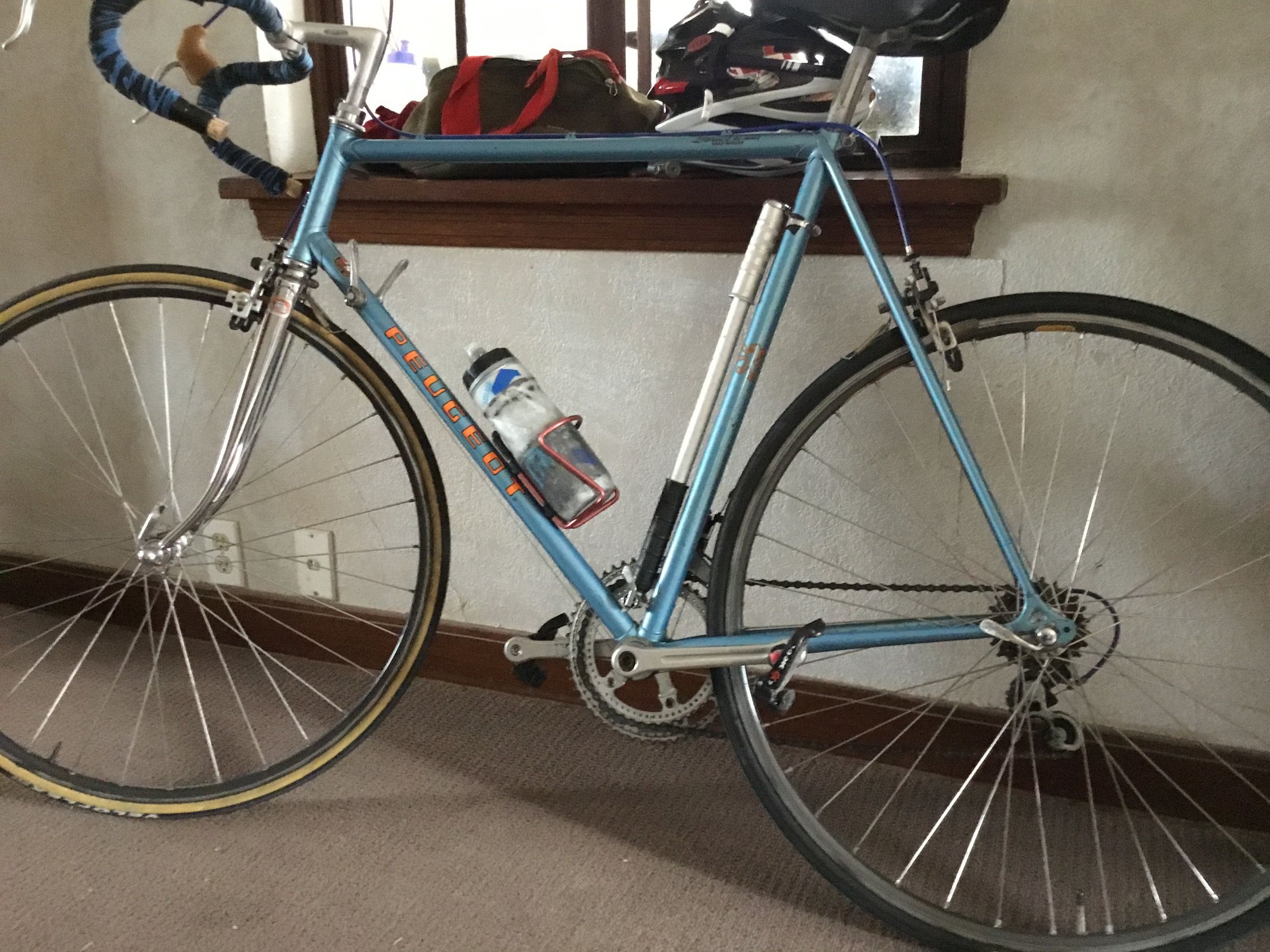
Of all the race bikes I own, my PSV has the most amount of rake on its fork.
That, plus the relaxed geometry of my 56cm size PSV, results in a very stable, neutral handling bike.
I do find the curve of the fork legs to be a bit weird looking as they have more of a kink than a smooth curve with a short area of bend then a short straight section below it to the front dropouts. Not as elegant looking as the curves on my bikes with Columbus fork tubes.
Not sure if the fork legs came pre-bent from the Vitus factory, but I wish Peugeot gave them a better looking curve than what they have.....
That, plus the relaxed geometry of my 56cm size PSV, results in a very stable, neutral handling bike.
I do find the curve of the fork legs to be a bit weird looking as they have more of a kink than a smooth curve with a short area of bend then a short straight section below it to the front dropouts. Not as elegant looking as the curves on my bikes with Columbus fork tubes.
Not sure if the fork legs came pre-bent from the Vitus factory, but I wish Peugeot gave them a better looking curve than what they have.....
01-27-19 | 10:03 PM
#25
Senior Member
Joined: Nov 2015
Posts: 4,900
Likes: 1,126
Most Italian 80's bikes like my Pinarello and Bottecchia have nicer curves on their forks that extend ll the way to the dropouts, with less rake:
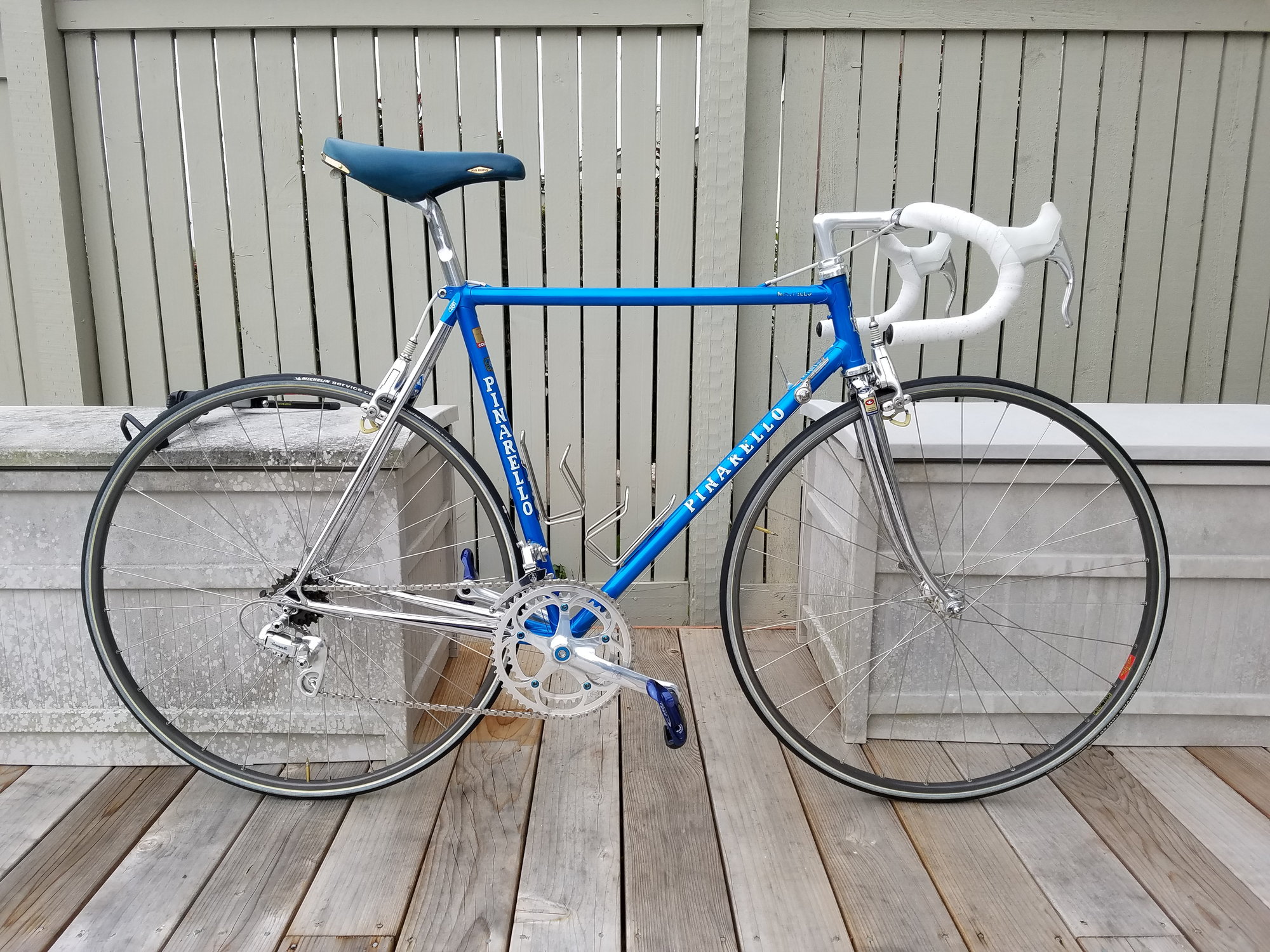
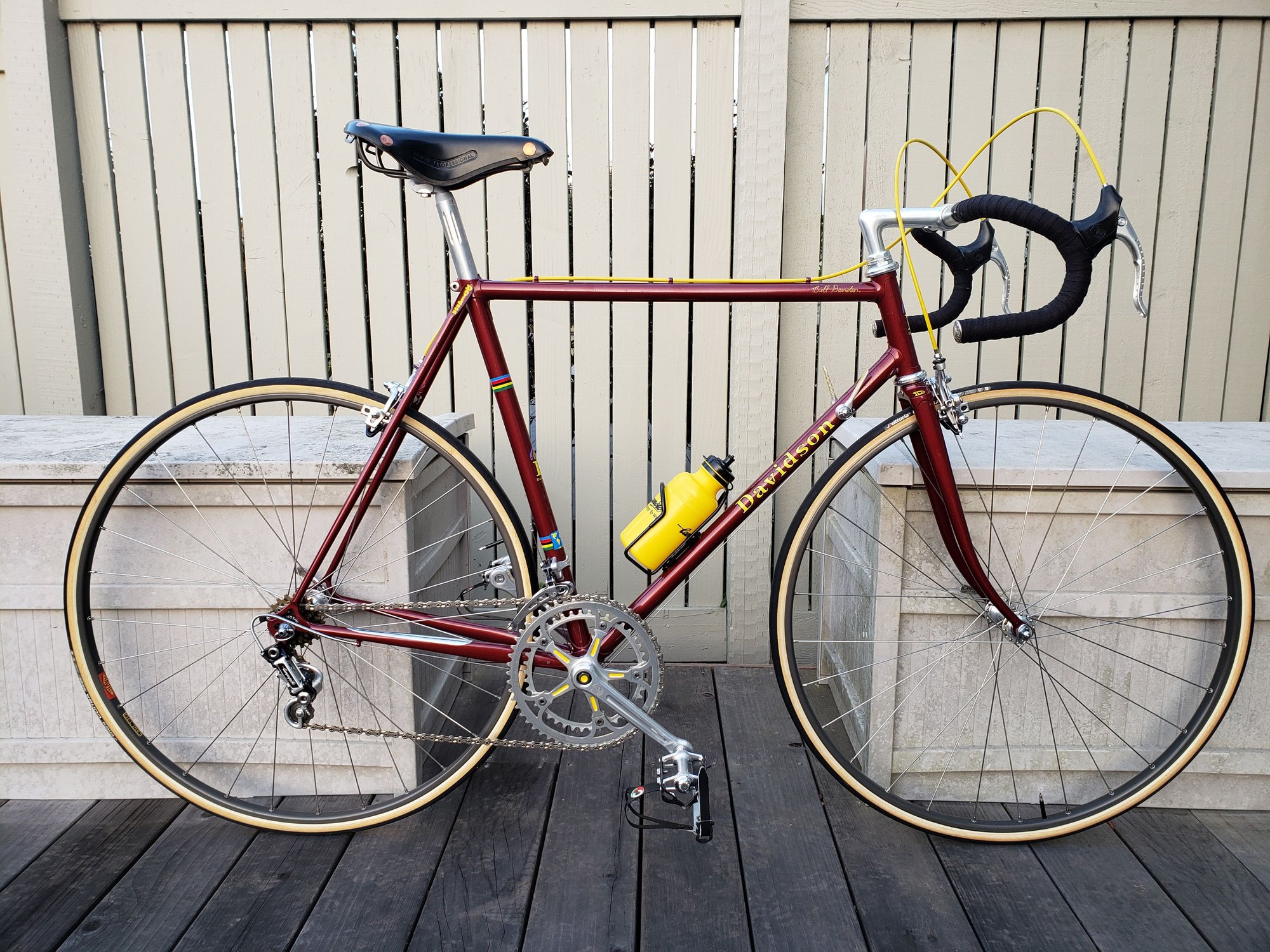
My Davidson, also built with Columbus tubing has a very nice consistent curve, going down to the dropouts.
My Gitane TdF that is built from Supervitus 983, deems to have the same kink/straight thing, going on with its lower fork legs. So it must be a Supervitus thing......
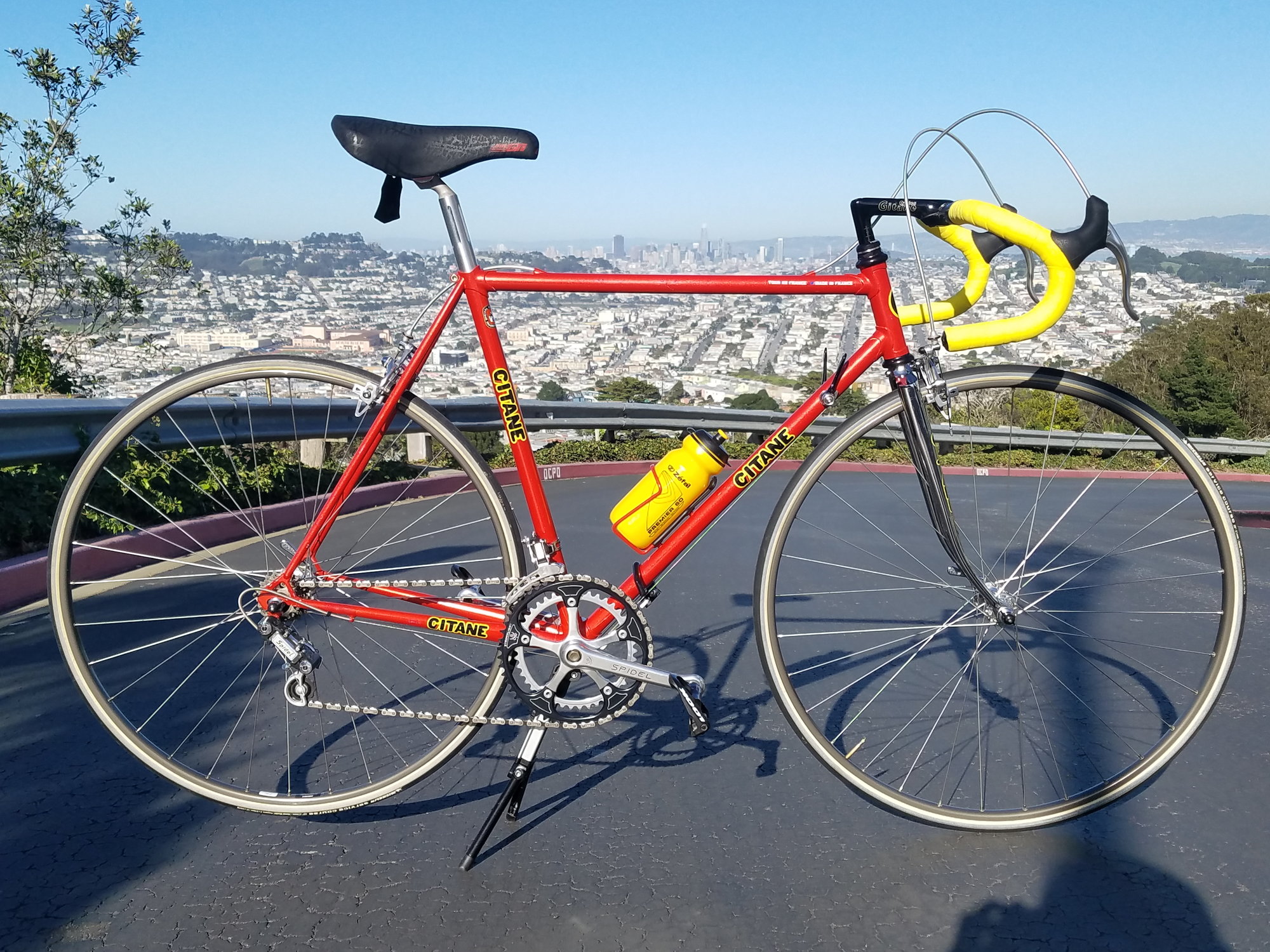
Fork legs do not change in design as size goes up.
__________________
72 Line Seeker
83 Davidson Signature
84 Peugeot PSV
84 Peugeot PY10FC
84 Gitane Tour de France.
85 Vitus Plus Carbone 7
86 ALAN Record Carbonio
86 Medici Aerodynamic (Project)
88 Pinarello Montello
89 Bottecchia Professional Chorus SL
95 Trek 5500 OCLV (Project)
72 Line Seeker
83 Davidson Signature
84 Peugeot PSV
84 Peugeot PY10FC
84 Gitane Tour de France.
85 Vitus Plus Carbone 7
86 ALAN Record Carbonio
86 Medici Aerodynamic (Project)
88 Pinarello Montello
89 Bottecchia Professional Chorus SL
95 Trek 5500 OCLV (Project)
Last edited by Chombi1; 01-27-19 at 10:28 PM.