


when did gears become evil?
 07-12-09 | 05:00 PM
#76

Senior Member
Joined: Sep 2007
Posts: 4,466
Likes: 24
From: Scottsdale, AZ
Bikes: many
So how do we explain that many of the bikes in the early 20th century were fixed or single speed bikes of one form or another? These weren't designed for track racing but riding in general.
Yes many bike manufacturers in the early years produced fixed axle bikes but I sure it was more of a matter of economics as it is cheaper to produce a fixed versus geared bike. As the consumers disposable income increased so did the desire for better equipped, easier to ride bikes. With the advent of efficient production methods and improved designs fixed gear was relegated to competition use primarily..Yes individual use such as messenger services continued but it really has not been but for the recent past the upsurge in fixed axle a desired form.
From what I have read in various sources this seems to be the common perception.
Frankly I could care less what other people are riding. Don't like it, don't ride it.
Well as you can see in my previous posts I believe it's a safety issue as much as a personal choice. similar to riding without a helmet. Some places require it and some don't. Is there a correct opinion? Probably not but it does elicit conversation..does it not?
Yes many bike manufacturers in the early years produced fixed axle bikes but I sure it was more of a matter of economics as it is cheaper to produce a fixed versus geared bike. As the consumers disposable income increased so did the desire for better equipped, easier to ride bikes. With the advent of efficient production methods and improved designs fixed gear was relegated to competition use primarily..Yes individual use such as messenger services continued but it really has not been but for the recent past the upsurge in fixed axle a desired form.
From what I have read in various sources this seems to be the common perception.
Frankly I could care less what other people are riding. Don't like it, don't ride it.
Well as you can see in my previous posts I believe it's a safety issue as much as a personal choice. similar to riding without a helmet. Some places require it and some don't. Is there a correct opinion? Probably not but it does elicit conversation..does it not?
 07-12-09 | 05:03 PM
#77

soonerbills
Joined: Feb 2008
Posts: 935
Likes: 0
From: Okieland
Bikes: 25 at last count. One day I'll make a list
So are you contradicting your original statement that fixed gear was only designed for highly trained professionals on a closed track?
On retrospect I suppose so but only to a degree. I have yet meet any one who rode bikes in the 1920's
so I will only assume they were very happy to get some gears. As well In my youth and for most of my adult life fixed gear bikes were track purpose bikes or utilitarian items...not percieved as everyday machines...but things change.
And as I said before this is mostly my opinion and other obviously will do as they wish so Godspeed to them and I hope they stay healthy!
On retrospect I suppose so but only to a degree. I have yet meet any one who rode bikes in the 1920's
so I will only assume they were very happy to get some gears. As well In my youth and for most of my adult life fixed gear bikes were track purpose bikes or utilitarian items...not percieved as everyday machines...but things change.
And as I said before this is mostly my opinion and other obviously will do as they wish so Godspeed to them and I hope they stay healthy!
07-12-09 | 05:09 PM
#78
soonerbills
Joined: Feb 2008
Posts: 935
Likes: 0
From: Okieland
Bikes: 25 at last count. One day I'll make a list
Sorry, but this is just a superficial analysis that you made up. Right?
Not really, it's more of a anecdotal opinion based on 2nd hand knowledge gained by reading various items over the years...
But if you would like to shred it you are more than welcome.
Not really, it's more of a anecdotal opinion based on 2nd hand knowledge gained by reading various items over the years...
But if you would like to shred it you are more than welcome.
07-12-09 | 07:51 PM
#79

Senior Member
Joined: Mar 2008
Posts: 5,630
Likes: 18
From: Rhode Island (an obscure suburb of Connecticut)
Bikes: one of each
I live in the hills. I'm a fixed chicken, I'd never ride with out a brake, that's just Darwinism waiting to happen. BUT I do like trying to go slow down a steep hill. It works a whole different set of muscles. Eventually I get to the stop sign at the bottom of my hill and there's no way you'd be able to stop without a handbrake.
Here's my latest victim, by the way. It's a Phillips, I replaced my Raleigh Sport with it because I figured a fixy aught to be black, not green. That and the Raleigh was worth more so I came out ahead money wise.
I've hauled the dremel out to the garage a couple of times now but I still can't find that derrailler hanger. Can anyone tell me where to find it?
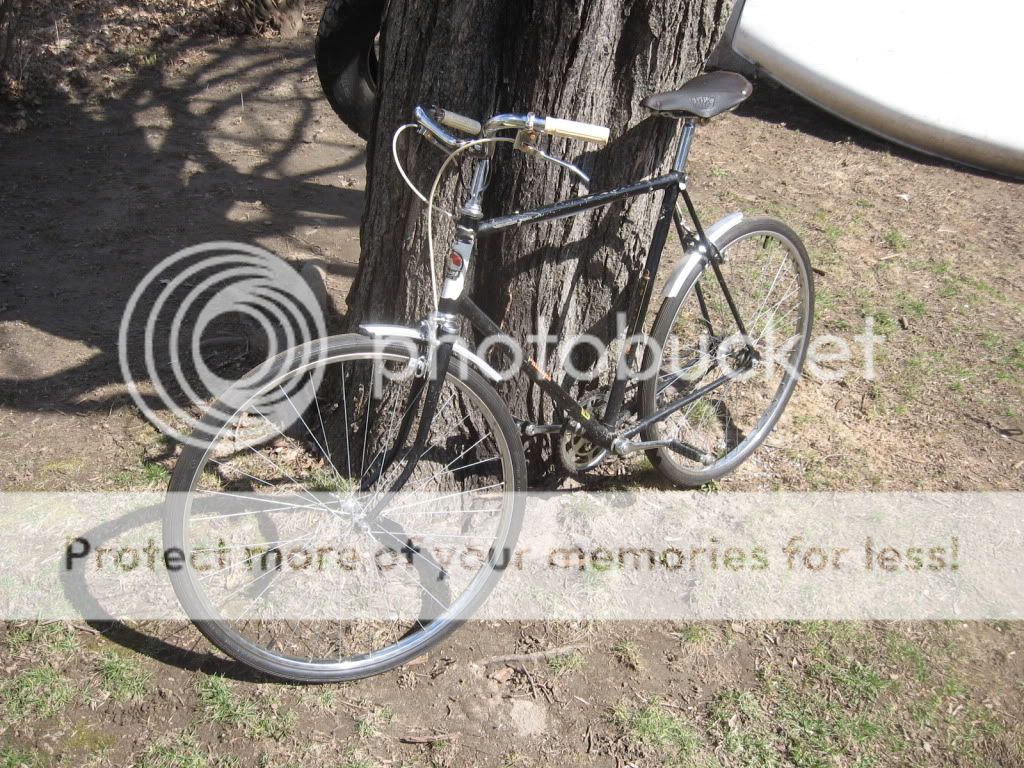
Here's my latest victim, by the way. It's a Phillips, I replaced my Raleigh Sport with it because I figured a fixy aught to be black, not green. That and the Raleigh was worth more so I came out ahead money wise.
I've hauled the dremel out to the garage a couple of times now but I still can't find that derrailler hanger. Can anyone tell me where to find it?
07-12-09 | 10:36 PM
#80
Thread Starter
Registered User
Joined: Jul 2008
Posts: 386
Likes: 0
From: Methuen, MA
Bikes: Armstrong, Robin Hood, Hercules, Phillips
EG-So are we supposed to leave the bikes 100% as they were intended? No swapping parts and components for comfort? Or usability? I love bikes for what they are: efficient, economic transportation that can easily be adapted for specific needs. If a fixed gear meets that for someone, more power to them.
if you are going to relist the bike back on Craigs List? you bet your ass.
you want to take your gears off for comfort fine.
but if you are done with the bike, put them back.
there are so damn many vintage fixies on CL right now,
i can't help thinking that the bikes are just being stripped for their parts
and these 'fixies' are actually just someone's leftovers being sold as something trendy.
07-12-09 | 10:39 PM
#81
Gear Hub fan
Joined: Nov 2008
Posts: 2,829
Likes: 2
From: Reno, NV
Bikes: Civia Hyland Rohloff, Swobo Dixon, Colnago, Univega
For the history buffs.
From the 1860s to about 1900 virtually all bikes were fixed gear. This included both high wheelers and "Safety" bicycles which started taking over from them about 1885. Early riders had no choice it was pretty much either a fixed gear bike or nothing.
Both the modern freewheel and coaster brake were developed in the 1898 to 1900 period. They took over on the road bike fairly rapidly. The SA three speed hub was introduced in 1902 and was a rapid success. Most people who could afford it found that they liked freewheels and gears. They made the bike both easier to ride and more versatile, capable of handling more varied terrain.
In France they chose to go with the derailleur drivetrain. Early versions go back to the start of the 20th century though most of the development took place in the period between the two world wars. Many varied gear train designs are very thoroughly covered in Frank Berto's book "The Dancing Chain". IMO the third edition is excellent for those interested in this area of bike history.
Now the speculation:
The recent revival in FG popularity for road use is definitely a retro step. As it followed the development of indexed shifting by some years I wonder personally if there is a connection. Presumably not true of this group but how much of the attraction of fixed gear and single speed bikes is the inability of many bicyclists to keep a indexed shifting derailleur gear train in proper adjustment? A friction shifting gear train could be shifted by ear and fine tuned to run quietly but a indexed gear train that is a bit out of adjustment can be a PITA to a rider not familiar with adjustment.
I had a friend over yesterday and I helped him install a rack, adjusted his front wheel bearings and showed him how to touch up rear derailleur shifting adjustment when the shifting started getting poor. The front wheel bearings were so loose that the wheel had almost 1/4" play at the rim. The dealer who had installed new tires on the bike (a Trek MTB) had not even taken the time to adjust it or mention the need for adjustment.
More and more of the public it seems to me are not mechanically knowledgeable at all. Being able to adjust and fix things seems to be a dying art in America. Is this part of the popularity of FG and SS bikes, minimum adjustments needed?
From the 1860s to about 1900 virtually all bikes were fixed gear. This included both high wheelers and "Safety" bicycles which started taking over from them about 1885. Early riders had no choice it was pretty much either a fixed gear bike or nothing.
Both the modern freewheel and coaster brake were developed in the 1898 to 1900 period. They took over on the road bike fairly rapidly. The SA three speed hub was introduced in 1902 and was a rapid success. Most people who could afford it found that they liked freewheels and gears. They made the bike both easier to ride and more versatile, capable of handling more varied terrain.
In France they chose to go with the derailleur drivetrain. Early versions go back to the start of the 20th century though most of the development took place in the period between the two world wars. Many varied gear train designs are very thoroughly covered in Frank Berto's book "The Dancing Chain". IMO the third edition is excellent for those interested in this area of bike history.
Now the speculation:
The recent revival in FG popularity for road use is definitely a retro step. As it followed the development of indexed shifting by some years I wonder personally if there is a connection. Presumably not true of this group but how much of the attraction of fixed gear and single speed bikes is the inability of many bicyclists to keep a indexed shifting derailleur gear train in proper adjustment? A friction shifting gear train could be shifted by ear and fine tuned to run quietly but a indexed gear train that is a bit out of adjustment can be a PITA to a rider not familiar with adjustment.
I had a friend over yesterday and I helped him install a rack, adjusted his front wheel bearings and showed him how to touch up rear derailleur shifting adjustment when the shifting started getting poor. The front wheel bearings were so loose that the wheel had almost 1/4" play at the rim. The dealer who had installed new tires on the bike (a Trek MTB) had not even taken the time to adjust it or mention the need for adjustment.
More and more of the public it seems to me are not mechanically knowledgeable at all. Being able to adjust and fix things seems to be a dying art in America. Is this part of the popularity of FG and SS bikes, minimum adjustments needed?
__________________
Gear Hubs Owned: Rohloff disc brake, SRAM iM9 disc brake, SRAM P5 freewheel, Sachs Torpedo 3 speed freewheel, NuVinci CVT, Shimano Alfine SG S-501, Sturmey Archer S5-2 Alloy. Other: 83 Colnago Super Record, Univega Via De Oro
Visit and join the Yahoo Geared Hub Bikes group for support and links.
https://groups.yahoo.com/group/Geared_hub_bikes/
Gear Hubs Owned: Rohloff disc brake, SRAM iM9 disc brake, SRAM P5 freewheel, Sachs Torpedo 3 speed freewheel, NuVinci CVT, Shimano Alfine SG S-501, Sturmey Archer S5-2 Alloy. Other: 83 Colnago Super Record, Univega Via De Oro
Visit and join the Yahoo Geared Hub Bikes group for support and links.
https://groups.yahoo.com/group/Geared_hub_bikes/
07-13-09 | 02:33 AM
#82
Senior Member
Joined: Apr 2009
Posts: 1,511
Likes: 7
From: Boulder County, CO
Bikes: '92 22" Cannondale M2000, '92 Cannondale R1000 Tandem, another modern Canndondale tandem, Two Holy Grail '86 Cannondale ST800s 27" (68.5cm) Touring bike w/Superbe Pro components and Phil Wood hubs. A bunch of other 27" ST frames & bikes.
maybe someone can explain to me the obsession folks have to strip off their gears and turn beautiful bikes into mongrel 'fixies'?
what starts off as a well designed piece of machinery ends up as something akin to crippleware. I read CL listings for bikes that have been cannibalized in such a manner, i weep for the bike it used to be.
what starts off as a well designed piece of machinery ends up as something akin to crippleware. I read CL listings for bikes that have been cannibalized in such a manner, i weep for the bike it used to be.
The problem I have with fixies is that they are exactly the opposite. They are mindless hipster contrivances.
Seemingly every one has a vintage frame completely stripped and built back up with Surly hubs and Velocity Deep V rims.
What I really hate is the clone obsession with the keirin 'look'.
I own a bunch of bikes (tandems, mountain bikes, road single etc.) and I think each of these bikes have their place. The fixie is idiotic. Exactly the wrong gear ratio about exactly all the time...
Don't even get me started on what a fixie does to the meniscus in your knees...
Sheer idiocy.
This notion that the fixed is mechanically simpler is fringe at best. The hipster wannabe on his fixie doesn't ride it 'cause its simpler, they ride it because they think its hip.
It ain't hip if all the clones are doing it...
07-13-09 | 02:56 AM
#83

Bicycle Repair Man !!!
Joined: Sep 2007
Posts: 27,266
Likes: 152
From: YEG
Bikes: See my sig...
One of the things I love about classic and vintage bikes is the opportunity to find a bike that reflects your tastes as a cyclist. You can find a replica team bike of your favorite historical pro cyclist and ride what 'they rode' in a Gran tour. Try that with a F1 race car driver...
The problem I have with fixies is that they are exactly the opposite. They are mindless hipster contrivances.
Seemingly every one has a vintage frame completely stripped and built back up with Surly hubs and Velocity Deep V rims.
What I really hate is the clone obsession with the keirin 'look'.
I own a bunch of bikes (tandems, mountain bikes, road single etc.) and I think each of these bikes have their place. The fixie is idiotic. Exactly the wrong gear ratio about exactly all the time...
Don't even get me started on what a fixie does to the meniscus in your knees...
Sheer idiocy.
This notion that the fixed is mechanically simpler is fringe at best. The hipster wannabe on his fixie doesn't ride it 'cause its simpler, they ride it because they think its hip.
It ain't hip if all the clones are doing it...
The problem I have with fixies is that they are exactly the opposite. They are mindless hipster contrivances.
Seemingly every one has a vintage frame completely stripped and built back up with Surly hubs and Velocity Deep V rims.
What I really hate is the clone obsession with the keirin 'look'.
I own a bunch of bikes (tandems, mountain bikes, road single etc.) and I think each of these bikes have their place. The fixie is idiotic. Exactly the wrong gear ratio about exactly all the time...
Don't even get me started on what a fixie does to the meniscus in your knees...
Sheer idiocy.
This notion that the fixed is mechanically simpler is fringe at best. The hipster wannabe on his fixie doesn't ride it 'cause its simpler, they ride it because they think its hip.
It ain't hip if all the clones are doing it...
Tell me about this bike ?
Is it a conversion ?
Does it have deep V's ?
Do my knees hurt ?
 07-13-09 | 05:33 AM
#84
Peace, Love, Bikes
Joined: Sep 2006
Posts: 900
Likes: 1
From: Central Ohio
Bikes: Schwinn Le Tour III
if you are going to relist the bike back on Craigs List? you bet your ass.
you want to take your gears off for comfort fine.
but if you are done with the bike, put them back.
there are so damn many vintage fixies on CL right now,
i can't help thinking that the bikes are just being stripped for their parts
and these 'fixies' are actually just someone's leftovers being sold as something trendy.
you want to take your gears off for comfort fine.
but if you are done with the bike, put them back.
there are so damn many vintage fixies on CL right now,
i can't help thinking that the bikes are just being stripped for their parts
and these 'fixies' are actually just someone's leftovers being sold as something trendy.
As long as people are riding, who cares?
07-13-09 | 10:25 AM
#85

aka Tom Reingold


Joined: Jan 2009
Posts: 44,320
Likes: 6,606
From: New York, NY, and High Falls, NY, USA
Bikes: 1962 Rudge Sports, 1971 Raleigh Super Course, 1971 Raleigh Pro Track, 1974 Raleigh International, 1975 Viscount Fixie, 1982 McLean, 1996 Lemond (Ti), 2002 Burley Zydeco tandem
If you can't lick 'em, join 'em. I don't understand why people can charge so much for ladies' shoes or for computer cables. To me, it means I'm the stupid one, not the customers and certainly not the sellers. It means I'm in the wrong business.
__________________
Tom Reingold, tom@noglider.com
New York City and High Falls, NY
Blogs: The Experienced Cyclist; noglider's ride blog
“When man invented the bicycle he reached the peak of his attainments.” — Elizabeth West, US author
Please email me rather than PM'ing me. Thanks.
Tom Reingold, tom@noglider.com
New York City and High Falls, NY
Blogs: The Experienced Cyclist; noglider's ride blog
“When man invented the bicycle he reached the peak of his attainments.” — Elizabeth West, US author
Please email me rather than PM'ing me. Thanks.
07-13-09 | 11:13 AM
#86

Pug lover! Dogs and bikes
Joined: Sep 2008
Posts: 1,161
Likes: 1
From: San Jose, CA
I find the fixed gear = hipster argument a bit tiresome. That's like automatically equating that all those who ride C&V are old. It just isn't true. The fixed gear crowd is quite varied just like any other. You only get to see this once you get rid of that image you have stuck in your head of what you think a fixed gear rider should look like.
07-13-09 | 11:22 AM
#87

If I'm in the "wrong" gear on my track bike I either speed up or slow down until I'm in the "right" gear.
My knees are fine, thanks.
My knees are fine, thanks.
__________________
1989 Schwinn Paramount OS
1980 Mclean/Silk Hope Sport Touring
1983 Bianchi pista
1976 Fuji Feather track
1979 raleigh track
"I've consulted my sources and I'm pretty sure your derailleur does not exist"
1989 Schwinn Paramount OS
1980 Mclean/Silk Hope Sport Touring
1983 Bianchi pista
1976 Fuji Feather track
1979 raleigh track
"I've consulted my sources and I'm pretty sure your derailleur does not exist"
07-13-09 | 11:26 AM
#88
aka Tom Reingold
Joined: Jan 2009
Posts: 44,320
Likes: 6,606
From: New York, NY, and High Falls, NY, USA
Bikes: 1962 Rudge Sports, 1971 Raleigh Super Course, 1971 Raleigh Pro Track, 1974 Raleigh International, 1975 Viscount Fixie, 1982 McLean, 1996 Lemond (Ti), 2002 Burley Zydeco tandem
I find the fixed gear = hipster argument a bit tiresome. That's like automatically equating that all those who ride C&V are old. It just isn't true. The fixed gear crowd is quite varied just like any other. You only get to see this once you get rid of that image you have stuck in your head of what you think a fixed gear rider should look like.
Fixed gear is a trend, fad, whatever you call it. But that's not necessarily bad. Hipster is being used as a derogatory term. What's wrong with staying in style? Everything you do, whether you mean it to or not, makes a statement. Some want to say they're hip. Some want to say they're not hip, i.e. they are reverse snobs. So?
Even if someone rides a fixed gear because it's fashionable, the person might also like some of the advantages of riding fixed. As someone pointed out, you work some muscle groups riding fixed that get no workout at all on a freewheel.
__________________
Tom Reingold, tom@noglider.com
New York City and High Falls, NY
Blogs: The Experienced Cyclist; noglider's ride blog
“When man invented the bicycle he reached the peak of his attainments.” — Elizabeth West, US author
Please email me rather than PM'ing me. Thanks.
Tom Reingold, tom@noglider.com
New York City and High Falls, NY
Blogs: The Experienced Cyclist; noglider's ride blog
“When man invented the bicycle he reached the peak of his attainments.” — Elizabeth West, US author
Please email me rather than PM'ing me. Thanks.
07-13-09 | 11:37 AM
#89
Pug lover! Dogs and bikes
Joined: Sep 2008
Posts: 1,161
Likes: 1
From: San Jose, CA
For the history buffs.
From the 1860s to about 1900 virtually all bikes were fixed gear. This included both high wheelers and "Safety" bicycles which started taking over from them about 1885. Early riders had no choice it was pretty much either a fixed gear bike or nothing.
Both the modern freewheel and coaster brake were developed in the 1898 to 1900 period. They took over on the road bike fairly rapidly. The SA three speed hub was introduced in 1902 and was a rapid success. Most people who could afford it found that they liked freewheels and gears. They made the bike both easier to ride and more versatile, capable of handling more varied terrain.
In France they chose to go with the derailleur drivetrain. Early versions go back to the start of the 20th century though most of the development took place in the period between the two world wars. Many varied gear train designs are very thoroughly covered in Frank Berto's book "The Dancing Chain". IMO the third edition is excellent for those interested in this area of bike history.
Now the speculation:
The recent revival in FG popularity for road use is definitely a retro step. As it followed the development of indexed shifting by some years I wonder personally if there is a connection. Presumably not true of this group but how much of the attraction of fixed gear and single speed bikes is the inability of many bicyclists to keep a indexed shifting derailleur gear train in proper adjustment? A friction shifting gear train could be shifted by ear and fine tuned to run quietly but a indexed gear train that is a bit out of adjustment can be a PITA to a rider not familiar with adjustment.
I had a friend over yesterday and I helped him install a rack, adjusted his front wheel bearings and showed him how to touch up rear derailleur shifting adjustment when the shifting started getting poor. The front wheel bearings were so loose that the wheel had almost 1/4" play at the rim. The dealer who had installed new tires on the bike (a Trek MTB) had not even taken the time to adjust it or mention the need for adjustment.
More and more of the public it seems to me are not mechanically knowledgeable at all. Being able to adjust and fix things seems to be a dying art in America. Is this part of the popularity of FG and SS bikes, minimum adjustments needed?
From the 1860s to about 1900 virtually all bikes were fixed gear. This included both high wheelers and "Safety" bicycles which started taking over from them about 1885. Early riders had no choice it was pretty much either a fixed gear bike or nothing.
Both the modern freewheel and coaster brake were developed in the 1898 to 1900 period. They took over on the road bike fairly rapidly. The SA three speed hub was introduced in 1902 and was a rapid success. Most people who could afford it found that they liked freewheels and gears. They made the bike both easier to ride and more versatile, capable of handling more varied terrain.
In France they chose to go with the derailleur drivetrain. Early versions go back to the start of the 20th century though most of the development took place in the period between the two world wars. Many varied gear train designs are very thoroughly covered in Frank Berto's book "The Dancing Chain". IMO the third edition is excellent for those interested in this area of bike history.
Now the speculation:
The recent revival in FG popularity for road use is definitely a retro step. As it followed the development of indexed shifting by some years I wonder personally if there is a connection. Presumably not true of this group but how much of the attraction of fixed gear and single speed bikes is the inability of many bicyclists to keep a indexed shifting derailleur gear train in proper adjustment? A friction shifting gear train could be shifted by ear and fine tuned to run quietly but a indexed gear train that is a bit out of adjustment can be a PITA to a rider not familiar with adjustment.
I had a friend over yesterday and I helped him install a rack, adjusted his front wheel bearings and showed him how to touch up rear derailleur shifting adjustment when the shifting started getting poor. The front wheel bearings were so loose that the wheel had almost 1/4" play at the rim. The dealer who had installed new tires on the bike (a Trek MTB) had not even taken the time to adjust it or mention the need for adjustment.
More and more of the public it seems to me are not mechanically knowledgeable at all. Being able to adjust and fix things seems to be a dying art in America. Is this part of the popularity of FG and SS bikes, minimum adjustments needed?
tatfiend, I think you make an interesting point which I agree with. One draw of fixed gear bikes is the simplicity of getting started and maintaining the bike. For someone on a budget you can pick up any old frame with desirable dropouts, change the rear wheel to a track wheel + lock ring/cog and you're pretty much done. You have very little maintain.
I'll be first to admit that learning about road bikes with dérailleurs, extra cables (that fixed does not require), shifting, etc. is all a bit overwhelming without prior knowledge of how things work. I was in this same situation not long ago. I rode fixed gear, have always loved C&V, and finally learned about road bike and was able to put together my first C&V bike. It definitely takes time to learn and some people just want something simple to get up and ride like a single speed or fixed gear. Furthermore, not everyone thinks about taking advantage of all the knowledge this forum has. I'm quite thankful for this forum and it's members because without this resource I really don't know if I would have continued learning about bike maintenance and C&V.
However, single speed and fixed gear is definitely a gateway to other forms of cycling. I have many friends who love fixed gear, but want to get started on road bikes since they've seen how much I love my Peugeot.
Is the rising popularity of fixed gear bikes a bad thing? I really don't think so. Many people, including myself, got back into the saddle because of the interest in fixed gear riding. This can lead to interest in other forms of riding like C&V, road, etc. If it gets people up and on a bike it's a good thing.
07-13-09 | 11:42 AM
#90

www.theheadbadge.com

Joined: Sep 2005
Posts: 29,025
Likes: 5,537
From: Southern Florida
Bikes: https://www.theheadbadge.com

 07-13-09 | 11:47 AM
#92
Pug lover! Dogs and bikes
Joined: Sep 2008
Posts: 1,161
Likes: 1
From: San Jose, CA
One thing I have been noticing though (at least in my area) is the increasing choices for fixed gear riders when it comes to frames. I still see conversions, but definitely not as many as before. Probably stems from people now understanding track geometry vs touring or road. More and more people are opting for new steel track frames instead of converting C&V road bikes.
07-13-09 | 12:19 PM
#93

Senior Member
Joined: Oct 2004
Posts: 2,947
Likes: 1
From: Absecon, NJ
Bikes: Puch Luzern, Puch Mistral SLE, Bianchi Pista, Motobecane Grand Touring, Austro-Daimler Ultima, Legnano, Raleigh MountainTour, Cannondale SM600
I disagree completely. It's exactly the reason many choose fixed gear for commuting. Ever have a freehub freeze up on you in the winter? I have. It sucks.
07-13-09 | 12:42 PM
#94

Senior Member
Joined: Jul 2002
Posts: 40,863
Likes: 3,116
From: Sacramento, California, USA
Bikes: Specialized Tarmac, Canyon Exceed, Specialized Transition, Ellsworth Roots, Ridley Excalibur
One of the things I love about classic and vintage bikes is the opportunity to find a bike that reflects your tastes as a cyclist. You can find a replica team bike of your favorite historical pro cyclist and ride what 'they rode' in a Gran tour. Try that with a F1 race car driver...
The problem I have with fixies is that they are exactly the opposite. They are mindless hipster contrivances.
Seemingly every one has a vintage frame completely stripped and built back up with Surly hubs and Velocity Deep V rims.
What I really hate is the clone obsession with the keirin 'look'.
I own a bunch of bikes (tandems, mountain bikes, road single etc.) and I think each of these bikes have their place. The fixie is idiotic. Exactly the wrong gear ratio about exactly all the time...
Don't even get me started on what a fixie does to the meniscus in your knees...
Sheer idiocy.
This notion that the fixed is mechanically simpler is fringe at best. The hipster wannabe on his fixie doesn't ride it 'cause its simpler, they ride it because they think its hip.
It ain't hip if all the clones are doing it...
The problem I have with fixies is that they are exactly the opposite. They are mindless hipster contrivances.
Seemingly every one has a vintage frame completely stripped and built back up with Surly hubs and Velocity Deep V rims.
What I really hate is the clone obsession with the keirin 'look'.
I own a bunch of bikes (tandems, mountain bikes, road single etc.) and I think each of these bikes have their place. The fixie is idiotic. Exactly the wrong gear ratio about exactly all the time...
Don't even get me started on what a fixie does to the meniscus in your knees...
Sheer idiocy.
This notion that the fixed is mechanically simpler is fringe at best. The hipster wannabe on his fixie doesn't ride it 'cause its simpler, they ride it because they think its hip.
It ain't hip if all the clones are doing it...
I disagree with so much of your post, but others have addressed those points. But you are correct that the fixed gear is almost always in the wrong gear. But you're incorrect that it makes the fixed gear idiotic. On the contrary, it's what makes the fixed gear brilliant.
Going uphill or into a headwind, the gear is likely too high, thus forcing you to turn the cranks at low cadence with high power, and you gain strength. Going downhill or with a tailwind, the gear is likely too low, thus forcing you to turn the cranks with a high cadence, and you gain suppleness. The net result is to widen your powerband. I've noticed the improvement in race situations, but increased power and suppleness can help any rider, racer or recreational.
07-13-09 | 12:58 PM
#95

Sturmey Archer Hub
Joined: Aug 2005
Posts: 2,683
Likes: 1,997
From: New England
Bikes: Old Schwinns and old Raleighs
Yes, it's a shame when people "mess up" a vintage bicycle. I don't agree with doing that in the sense that I wouldn't do it to my own. But it's their property. If you meltdown or go "holier than thou" every time someone else did something stupid, you'd spend your whole life that way. It's just not worth it in the scheme of life.
__________________
Classic American and British Roadsters, Utility Bikes, and Sporting Bikes (1935-1979): HERE
Classic American and British Roadsters, Utility Bikes, and Sporting Bikes (1935-1979): HERE
07-13-09 | 01:15 PM
#96

Senior Member
Joined: Oct 2004
Posts: 2,124
Likes: 2
From: NYC
Bikes: All 70s and 80s, only steel.
While the ease of maintaining a fixed gear bike is cited as a plus by many, I'd venture to guess one of the things that draws people to them in the first place is the idea of converting the bike. I just finished helping a third friend who started w/ a Schwinn Varsity he bought off some kids on the street, began tinkering on the brakes, and just recently finished his own one-speed Pug conversion. The initial intrigue of figuring out how these things work is facilitated by the idea of doing a conversion. I know that started my fascination, and I know a lot of other people who got back into bikes via this route.
07-13-09 | 01:15 PM
#97
Pug lover! Dogs and bikes
Joined: Sep 2008
Posts: 1,161
Likes: 1
From: San Jose, CA
I disagree with so much of your post, but others have addressed those points. But you are correct that the fixed gear is almost always in the wrong gear. But you're incorrect that it makes the fixed gear idiotic. On the contrary, it's what makes the fixed gear brilliant.
Going uphill or into a headwind, the gear is likely too high, thus forcing you to turn the cranks at low cadence with high power, and you gain strength. Going downhill or with a tailwind, the gear is likely too low, thus forcing you to turn the cranks with a high cadence, and you gain suppleness. The net result is to widen your powerband. I've noticed the improvement in race situations, but increased power and suppleness can help any rider, racer or recreational.
Going uphill or into a headwind, the gear is likely too high, thus forcing you to turn the cranks at low cadence with high power, and you gain strength. Going downhill or with a tailwind, the gear is likely too low, thus forcing you to turn the cranks with a high cadence, and you gain suppleness. The net result is to widen your powerband. I've noticed the improvement in race situations, but increased power and suppleness can help any rider, racer or recreational.
I really don't see a good or bad here. Both styles of riding have their place. However, destroying frames for aesthetics... Well I personally don't agree and I'll just leave it at that.
07-13-09 | 01:24 PM
#98
Senior Member
Joined: Sep 2008
Posts: 342
Likes: 0
Yes I have done a bit of riding fixed style and I do understand about the simplicity of the mechanics as well as the feeling of enhanced connection with the bike. But still I find the value of these attributes to small compared to the loss of true control over the machine during real world use.
I know your going to try to explain that because of the direct connection effect you actually have more control but it is my belief that very few people are skilled enough of a rider to be able to maintain control in emergency situations. Maybe you are skilled enough but is the average rider? I think not.
These bikes were designed to be ridden on a closed track by professional riders who would be capable of slowing and stopping the bike in a capable manner.
A perfect example of the danger of fixies in traffic is what I observed while in downtown Tulsa a while back. I was behind a truck at a red light, a rider on a fixie was coming down a incline street towards the light when the light changed. The truck started to move into the intersection before the rider started to slow, unfortunatly he lost grip on his pedals and had to make a panic pull on the only brake which was the front and he subsequently flipped the bike. thank god the truck driver did see him and was able to stop averting a real tragedy. The rider ended up with only scrapes but it could have been a real mess.
Could a more competent or alert rider avoided the incident all together? Probably. But I shudder to think of how many other people are out there riding bikes that are not,were not and never were made to be in traffic and don't have the skills needed to ride that bike safely.
I hope I never have to see a incident like that again.
I know your going to try to explain that because of the direct connection effect you actually have more control but it is my belief that very few people are skilled enough of a rider to be able to maintain control in emergency situations. Maybe you are skilled enough but is the average rider? I think not.
These bikes were designed to be ridden on a closed track by professional riders who would be capable of slowing and stopping the bike in a capable manner.
A perfect example of the danger of fixies in traffic is what I observed while in downtown Tulsa a while back. I was behind a truck at a red light, a rider on a fixie was coming down a incline street towards the light when the light changed. The truck started to move into the intersection before the rider started to slow, unfortunatly he lost grip on his pedals and had to make a panic pull on the only brake which was the front and he subsequently flipped the bike. thank god the truck driver did see him and was able to stop averting a real tragedy. The rider ended up with only scrapes but it could have been a real mess.
Could a more competent or alert rider avoided the incident all together? Probably. But I shudder to think of how many other people are out there riding bikes that are not,were not and never were made to be in traffic and don't have the skills needed to ride that bike safely.
I hope I never have to see a incident like that again.
As for other safety concerns, I actually feel safer riding my fixed gear bike (with brakes) in NYC traffic than I do on my geared bikes. I don't hit as high a top speed, I'm not distracted by shifting, and after many miles on the same fixed ratio I feel more intuitively connected to my speed and the available traction in that gear. It's one of the reasons I find myself using the fixed bike when I'm commuting or running errands in traffic. Longer higher speed rides on bikes trails or in the parks are the only time I grab a bike with gears these days. Brifters help though. I don't really like riding my vintage bike with downtube shifters in traffic as I like to keep both hands on the bars and/or near the brakes.
Last edited by palladio; 07-13-09 at 01:30 PM.
07-13-09 | 02:02 PM
#99
Senior Member
Joined: Jul 2005
Posts: 2,308
Likes: 16
I live in the hills. I'm a fixed chicken, I'd never ride with out a brake, that's just Darwinism waiting to happen. BUT I do like trying to go slow down a steep hill. It works a whole different set of muscles. Eventually I get to the stop sign at the bottom of my hill and there's no way you'd be able to stop without a handbrake.
Here's my latest victim, by the way. It's a Phillips, I replaced my Raleigh Sport with it because I figured a fixy aught to be black, not green. That and the Raleigh was worth more so I came out ahead money wise.
I've hauled the dremel out to the garage a couple of times now but I still can't find that derrailler hanger. Can anyone tell me where to find it?
Here's my latest victim, by the way. It's a Phillips, I replaced my Raleigh Sport with it because I figured a fixy aught to be black, not green. That and the Raleigh was worth more so I came out ahead money wise.
I've hauled the dremel out to the garage a couple of times now but I still can't find that derrailler hanger. Can anyone tell me where to find it?
07-13-09 | 02:23 PM
#100
Senior Member
Joined: Jul 2005
Posts: 2,308
Likes: 16
Yikes. This is turning C&V into emotional hamburger.
Somehow this turned into a conversation about whether riding fixed has any merits. Plainly this is a matter of preference and fad. Single speed is also attractive to many, as someone pointed out, because they never shift gears on their geared bikes anyway.
I volunteer at the bike coop, and I get people--mostly college students--coming in all the time with some problem or other, and I end up helping them fix some things that they didn't know were broken/dangerous. Often I start to check the shifting, and I point out that the cable is rusted solid or something. I can't tell you how often they reply: "Oh, I don't ever mess with that. I don't even really know what it does." People are just ignorant about how bikes work. Ignorance is a breeding ground for single speeding/fixing.
However, I think that EraserGirl's point was the preservation of geared vintage bikes. I, too, feel sad when I see them at the bike coop stripping the original components off of a bike. Lots of perfectly good equipment just gets trashed in the process. People are ignorant about the heritage of this stuff. Yes, it's plentiful, but not as much as it used to be. They're really not mass manufacturing good quality bike components like they used to -- at least, not components with the old-time elegance found even in the bike boom.
Pretty soon, you'll go to the box of stems at the bike coop, looking for a graceful forged aluminum stem from the seventies, and all there will be are crap welded steel mountain bike stems from China.
The fixie trend, with its blithe contempt for the material heritage of our culture, accelerates the disintegration of artifacts that embodied an elegance that is valued no more.
I'm sure the Buddha would say that what attachment gets you: suffering.
Somehow this turned into a conversation about whether riding fixed has any merits. Plainly this is a matter of preference and fad. Single speed is also attractive to many, as someone pointed out, because they never shift gears on their geared bikes anyway.
I volunteer at the bike coop, and I get people--mostly college students--coming in all the time with some problem or other, and I end up helping them fix some things that they didn't know were broken/dangerous. Often I start to check the shifting, and I point out that the cable is rusted solid or something. I can't tell you how often they reply: "Oh, I don't ever mess with that. I don't even really know what it does." People are just ignorant about how bikes work. Ignorance is a breeding ground for single speeding/fixing.
However, I think that EraserGirl's point was the preservation of geared vintage bikes. I, too, feel sad when I see them at the bike coop stripping the original components off of a bike. Lots of perfectly good equipment just gets trashed in the process. People are ignorant about the heritage of this stuff. Yes, it's plentiful, but not as much as it used to be. They're really not mass manufacturing good quality bike components like they used to -- at least, not components with the old-time elegance found even in the bike boom.
Pretty soon, you'll go to the box of stems at the bike coop, looking for a graceful forged aluminum stem from the seventies, and all there will be are crap welded steel mountain bike stems from China.
The fixie trend, with its blithe contempt for the material heritage of our culture, accelerates the disintegration of artifacts that embodied an elegance that is valued no more.
I'm sure the Buddha would say that what attachment gets you: suffering.