


high flange vs low flange
 07-13-09 | 01:14 AM
#1
Thread Starter
vintage road bike addict
Joined: Oct 2008
Posts: 82
Likes: 0
From: san diego
high flange vs low flange
Hi guys.
Just wondering what is the reasoning for a high-flange vs a low-flange hub.
(and for that matter mid-flange hub)
I have a set of high-flange campy hubs for the campy bikes,
and the old sunshine high-flange front/ phil low-flange rear for japanese beater,
but just really like the looks of the large hubs.
I've been using a nice set of 90's phil hubs, more like a mid-flange hub than a low-flange, on my '73 lately,
and just started wondering what the benefits/drawbacks are.
Thanks guys.
TP
Just wondering what is the reasoning for a high-flange vs a low-flange hub.
(and for that matter mid-flange hub)
I have a set of high-flange campy hubs for the campy bikes,
and the old sunshine high-flange front/ phil low-flange rear for japanese beater,
but just really like the looks of the large hubs.
I've been using a nice set of 90's phil hubs, more like a mid-flange hub than a low-flange, on my '73 lately,
and just started wondering what the benefits/drawbacks are.
Thanks guys.
TP
 07-13-09 | 02:15 AM
#2
Senior Member
Joined: Jun 2009
Posts: 332
Likes: 0
Originally Posted by Sheldon Brown
"High-flange" or "large-flange" hubs have a larger flange, usually drilled out for lightness. They transmit torsional forces with less stress to the spokes than small-flange hubs do, but this is not a problem in practice with modern equipment. High-flange hubs can make a wheel with slightly greater lateral strength than equivalent small-flange hubs, because the spokes create a wider bracing angle to the rim. This makes them popular with track sprinters, who create greater-than-normal side loads on their wheels.

The only drawback I can think of about a high-flange vs a low-flange, is the extra weight, if you're really all that worried about it.

 07-13-09 | 07:14 AM
#4
Senior Member
Joined: Jul 2007
Posts: 5,045
Likes: 16
From: Lancaster County, PA
Bikes: '39 Hobbs, '58 Marastoni, '73 Italian custom, '75 Wizard, '76 Wilier, '78 Tom Kellogg, '79 Colnago Super, '79 Sachs, '81 Masi Prestige, '82 Cuevas, '83 Picchio Special, '84 Murray-Serotta, '85 Trek 170, '89 Bianchi, '90 Bill Holland, '94 Grandis
High flange hubs were considered to be stiffer "back in the day." Some folks insist they can tell the difference; I can't, but I don't have a powerful riding style (understatement). If you look at old pics and video, you'll see that high flange hubs were often used for time trialing. In the Eddy era, you also tend to see them on French bikes, while Italian bikes usually have low-flange hubs (there was at least a perception among some racer types that Italian frames were stiffer than French ones).
07-13-09 | 09:19 AM
#5

PanGalacticGargleBlaster
Joined: Apr 2009
Posts: 7,531
Likes: 9
From: Smugglers Notch, Vermont
Bikes: Upright and Recumbent....too many to list, mostly Vintage.
i'd imagine that a low flange hub might weigh less than a high flange hub...less metal.
but +1 that high flange hubs look the best.
but +1 that high flange hubs look the best.
__________________
--Don't Panic.
--Don't Panic.
07-13-09 | 09:49 AM
#6

Senior Member

Joined: Aug 2006
Posts: 2,005
Likes: 54
From: Toronto, Ontario
The main reason I like high flange hubs is that when your riding and the sun is shining you can look down at the shadow of your bike and see the sun spinning through your hubs - it doesn't work with low flange.
07-13-09 | 10:11 AM
#7

Steel is real, baby!
Joined: Dec 2008
Posts: 2,532
Likes: 8
From: Boise, ID
Bikes: 1984 Pinarello, 1986 Bianchi Portofino, 1988 Bianchi Trofeo, 1989 Specialized Allez, 1989 Specialized Hard Rock, 2001 Litespeed Tuscany
I've always preferred the look of low flange, myself. But that's just me. Although, they do look nice if they are polished mirror bright!
But what others have said is right: High flange hubs reduced the length of the spokes, resulting in a stiffer wheel. They were mainly used for track bikes and tt-specific bikes, etc.
Craven: The hubs themselves weighed a tad more (if my old-fart memory is working correctly today), but the (less) weight of the shorter spokes offset it.
But what others have said is right: High flange hubs reduced the length of the spokes, resulting in a stiffer wheel. They were mainly used for track bikes and tt-specific bikes, etc.
Craven: The hubs themselves weighed a tad more (if my old-fart memory is working correctly today), but the (less) weight of the shorter spokes offset it.
07-13-09 | 08:00 PM
#9

Senior Member
Joined: Mar 2008
Posts: 5,630
Likes: 18
From: Rhode Island (an obscure suburb of Connecticut)
Bikes: one of each
The spoke holes area also further apart on a high flange hub. I don't recall seeing a flange crack between the spoke holes but I've seen plenty of other gadgets crack between fastner holes (Like wooden sailboats).
07-13-09 | 10:51 PM
#10
Senior Member

Joined: Aug 2005
Posts: 801
Likes: 29
From: Minneapolis, MN
Personally I prefer high flange. But they may not be Plan A for very high mileage riders.
A friend who is just a few months short of half a million miles has had 2 high flange Campi hubs fracture at the barrel due to increased flexing of the barrel caused by the increased leverage of the high flanges. The flex is tiny but aluminum has no fatigue limit so after several million cycles it can fail.
BTW the guy is a featherweight spinner and very easy on his equipment.
A friend who is just a few months short of half a million miles has had 2 high flange Campi hubs fracture at the barrel due to increased flexing of the barrel caused by the increased leverage of the high flanges. The flex is tiny but aluminum has no fatigue limit so after several million cycles it can fail.
BTW the guy is a featherweight spinner and very easy on his equipment.
 07-13-09 | 11:12 PM
#12

Insane Bicycle Mechanic


Joined: Mar 2008
Posts: 10,167
Likes: 1,134
From: other Vancouver
__________________
Jeff Wills
Comcast nuked my web page. It will return soon..
Jeff Wills
Comcast nuked my web page. It will return soon..
07-13-09 | 11:13 PM
#13

Fresh Garbage
Joined: Apr 2009
Posts: 13,190
Likes: 30
From: Los Angeles
Bikes: N+1
07-13-09 | 11:28 PM
#14
Senior Member
Joined: Jul 2005
Posts: 2,308
Likes: 16
Yah, you betcha:
https://home.comcast.net/~jeff_wills/...es/bike041.htm
https://home.comcast.net/~jeff_wills/...es/bike041.htm
07-14-09 | 12:35 PM
#15
Senior Member
Joined: Aug 2005
Posts: 801
Likes: 29
From: Minneapolis, MN
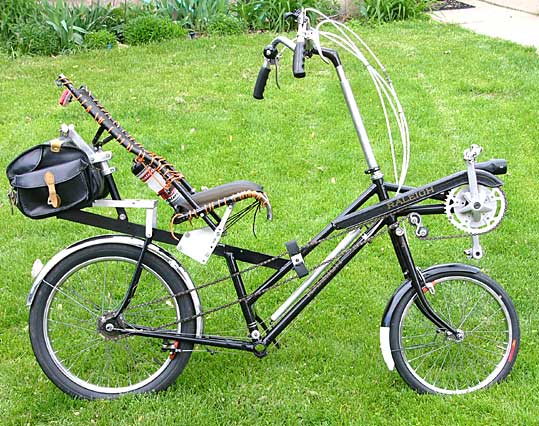
Frame is a '64 Raleigh Woman's Sport (slightly modified
 )
)Rear wheel and fender from a '72 Raleigh Twenty
Front wheel and fender from a '64 Moulton Deluxe
North Road handlebars are great for a bent as are the original Dare grips.
07-14-09 | 12:44 PM
#16

multimodal commuter
Joined: Nov 2006
Posts: 19,810
Likes: 597
From: NJ, NYC, LI
Bikes: 1940s Fothergill, 1959 Allegro Special, 1963? Claud Butler Olympic Sprint, Lambert 'Clubman', 1974 Fuji "the Ace", 1976 Holdsworth 650b conversion rando bike, 1983 Trek 720 tourer, 1984 Counterpoint Opus II, 1993 Basso Gap, 2010 Downtube 8h, and...
07-14-09 | 01:27 PM
#17

later 60's and 70's the pros migrated to low flange. And so did the market.
I have plenty of both, I really don't think there is much of a difference.
But if you want to be really cool, have a low flange front and a Hi-Lo rear. Allegedly for better spoke angle. But I just classify them as cool. In a very Euro-Asia Imports kind of way, as they imported 500 sets way back.
07-14-09 | 01:31 PM
#18
I will say around town lately I have seen some Cruiser type bikes with really huge alloy Hi flange hubs, look kind of AirLite with big holes in the flanges...36 spokes. I have not bothered to figure out how they can be obtained yet though.
07-14-09 | 07:36 PM
#19

Sheldon Brown suggested that the most practical wheelset might be low-flange front and high-flange rear. He also liked the 32F/40R British approach to spoke count. And he suggested that different width tires on front and rear was sensible, since they don't carry the same load, but (IIRC) ended by mentioning that he did have a bike with wider tire in front, because that absorbed more road shock!
07-14-09 | 09:05 PM
#20
Senior Member
Joined: Jul 2005
Posts: 2,308
Likes: 16
Ha! Mark--actually, after I posted in response to Jeff's bike, I thought about your Raleigh, which I remembered seeing here some time ago.
07-14-09 | 09:34 PM
#21

feros ferio

Joined: Jul 2000
Posts: 22,414
Likes: 1,880
From: www.ci.encinitas.ca.us
Bikes: 1959 Capo Modell Campagnolo; 1960 Capo Sieger (2); 1962 Carlton Franco Suisse; 1970 Peugeot UO-8; 1982 Bianchi Campione d'Italia; 1988 Schwinn Project KOM-10;
I once cracked a Shimano HF front hub at a spoke hole.
__________________
"Far and away the best prize that life offers is the chance to work hard at work worth doing." --Theodore Roosevelt
Capo: 1959 Modell Campagnolo, S/N 40324; 1960 Sieger (2), S/N 42624, 42597
Carlton: 1962 Franco Suisse, S/N K7911
Peugeot: 1970 UO-8, S/N 0010468
Bianchi: 1982 Campione d'Italia, S/N 1.M9914
Schwinn: 1988 Project KOM-10, S/N F804069
"Far and away the best prize that life offers is the chance to work hard at work worth doing." --Theodore Roosevelt
Capo: 1959 Modell Campagnolo, S/N 40324; 1960 Sieger (2), S/N 42624, 42597
Carlton: 1962 Franco Suisse, S/N K7911
Peugeot: 1970 UO-8, S/N 0010468
Bianchi: 1982 Campione d'Italia, S/N 1.M9914
Schwinn: 1988 Project KOM-10, S/N F804069
07-14-09 | 09:35 PM
#22
feros ferio
Joined: Jul 2000
Posts: 22,414
Likes: 1,880
From: www.ci.encinitas.ca.us
Bikes: 1959 Capo Modell Campagnolo; 1960 Capo Sieger (2); 1962 Carlton Franco Suisse; 1970 Peugeot UO-8; 1982 Bianchi Campione d'Italia; 1988 Schwinn Project KOM-10;
High flange hubs were popular through the 1960s and into the 1970s, about the same time as centerpull brakes. HF hubs seem to be making a comeback, at least in some brands.
__________________
"Far and away the best prize that life offers is the chance to work hard at work worth doing." --Theodore Roosevelt
Capo: 1959 Modell Campagnolo, S/N 40324; 1960 Sieger (2), S/N 42624, 42597
Carlton: 1962 Franco Suisse, S/N K7911
Peugeot: 1970 UO-8, S/N 0010468
Bianchi: 1982 Campione d'Italia, S/N 1.M9914
Schwinn: 1988 Project KOM-10, S/N F804069
"Far and away the best prize that life offers is the chance to work hard at work worth doing." --Theodore Roosevelt
Capo: 1959 Modell Campagnolo, S/N 40324; 1960 Sieger (2), S/N 42624, 42597
Carlton: 1962 Franco Suisse, S/N K7911
Peugeot: 1970 UO-8, S/N 0010468
Bianchi: 1982 Campione d'Italia, S/N 1.M9914
Schwinn: 1988 Project KOM-10, S/N F804069
07-14-09 | 09:43 PM
#23

Veteran Racer
Joined: Jul 2009
Posts: 11,866
Likes: 923
From: Ciudad de Vacas, Tejas
Bikes: 34 frames + 82 wheels
Actually, they are still to this day preferred for track racing, particularly in sprinting. Also, Campy made a HI/LO rear hub with a high flange on the right side (freewheel side) and a low flange on the left. The idea was that there was less dish in the wheel and shorter spokes on the pulling side, resulting in less windup and more lateral stiffness. Some current rear wheels are built with HI/LO hubs such as those made by Easton. In the 70s and 80s, I had two sets of tubular racing wheels, a low flange set for road racing and a high flange set for criteriums.
