


Q about Touring vs Racing frames, 'slack' geometry
 02-18-10 | 08:29 AM
#26


Senior Member

Joined: Apr 2005
Posts: 17,196
Likes: 761
From: Ann Arbor, MI
Bikes: 1980 Masi, 1984 Mondonico, 1984 Trek 610, 1980 Woodrup Giro, 2005 Mondonico Futura Leggera ELOS, 1967 PX10E, 1971 Peugeot UO-8
According to Retro Raleighs, the Competition has 74/74 degree headtube/seat tube angles, while the international has 73's. At least, according to this guy for the International:
https://search.bikelist.org/beta/TreeView.aspx?id=317914
Either way, chances are that you won't notice TOO much difference, assuming a similar setup, size and fit.
https://search.bikelist.org/beta/TreeView.aspx?id=317914
Either way, chances are that you won't notice TOO much difference, assuming a similar setup, size and fit.
 02-18-10 | 08:48 AM
#27

perpetually frazzled

Joined: Sep 2008
Posts: 2,469
Likes: 9
From: Linton, IN
Bikes: 1977 Bridgestone Kabuki Super Speed; 1979 Raleigh Professional; 1983 Raleigh Rapide mixte; 1974 Peugeot UO-8; 1993 Univega Activa Trail; 1972 Raleigh Sports; 1967 Phillips; 1981 Schwinn World Tourist; 1976 Schwinn LeTour mixte; 1964 Western Flyer
You're right of course. Silly me for looking at the '78 catalogue on Sheldon's site...
02-18-10 | 09:45 AM
#28

Senior Member
Joined: Aug 2008
Posts: 4,134
Likes: 192
From: Somerville, MA and Catskill Mtns
my method for determining frame geometry when existing information such as from catalogs is not available is to take as perfect of a "profile" shot of the bike as possible, with the bike perfectly level and the camera located midway between the wheels, and from at least 4-5 feet away. then i use architectural drafting software to superimpose lines over the frame tubes. the software calculates the angles of the lines. it's not a perfect method because perceived angles vary with camera angle and distance, but so far my method is consistent +/- ~0.5 degrees with published numbers. of course, drawing lines by hand or cutting paper, and comparing against a protractor works about as well, but takes longer.
here are some angles that i have calculated on a few of my bikes:
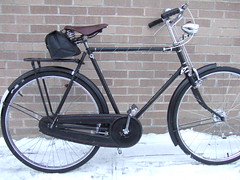
1951 raleigh DL1: 66 degree seat tube (talk about *slack*!), 68 degree head tube:
1978 raleigh competition GS: 74 degree seat tube, 74 degree head tube (jibes with published data):

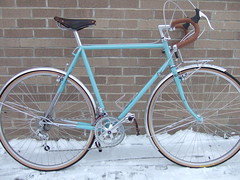
1985 shogun 2000: 72 degree seat tube, 73 degree head tube:
here are some angles that i have calculated on a few of my bikes:
1951 raleigh DL1: 66 degree seat tube (talk about *slack*!), 68 degree head tube:
1978 raleigh competition GS: 74 degree seat tube, 74 degree head tube (jibes with published data):
1985 shogun 2000: 72 degree seat tube, 73 degree head tube:
02-18-10 | 10:49 AM
#29

Iconoclast
Joined: Aug 2009
Posts: 3,176
Likes: 2
From: California
Bikes: Colnago Super, Fuji Opus III, Specialized Rockhopper, Specialized Sirrus (road)
First of all, those Raleighs are top notch. Love them!
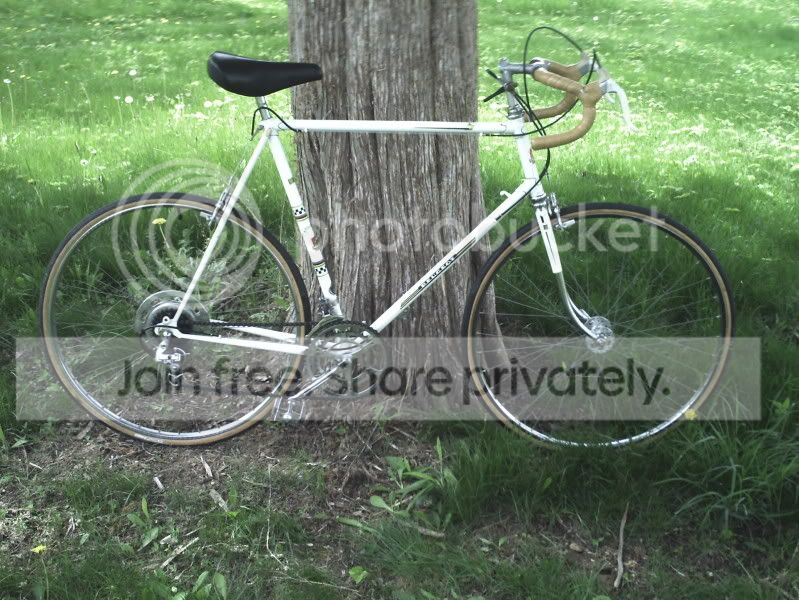
It's hard to tell a few degrees, but I CAN tell you that where the first bike is insanely twitchy and will dart wherever your eyes go, the bike in the middle is comfortable all day, but is still relatively quick, and the last bike almost WON'T turn. The thing handles like a truck.
It seems as if that would be because that Peugeot has no trail, correct?
Does anyone know some approximate values that one typically finds in a 'twitchy' frame? Ex: head tube angle, seat tube angle, chain stay length, top tube length, wheelbase, etc?
What might someone surmise about a frame like this?

It's hard to tell a few degrees, but I CAN tell you that where the first bike is insanely twitchy and will dart wherever your eyes go, the bike in the middle is comfortable all day, but is still relatively quick, and the last bike almost WON'T turn. The thing handles like a truck.
Does anyone know some approximate values that one typically finds in a 'twitchy' frame? Ex: head tube angle, seat tube angle, chain stay length, top tube length, wheelbase, etc?
What might someone surmise about a frame like this?
02-18-10 | 12:56 PM
#30
Senior Member
Joined: Apr 2005
Posts: 17,196
Likes: 761
From: Ann Arbor, MI
Bikes: 1980 Masi, 1984 Mondonico, 1984 Trek 610, 1980 Woodrup Giro, 2005 Mondonico Futura Leggera ELOS, 1967 PX10E, 1971 Peugeot UO-8
First of all, those Raleighs are top notch. Love them!
It seems as if that would be because that Peugeot has no trail, correct?
Does anyone know some approximate values that one typically finds in a 'twitchy' frame? Ex: head tube angle, seat tube angle, chain stay length, top tube length, wheelbase, etc?
What might someone surmise about a frame like this?
It seems as if that would be because that Peugeot has no trail, correct?
Does anyone know some approximate values that one typically finds in a 'twitchy' frame? Ex: head tube angle, seat tube angle, chain stay length, top tube length, wheelbase, etc?
What might someone surmise about a frame like this?
Measure the numbers for your Uni, I'd be glad to speculate based on them.
02-18-10 | 01:20 PM
#31
perpetually frazzled
Joined: Sep 2008
Posts: 2,469
Likes: 9
From: Linton, IN
Bikes: 1977 Bridgestone Kabuki Super Speed; 1979 Raleigh Professional; 1983 Raleigh Rapide mixte; 1974 Peugeot UO-8; 1993 Univega Activa Trail; 1972 Raleigh Sports; 1967 Phillips; 1981 Schwinn World Tourist; 1976 Schwinn LeTour mixte; 1964 Western Flyer
My UO-8 does fairly well while descending - I've had it to about 35 mph before and it stays just as stable. Again, I'd love to tour on a bike with similar geometry.
02-18-10 | 02:17 PM
#32
Gear Hub fan
Joined: Nov 2008
Posts: 2,829
Likes: 2
From: Reno, NV
Bikes: Civia Hyland Rohloff, Swobo Dixon, Colnago, Univega
rat fink;
Per my understanding modern theory is that large fork rake and minimal trail makes for a twitchier bike rather than more stable. The French used such geometry in a lot of frames due in part to it giving better handling and bike feel with a front load; think Randonneur and Porteur bike geometry.
Frame dimensions and angles seem to be so interrelated though that it is hard to separate them out from one another. Seat tube angle seems to be the angle that would least affect handling normally I suspect.
Per my understanding modern theory is that large fork rake and minimal trail makes for a twitchier bike rather than more stable. The French used such geometry in a lot of frames due in part to it giving better handling and bike feel with a front load; think Randonneur and Porteur bike geometry.
Frame dimensions and angles seem to be so interrelated though that it is hard to separate them out from one another. Seat tube angle seems to be the angle that would least affect handling normally I suspect.
__________________
Gear Hubs Owned: Rohloff disc brake, SRAM iM9 disc brake, SRAM P5 freewheel, Sachs Torpedo 3 speed freewheel, NuVinci CVT, Shimano Alfine SG S-501, Sturmey Archer S5-2 Alloy. Other: 83 Colnago Super Record, Univega Via De Oro
Visit and join the Yahoo Geared Hub Bikes group for support and links.
https://groups.yahoo.com/group/Geared_hub_bikes/
Gear Hubs Owned: Rohloff disc brake, SRAM iM9 disc brake, SRAM P5 freewheel, Sachs Torpedo 3 speed freewheel, NuVinci CVT, Shimano Alfine SG S-501, Sturmey Archer S5-2 Alloy. Other: 83 Colnago Super Record, Univega Via De Oro
Visit and join the Yahoo Geared Hub Bikes group for support and links.
https://groups.yahoo.com/group/Geared_hub_bikes/
02-18-10 | 04:14 PM
#33

Hebrews 10:20a
Joined: Oct 2009
Posts: 141
Likes: 1
Bikes: '74 Viscount Aerospace GP
Going back to what Robbietunes and myself said earlier; that rear tire is nearly touching the FD, and the toes of your feet may make contact with the wheel when turned from side to side (not sure) -- definitely a racing frame.
In looking at C &V frames, also realize that some French built bicycles in particular were built as Randonneur bicycles. They were made for racing long distances unsupported; you wanted a stiff frame for maximum speed, but with enough clearance so that you could install fenders and fat tires. They also had a longer wheelbase, that along with the steering geometry made the bike stable enough to be to be handled by a fatigued rider in the middle of the night without being overly slow. Here is a good example:
https://www.heronbicycles.com/rand.html

The art of bicycle geometry can get pretty complicated.
-James
In looking at C &V frames, also realize that some French built bicycles in particular were built as Randonneur bicycles. They were made for racing long distances unsupported; you wanted a stiff frame for maximum speed, but with enough clearance so that you could install fenders and fat tires. They also had a longer wheelbase, that along with the steering geometry made the bike stable enough to be to be handled by a fatigued rider in the middle of the night without being overly slow. Here is a good example:
https://www.heronbicycles.com/rand.html
The art of bicycle geometry can get pretty complicated.
-James
02-18-10 | 04:33 PM
#34

Señor Member


Joined: Oct 2004
Posts: 18,485
Likes: 1,565
From: Hardy, VA
Bikes: Mostly English - predominantly Raleighs
I think you've got it backwards. If the seat tube is longer than the top tube - racier... if the top tube is longer than the seat tube - more relaxed.
__________________
In search of what to search for.
In search of what to search for.
02-18-10 | 04:36 PM
#35
Buh'wah?!
Joined: Jul 2008
Posts: 2,086
Likes: 2
From: Charlottesville VA
Bikes: 2014 Giant Trance

 02-18-10 | 08:58 PM
#37

www.theheadbadge.com

Joined: Sep 2005
Posts: 29,025
Likes: 5,537
From: Southern Florida
Bikes: https://www.theheadbadge.com
__________________


02-18-10 | 10:39 PM
#38

Early Diamondback mountain bike. Looks almost as relaxed as some of the Raleighs posted here.,,,,BD
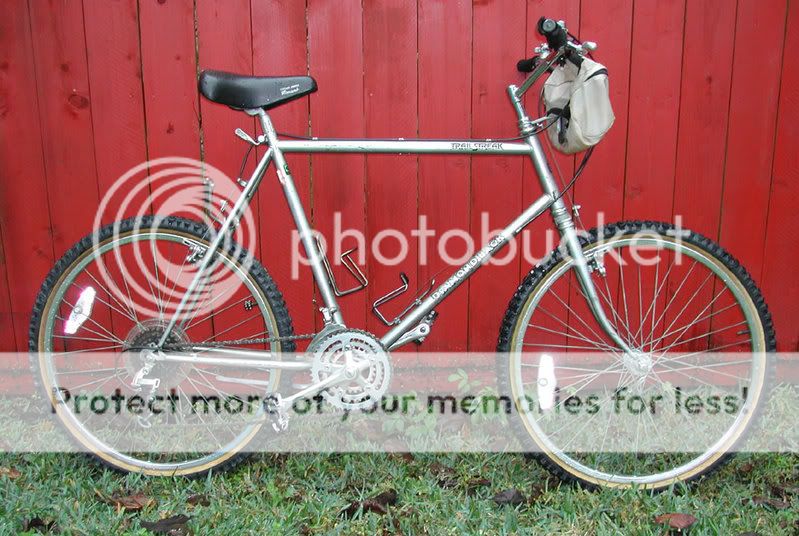
And one of my own creations, back before I stopped playing with the welder so much.. This thing could practically spin on the rear tire, despite the
geometry, hehe.
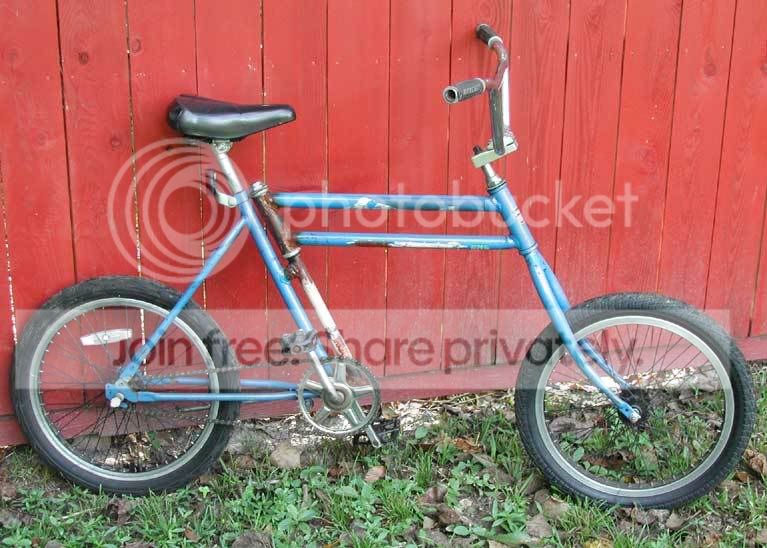
And one of my own creations, back before I stopped playing with the welder so much.. This thing could practically spin on the rear tire, despite the
geometry, hehe.
__________________
So many bikes, so little dime.
So many bikes, so little dime.
02-19-10 | 12:11 AM
#39
Iconoclast
Joined: Aug 2009
Posts: 3,176
Likes: 2
From: California
Bikes: Colnago Super, Fuji Opus III, Specialized Rockhopper, Specialized Sirrus (road)
 02-19-10 | 12:40 PM
#41
Senior Member
Joined: Apr 2005
Posts: 17,196
Likes: 761
From: Ann Arbor, MI
Bikes: 1980 Masi, 1984 Mondonico, 1984 Trek 610, 1980 Woodrup Giro, 2005 Mondonico Futura Leggera ELOS, 1967 PX10E, 1971 Peugeot UO-8
I'm not sure either of you are wrong. Some think there's high trail, which is fairly stable, and mid-trail, which can be rather twitchy, low trail, and very low trail, which is pretty stable. I don't have a handle on all the physics of this, save to say my UO-8 and those of others I've talked to are not twitchy in the least, even with modern tires on the bike.
02-19-10 | 02:43 PM
#42
Iconoclast
Joined: Aug 2009
Posts: 3,176
Likes: 2
From: California
Bikes: Colnago Super, Fuji Opus III, Specialized Rockhopper, Specialized Sirrus (road)
02-19-10 | 04:00 PM
#43
Gear Hub fan
Joined: Nov 2008
Posts: 2,829
Likes: 2
From: Reno, NV
Bikes: Civia Hyland Rohloff, Swobo Dixon, Colnago, Univega
Bikedued;
Most of the early mountain bikes had very relaxed geometry as they were based on the geometry of the old pre WW2 Schwinn cruiser frames used by the original MTB builders in Marin County.
Most of the early mountain bikes had very relaxed geometry as they were based on the geometry of the old pre WW2 Schwinn cruiser frames used by the original MTB builders in Marin County.
__________________
Gear Hubs Owned: Rohloff disc brake, SRAM iM9 disc brake, SRAM P5 freewheel, Sachs Torpedo 3 speed freewheel, NuVinci CVT, Shimano Alfine SG S-501, Sturmey Archer S5-2 Alloy. Other: 83 Colnago Super Record, Univega Via De Oro
Visit and join the Yahoo Geared Hub Bikes group for support and links.
https://groups.yahoo.com/group/Geared_hub_bikes/
Gear Hubs Owned: Rohloff disc brake, SRAM iM9 disc brake, SRAM P5 freewheel, Sachs Torpedo 3 speed freewheel, NuVinci CVT, Shimano Alfine SG S-501, Sturmey Archer S5-2 Alloy. Other: 83 Colnago Super Record, Univega Via De Oro
Visit and join the Yahoo Geared Hub Bikes group for support and links.
https://groups.yahoo.com/group/Geared_hub_bikes/
02-19-10 | 05:16 PM
#44

Elitest Murray Owner
Joined: Apr 2006
Posts: 2,657
Likes: 3
Bikes: 1972 Columbia Tourist Expert III, Columbia Roadster
 02-19-10 | 11:42 PM
#45

curmudgineer
Joined: Dec 2009
Posts: 4,417
Likes: 113
From: Chicago SW burbs
Bikes: 2 many 2 fit here
I'm sure Road Fan intends the correct meaning, but I'll get up on my soap box briefly and say that a digital gauge may offer precision (high resolution) without good accuracy. I prefer accuracy over precision but having both together is nice.
02-21-10 | 12:02 PM
#46
Senior Member
Joined: Apr 2005
Posts: 17,196
Likes: 761
From: Ann Arbor, MI
Bikes: 1980 Masi, 1984 Mondonico, 1984 Trek 610, 1980 Woodrup Giro, 2005 Mondonico Futura Leggera ELOS, 1967 PX10E, 1971 Peugeot UO-8
Seat tube and head tube angles. Fork rake would be useful, too, but it's not as easy to measure. Did you do seat tube center-center, center to top, or what?
Last edited by Road Fan; 02-21-10 at 12:06 PM.
02-21-10 | 01:06 PM
#47
Iconoclast
Joined: Aug 2009
Posts: 3,176
Likes: 2
From: California
Bikes: Colnago Super, Fuji Opus III, Specialized Rockhopper, Specialized Sirrus (road)
I did the seat tube center of the crank to top of the seat tube. I don't have any way of determining those other angles, unfortunately.


 02-21-10 | 07:33 PM
#50
Senior Member
Joined: Apr 2005
Posts: 17,196
Likes: 761
From: Ann Arbor, MI
Bikes: 1980 Masi, 1984 Mondonico, 1984 Trek 610, 1980 Woodrup Giro, 2005 Mondonico Futura Leggera ELOS, 1967 PX10E, 1971 Peugeot UO-8
High BB generally is done to improve pedal clearance while pedaling. This combined with teh short seatstays suggests a racing orientation. A 58 cm c-t seat tube is around 56-57 cm c-c, and hence this frame is not far from square.
You can tour on almost anything, but this was not designed to make touring easier, IMHO.