


"fork's bent"
 12-08-10 | 05:17 PM
#1

Thread Starter
Senior Member

Joined: Mar 2002
Posts: 3,085
Likes: 8
From: NJ
"fork's bent"
Hi.
I see the bent fork jokes on here constantly. I'm not trying to be funny with this thread, though. I recall the first old steel road frame i ever bought, some sort of mid-line peugeot that i bought about 9 years ago. The fork was waaaaaaaay bent, but i didn't notice il i put a wheel in it. took the wheel out, looked again, and it was very very noticeably bent. I figured that's what it was.
However, i just read the thread about the guy with the NR-equipped blue ralieh international that he got off ebay with the bum downtube and other issues. Some ppl called it out for having a bent fork. I couldn't see it, from the pictures. Someone mentioned that the front wheel looked offset; i sometimes find that i need to straighten front wheels as i tighten them into the fork. That fact, coupled with the ubiquitous bent fork jokes on here, has got me terribly freekin' paranoid that all my forks are bent...
What is, in everyone's experience, the best way to determine a fork's straightness?
thanks,
-rob
I see the bent fork jokes on here constantly. I'm not trying to be funny with this thread, though. I recall the first old steel road frame i ever bought, some sort of mid-line peugeot that i bought about 9 years ago. The fork was waaaaaaaay bent, but i didn't notice il i put a wheel in it. took the wheel out, looked again, and it was very very noticeably bent. I figured that's what it was.
However, i just read the thread about the guy with the NR-equipped blue ralieh international that he got off ebay with the bum downtube and other issues. Some ppl called it out for having a bent fork. I couldn't see it, from the pictures. Someone mentioned that the front wheel looked offset; i sometimes find that i need to straighten front wheels as i tighten them into the fork. That fact, coupled with the ubiquitous bent fork jokes on here, has got me terribly freekin' paranoid that all my forks are bent...
What is, in everyone's experience, the best way to determine a fork's straightness?
thanks,
-rob
 12-08-10 | 05:20 PM
#2

Senior Member
Joined: Dec 2009
Posts: 8,343
Likes: 16
From: Louisville
A bent fork is a minor inconvenience. I see guys with DUI bars and obviously bent forks truckin' down the sidewalk with nary an issue every day. When your tire starts to rub the down tube, it's time to get it looked at.
12-08-10 | 05:24 PM
#3

Senior Member
Joined: Sep 2007
Posts: 2,454
Likes: 9
SP
Bend, OR
...taking off my smart@$$ hat.
12-08-10 | 05:47 PM
#4

Senior Member


Joined: Apr 2007
Posts: 12,564
Likes: 2,739
From: Thunder Bay, Ontario, Canada - burrrrr!
Bikes: 1958 Rabeneick 120D, 1968 Legnano Gran Premio, 196? Torpado Professional, 2000 Marinoni Piuma
Vintage road bicycles are pretty fragile steeds, when compared to almost all other styles. Vintage bicycles are, well, vintage - which is another word for old. And old suggests use. So, if you use something fragile a lot, chances are it will go out of whack, sooner or later?
My experience has been that the better bikes are usually OK. Entry to mid level, look closely. And, of course, the older the bicycle, the more likely it will have experienced trauma at some time in its life. But not to fear...
Vintage steel is pretty solid stuff and, more often than not, can be bent back into place with reasonable ease. It does help to know what you are doing, of course. Don't tie your frame set to a tree and have at it with a two by four lever. Nope, ya gotta watch out for those trees. The two by four is OK, though and I am serious.
I am the guy that pointed out the bent fork. A fork does not have to be bent noticeably backward to qualify as bent. Sure, it is important to look, squarely, at the fork from the side, but look also from the front.
When looking from the front, consider the position of the wheel rim between the fork blades.

Does it split the space evenly? If not, chances are the forks are bent. Look at the one picture of the International and see how close the rim sit to one of the fork blades. Does that look right to you?
Anyway, that is my opinion on the subject. I have offered this same opinion, in greater detail, in case anyone is interested.
My experience has been that the better bikes are usually OK. Entry to mid level, look closely. And, of course, the older the bicycle, the more likely it will have experienced trauma at some time in its life. But not to fear...
Vintage steel is pretty solid stuff and, more often than not, can be bent back into place with reasonable ease. It does help to know what you are doing, of course. Don't tie your frame set to a tree and have at it with a two by four lever. Nope, ya gotta watch out for those trees. The two by four is OK, though and I am serious.
I am the guy that pointed out the bent fork. A fork does not have to be bent noticeably backward to qualify as bent. Sure, it is important to look, squarely, at the fork from the side, but look also from the front.
When looking from the front, consider the position of the wheel rim between the fork blades.
Does it split the space evenly? If not, chances are the forks are bent. Look at the one picture of the International and see how close the rim sit to one of the fork blades. Does that look right to you?
Anyway, that is my opinion on the subject. I have offered this same opinion, in greater detail, in case anyone is interested.
12-08-10 | 05:58 PM
#5
Thread Starter
Senior Member
Joined: Mar 2002
Posts: 3,085
Likes: 8
From: NJ
Vintage road bicycles are pretty fragile steeds, when compared to almost all other styles. Vintage bicycles are, well, vintage - which is another word for old. And old suggests use. So, if you use something fragile a lot, chances are it will go out of whack, sooner or later?
My experience has been that the better bikes are usually OK. Entry to mid level, look closely. And, of course, the older the bicycle, the more likely it will have experienced trauma at some time in its life. But not to fear...
Vintage steel is pretty solid stuff and, more often than not, can be bent back into place with reasonable ease. It does help to know what you are doing, of course. Don't tie your frame set to a tree and have at it with a two by four lever. Nope, ya gotta watch out for those trees. The two by four is OK, though and I am serious.
I am the guy that pointed out the bent fork. A fork does not have to be bent noticeably backward to qualify as bent. Sure, it is important to look, squarely, at the fork from the side, but look also from the front.
When looking from the front, consider the position of the wheel rim between the fork blades.
Does it split the space evenly? If not, chances are the forks are bent. Look at the one picture of the International and see how close the rim sit to one of the fork blades. Does that look right to you?
Anyway, that is my opinion on the subject. I have offered this same opinion, in greater detail, in case anyone is interested.
My experience has been that the better bikes are usually OK. Entry to mid level, look closely. And, of course, the older the bicycle, the more likely it will have experienced trauma at some time in its life. But not to fear...
Vintage steel is pretty solid stuff and, more often than not, can be bent back into place with reasonable ease. It does help to know what you are doing, of course. Don't tie your frame set to a tree and have at it with a two by four lever. Nope, ya gotta watch out for those trees. The two by four is OK, though and I am serious.
I am the guy that pointed out the bent fork. A fork does not have to be bent noticeably backward to qualify as bent. Sure, it is important to look, squarely, at the fork from the side, but look also from the front.
When looking from the front, consider the position of the wheel rim between the fork blades.
Does it split the space evenly? If not, chances are the forks are bent. Look at the one picture of the International and see how close the rim sit to one of the fork blades. Does that look right to you?
Anyway, that is my opinion on the subject. I have offered this same opinion, in greater detail, in case anyone is interested.
They don't look bent, but..?
-rob
12-08-10 | 06:06 PM
#6
Senior Member
Joined: Apr 2007
Posts: 12,564
Likes: 2,739
From: Thunder Bay, Ontario, Canada - burrrrr!
Bikes: 1958 Rabeneick 120D, 1968 Legnano Gran Premio, 196? Torpado Professional, 2000 Marinoni Piuma
i'm best off squeezing the front brake at the same time, to perfect alignment. Is this evidence of a bent fork?
A properly installed wheel, sitting in a true set of forks, will split the space between the fork blades evenly. If the space is not even, one of two problems exist.
Either the wheel is out of dish, or the forks are bent. Or both. The example I offered is very obvious, but look again at the picture of the Raleigh International in the OP. To me, the wheel is wayyy offset.
12-08-10 | 06:08 PM
#7
Senior Member


Joined: Dec 2005
Posts: 18,759
Likes: 11,485
The first new bike I purchased was a Trek 412 from Palo Alto bike shop (paid for with my first post-college pay check). Less than a year later, I had a head on collision with another cyclist on the Stanford campus. My fork was fine, but it bent the top tube and down tube just behind the head tube. What I was told was that the fork is actually supposed to absorb the impact of those kind of collisions; thus, my non-bent fork failed me! I continued to ride that bike with its awfully twitchy handling until it got stolen a couple of years later. It wouldn't be another 20+ years that I'd buy a new bike (a Kogswell P/R in 2006, which I've since sold off).
Neal
Neal
12-08-10 | 06:44 PM
#8


Thrifty Bill
Joined: Jan 2008
Posts: 23,639
Likes: 1,106
From: Mans of NC & SW UT Desert
Bikes: 86 Katakura Silk, 87 Prologue X2, 88 Cimarron LE, 1975 Sekai 4000 Professional, 73 Paramount, plus more
Typically, if bent from a front end collision, fork will be bent backwards towards the down tube. I use a straight edge to measure this type of bent fork. If the fork is straight, everything should line up: the stem bolt, through the center of the head tube, through the center of the fork crown, and down the fork leg.
+1 To below, the straight edge test does not show side to side bend, which is pretty common damage wise as well.
Regardless of fork bend, learn to ID buckling/rippling of the DT and Top Tube, as that damage is often game over for the frame.

+1 To below, the straight edge test does not show side to side bend, which is pretty common damage wise as well.
Regardless of fork bend, learn to ID buckling/rippling of the DT and Top Tube, as that damage is often game over for the frame.
Last edited by wrk101; 12-09-10 at 07:44 AM.
12-09-10 | 05:37 AM
#9
Senior Member
Joined: Apr 2007
Posts: 12,564
Likes: 2,739
From: Thunder Bay, Ontario, Canada - burrrrr!
Bikes: 1958 Rabeneick 120D, 1968 Legnano Gran Premio, 196? Torpado Professional, 2000 Marinoni Piuma
Typically, if bent from a front end collision, fork will be bent backwards towards the down tube.
So, it the forks are bent back, the you had better check for other irregularities as well.
Remember, forks are very strong, comparatively, from front to back (just try bending a fork blade forwards or backwards, with your bare hands) than they are side to side (most people can bend a fork blade to one side, or the other, with their bare hands). With this in mind, does it make sense that forks would not be bent sideways also?
Just an old fella's opinion.
12-09-10 | 07:22 AM
#10

Senior Member
Joined: May 2008
Posts: 1,554
Likes: 2
From: Southwest Michigan
Bikes: Fuji Monterey, Schwinn Traveler, Fuji Special Road Racer, Gitane Interclub, Sun EZ-1, Schwinn Frontier, Puch Cavalier, Vista Cavalier, Armstrong, Raleigh Sports, Schwinn Stingray
Here is an obviously bent fork example:
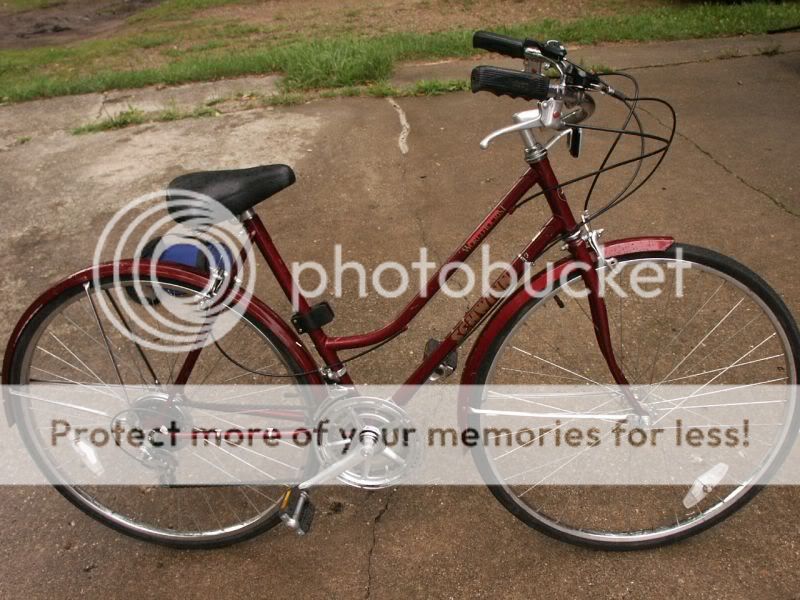
Note how close the front wheel is to the down tube. Somehow I missed seeing the bent fork in the thrift store because I was distracted by the FFS system and broken shifter and wondering if I could fix it or not. I spun both the wheels and looked for straightness, and even checked the deraileurs, but didn't notice the fork until I was putting it on the car. Funny thing about this is that front wheel is currently in service on a friends bike. The frame and fork took the hit, yet the wheel survived and stayed true and round... ok well true and round enough to keep using.
Here's one that's less obvious:
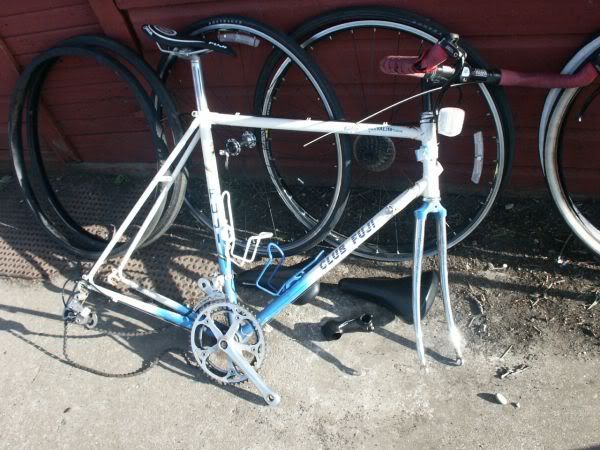
The bike had been in an accident, it seemed fine for the rider but then while out riding the top tube bulged, the down tube wrinkled and the tire went back into the downtube. It's more difficult to tell from the picture, and often a picture like this is all you get from an ebay or CL ad. The fork looked good to me at first, however it is bent. It's a pretty chrome fork and if I end up having a use for it, I may try to bend it back. The frame however is now wall art.
Note how close the front wheel is to the down tube. Somehow I missed seeing the bent fork in the thrift store because I was distracted by the FFS system and broken shifter and wondering if I could fix it or not. I spun both the wheels and looked for straightness, and even checked the deraileurs, but didn't notice the fork until I was putting it on the car. Funny thing about this is that front wheel is currently in service on a friends bike. The frame and fork took the hit, yet the wheel survived and stayed true and round... ok well true and round enough to keep using.
Here's one that's less obvious:
The bike had been in an accident, it seemed fine for the rider but then while out riding the top tube bulged, the down tube wrinkled and the tire went back into the downtube. It's more difficult to tell from the picture, and often a picture like this is all you get from an ebay or CL ad. The fork looked good to me at first, however it is bent. It's a pretty chrome fork and if I end up having a use for it, I may try to bend it back. The frame however is now wall art.
Last edited by BigPolishJimmy; 12-09-10 at 07:29 AM.
12-09-10 | 08:20 AM
#11
car guy, recovering
Joined: Nov 2008
Posts: 1,255
Likes: 9
From: Mount Vernon, NY
Bikes: Olympia Competizione & Special Piuma, Frejus track circa 1958, Dahon Helios, many others
Forks get bent from running into things or from being run into (or over). Typically, both blades bend because they are joined by the crown at the top and by the hub at the bottom. Generally, forks get bent back or to one side. sometimes only one will bend, usually backwards, and put some twist into the other. Steel is pretty elastic, which means it likes to spring back to its original shape. Therefore, it has to be moved a lot to stay in its new position, i.e. to get bent. This means that most bent forks look bent.
If a bike veers off to one side when riding no hands, the fork is probably bent. If you can ride no hands and the bike tracks straight, the fork is either not bent, or both blades are bent back the same amount. As long as the bend is in the blade, there is a good chance of straightening the fork. If the bend is between the crown and steerer tube, the fork is probably junk. You can usually tell this by how the headset feels: if there is no play or binding when rotating the fork in the frame, the steerer is probably OK.
A fork that is bent back generally looks like it. A fork that is bent to one side generally feels like it. Basically, if you cannot see or feel a bend in the fork, it is likely not bent, or not bent enough to matter.
By the way, the classic method for straightening a fork that has been bent back is to reverse the fork with a wheel installed, then wheel it hard into a wall. I am not recommending this, but in the proper hands it works surprisingly often and surprisingly well.
If a bike veers off to one side when riding no hands, the fork is probably bent. If you can ride no hands and the bike tracks straight, the fork is either not bent, or both blades are bent back the same amount. As long as the bend is in the blade, there is a good chance of straightening the fork. If the bend is between the crown and steerer tube, the fork is probably junk. You can usually tell this by how the headset feels: if there is no play or binding when rotating the fork in the frame, the steerer is probably OK.
A fork that is bent back generally looks like it. A fork that is bent to one side generally feels like it. Basically, if you cannot see or feel a bend in the fork, it is likely not bent, or not bent enough to matter.
By the way, the classic method for straightening a fork that has been bent back is to reverse the fork with a wheel installed, then wheel it hard into a wall. I am not recommending this, but in the proper hands it works surprisingly often and surprisingly well.
 12-09-10 | 08:27 AM
#12
Senior Member
Joined: Nov 2004
Posts: 23,212
Likes: 3,122
Whenever I go to look at a bicycle I have my Allen keys with me to ensure the post and stem are free and can be adjusted. I take my Allen key and lay it across the front edge of the fork crown. I then sight down the fork and ensure the crown/key lines up (i.e is parallel to) the front axle. When a bike is crashed and the forks are bent, it is rare for both blades to bent the same amount, as the rbicycle would have had to strike the object at a perfect 90 degree angle. This method will pick up reasonably small variations in fore-aft variations betwen the two blades.
Bent forks are also often detectable during the test ride. Bent forks typically will cause the bicycle to pull to one side. However, to detect this you may have to ride hand's free or with very light pressue on the bars.
Lateral misalignment is judged via the rim position between the blades, as stated above. However, be aware that a miscentered wheel could also be due to improper wheel dish or true. You can eliminate these possibilities by turning the wheel around and ensuring that the same point of the wheel (i.e the valve ) is always located between the blades. If the problem shifts to the opposite of the fork when the wheel is flipped, then it's a problem with the wheel and not the fork.
Bent forks are also often detectable during the test ride. Bent forks typically will cause the bicycle to pull to one side. However, to detect this you may have to ride hand's free or with very light pressue on the bars.
Lateral misalignment is judged via the rim position between the blades, as stated above. However, be aware that a miscentered wheel could also be due to improper wheel dish or true. You can eliminate these possibilities by turning the wheel around and ensuring that the same point of the wheel (i.e the valve ) is always located between the blades. If the problem shifts to the opposite of the fork when the wheel is flipped, then it's a problem with the wheel and not the fork.
12-09-10 | 05:55 PM
#13
Thread Starter
Senior Member
Joined: Mar 2002
Posts: 3,085
Likes: 8
From: NJ
these are all excellent tips. i've been obsessively checking my fleet, and it looks like they're all unbent, or at least "not bent enough to matter".
Thank you, everyone. I hope others learned something from this thread, too.
-rob
ps- it may be helpful to lay off the gratuitous "fork's bent" jokes. Maybe i'm the only one, but im starting to develop a complex...
Thank you, everyone. I hope others learned something from this thread, too.
-rob
ps- it may be helpful to lay off the gratuitous "fork's bent" jokes. Maybe i'm the only one, but im starting to develop a complex...
12-09-10 | 06:34 PM
#14

Senior Member
Joined: Jul 2006
Posts: 6,930
Likes: 5
From: Toronto (again) Ontario, Canada
Bikes: Old Bike: 1975 Raleigh Delta, New Bike: 2004 Norco Bushpilot
these are all excellent tips. i've been obsessively checking my fleet, and it looks like they're all unbent, or at least "not bent enough to matter".
Thank you, everyone. I hope others learned something from this thread, too.
-rob
ps- it may be helpful to lay off the gratuitous "fork's bent" jokes. Maybe i'm the only one, but im starting to develop a complex...
Thank you, everyone. I hope others learned something from this thread, too.
-rob
ps- it may be helpful to lay off the gratuitous "fork's bent" jokes. Maybe i'm the only one, but im starting to develop a complex...
1) far enough out of whack that it affects handling
2) made of Aluminum or Carbon fibre
3) a rare or unusual fork
4) the frame is also affected
5) a bike you just bought
These days you can buy an inexpensive steel fork for very little and replace a bent one.
12-09-10 | 06:36 PM
#15
Noob
Joined: Nov 2009
Posts: 357
Likes: 6
From: Bay Area
Bikes: '86 Schwinn Paramount
Hmmm, I never thought "Bent to one side". I've noticed that while I'm riding and I look straight down onto the frame, it looks like I'm leaning to one side. I tried to see if it was because I was on the right side of the crown of a road but even on level ground there is a slight lean. It tracks straight without hands. Could it be a fork issue?
12-10-10 | 04:01 AM
#16
Senior Member
Joined: Apr 2007
Posts: 12,564
Likes: 2,739
From: Thunder Bay, Ontario, Canada - burrrrr!
Bikes: 1958 Rabeneick 120D, 1968 Legnano Gran Premio, 196? Torpado Professional, 2000 Marinoni Piuma
Hmmm, I never thought "Bent to one side". I've noticed that while I'm riding and I look straight down onto the frame, it looks like I'm leaning to one side. I tried to see if it was because I was on the right side of the crown of a road but even on level ground there is a slight lean. It tracks straight without hands. Could it be a fork issue?
I posted the front end picture of a bicycle that had bent forks, bent both backward and to the side. That bicycle, a Mercier, rode dead straight, hands off of the bars. It was not until I had built the bike, and then set it up, for picture taking, that I noticed the bent fork issue.
My guess is this old bike had both bent forks and a bent frame set, one canceling the negative ride qualities of the other out. Werid and that old Mercier now hangs in The Old Shed. Of course, now that I am becoming a fork fixing fella, I might have a go at those old French forks, and some Bianchi forks, and...
05-25-13 | 11:47 PM
#17

Member
Joined: Oct 2012
Posts: 25
Likes: 0
From: Romania
Bikes: Bianchi neo retro, Steppenwolf Taiga 26"
Can you tell if my fork is bent?
Also I would like to add the following:
There are small riples on the tt and downtube near the headtube.
The wheelbase is only 97 cm, with the tt at 56 cm.
I get a lot of toe rubing, felt one time, and almoust lost it several times.
I almoust crashed yesterday going 55km on a descent - a nasty speedwooble developed, but I think it was induced by a lateral wind.
I've been riding the bike for about 400 km, it runs fine, handling wise and confort, but with the late speed woble incident I'm afraid going on descents.
05-26-13 | 01:45 AM
#18

Senior Member

Joined: Aug 2011
Posts: 1,394
Likes: 20
From: OZARKS
With those issues who cares? if its bent take to a a frame shop and have it fixed whatever is wrong... I would say steering tube is bent and the forks might be a replacement if they are not bent
__________________
riding
riding

 05-26-13 | 06:44 AM
#20

Senior Member
Joined: May 2010
Posts: 3,904
Likes: 36
From: Hurricane Alley , Florida
Bikes: Treks (USA), Schwinn Paramount, Schwinn letour,Raleigh Team Professional, Gazelle GoldLine Racing, 2 Super Mondias, Carlton Professional.
So true. The last three builds I've done the forks were out of alignment. Not by much, but enough to make my wonder how the heck someone could ride a bike with the fork skewed to one side or the other.
05-26-13 | 06:58 AM
#21

Senior Member
Joined: Dec 2005
Posts: 740
Likes: 4
From: Pacific Northwest
05-26-13 | 10:07 AM
#22

Ride, Wrench, Swap, Race
Joined: Jan 2010
Posts: 9,809
Likes: 1,784
From: Northern California
Bikes: Cheltenham-Pedersen racer, Boulder F/S Paris-Roubaix, Varsity racer, '52 Christophe, '62 Continental, '92 Merckx, '75 Limongi, '76 Presto, '72 Gitane SC, '71 Schwinn SS, etc.
I can't detect this kind of sideways misalignment while riding either.
But when it's the front triangle, steerer or fork legs putting the axle even 2mm off to one side, the bike pulls to the opposite side and becomes difficult or impossible to ride hands-free. It then is up to me to figure out which of those three possibilities is the real culprit, and correcting it.
And of course it can also be that the dropout slots aren't set at the same height, but usually that's only on a very poorly-made frame and I try to save the metal removal option for only when it is fully warranted.
Randyjawa wrote:
"My guess is this old bike had both bent forks and a bent frame set, one canceling the negative ride qualities of the other out."
Considering that your Mercier appears to have a typical 1957-style fram/fork geometry, a frontal hit as you described really could bring the bike's geometry into a more contemporary decade! It very well could be an improvement, if the headset still functions as it should, the rider's foot still clears the front tire and the aesthetic of the changes is tolerable.
I almost thought I was looking at my own Steyr Clubman, a bike whose frame/fork geometry is even older than it's intro date of 1961.
According to Dave Moulton's blog, this (typically ~1950's/1960's) vintage of frame had the extra fork rake offset to simply build a lower-trail version of the framesets from much earlier, keeping the barely 71-degree frame angles and simply adding some bend to the fork legs.
Very much like my 1963 Legnano!
Indeed, the steering is surprisingly light and quick
Notice any similarities?

Last edited by dddd; 05-26-13 at 10:23 AM.
05-26-13 | 10:28 AM
#23
Rides Majestic
Joined: Jan 2013
Posts: 1,339
Likes: 7
From: Westfield, MA
Bikes: 1983 Univega Gran Turismo, 1970 Schwinn Super Sport, 2001 Univega Modo Vincere, Self-Built Nashbar Touring, 1974 Peugeot U08, 1974 Atala Grand Prix, 1986 Ross Mt. Hood, 80's Maruishi MT-18
I've seen cases of front wheels being poorly aligned on bikes, mostly lower end stuff. I purchased a lightly ridden Raleigh Capri from a friend who never crashed it, but the front wheel was not well aligned in the fork dropouts. Close inspection revealed that one of the dropouts was not parallel to the front/rear axis. When the wheel was tightened, it would cause a twist in the fork blade and the wheel would go off to one side. Straightening the dropout resolved the problem. I experienced a similar phenomenon after cold setting the rear triangle of my Schwinn Super Sport. Rechecking and adjusting the parallelism of the dropouts solved it.
05-26-13 | 10:34 AM
#24

Extraordinary Magnitude
Joined: Aug 2009
Posts: 14,080
Likes: 2,134
From: Waukesha WI
Bikes: 1978 Trek TX700; 1978/79 Trek 736; 1984 Specialized Stumpjumper Sport; 1984 Schwinn Voyageur SP; 1985 Trek 620; 1985 Trek 720; 1986 Trek 400 Elance; 1987 Schwinn High Sierra; 1990 Miyata 1000LT
I'm thinking of Jeff Foxworthy saying "you might have a bent fork if..."
__________________
*Recipient of the 2006 Time Magazine "Person Of The Year" Award*
Commence to jigglin’ huh?!?!
"But hey, always love to hear from opinionated amateurs." -says some guy to Mr. Marshall.
Commence to jigglin’ huh?!?!
"But hey, always love to hear from opinionated amateurs." -says some guy to Mr. Marshall.
05-26-13 | 10:57 AM
#25
Thrifty Bill
Joined: Jan 2008
Posts: 23,639
Likes: 1,106
From: Mans of NC & SW UT Desert
Bikes: 86 Katakura Silk, 87 Prologue X2, 88 Cimarron LE, 1975 Sekai 4000 Professional, 73 Paramount, plus more
Hi.
However, i just read the thread about the guy with the NR-equipped blue ralieh international that he got off ebay with the bum downtube and other issues. Some ppl called it out for having a bent fork. I couldn't see it, from the pictures. Someone mentioned that the front wheel looked offset; i sometimes find that i need to straighten front wheels as i tighten them into the fork. That fact, coupled with the ubiquitous bent fork jokes on here, has got me terribly freekin' paranoid that all my forks are bent...
What is, in everyone's experience, the best way to determine a fork's straightness?
thanks,
-rob
However, i just read the thread about the guy with the NR-equipped blue ralieh international that he got off ebay with the bum downtube and other issues. Some ppl called it out for having a bent fork. I couldn't see it, from the pictures. Someone mentioned that the front wheel looked offset; i sometimes find that i need to straighten front wheels as i tighten them into the fork. That fact, coupled with the ubiquitous bent fork jokes on here, has got me terribly freekin' paranoid that all my forks are bent...
What is, in everyone's experience, the best way to determine a fork's straightness?
thanks,
-rob
2. In person fork check, I use a straight edge: level, yardstick, whatever. I center it on the stem bolt, through the center of the fork crown. Its pretty obvious when the bike is bent backwards (the usual tweak). Not so good at the sideways tweak.

