


75 years of geometry
 10-21-11 | 07:11 PM
#1

Thread Starter
Senior Member


Joined: Jun 2006
Posts: 12,861
Likes: 5,393
From: NW Burbs, Chicago
75 years of geometry
So make a short story long, there is a contest called the Oregon Manifest to design and fabricate a utility bike. If they have it in 2013 and if I can raise the money, I am going to enter. Any how, in determining the "ideal" geometry for this bike, I looked at what I have. And since it is important to me to visualize, I made drawings.
The black is from the early 1930s, the red is from the late 1950s and the blue is from 2009. The first set of overlaps shows when you align the saddles and bars. The second set of overlaps shows when you aligh the BB.
I find the results to be not very surprising but nonetheless interesting.
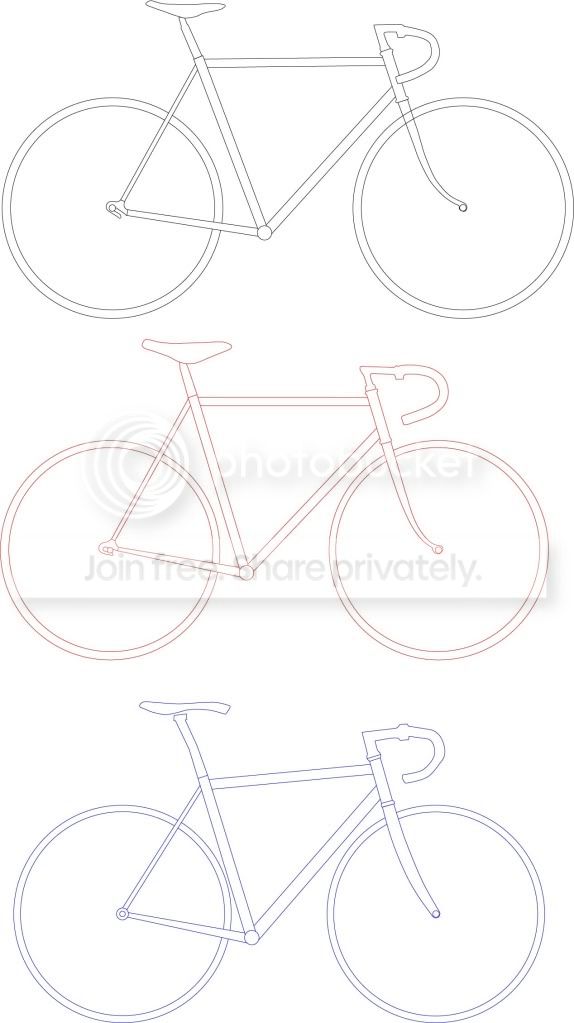
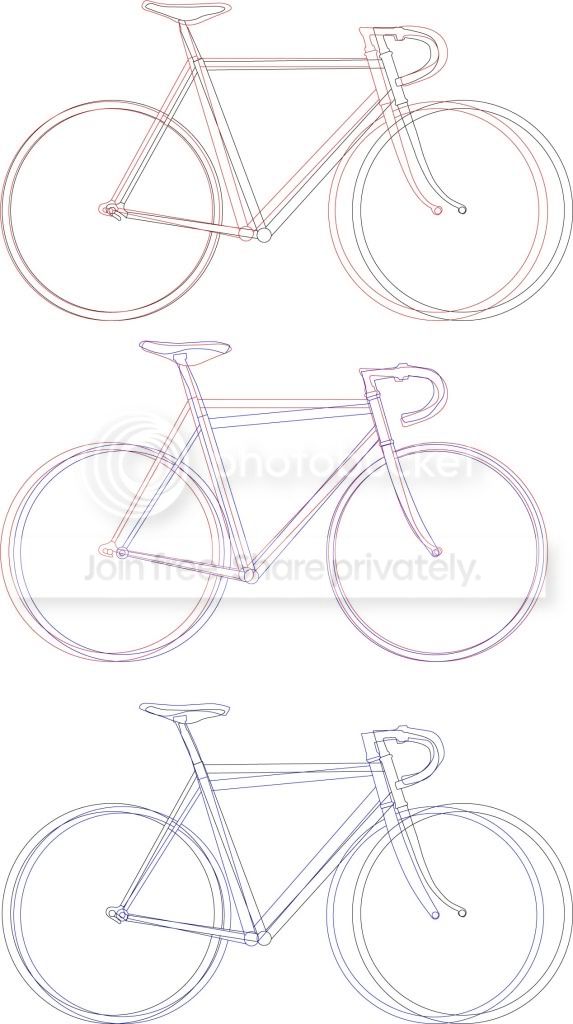
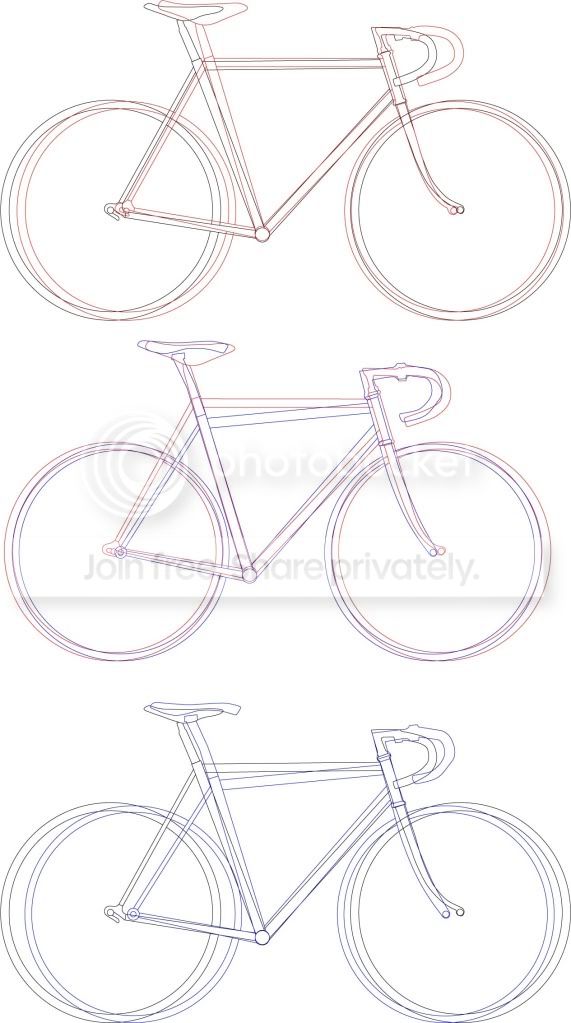
The black is from the early 1930s, the red is from the late 1950s and the blue is from 2009. The first set of overlaps shows when you align the saddles and bars. The second set of overlaps shows when you aligh the BB.
I find the results to be not very surprising but nonetheless interesting.
 10-21-11 | 08:20 PM
#2

Get off my lawn!

Joined: Nov 2010
Posts: 6,035
Likes: 118
From: The Garden State
Bikes: 1917 Loomis, 1923 Rudge, 1930 Hercules Renown, 1947 Mclean, 1948 JA Holland, 1955 Hetchins, 1957 Carlton Flyer, 1962 Raleigh Sport, 1978&81 Raleigh Gomp GS', 2010 Raliegh Clubman
phew...thought the title had something to do with Middle School!
Interesting. On the 30's profile, you might consider moving the saddle a few inches forward since the seatpost were generaly "7" shaped setting the rider more over the cranks than what the slack geometry would suggest.
Interesting. On the 30's profile, you might consider moving the saddle a few inches forward since the seatpost were generaly "7" shaped setting the rider more over the cranks than what the slack geometry would suggest.
10-21-11 | 08:29 PM
#3

Senior Member

Joined: Sep 2005
Posts: 3,003
Likes: 303
From: Hervey Bay, Qld, Australia.
Bikes: Colnago (82, 85, 89, 90, 91, 96, 03), 85 Cinelli, 90 Rossin, 83 Alan, 82 Bianchi, 78 Fountain, 2 x Pinarello, Malvern Star (37), Hillman (70's), 80's Beretto Lo-Pro Track, 80's Kenevans Lo-Pro, Columbus Max (95), DeGrandi (80's) Track.
I must commend you on a very informative and interesting set of drawings. They really do illustrate geometry changes over the 75 years. It was really interesting to see you kept the saddle / handlebar relationship as a constant.
The wheelbase and bottom bracket relationships do tell a developing story and it was informative to see the seat tube angle tightening then relaxing slightly.
The 1950 to 2009 rear wheel position did change significantly being much more tucked under the saddle while the 1930 wheelbase was quite extended.
Do you have these particular bikes at present? I would really like your impressions as to their ride qualities.
So well done. Congratulations,
Gary.
The wheelbase and bottom bracket relationships do tell a developing story and it was informative to see the seat tube angle tightening then relaxing slightly.
The 1950 to 2009 rear wheel position did change significantly being much more tucked under the saddle while the 1930 wheelbase was quite extended.
Do you have these particular bikes at present? I would really like your impressions as to their ride qualities.
So well done. Congratulations,
Gary.
10-21-11 | 11:37 PM
#4

Senior Member
Joined: Apr 2011
Posts: 701
Likes: 0
From: Lancaster,CA the desert north of Los Angeles
Bikes: 84' Ciocc, 79' Shogun 1000, 76' KHS Gran Sport, 96' Schwinn Super Sport,
I think the geometry changed to better suit the roads. 1930's had a lot of dirt road so longer chainstays and a higher BB. 1960's went to a more extreme position and 2009 went a little more relaxed to fight fatigue.
10-22-11 | 03:13 AM
#5

Senior Member
Joined: May 2011
Posts: 378
Likes: 3
From: Oslo, Norway
Bikes: 1951 Armand Carlsen, 1969 DBS Deluxe, 1949 Diamant, 1978 DBS Winner Tandem, 1955 Herkules... to infinity and beyond!
Notice that on the 1950s and 2009 bike the front of the handlebars align with the hub, just as the great Dave Moulton suggests! In other words the 1930s would need a much longer stem for optimal handling.
 10-22-11 | 06:44 AM
#7
Senior Member
Joined: Jun 2010
Posts: 7,579
Likes: 6
From: Pearland, Texas
Bikes: Cannondale, Trek, Raleigh, Santana
iab, Good luck in the competition!
I made a similar study in 2005 on sport motorcycles. There too it was interesting how the evolution went from one extreme to the other and then settled into a basically neutral handling formula comprising various head tube angles and wheelbase dimensions.
Brad
I made a similar study in 2005 on sport motorcycles. There too it was interesting how the evolution went from one extreme to the other and then settled into a basically neutral handling formula comprising various head tube angles and wheelbase dimensions.
Brad
10-22-11 | 08:09 AM
#8
Thread Starter
Senior Member
Joined: Jun 2006
Posts: 12,861
Likes: 5,393
From: NW Burbs, Chicago
I have back problems in the past and I am very sensitive about the seat/center of the bars relation. My feet can dangle and deal with a change in position of the BB. I also tend to position myself on the back of the saddle, riding the rivet has no appeal.
The modern bike rides as you would imagine with the short wheelbase and its stiffness. It is steel but the oversize tubing and compact geometry make the feel of it more crisp than the other bikes.
The thing that struck me the most is the 1950s bike has the same steep seat and head tube angles of the 2009 bike but has the longer wheelbase because of the low trail and extended rear triangle. I use a set-back seat post on the 2009 bike which effectively moves the BB forward compared to the 1950s bike. Probably explains why I am very comfortable out of the saddle on the 1950s bike. But since it is not as stiff as the 2009 bike, it is a bit squishy when I put my considerable weight on the pedals. I happen to prefer the feel of the stiffer bike.
The 1930 bike (a race bike mind you) is very plush. The wheelbase is 11 cm longer than the 2009 and 6 cm longer than the 1950s bike. Its the type of bike where you just want to serpentine down the road. Its odd getting out of the saddle on that bike with the BB so forward. But I really don't ride that one hard. For the competition, I plan to use a geometry more similar to the 1930s bike than the others. I do like the sloping top tube of the 2009 bike (I know, my words are heresy). It leaves room for "junk" when waiting at the stop light.
The modern bike rides as you would imagine with the short wheelbase and its stiffness. It is steel but the oversize tubing and compact geometry make the feel of it more crisp than the other bikes.
The thing that struck me the most is the 1950s bike has the same steep seat and head tube angles of the 2009 bike but has the longer wheelbase because of the low trail and extended rear triangle. I use a set-back seat post on the 2009 bike which effectively moves the BB forward compared to the 1950s bike. Probably explains why I am very comfortable out of the saddle on the 1950s bike. But since it is not as stiff as the 2009 bike, it is a bit squishy when I put my considerable weight on the pedals. I happen to prefer the feel of the stiffer bike.
The 1930 bike (a race bike mind you) is very plush. The wheelbase is 11 cm longer than the 2009 and 6 cm longer than the 1950s bike. Its the type of bike where you just want to serpentine down the road. Its odd getting out of the saddle on that bike with the BB so forward. But I really don't ride that one hard. For the competition, I plan to use a geometry more similar to the 1930s bike than the others. I do like the sloping top tube of the 2009 bike (I know, my words are heresy). It leaves room for "junk" when waiting at the stop light.
10-22-11 | 08:52 AM
#9


feros ferio

Joined: Jul 2000
Posts: 22,398
Likes: 1,865
From: www.ci.encinitas.ca.us
Bikes: 1959 Capo Modell Campagnolo; 1960 Capo Sieger (2); 1962 Carlton Franco Suisse; 1970 Peugeot UO-8; 1982 Bianchi Campione d'Italia; 1988 Schwinn Project KOM-10;
My ca. 1960 Capos and ca. 1980 Bianchi certainly fit the scenario posed in this thread, and I concur that the evolving quality of roads was the principal driving factor. My Bianchi, relaxed by modern full-race standards, is about as stiff as I care to go.
I like the Capo for long leisurely roads, but I favor the Bianchi for climbing and sprinting.
I like the Capo for long leisurely roads, but I favor the Bianchi for climbing and sprinting.
__________________
"Far and away the best prize that life offers is the chance to work hard at work worth doing." --Theodore Roosevelt
Capo: 1959 Modell Campagnolo, S/N 40324; 1960 Sieger (2), S/N 42624, 42597
Carlton: 1962 Franco Suisse, S/N K7911
Peugeot: 1970 UO-8, S/N 0010468
Bianchi: 1982 Campione d'Italia, S/N 1.M9914
Schwinn: 1988 Project KOM-10, S/N F804069
"Far and away the best prize that life offers is the chance to work hard at work worth doing." --Theodore Roosevelt
Capo: 1959 Modell Campagnolo, S/N 40324; 1960 Sieger (2), S/N 42624, 42597
Carlton: 1962 Franco Suisse, S/N K7911
Peugeot: 1970 UO-8, S/N 0010468
Bianchi: 1982 Campione d'Italia, S/N 1.M9914
Schwinn: 1988 Project KOM-10, S/N F804069
10-22-11 | 09:16 AM
#10

Cisalpinist
Joined: Jan 2011
Posts: 5,557
Likes: 18
From: Holland
Bikes: blue ones.
The funny thing is that there's a huge difference between my 50's RIH and 1980's concorde (new build - seperate thread coming up) in terms of geometry, but that my 05 Principia has nearly the same angles as the 80's bike.
10-22-11 | 06:11 PM
#11

Unique Vintage Steel
Joined: May 2005
Posts: 11,591
Likes: 287
From: Allen, TX
Bikes: Kirk Frameworks JKS-C, Serotta Nova, Gazelle AB-Frame, Fuji Team Issue, Surly Straggler
I recently did the same sort of photo experiment, but with photos of my actual bikes. I was curious on how close my setups where to one another, and where I could tweak them to fit me better. Here's some of the results:

87 Serotta Nova (57cm) / 2006 Fuji Team Issue (56 CTT)

83 Gazelle AB-Frame (58.5cm) / 2006 Fuji

83 Gazelle / 87 Serotta.
I still have the trainer setup in the living room, tomorrow I'm going to pull the A-Frame in there and photograph that one to see how different the A-Frame and the AB-Frame's geometry differs.
87 Serotta Nova (57cm) / 2006 Fuji Team Issue (56 CTT)
83 Gazelle AB-Frame (58.5cm) / 2006 Fuji
83 Gazelle / 87 Serotta.
I still have the trainer setup in the living room, tomorrow I'm going to pull the A-Frame in there and photograph that one to see how different the A-Frame and the AB-Frame's geometry differs.
 10-22-11 | 06:24 PM
#12
Senior Member
Joined: Sep 2005
Posts: 3,003
Likes: 303
From: Hervey Bay, Qld, Australia.
Bikes: Colnago (82, 85, 89, 90, 91, 96, 03), 85 Cinelli, 90 Rossin, 83 Alan, 82 Bianchi, 78 Fountain, 2 x Pinarello, Malvern Star (37), Hillman (70's), 80's Beretto Lo-Pro Track, 80's Kenevans Lo-Pro, Columbus Max (95), DeGrandi (80's) Track.
Great idea Kurt.
10-22-11 | 07:15 PM
#13
Unique Vintage Steel
Joined: May 2005
Posts: 11,591
Likes: 287
From: Allen, TX
Bikes: Kirk Frameworks JKS-C, Serotta Nova, Gazelle AB-Frame, Fuji Team Issue, Surly Straggler
Gary, if you were talkin to me, you've got the wrong cuda = name. No harm, happens fairly often.
The surprising result was the Gazelle / Serotta pairing. Not only just how close they were considering the size difference, but also seeing the minor differences in the front end geometry. I always felt like the Gazelle was more aggressive than the Serotta and the photos show it. I've been adjusting the reach on the Fuji, trying to decide if I like the shorter reach compared to the steel frames. I need to get a couple more rides in before I make any final decisions, but with my number coming up in my custom builder's queue any day now, I need to get about getting to that.
The surprising result was the Gazelle / Serotta pairing. Not only just how close they were considering the size difference, but also seeing the minor differences in the front end geometry. I always felt like the Gazelle was more aggressive than the Serotta and the photos show it. I've been adjusting the reach on the Fuji, trying to decide if I like the shorter reach compared to the steel frames. I need to get a couple more rides in before I make any final decisions, but with my number coming up in my custom builder's queue any day now, I need to get about getting to that.
 10-22-11 | 10:12 PM
#15

Behold my avatar:
Joined: May 2006
Posts: 1,037
Likes: 447
From: SW Colorado
Bikes: 2019 Gorilla Monsoon, 2013 Surly Krampus, Brompton folder
.
But what is their relevance to the design of a "utility" bike... a sort of every-person's urban get-around cycle? All three of your examples look to have rather racing oriented geometries.
.
Last edited by dgodave; 10-23-11 at 09:05 AM.
10-23-11 | 12:08 AM
#16
Senior Member
Joined: Sep 2005
Posts: 3,003
Likes: 303
From: Hervey Bay, Qld, Australia.
Bikes: Colnago (82, 85, 89, 90, 91, 96, 03), 85 Cinelli, 90 Rossin, 83 Alan, 82 Bianchi, 78 Fountain, 2 x Pinarello, Malvern Star (37), Hillman (70's), 80's Beretto Lo-Pro Track, 80's Kenevans Lo-Pro, Columbus Max (95), DeGrandi (80's) Track.
Gary, if you were talkin to me, you've got the wrong cuda = name. No harm, happens fairly often.
The surprising result was the Gazelle / Serotta pairing. Not only just how close they were considering the size difference, but also seeing the minor differences in the front end geometry. I always felt like the Gazelle was more aggressive than the Serotta and the photos show it. I've been adjusting the reach on the Fuji, trying to decide if I like the shorter reach compared to the steel frames. I need to get a couple more rides in before I make any final decisions, but with my number coming up in my custom builder's queue any day now, I need to get about getting to that.
The surprising result was the Gazelle / Serotta pairing. Not only just how close they were considering the size difference, but also seeing the minor differences in the front end geometry. I always felt like the Gazelle was more aggressive than the Serotta and the photos show it. I've been adjusting the reach on the Fuji, trying to decide if I like the shorter reach compared to the steel frames. I need to get a couple more rides in before I make any final decisions, but with my number coming up in my custom builder's queue any day now, I need to get about getting to that.
10-23-11 | 12:28 AM
#17

Bicycle Repair Man !!!
Joined: Sep 2007
Posts: 27,266
Likes: 152
From: YEG
Bikes: See my sig...
The hallmark of a great utility bicycle is ruggedness, a high comfort factor, and the ability to carry significant loads ranging from front and rear racks / panniers to full on delivery bicycles with a variety of designs.
This is not to say that a road bicycle cannot be very utilitarian.
This is not to say that a road bicycle cannot be very utilitarian.
10-23-11 | 03:52 AM
#18

On the subject of design over the decades, I too set up my bikes as close as possible to my target position. Keeping in mind that at the time of mfg. the concepts of a good position on a race bike have changed. Profile views do not account for changes in handlebar width for example. Ideas on where the saddle belonged changed. As mentioned earlier the seat posts with a horizontal extension, often got a more modern seat position in relation to the crank center, I found it interesting that it took so long to be admitted by framebuilders.
In the 70's fashion was indeed moving the rear triangle tighter, it looks more "race". With the wider rear ends of 10/11 speed bikes, I am surprised it has stayed so short, 415 mm or more I think would be better, not the sub 410 often seen today.
I have a smattering of bikes from the 50's to the 90's. I was surprised that the 50's bike was as "modern" as it was. Probably though if I was buying a bike way back, I would have been fitted to a larger frame. On the 50's bike I was guessing from the images when I bought it the bike was 72° parallel, and the top tube was close to my favored length. The front end is relaxed, as is the rear end which I think is near 440 mm, a great "white road" bike for me.
The Oregon Manifest competition is interesting, like all design contests the appearance is given higher priority than the required utility. As with any design competition, one must know who the judges are before deciding on a design to build. Unless you are going to build the bike anyway.
In the 70's fashion was indeed moving the rear triangle tighter, it looks more "race". With the wider rear ends of 10/11 speed bikes, I am surprised it has stayed so short, 415 mm or more I think would be better, not the sub 410 often seen today.
I have a smattering of bikes from the 50's to the 90's. I was surprised that the 50's bike was as "modern" as it was. Probably though if I was buying a bike way back, I would have been fitted to a larger frame. On the 50's bike I was guessing from the images when I bought it the bike was 72° parallel, and the top tube was close to my favored length. The front end is relaxed, as is the rear end which I think is near 440 mm, a great "white road" bike for me.
The Oregon Manifest competition is interesting, like all design contests the appearance is given higher priority than the required utility. As with any design competition, one must know who the judges are before deciding on a design to build. Unless you are going to build the bike anyway.
Last edited by repechage; 10-23-11 at 04:02 AM.
10-23-11 | 04:01 AM
#19
cuda2k- keep in mind that the various saddles you have there may not place your pelvis in the same place in relation to their profile. If you have set up you knee over the pedal axle the same of all, and use the same length crank... then working from the crank center is probably the best route for general position comparison.
Also, the various brake lever and handlebar shapes, will guide your hands to various places on the bars, so for that upcoming custom build know what you intend to use and test flight it before you lock in the design.
The Gazelle's aggressive front end is not too big a surprise, benelux was known for many criterium races.
Also, the various brake lever and handlebar shapes, will guide your hands to various places on the bars, so for that upcoming custom build know what you intend to use and test flight it before you lock in the design.
The Gazelle's aggressive front end is not too big a surprise, benelux was known for many criterium races.
10-23-11 | 01:16 PM
#20
Thread Starter
Senior Member
Joined: Jun 2006
Posts: 12,861
Likes: 5,393
From: NW Burbs, Chicago
That said, there is a long tradition of converting "race" bikes to a utilitarian role. Italian manufacturers took advatage of this from the 50s through the 70s with their Sport models. A definate cross between the bici da corsa and the bici da citta. No reason to believe a "racing" geometry couldn't be used.
Also, for the competition, I am looking specifically at a commuting bike, not an all out workhorse. I have gotten 100 responses from the first survey I done and there is a definate need for a commuter to double as a fun bike for other than going back and forth to work. If I would have one suggestion for the competition, I think there should be different categories of a utilitarian bike. Something for car-free-living is apples to oranges compared to what I use as a cummuter.
10-23-11 | 08:03 PM
#21
Senior Member
Joined: Feb 2008
Posts: 1,115
Likes: 17
Studying these geometries is just a part of the research I will do. I will be looking at other frame designs. I just have easy access to these so they were first. And since they are vintage, I thought I would post here.
That said, there is a long tradition of converting "race" bikes to a utilitarian role. Italian manufacturers took advatage of this from the 50s through the 70s with their Sport models. A definate cross between the bici da corsa and the bici da citta. No reason to believe a "racing" geometry couldn't be used.
Also, for the competition, I am looking specifically at a commuting bike, not an all out workhorse. I have gotten 100 responses from the first survey I done and there is a definate need for a commuter to double as a fun bike for other than going back and forth to work. If I would have one suggestion for the competition, I think there should be different categories of a utilitarian bike. Something for car-free-living is apples to oranges compared to what I use as a commuter.
That said, there is a long tradition of converting "race" bikes to a utilitarian role. Italian manufacturers took advatage of this from the 50s through the 70s with their Sport models. A definate cross between the bici da corsa and the bici da citta. No reason to believe a "racing" geometry couldn't be used.
Also, for the competition, I am looking specifically at a commuting bike, not an all out workhorse. I have gotten 100 responses from the first survey I done and there is a definate need for a commuter to double as a fun bike for other than going back and forth to work. If I would have one suggestion for the competition, I think there should be different categories of a utilitarian bike. Something for car-free-living is apples to oranges compared to what I use as a commuter.
Different folks often ride very different bikes in the same event. Think about PBP, just as an example. I am sure there are lots of modern (even fender-less CF) 700c race bikes used for that ride, but some people ride full-on randonneuring bikes, and everything in-between, I suppose.
When Jan Heine set the mixed-tandem record in PBP with Jaye Hayworth, they were on something like a 1952 Herse tandem. Certainly an outlier of the (tandem) bikes in that event!
Personally, I am becoming more and more convinced that non-oversized steel 700c frames with the 'sport bike" geometry of the 1970s can do an awful lot. Think circa 73-degree HT angles, moderate (50-60 mm) fork rakes, moderate chainstay lengths, moderate BB drop, lots of tire/fender clearance, etc. A geometry like that can do a whole bunch of things quite well, I believe, and you can fine-tune the geometry variables as well as the tubing variables depending on intended 'primary' useage....
Last edited by 753proguy; 10-23-11 at 08:04 PM. Reason: spellin' (what else??)

Thread
Thread Starter
Forum
Replies
Last Post
agmetal
Fitting Your Bike
1
04-04-16 01:54 PM
