


Explain Q-factor Please

 01-05-12 | 10:03 PM
#2


Rustbelt Rider
Joined: Oct 2008
Posts: 9,105
Likes: 390
From: Canton, OH
Bikes: 1990 Trek 1420 - 1978 Raleigh Professional - 1973 Schwinn Collegiate - 1974 Schwinn Suburban
Hmm, I'd like to learn this too.
__________________
|^^^^^^^^^^^^^^| ||
|......GO.BROWNS........| ||'|";, ___.
|_..._..._______===|=||_|__|..., ] -
"(@)'(@)"""''"**|(@)(@)*****''(@)
|^^^^^^^^^^^^^^| ||
|......GO.BROWNS........| ||'|";, ___.
|_..._..._______===|=||_|__|..., ] -
"(@)'(@)"""''"**|(@)(@)*****''(@)
 01-05-12 | 10:24 PM
#4

Senior Member
Joined: Apr 2009
Posts: 10,303
Likes: 61
From: Detroit
__________________
- Auchen
- Auchen
01-05-12 | 10:28 PM
#5

Senior Member

Joined: Apr 2005
Posts: 17,197
Likes: 761
From: Ann Arbor, MI
Bikes: 1980 Masi, 1984 Mondonico, 1984 Trek 610, 1980 Woodrup Giro, 2005 Mondonico Futura Leggera ELOS, 1967 PX10E, 1971 Peugeot UO-8
The distance between the crank arms measured from the outside of the drive side arm at the pedal to the outside of the non-drive side arm at the pedal. You feel it as the distance between your feet as you pedal. For some people, bigger is worse, for others bigger is better. Today, low Q is about 145 mm. Years back, low Q was 130.
01-05-12 | 10:50 PM
#6

Thread Starter
Senior Member
Joined: Jun 2009
Posts: 2,306
Likes: 4
From: Montereyish
The distance between the crank arms measured from the outside of the drive side arm at the pedal to the outside of the non-drive side arm at the pedal. You feel it as the distance between your feet as you pedal. For some people, bigger is worse, for others bigger is better. Today, low Q is about 145 mm. Years back, low Q was 130.
01-05-12 | 10:54 PM
#7
Rustbelt Rider
Joined: Oct 2008
Posts: 9,105
Likes: 390
From: Canton, OH
Bikes: 1990 Trek 1420 - 1978 Raleigh Professional - 1973 Schwinn Collegiate - 1974 Schwinn Suburban
__________________
|^^^^^^^^^^^^^^| ||
|......GO.BROWNS........| ||'|";, ___.
|_..._..._______===|=||_|__|..., ] -
"(@)'(@)"""''"**|(@)(@)*****''(@)
|^^^^^^^^^^^^^^| ||
|......GO.BROWNS........| ||'|";, ___.
|_..._..._______===|=||_|__|..., ] -
"(@)'(@)"""''"**|(@)(@)*****''(@)
01-05-12 | 11:29 PM
#8

Senior Member
Joined: Jul 2005
Posts: 4,992
Likes: 713
From: Boulder County, CO
Bikes: '80 Masi Gran Criterium, '12 Trek Madone, early '60s Frejus track
Coincidental.
Q factor is addresses the ergonomics of the bike. Along the way, bottom bracket spindle length, a factor in this ergonomic dimension, affects the location of the chainring along its axis, but it is not the sole proximate cause.
By the way, Q factor was coined by Grant Petersen in the 1990 or '91 Bridgestone catalog. He said that riders of bikes with large Q factors looked like ducks, and ducks quack, hence the assignment of the letter Q.
Q factor is addresses the ergonomics of the bike. Along the way, bottom bracket spindle length, a factor in this ergonomic dimension, affects the location of the chainring along its axis, but it is not the sole proximate cause.
By the way, Q factor was coined by Grant Petersen in the 1990 or '91 Bridgestone catalog. He said that riders of bikes with large Q factors looked like ducks, and ducks quack, hence the assignment of the letter Q.
01-06-12 | 02:14 AM
#9
Senior Member
Joined: Jan 2010
Posts: 111
Likes: 1
I think lower q is appealing mainly for small to medium road riders. Or maybe people who are just used to the older narrower normal width of around 140mm. Older road crank arms were straighter and it seems like most of the increase in q comes from the newer arms bending out more, independent of the chainring location. And some front derailers are wider than others, in the mechanism or the cage width, and just wont work sometimes with an old straight crank arm. I ride about a 54 and seem to like a lower q so often try to use old cranks, and a problem I've had is with some front derailers hitting the crank arm in high gear. I've got below 140mm q on 8 speed road bikes, a downside is using old parts and maybe a bit more attention adjusting and trimming the front derailer, and maybe a bit of rub in the highest gear, but I doubt the actual chainline is a problem. Also, if you have big feet or ride in regular shoes, your heal may hit the chainstay.
I probably couldn't tell the difference between say 140 and 150mm q, but 160 felt uncomfortable so I figured narrower was probably better for me if possible.
I probably couldn't tell the difference between say 140 and 150mm q, but 160 felt uncomfortable so I figured narrower was probably better for me if possible.
01-06-12 | 02:20 AM
#10
Thread Starter
Senior Member
Joined: Jun 2009
Posts: 2,306
Likes: 4
From: Montereyish
Coincidental.
Q factor is addresses the ergonomics of the bike. Along the way, bottom bracket spindle length, a factor in this ergonomic dimension, affects the location of the chainring along its axis, but it is not the sole proximate cause.
By the way, Q factor was coined by Grant Petersen in the 1990 or '91 Bridgestone catalog. He said that riders of bikes with large Q factors looked like ducks, and ducks quack, hence the assignment of the letter Q.
Q factor is addresses the ergonomics of the bike. Along the way, bottom bracket spindle length, a factor in this ergonomic dimension, affects the location of the chainring along its axis, but it is not the sole proximate cause.
By the way, Q factor was coined by Grant Petersen in the 1990 or '91 Bridgestone catalog. He said that riders of bikes with large Q factors looked like ducks, and ducks quack, hence the assignment of the letter Q.
01-06-12 | 04:53 AM
#11
Senior Member
Joined: Apr 2005
Posts: 17,197
Likes: 761
From: Ann Arbor, MI
Bikes: 1980 Masi, 1984 Mondonico, 1984 Trek 610, 1980 Woodrup Giro, 2005 Mondonico Futura Leggera ELOS, 1967 PX10E, 1971 Peugeot UO-8
Dependent on how the crank is designed, but obviously it might be harder to narrow Q with a triple, and narrow cranks might only line up right with the cassette if you do 126 mm. I don't think there's a true ergonomic relationship.
01-06-12 | 04:56 AM
#12
Senior Member
Joined: Apr 2005
Posts: 17,197
Likes: 761
From: Ann Arbor, MI
Bikes: 1980 Masi, 1984 Mondonico, 1984 Trek 610, 1980 Woodrup Giro, 2005 Mondonico Futura Leggera ELOS, 1967 PX10E, 1971 Peugeot UO-8
I think lower q is appealing mainly for small to medium road riders. Or maybe people who are just used to the older narrower normal width of around 140mm. Older road crank arms were straighter and it seems like most of the increase in q comes from the newer arms bending out more, independent of the chainring location. And some front derailers are wider than others, in the mechanism or the cage width, and just wont work sometimes with an old straight crank arm. I ride about a 54 and seem to like a lower q so often try to use old cranks, and a problem I've had is with some front derailers hitting the crank arm in high gear. I've got below 140mm q on 8 speed road bikes, a downside is using old parts and maybe a bit more attention adjusting and trimming the front derailer, and maybe a bit of rub in the highest gear, but I doubt the actual chainline is a problem. Also, if you have big feet or ride in regular shoes, your heal may hit the chainstay.
I probably couldn't tell the difference between say 140 and 150mm q, but 160 felt uncomfortable so I figured narrower was probably better for me if possible.
I probably couldn't tell the difference between say 140 and 150mm q, but 160 felt uncomfortable so I figured narrower was probably better for me if possible.
01-06-12 | 05:00 AM
#13
Senior Member
Joined: Apr 2005
Posts: 17,197
Likes: 761
From: Ann Arbor, MI
Bikes: 1980 Masi, 1984 Mondonico, 1984 Trek 610, 1980 Woodrup Giro, 2005 Mondonico Futura Leggera ELOS, 1967 PX10E, 1971 Peugeot UO-8
Narrow? Fast? sleek? me? If round is an aero shape, then maybe so, but I tend to doubt it.
01-06-12 | 05:18 AM
#14
Senior Member
Joined: Nov 2011
Posts: 418
Likes: 2
From: Toronto, Canada
01-06-12 | 06:25 AM
#15
Senior Member
Joined: Jun 2010
Posts: 7,579
Likes: 6
From: Pearland, Texas
Bikes: Cannondale, Trek, Raleigh, Santana
I think one of the concerns at that time was with wider 130 mm dropout spacing becoming popular, which meant moving the chainline and subsequently the pedals slightly outward. Some crankarms have an inward curve and some pedals have shorter axles to help (too much of either/both would lead to bleeding ankle bones).
While there are some formulas for fitting a bike, I don't remember anything regarding tread width, but common sense suggests riders with shorter legs and/or narrow hips would be more concerned.
Brad
01-06-12 | 06:55 AM
#16

What??? Only 2 wheels?


Joined: Apr 2010
Posts: 13,501
Likes: 996
From: Boston-ish, MA
Bikes: 72 Peugeot UO-8, 82 Peugeot TH8, 87 Bianchi Brava, 76? Masi Grand Criterium, 74 Motobecane Champion Team, 86 & 77 Gazelle champion mondial, 81? Grandis, 82? Tommasini, 83 Peugeot PF10
Higher Q also means that the risk of a pedal striking the ground in a corner is slightly higher in a tight, fast corner.
__________________
Real cyclists use toe clips.
With great bikes comes great responsibility.
jimmuller
Real cyclists use toe clips.
With great bikes comes great responsibility.
jimmuller
01-06-12 | 07:25 AM
#17

Senior Member
Joined: Aug 2005
Posts: 2,234
Likes: 2
From: ontario
And thats why I don't like those outboard bearing cranksets, I feel my feet are too far apart with them, not that I've tried many different ones out, but I can't see the range being much different from one to the other, the cranks on isis or octalink or whatever are practically beside the bb shell.
01-06-12 | 09:40 AM
#18

Senior Member
Joined: Aug 2008
Posts: 4,134
Likes: 192
From: Somerville, MA and Catskill Mtns
Wow, so many responses already. I became aware of Q factor awhile ago when I was trying to figure out why I was getting knee pain on my converted mtb. I have long legs (34" inseam) but narrow hips. I experimented with low Q cranks and realized that my knees were a lot happier! Now I try to minimize the Q on all my road bikes. My 1x5 Jeunet with TA cranks has a Q of about 134mm. My 2x8 Shogun with TA cranks has a Q of 136mm, and my Mercian 2x5 with Campy NR cranks has a Q of 136mm. By comparison, as originally spec'd, my Schwinn Voyageur with 3x6 Deore drivetrain had a Q of about 160mm. I got it down to 151mm simply by swapping out the BB spindle for a much shorter one (and still had enough chainring clearance and no chainlineproblems). My mtb with 135mm spacing? 175mm Q!!!
Correct, and this is one reason track bikes are designed with narrow Q (and are outfitted with narrow pedals).
Yes, this is very much true, and you can see this when you try to use ultra-narrow Q cranksets (like vintage TA) with modern 8- and 9-speed cassettes. The chainline is biased toward the larger cogs, and sometimes when in the small cog the chain will even scrape the end of the crank arm as it rotates past the chain.
Yes, this is very much true, and you can see this when you try to use ultra-narrow Q cranksets (like vintage TA) with modern 8- and 9-speed cassettes. The chainline is biased toward the larger cogs, and sometimes when in the small cog the chain will even scrape the end of the crank arm as it rotates past the chain.
01-06-12 | 12:03 PM
#19

one life on two wheels
Joined: Jul 2008
Posts: 2,552
Likes: 27
From: St. Petersburg, FL
You should watch the film "The Flying Scotsman" Graeme Obree had some revolutionary thoughts on the subject of tread or Q factor:
"Obree called his bike "Old Faithful". It has a narrow bottom bracket, around which the cranks revolve, to bring his legs closer together, as he thought this is the "natural" position. As shown in the film, he thought a tread of "one banana" would be ideal. The bike has no top tube, so that his knees did not hit the frame. The chainstays are not horizontal so that the cranks can pass with a narrow bottom bracket. The fork had only one blade, carefully shaped to be as narrow as possible."
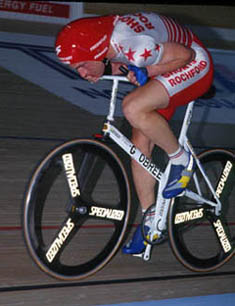
"Obree called his bike "Old Faithful". It has a narrow bottom bracket, around which the cranks revolve, to bring his legs closer together, as he thought this is the "natural" position. As shown in the film, he thought a tread of "one banana" would be ideal. The bike has no top tube, so that his knees did not hit the frame. The chainstays are not horizontal so that the cranks can pass with a narrow bottom bracket. The fork had only one blade, carefully shaped to be as narrow as possible."

 01-06-12 | 08:38 PM
#21
Senior Member
Joined: Mar 2007
Posts: 6,401
Likes: 19
"Q" is a term invented by Grant Peterson of Bridgestone/Rivendell. I kind of like his schtick but there was no real reason to invent another word to replace "tread".
Tread was considered critical by early racers. Aluminum cranks were not adopted by racers until decades after they had proven reliable, primarily because of their higher tread. During the period from about 1920 to about 1960, narrow tread was considered critical to a racer's success. Cottered steel cranks are normally at least a centimeter narrower than vintage aluminum cranks - and through the 80s and 90s, tread got progressively higher. I suspect that Grant reinvigorated (sort of) the discussion about tread because the triples used on fat chainstay mountain bikes with wide rear spacing were getting ludicrous. So now some of us are at the point where we consider tread as a factor in comfort, or even performance: Aside from Obree, I'm aware of a special TT bike made by Trek for Armstrong, the "secret" of which was lower tread than typical. (Armstrong used it in training, but as he wasn't physiologically adapted to it, it didn't work for him and was discarded.)
Personally, I think some folks (Jan Heine, for instance) have gone a little overboard. I am sure some people like the lowest possible tread, and frankly, I'm sure a lot of people don't notice it at all. I'm kind of in the middle: really wide tread makes me feel like I'm on horseback, but really narrow tread makes my knees hurt. So I simply avoid the extremes, and otherwise don't think about it. I suspect that it's something most people don't need to worry about.
Tread was considered critical by early racers. Aluminum cranks were not adopted by racers until decades after they had proven reliable, primarily because of their higher tread. During the period from about 1920 to about 1960, narrow tread was considered critical to a racer's success. Cottered steel cranks are normally at least a centimeter narrower than vintage aluminum cranks - and through the 80s and 90s, tread got progressively higher. I suspect that Grant reinvigorated (sort of) the discussion about tread because the triples used on fat chainstay mountain bikes with wide rear spacing were getting ludicrous. So now some of us are at the point where we consider tread as a factor in comfort, or even performance: Aside from Obree, I'm aware of a special TT bike made by Trek for Armstrong, the "secret" of which was lower tread than typical. (Armstrong used it in training, but as he wasn't physiologically adapted to it, it didn't work for him and was discarded.)
Personally, I think some folks (Jan Heine, for instance) have gone a little overboard. I am sure some people like the lowest possible tread, and frankly, I'm sure a lot of people don't notice it at all. I'm kind of in the middle: really wide tread makes me feel like I'm on horseback, but really narrow tread makes my knees hurt. So I simply avoid the extremes, and otherwise don't think about it. I suspect that it's something most people don't need to worry about.
01-08-12 | 03:16 AM
#22
Senior Member
Joined: Jan 2010
Posts: 111
Likes: 1
Interesting to read sheldon about the low profile cranks. If I'm understanding him I guess I'd have to disagree, since there doesn't seem to be much standardization of frame dimensions along chainstay widths. I've often had problems with chainring to frame clearance when trying to minimize q, but not often with crank arm to frame clearance. With the low profile crank design, and the outward bend to the cranks, (more space between the outer chainring and arm) you can often bring the chainrings closer with a narrower bb spindle, but the arms will still be out well away from the frame. With an older straighter armed crank and the right spindle length, you can often get much narrower, but then the issue of front derailer compatibility may come up. Crank and frame and front derailer makers must collaborate on these measurements, I wish they would show them more clearly. If I were looking for a new bike, q measurements and possibilities with compatible and hopefully modern parts would be a big plus.
01-09-12 | 02:29 AM
#23
Senior Member
Joined: Jan 2010
Posts: 111
Likes: 1
The sheldonbrown link in this thread that goes to a bridgestone article sounds right to me, I was thinking of a different description of low profile cranks that I think was also on sheldons site, sorry for any confusion. I tried to measure a few old road bikes, 80's, 126mm rear spacing, with some very straight, pretty straight, and obviously angled but maybe not low profile cranks. These are bikes that I've fiddled with to try to minimize q so the chainrings are all pretty close to the chainstays. The frame chainstay dimensions differed a little bit, as well as the chainring to frame clearances, but by far the biggest differences were crank arm to chainstay.
Interestingly, the lowest q of 137mm was with an old cannondale with the straighest crank I had, thanks to the dents in the chainstays for both arms and chainrings there's still plenty of clearance all around. With the most angled cranks on another old but similar cdale, q goes to 148mm, with chainrings still close to the frame. A bridgestone did seem to be narrower across the chainstays at the crank arms, but at 142mm q, with plenty of arm to stay clearance with the pretty straight cranks, the chainring nearly rubs the (undented) chainstay.
Interestingly, the lowest q of 137mm was with an old cannondale with the straighest crank I had, thanks to the dents in the chainstays for both arms and chainrings there's still plenty of clearance all around. With the most angled cranks on another old but similar cdale, q goes to 148mm, with chainrings still close to the frame. A bridgestone did seem to be narrower across the chainstays at the crank arms, but at 142mm q, with plenty of arm to stay clearance with the pretty straight cranks, the chainring nearly rubs the (undented) chainstay.
01-09-12 | 06:40 AM
#24
Senior Member
Joined: Apr 2005
Posts: 17,197
Likes: 761
From: Ann Arbor, MI
Bikes: 1980 Masi, 1984 Mondonico, 1984 Trek 610, 1980 Woodrup Giro, 2005 Mondonico Futura Leggera ELOS, 1967 PX10E, 1971 Peugeot UO-8
If you start playing with triples, you'll see a lot 165 mm Q's.
Chainstays on better bikes are shaped by the builder - not likely to be the same across the board, if you're measuring down to the millimeter (as we should).
Chainstays on better bikes are shaped by the builder - not likely to be the same across the board, if you're measuring down to the millimeter (as we should).
01-09-12 | 12:39 PM
#25

Old fart

Joined: Nov 2004
Posts: 26,411
Likes: 5,350
From: Appleton WI
Bikes: Several, mostly not name brands.

