


Hardened but not cracked leather Brooks
 06-09-12 | 10:47 PM
#1
Thread Starter
Senior Member
Joined: Apr 2012
Posts: 164
Likes: 6
Hardened but not cracked leather Brooks
Hey, I have an older hardened brooks saddle. The leather is almost rock hard, but no cracks and otherwise looks good. I want to re-hydrate it so that it will form to my shape (my butt) better. Also, I am kind of afraid that being hardened it will be more liable to cracking if I use it (maybe I am wrong about this).
I've searched the forum - I see a million different exotic product suggestions, some less exotic suggestions and some suggesting a soak in water before using proofide. I have brooks proofide. I don't have easy access to a horse saddle shop or freshly squeezed cod oil or whatever. The proofide doesn't seem to be rehydrating the leather. I am looking for a definitive answer on a product that will work to rehydrate/soften up the leather a bit and is not sourced from a small archipelago off the horn of Africa (can be easily obtained). Not something for regular conditioning - I have the proofide.
Suggestions appreciated. Thanks!
I've searched the forum - I see a million different exotic product suggestions, some less exotic suggestions and some suggesting a soak in water before using proofide. I have brooks proofide. I don't have easy access to a horse saddle shop or freshly squeezed cod oil or whatever. The proofide doesn't seem to be rehydrating the leather. I am looking for a definitive answer on a product that will work to rehydrate/soften up the leather a bit and is not sourced from a small archipelago off the horn of Africa (can be easily obtained). Not something for regular conditioning - I have the proofide.
Suggestions appreciated. Thanks!
 06-10-12 | 12:16 AM
#2

Senior Member
Joined: Jan 2011
Posts: 83
Likes: 3
From: Berkeley, CA
I've used neatsfoot oil as recommended by Sheldon Brown and others on this forum. I bought it from a shoe shop that sold leather shoes. To 'baptize' the saddle, as Sheldon calls it, I used some aluminum foil molded around it. Turned the thing upside down, poured the oil in there, let it sit for a few hours and finally poured the remaining oil back into the bottle. I treated two old saddles and both were softened but one of them eventually tore anyway. The second one is still going strong. It doesn't look like a brand new Brooks but it's the most comfortable saddle I have.
06-10-12 | 12:37 AM
#3
Thread Starter
Senior Member
Joined: Apr 2012
Posts: 164
Likes: 6
in re: Sheldon, I am not breaking in a new saddle so much as bringing back to life an old, fossilized one. I hope it will work the same nonetheless? OK I will try this since you are the only suggestion.
Thanks
Thanks
06-10-12 | 12:46 AM
#4
Senior Member
Joined: Jan 2011
Posts: 83
Likes: 3
From: Berkeley, CA
The oil will soften the leather but if cracks have already developed from the drying out, treatment will not make them disappear. My first saddle had developed some cracks so although the oil softened the leather, the cracks grew and finally tore through the saddle. Since your saddle doesn't have any cracks it should be fine.
06-10-12 | 02:50 AM
#5

Freewheel Medic


Joined: Oct 2005
Posts: 13,569
Likes: 3,314
From: An Island on the Coast of GA!
Bikes: Snazzy* Schwinns, Classy Cannondales & a Super Pro Aero Lotus (* Ed.)
Pictures would be helpful. 
Booty sweat is also a big help. Keep Proofiding until the hottest, most humid day. Mount on bike and ride and sweat on that ole' Brooks for as many miles as you can endure. Repeat, repeat, repeat.
At this point your booty will be broken into the Brooks and the hardness will not phase you one little bit. But if it still does, you do not have a Brooks booty and probably never will.
  At that point offer it up as trade booty (your Brooks,
  not your booty) for your next bike project.
Booty sweat is also a big help. Keep Proofiding until the hottest, most humid day. Mount on bike and ride and sweat on that ole' Brooks for as many miles as you can endure. Repeat, repeat, repeat.
At this point your booty will be broken into the Brooks and the hardness will not phase you one little bit.
But if it still does, you do not have a Brooks booty and probably never will. At that point offer it up as trade booty (your Brooks, not your booty) for your next bike project.
__________________
Bob
Enjoying the GA coast all year long!
Thanks for visiting my website: www.freewheelspa.com
Bob
Enjoying the GA coast all year long!
Thanks for visiting my website: www.freewheelspa.com
06-10-12 | 05:31 AM
#6

Senior Member
Joined: Apr 2005
Posts: 16,748
Likes: 138
From: Wherever
Something might help, if you're not already doing it. Apply the Proofide under heat. Not a lot, but melt that stuff down into the leather, and apply more. Proofide is a mixture of oils suspended in waxes, so it's designed to sit near the surface of the leather, thus protecting it but not over-softening it. If you "melt" it in with a hair dryer or carefully used heat gun, it will penetrate more deeply. I have a barely used Pro model from the early 70's. It's hard as a rock. It was built that way. I don't mind and just use Proofide on it once in a while.
 06-10-12 | 05:48 AM
#8


Senior Member
Joined: Apr 2005
Posts: 17,196
Likes: 761
From: Ann Arbor, MI
Bikes: 1980 Masi, 1984 Mondonico, 1984 Trek 610, 1980 Woodrup Giro, 2005 Mondonico Futura Leggera ELOS, 1967 PX10E, 1971 Peugeot UO-8
I had a hardened B17 bought off Ebay. I didn't do any hydrating, I just washed it with saddle soap, let it dry, then did a light coat of Proofide on the top and heavier on th bottom. I left in the sun for an afternoon, and it was greatly improved. This was enough to let my discover that the sit bone areas collapsed under my weight, leaving the hatchet effect. The (I told my buyer about it) buyer did not complain. I have a B17 Imp that is pretty decent.
As many stories as exist about the success of alternatives to Proofide, stories exist about their failures, up to destroying a good saddle.
As many stories as exist about the success of alternatives to Proofide, stories exist about their failures, up to destroying a good saddle.
06-11-12 | 11:25 PM
#9
Thread Starter
Senior Member
Joined: Apr 2012
Posts: 164
Likes: 6
As many stories as exist about the success of alternatives to Proofide, stories exist about their failures, up to destroying a good saddle.
Anyway, here are some pics by request, don't know if you can 'see' hardness. I've been using the proofide every day, letting it sit for 24 hrs then polishing and reapplying. I may try to heat treatment since this makes sense as it is wax based.
06-11-12 | 11:37 PM
#10
If solid but just petrified (rock hard) I would soak it in water overnight. I've done one (on advice from Tony Colegrave) and it came out very good and useable.
The saddle was soaked in plain water over night with the adjusting nut backed off completely. Then tightly stuffed inside with newspapers and tied around the skirts with a couple of toe straps to keep it's shape and let to air dry for a couple of days out of sunlight.
When dry I used just a bit of proofhide rubbed into the top and adjusted the tension carefully. Then began riding it.
Over oiling it will soften it but probably cause it to tear once you start riding it. I had that happen to a rare Campy Brooks that a previous owner doused in Neatsfoot oil to "save". Tore in half after a couple of rides.
The saddle was soaked in plain water over night with the adjusting nut backed off completely. Then tightly stuffed inside with newspapers and tied around the skirts with a couple of toe straps to keep it's shape and let to air dry for a couple of days out of sunlight.
When dry I used just a bit of proofhide rubbed into the top and adjusted the tension carefully. Then began riding it.
Over oiling it will soften it but probably cause it to tear once you start riding it. I had that happen to a rare Campy Brooks that a previous owner doused in Neatsfoot oil to "save". Tore in half after a couple of rides.
06-11-12 | 11:47 PM
#11

Rustbelt Rider
Joined: Oct 2008
Posts: 9,105
Likes: 390
From: Canton, OH
Bikes: 1990 Trek 1420 - 1978 Raleigh Professional - 1973 Schwinn Collegiate - 1974 Schwinn Suburban
Yea I guess that's what I am seeing. Someone PM'd me to beg me not to use neatsfoot. While others swear by it. I don't get how no opinion has coalesced around a best practice on this.
Anyway, here are some pics by request, don't know if you can 'see' hardness. I've been using the proofide every day, letting it sit for 24 hrs then polishing and reapplying. I may try to heat treatment since this makes sense as it is wax based.


Anyway, here are some pics by request, don't know if you can 'see' hardness. I've been using the proofide every day, letting it sit for 24 hrs then polishing and reapplying. I may try to heat treatment since this makes sense as it is wax based.
That looks similar to a B15 that had once. That saddle was rock hard and the leather was THICK! I compared it to my Brooks Professional and found it was noticeably thicker. Maybe you can do something, but It might just be a hard saddle.
__________________
|^^^^^^^^^^^^^^| ||
|......GO.BROWNS........| ||'|";, ___.
|_..._..._______===|=||_|__|..., ] -
"(@)'(@)"""''"**|(@)(@)*****''(@)
|^^^^^^^^^^^^^^| ||
|......GO.BROWNS........| ||'|";, ___.
|_..._..._______===|=||_|__|..., ] -
"(@)'(@)"""''"**|(@)(@)*****''(@)
06-12-12 | 12:13 AM
#12
Senior Member
Joined: Jan 2011
Posts: 83
Likes: 3
From: Berkeley, CA
I must admit I have very little experience attempting to revive dried out saddles so I apologize for the rather hasty advice. As noted earlier, I have only ever used neatsfoot on two old saddles one of which eventually tore in half. It may also be worth noting that I am a rather light rider at ~140 lbs. In both cases the saddles were in pretty poor shape with many small cracks on the surface. I'll try to get a few pictures so you can compare condition (yours is in much better shape). I'm still rather apprehensive about how the second one will hold up. I've only put a couple dozen miles on it so far. It is probably also worth noting that I have never tried proofhide.
Edit:
My saddle for comparison:
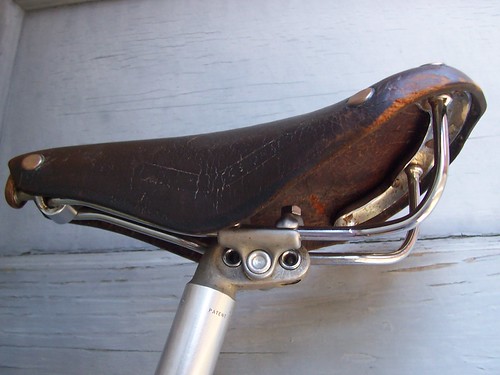
000_0176 by Mon Jaque, on Flickr
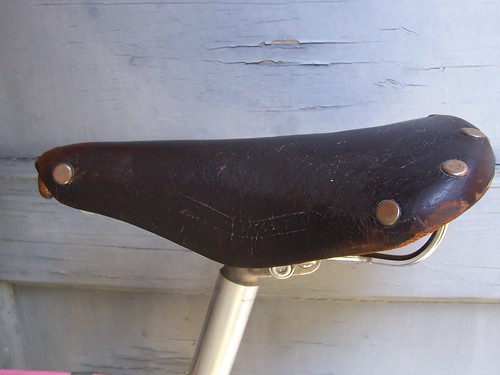
000_0179 by Mon Jaque, on Flickr
Edit:
My saddle for comparison:
000_0176 by Mon Jaque, on Flickr
000_0179 by Mon Jaque, on Flickr
Last edited by Rodion R; 06-12-12 at 02:08 PM.
06-12-12 | 03:19 AM
#13
Senior Member
Joined: Apr 2005
Posts: 16,748
Likes: 138
From: Wherever
You know what I'd do to it? Nothing. You've Proofide'd it now. If you find it uncomfortable as is, wear padded cycling shorts. That saddle probably came new as hard as you see it now. Or nearly so. It's a beauty. They were very thick and tough back then. That's why they lasted so long if properly cared for.
06-12-12 | 03:39 AM
#14
Freewheel Medic
Joined: Oct 2005
Posts: 13,569
Likes: 3,314
From: An Island on the Coast of GA!
Bikes: Snazzy* Schwinns, Classy Cannondales & a Super Pro Aero Lotus (* Ed.)
I agree with rootboy, except to say, the padded shorts don't always help. Some folks never find a traditional leather saddle comfortable. Have you tried riding it? Have you ridden on any other Brooks, Ideale, Wrights, etc., and did you find them comfortable?
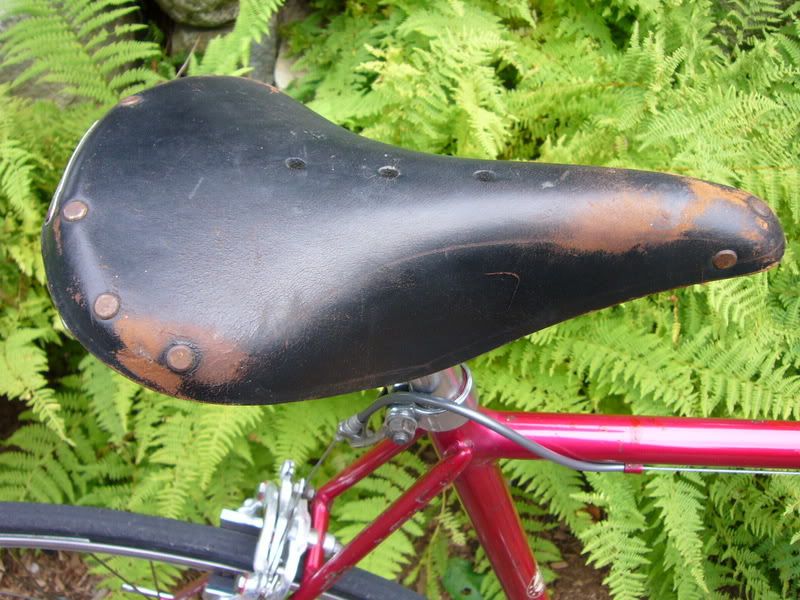
I agree almost with mkeller234, but it looks to be, more specifically a black B-15N. The B-15s I've seen did not have their skirts pierced for lacing. Mine have all turned brown over the years.
B-15
B-15N
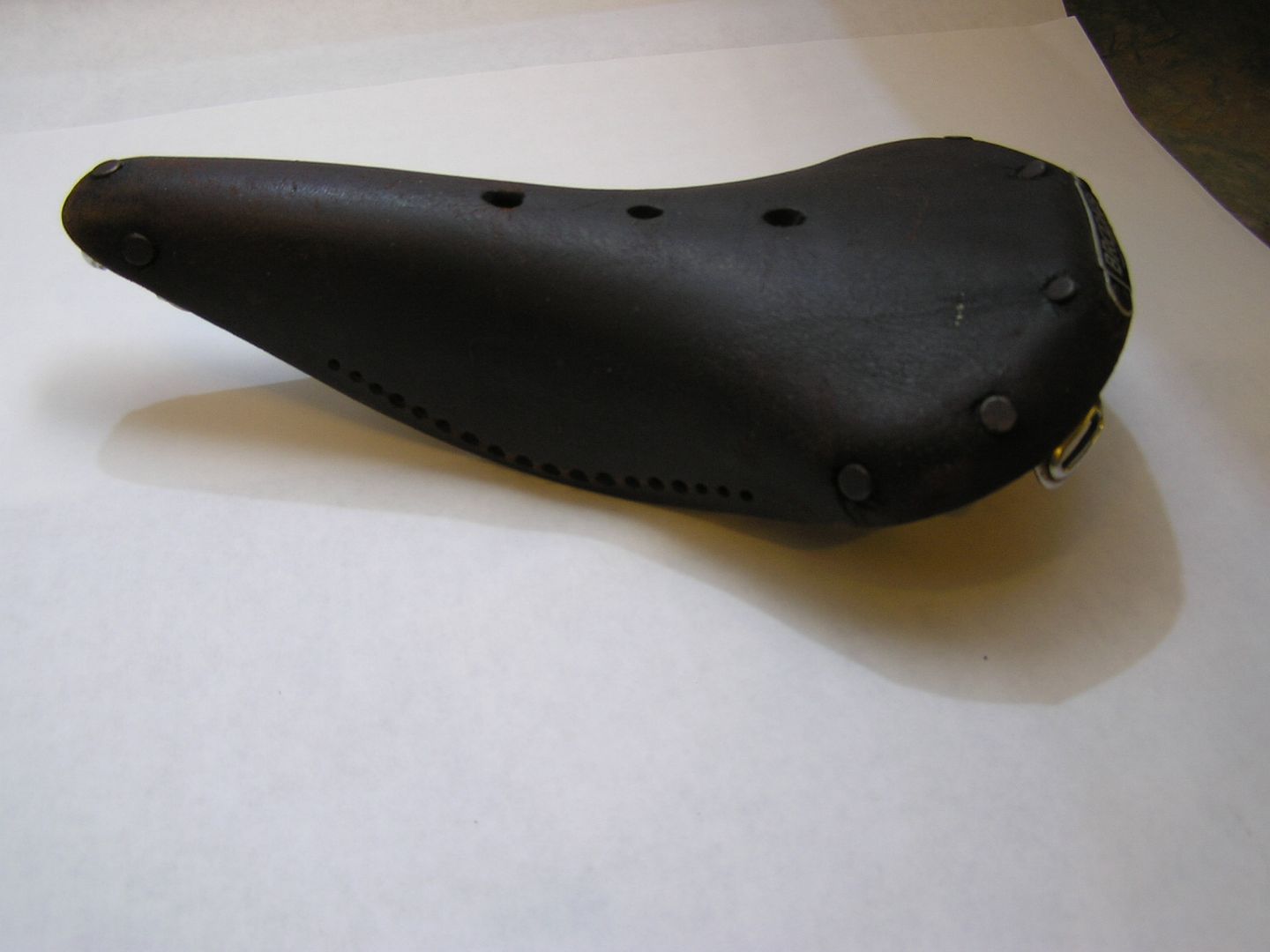
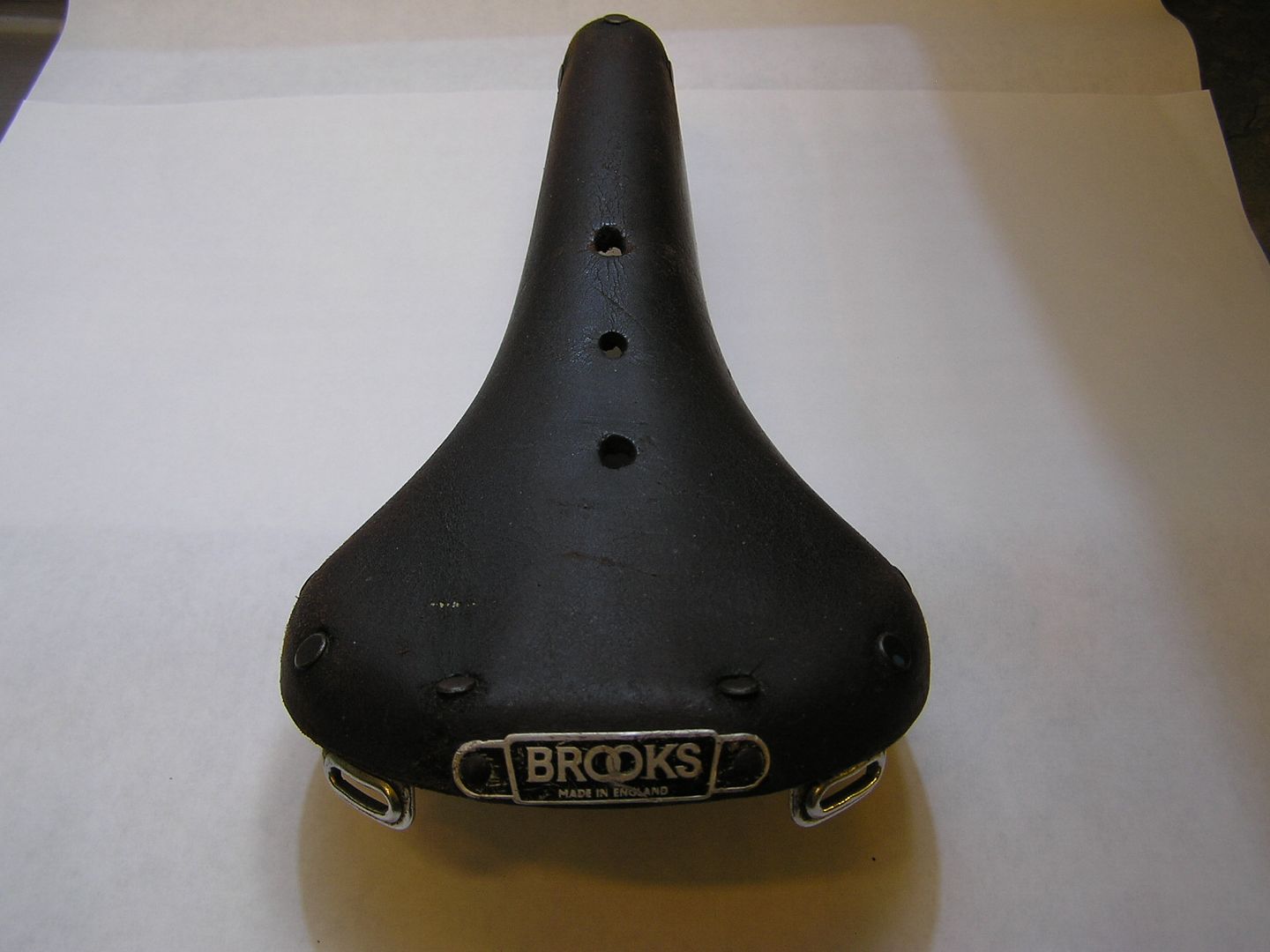
OP's Brooks


I agree almost with mkeller234, but it looks to be, more specifically a black B-15N. The B-15s I've seen did not have their skirts pierced for lacing. Mine have all turned brown over the years.
B-15
B-15N
OP's Brooks
__________________
Bob
Enjoying the GA coast all year long!
Thanks for visiting my website: www.freewheelspa.com
Bob
Enjoying the GA coast all year long!
Thanks for visiting my website: www.freewheelspa.com
06-12-12 | 04:25 AM
#15

Senior Member
Joined: Apr 2006
Posts: 4,058
Likes: 943
From: Washington County, Vermont, USA
Bikes: 1973-4 Gitane Tour de France, early 1970's Lejeune, 1970 Italvega Super Speciale, 2010 Surly Long Haul Trucker 26
Soak it in a plastic bag full of Lexol. It's worked very well for me. You can get it at any good leather shop.
__________________
www.redclovercomponents.com
"Progress might have been all right once, but it has gone on too long."
--Ogden Nash
www.redclovercomponents.com
"Progress might have been all right once, but it has gone on too long."
--Ogden Nash
Last edited by jonwvara; 06-12-12 at 04:26 AM. Reason: Am editor
06-12-12 | 04:41 AM
#16
Senior Member
Joined: Apr 2005
Posts: 17,196
Likes: 761
From: Ann Arbor, MI
Bikes: 1980 Masi, 1984 Mondonico, 1984 Trek 610, 1980 Woodrup Giro, 2005 Mondonico Futura Leggera ELOS, 1967 PX10E, 1971 Peugeot UO-8
Yea I guess that's what I am seeing. Someone PM'd me to beg me not to use neatsfoot. While others swear by it. I don't get how no opinion has coalesced around a best practice on this.
Anyway, here are some pics by request, don't know if you can 'see' hardness. I've been using the proofide every day, letting it sit for 24 hrs then polishing and reapplying. I may try to heat treatment since this makes sense as it is wax based.
Anyway, here are some pics by request, don't know if you can 'see' hardness. I've been using the proofide every day, letting it sit for 24 hrs then polishing and reapplying. I may try to heat treatment since this makes sense as it is wax based.
That saddle looks awfully good. There aren't any signs of collapse. I think the main and safest technique for "tenderizing" is to ride the bike, once there is a little bit of oil in the leather, to help keep it from collapsing. If you haven't ridden it yet, I'd use the saddle soap with a damp cloth, don't rinse it off, and let it dry. Then Proofide the top and bottom lightlu. Lace it but not with high tension, just tight enough to prevent splaying, and I think it's more important to lace under the "Brooks" impressions on the sides than at the rear or front. Try riding it, and set the saddle height for test rides so you can easily just lift your butt off a little bit. It WILL start hard, and you might really not like that.
Consider the cost of Proofide. First, a new B17N will set you back $90 to $140. A tin of Proofide, though tiny, is about $12 to $16, and I'd stongly recommend getting a fresh one, it can become rancid over time. I truly don't believe there's fast, safe way to make it more supple. I think the math is obvious.
06-12-12 | 04:59 AM
#17

Get off my lawn!

Joined: Nov 2010
Posts: 6,035
Likes: 119
From: The Garden State
Bikes: 1917 Loomis, 1923 Rudge, 1930 Hercules Renown, 1947 Mclean, 1948 JA Holland, 1955 Hetchins, 1957 Carlton Flyer, 1962 Raleigh Sport, 1978&81 Raleigh Gomp GS', 2010 Raliegh Clubman
PLEASE DON'T KILL IT!
Hit the brakes!!!! There is a huge difference between a hard, stiff leather Brooks ( the way Brooks are intended to be) and a dryed out leather saddle. It's had to determine the conditon via photos. If the underside of the saddle feels dry and parched, it's dry; if it feels leather/suede like it's fine. If it's dry, an application of proofhide or some other wax based product will help. It will still be hard (because it's supposed to be) but the leather will be conditioned) Soaking in water will temporarily soften the saddle (you can reform it through blocking) but in the end the process will dry it out ( like chapped lips in the winter ) Oils will break the leather fibers down and soften the saddle, making for a quick break in but risking a shorter useful life.
The safest and surest thing to do is proofhide the saddle top and bottom, let is sit overnight then go for a ride. If you've never ridded a hard leather saddle it may take some time to get used to. Most butt pain is not from the saddle being hard nor sufficient break in but poor adjustment. The saddle should have the nose slightly elevated but not so much as to (as once commented here ) make your "Pee Pee go Sleepy"
I hope you enjoy your saddle, don't gunk it up with all kinds of break methods cuz inthe end the odds are it will be ruined. keep it hard and prestine and you can always sell it if you don't like.
Hit the brakes!!!! There is a huge difference between a hard, stiff leather Brooks ( the way Brooks are intended to be) and a dryed out leather saddle. It's had to determine the conditon via photos. If the underside of the saddle feels dry and parched, it's dry; if it feels leather/suede like it's fine. If it's dry, an application of proofhide or some other wax based product will help. It will still be hard (because it's supposed to be) but the leather will be conditioned) Soaking in water will temporarily soften the saddle (you can reform it through blocking) but in the end the process will dry it out ( like chapped lips in the winter ) Oils will break the leather fibers down and soften the saddle, making for a quick break in but risking a shorter useful life.
The safest and surest thing to do is proofhide the saddle top and bottom, let is sit overnight then go for a ride. If you've never ridded a hard leather saddle it may take some time to get used to. Most butt pain is not from the saddle being hard nor sufficient break in but poor adjustment. The saddle should have the nose slightly elevated but not so much as to (as once commented here ) make your "Pee Pee go Sleepy"
I hope you enjoy your saddle, don't gunk it up with all kinds of break methods cuz inthe end the odds are it will be ruined. keep it hard and prestine and you can always sell it if you don't like.
Last edited by Velognome; 06-12-12 at 05:03 AM.
06-12-12 | 05:23 AM
#18
Senior Member
Joined: Apr 2005
Posts: 16,748
Likes: 138
From: Wherever
10-4 to the above two posts. They're supposed to be hard. You won't find a consensus on this subject because there are no hard and fast facts when it comes to this. When I first learned about them, you didn't get a nice, pliable, comfortable saddle until you put in the miles and paid your dues. Trying to make them soft pre-maturely usually resulted in pre-mature saddle death.
However, the OP's concern that the old leather has dried out is valid. The natural oils in the leather do oxidize and dissipate after 30 to 40 years, especially in arid climates, and in my experience it's very difficult to restore those natural oils once they're gone. You've done what you can with a few applications of a a wax/oil treatment. It may still crack if the leather has dried out, but the best thing is just to ride it and find out.
However, the OP's concern that the old leather has dried out is valid. The natural oils in the leather do oxidize and dissipate after 30 to 40 years, especially in arid climates, and in my experience it's very difficult to restore those natural oils once they're gone. You've done what you can with a few applications of a a wax/oil treatment. It may still crack if the leather has dried out, but the best thing is just to ride it and find out.
06-12-12 | 06:14 AM
#19

multimodal commuter
Joined: Nov 2006
Posts: 19,810
Likes: 597
From: NJ, NYC, LI
Bikes: 1940s Fothergill, 1959 Allegro Special, 1963? Claud Butler Olympic Sprint, Lambert 'Clubman', 1974 Fuji "the Ace", 1976 Holdsworth 650b conversion rando bike, 1983 Trek 720 tourer, 1984 Counterpoint Opus II, 1993 Basso Gap, 2010 Downtube 8h, and...
+1 to the most recent posts.
Obviously I haven't tried your saddle, so what do I know. But here's what I can tell you:
--your saddle looks exactly the way a good old Brooks saddle should look. Condition, judging from the photo, is 10 out of 10.
--your description, "hard as rock" is not encouraging. I prefer "hard as plywood" or "hard as fiberglass." You should be able to knock it without your knuckles and get a nice hard hollow sound without hurting yourself.
Aside from that, they only get soft at the end of their useful lives. Hard is good. I believe the current ones are a bit softer, which is a marketing decision; I guess the current Brooks company prefers to sell more saddles rather than to sell saddles that last 40+ years. If you want a softer saddle, maybe that's not the one for you. But I don't recommend that. I just rode a century on Sunday on a Wrights saddle that looks great but is, in my opinion, too soft. And I was beginning to hate it by the time I got home. A hard saddle supports your weight in just a couple places, namely bones that can handle it well, while a soft one distributes that weight over a lot of soft tissue that doesn't handle it as well.
Obviously I haven't tried your saddle, so what do I know. But here's what I can tell you:
--your saddle looks exactly the way a good old Brooks saddle should look. Condition, judging from the photo, is 10 out of 10.
--your description, "hard as rock" is not encouraging. I prefer "hard as plywood" or "hard as fiberglass." You should be able to knock it without your knuckles and get a nice hard hollow sound without hurting yourself.
Aside from that, they only get soft at the end of their useful lives. Hard is good. I believe the current ones are a bit softer, which is a marketing decision; I guess the current Brooks company prefers to sell more saddles rather than to sell saddles that last 40+ years. If you want a softer saddle, maybe that's not the one for you. But I don't recommend that. I just rode a century on Sunday on a Wrights saddle that looks great but is, in my opinion, too soft. And I was beginning to hate it by the time I got home. A hard saddle supports your weight in just a couple places, namely bones that can handle it well, while a soft one distributes that weight over a lot of soft tissue that doesn't handle it as well.
06-12-12 | 06:47 AM
#20
Senior Member
Joined: Apr 2005
Posts: 16,748
Likes: 138
From: Wherever
I'd like to add that I think you get many varying opinions on a question like this is precisely because there are no hard and fast rules, mostly just opinions. Some well-founded, others not. Including mine. While Otis' suggestion sounds counter-intuitive to me, far be it from me to discount it. I won't. Especially since it came from a guy named Tony Colegrave. That guy certainly knows his stuff. There are a lot of roads to get to Rome, some better than others, no doubt. There are surely many techniques mentioned here that work, and some that in my opinion are misguided. But it's just my opinion, based on what I've learned, which isn't everything.
I think the last sentence in the above post is a very important point.
I think the last sentence in the above post is a very important point.
06-12-12 | 07:08 AM
#21

Phyllo-buster
Joined: Jan 2010
Posts: 9,276
Likes: 2,698
From: Nova Scotia
Bikes: roadsters, club bikes, fixed and classic
PLEASE DON'T KILL IT!
Hit the brakes!!!! There is a huge difference between a hard, stiff leather Brooks ( the way Brooks are intended to be) and a dryed out leather saddle. ...don't gunk it up with all kinds of break methods cuz inthe end the odds are it will be ruined. keep it hard and prestine and you can always sell it if you don't like.
Hit the brakes!!!! There is a huge difference between a hard, stiff leather Brooks ( the way Brooks are intended to be) and a dryed out leather saddle. ...don't gunk it up with all kinds of break methods cuz inthe end the odds are it will be ruined. keep it hard and prestine and you can always sell it if you don't like.
06-12-12 | 07:15 AM
#22
Senior Member
Joined: Jan 2008
Posts: 12,940
Likes: 363
I vote with Road Fan and Velognome, also. A new Brooks is "hard" to most people. Riding it and using Proofhide as Brooks recommends are all I have ever done to my Pros and B-17's and they wear in nicely with pedaling time.
06-12-12 | 08:21 AM
#23
Get off my lawn!
Joined: Nov 2010
Posts: 6,035
Likes: 119
From: The Garden State
Bikes: 1917 Loomis, 1923 Rudge, 1930 Hercules Renown, 1947 Mclean, 1948 JA Holland, 1955 Hetchins, 1957 Carlton Flyer, 1962 Raleigh Sport, 1978&81 Raleigh Gomp GS', 2010 Raliegh Clubman
rhm
Aside from that, they only get soft at the end of their useful lives. Hard is good.
Aside from that, they only get soft at the end of their useful lives. Hard is good.
 06-12-12 | 08:42 AM
#24
I'd like to add that I think you get many varying opinions on a question like this is precisely because there are no hard and fast rules, mostly just opinions. Some well-founded, others not. Including mine. While Otis' suggestion sounds counter-intuitive to me, far be it from me to discount it. I won't. Especially since it came from a guy named Tony Colegrave. That guy certainly knows his stuff. There are a lot of roads to get to Rome, some better than others, no doubt. There are surely many techniques mentioned here that work, and some that in my opinion are misguided. But it's just my opinion, based on what I've learned, which isn't everything.
I think the last sentence in the above post is a very important point.
I think the last sentence in the above post is a very important point.
Soaking a saddle in anything is a fix, not a substitution for normal break-in.
06-12-12 | 08:50 AM
#25
Senior Member
Joined: Mar 2012
Posts: 4,869
Likes: 1,108
From: Tallahassee, FL
Proofide, proofide and then some more proofide. And some more after that. I have an old Cinelli saddle that I just used repeated treatments on over the course of a few weeks and it returned to decent condition very nicely.