


Rotating biopace rings
 12-04-14 | 07:27 AM
#51

Senior Member
Joined: Jun 2010
Posts: 604
Likes: 1
From: Richmond, TX
Bikes: 1988 Cannondale Criterium SR500
When one Googles for the information regarding the use of Biopace as rotor q-rings, one is directed to these threads which are act thus in a way similar to specialised wikipedia pages providing solutions to in-depth problems. I hope someone who, spending some time Googling like me, finds the information regarding the rotation of Biopace to act as Rotor Q-Rings useful. There are still a lot of Biopace around, at about a one 10th of the price.
I appreciate the resurrection of these threads. My cannondale has biopace and I've been trying to read about it. I've had it for 4 years or so I guess and had it out on loan for about 3 of the 4. The dozen or so times I rode it, I couldnt even tell a difference. It took a guy out on a ride to tell me about it a week ago. How embarrasing not to know that about a bike you are riding lol. I've never felt a difference and that late 80's Cannondale Crit Series feels considerably faster than my 2009(i forget the actual year) Specialized Allez.
 12-04-14 | 07:53 AM
#52


Oval rings oriented to achieve the highest pedaling load at the horizontal crank position per the Rotor and Q ring designs have been around since at least the 1930s and probably before that. That fad does indeed come and go.
Shimano's engineers analyzed the running stride as it pertains to cycling and recognized that the human leg has evolved to deliver maximum force most efficiently with a less acute knee angle, i.e., with the leg closer to full extension, than that seen with circular rings, let alone Rotor or Q rings. In addition, they recognized that the proportion of time spent delivering power is lower per running stride than per pedal revolution with circular rings (let alone Rotor, or Q rings).
Biopace rings are designed to mimic the mechanics of running by increasing the effective gear ratio at the point in the pedal stroke that corresponds to the running foot strike and also increasing the rest period per stroke. The compromise is that the design works best at up to the average running pace of 90 to 95 strides per minute and less well at higher cadences.
Biopace was reviewed in the various bike magazines at the time of its introduction as a brilliant advance in the ergonomics of cycling. Then, after 6 months or so, the reviewers started hearing complaints from racers about the uneven pedal stroke interfering with high-cadence attacks and sprints.
Since the only thing that sells more magazines than "It rules!" is "It sucks!," the benefits of Biopace for the majority of riders for most riding were thereafter ignored, and the design was vilified. The benefits are subtle, and subtle doesn't sell.
The Rotor/Q ring design appeals to common sense; the advantages of the Biopace design are nonintuitive. Common sense isn't always reliable; that's why science was invented. Turn your Biopace rings to any orientation you like, but give the Shimano engineers credit for knowing what they were doing.
Shimano's engineers analyzed the running stride as it pertains to cycling and recognized that the human leg has evolved to deliver maximum force most efficiently with a less acute knee angle, i.e., with the leg closer to full extension, than that seen with circular rings, let alone Rotor or Q rings. In addition, they recognized that the proportion of time spent delivering power is lower per running stride than per pedal revolution with circular rings (let alone Rotor, or Q rings).
Biopace rings are designed to mimic the mechanics of running by increasing the effective gear ratio at the point in the pedal stroke that corresponds to the running foot strike and also increasing the rest period per stroke. The compromise is that the design works best at up to the average running pace of 90 to 95 strides per minute and less well at higher cadences.
Biopace was reviewed in the various bike magazines at the time of its introduction as a brilliant advance in the ergonomics of cycling. Then, after 6 months or so, the reviewers started hearing complaints from racers about the uneven pedal stroke interfering with high-cadence attacks and sprints.
Since the only thing that sells more magazines than "It rules!" is "It sucks!," the benefits of Biopace for the majority of riders for most riding were thereafter ignored, and the design was vilified. The benefits are subtle, and subtle doesn't sell.
The Rotor/Q ring design appeals to common sense; the advantages of the Biopace design are nonintuitive. Common sense isn't always reliable; that's why science was invented. Turn your Biopace rings to any orientation you like, but give the Shimano engineers credit for knowing what they were doing.
Last edited by Trakhak; 12-04-14 at 08:00 AM.

 12-04-14 | 09:02 AM
#53

What??? Only 2 wheels?


Joined: Apr 2010
Posts: 13,501
Likes: 996
From: Boston-ish, MA
Bikes: 72 Peugeot UO-8, 82 Peugeot TH8, 87 Bianchi Brava, 76? Masi Grand Criterium, 74 Motobecane Champion Team, 86 & 77 Gazelle champion mondial, 81? Grandis, 82? Tommasini, 83 Peugeot PF10
 With that in mind I'll confess that I've never used either Biopace or Rotor/Q. And that won't stop me from making the statement:
Biopace always struck me as a solution looking for a problem, the answer to a question that was never asked in the first place.
__________________
Real cyclists use toe clips.
With great bikes comes great responsibility.
jimmuller
Real cyclists use toe clips.
With great bikes comes great responsibility.
jimmuller
12-04-14 | 10:11 AM
#54

Senior Member

Joined: Aug 2011
Posts: 22,676
Likes: 2,643
From: CID
Bikes: 1991 Bianchi Eros, 1964 Armstrong, 1988 Diamondback Ascent, 1988 Bianchi Premio, 1987 Bianchi Sport SX, 1980s Raleigh mixte (hers), All-City Space Horse (hers)
Well, I've never eaten many food that I just know I won't like. With that in mind I'll confess that I've never used either Biopace or Rotor/Q. And that won't stop me from making the statement:
Biopace always struck me as a solution looking for a problem, the answer to a question that was never asked in the first place.
With that in mind I'll confess that I've never used either Biopace or Rotor/Q. And that won't stop me from making the statement:Biopace always struck me as a solution looking for a problem, the answer to a question that was never asked in the first place.
Last edited by ThermionicScott; 12-04-14 at 10:14 AM.
12-05-14 | 01:50 PM
#55

Senior Member
Joined: Nov 2007
Posts: 1,144
Likes: 92
From: Yamaguchi City, Japan
Bikes: Trek Madone 5.2 SL 2007, Scott CRI team Issue 2005, ok KG386, R022 Re-framed Azzurri Primo, Felt Z5, Trek F7.3 FX
Hence my consternation at these threads -- however the rings are oriented, they seem like a way to compensate for uneven pedalling technique. Biopace made the gear "big" during the dead spot to carry more momentum through it. Rotor/Q makes the gear "small" during the dead spot because you're not applying power then. Neither approach is necessary if you shift to the right gear and pedal it smoothly.
There is an inherent problem in cycling in that humans are up-down-motile bipedalists, whereas bicycles require us to be circular motion cyclists. Biopace unrotated attempted to force bipedalists to become bicyclists. Take for example the comment
So a suggestion: use the Biopace (or round rings) in their old, unrotated form for training, to force yourselve to spin, and then rotate them -- to become Osymetric, Rotarized, Q-Ringal -- on race days to give yourself a bipedal boost.
This may be a bit like altitude training.
I will start gently. I have bid 20USD on a pair of Biopace HP. I think I will only use them Rotarized.
Last edited by timtak; 12-05-14 at 02:06 PM.
12-05-14 | 02:37 PM
#56
Senior Member
Joined: Nov 2007
Posts: 1,144
Likes: 92
From: Yamaguchi City, Japan
Bikes: Trek Madone 5.2 SL 2007, Scott CRI team Issue 2005, ok KG386, R022 Re-framed Azzurri Primo, Felt Z5, Trek F7.3 FX
......
Shimano's engineers analyzed the running stride as it pertains to cycling and recognized that the human leg has evolved to deliver maximum force most efficiently with a less acute knee angle, i.e., with the leg closer to full extension, than that seen with circular rings, let alone Rotor or Q rings. In addition, they recognized that the proportion of time spent delivering power is lower per running stride than per pedal revolution with circular rings (let alone Rotor, or Q rings).
Biopace rings are designed to mimic the mechanics of running by increasing the effective gear ratio at the point in the pedal stroke that corresponds to the running foot strike and also increasing the rest period per stroke. The compromise is that the design works best at up to the average running pace of 90 to 95 strides per minute and less well at higher cadences.
Biopace was reviewed in the various bike magazines at the time of its introduction as a brilliant advance in the ergonomics of cycling. Then, after 6 months or so, the reviewers started hearing complaints from racers about the uneven pedal stroke interfering with high-cadence attacks and sprints.
[SNIP]
The Rotor/Q ring design appeals to common sense; the advantages of the Biopace design are nonintuitive. Common sense isn't always reliable; that's why science was invented. Turn your Biopace rings to any orientation you like, but give the Shimano engineers credit for knowing what they were doing.
Shimano's engineers analyzed the running stride as it pertains to cycling and recognized that the human leg has evolved to deliver maximum force most efficiently with a less acute knee angle, i.e., with the leg closer to full extension, than that seen with circular rings, let alone Rotor or Q rings. In addition, they recognized that the proportion of time spent delivering power is lower per running stride than per pedal revolution with circular rings (let alone Rotor, or Q rings).
Biopace rings are designed to mimic the mechanics of running by increasing the effective gear ratio at the point in the pedal stroke that corresponds to the running foot strike and also increasing the rest period per stroke. The compromise is that the design works best at up to the average running pace of 90 to 95 strides per minute and less well at higher cadences.
Biopace was reviewed in the various bike magazines at the time of its introduction as a brilliant advance in the ergonomics of cycling. Then, after 6 months or so, the reviewers started hearing complaints from racers about the uneven pedal stroke interfering with high-cadence attacks and sprints.
[SNIP]
The Rotor/Q ring design appeals to common sense; the advantages of the Biopace design are nonintuitive. Common sense isn't always reliable; that's why science was invented. Turn your Biopace rings to any orientation you like, but give the Shimano engineers credit for knowing what they were doing.
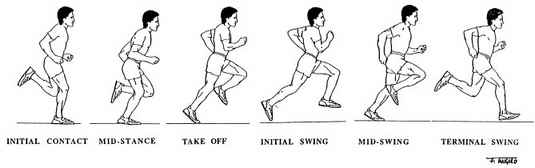
You will see that we deliver maximum force with a more acute (more bent) angle mid-stance, and that is why there is a "dead spot" in the pedalling cycle, because we are bipedal. natural-born-runners, and do not naturally deliver force with our knees fully extendend or bent at right angles.
If you think about it, it is pretty much impossible for the leg to deliver power when it is fully extended, because it can't extend any more. It can only push backwards, which is what we are encouraged to do when pedalling, and scrape the mud off our feet. But that is not where there main power of running or pedallying comes from, it comes when the knee is semi bent in mid stroke/gait when the leg is extending.
The Shimano engineers realised this, and realised it was a problem - we don't pedal in circles. So they designed a pedal to force cyclists to adapt to the needs of the circular motion bicycle.
From this blog post on the use of Rotor Q-Rings. This is a round chainwheel power output plot over the pedal cycle
As you can see the power output is not an ideal circle - even power output over the whole pedal cycle. Biopace corrected this (and caused knee pain).
This is the plot using Rotor Q-Rings.
As you can see it is worse, in that it is even less circular. It is allowing and encouraging the rider to mash. But bipedal humans are mashers, so it is letting and encouraging us to do what we were made to do, and it will be easier on the knees than attempting to push the pedal over the top of the circle or "scrape the mud of your shoes" and apply torque at the bottom, but at the same time it should worsen pedalling style.
Perhaps that is why Wiggo gave up on them after a couple of seasons. He should use Biopace in the off season! Perhaps I will try that, and Rotorize in the spring.
I won the auction and have bought two new Biopace chainrings 52T/42T for 19USD :-)
Last edited by timtak; 12-05-14 at 05:21 PM. Reason: show power plots
01-15-25 | 10:03 AM
#57
Senior Member
Joined: Oct 2014
Posts: 1,089
Likes: 543
From: Reno nevada
Bikes: a few that I can't recall
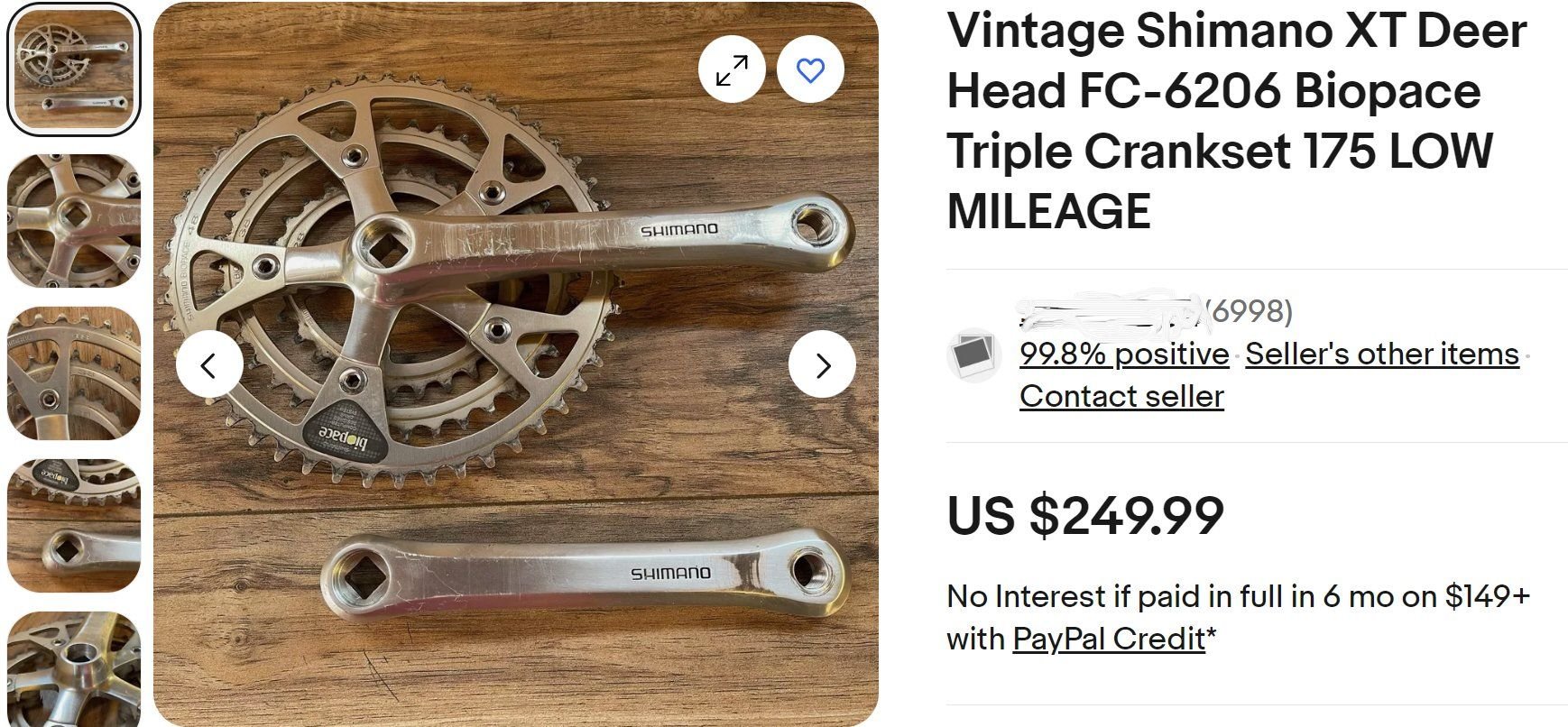
It is now 2025, and your Biopace you threw away, has been pulled from the dustbin and has been purchased for $250, by a guy riding an electric skateboard. He has a computer in his pocket that is more powerful by far than the computers that put a man on the moon, and he is assembling a bicycle to ride while his electric car is being charged ata public charging station.

 01-15-25 | 10:26 AM
#58
Must be symmetrical
Joined: Sep 2018
Posts: 480
Likes: 351
From: Germany
Bikes: ... but look, they're all totally different!
It is now 2025, and your Biopace you threw away, has been pulled from the dustbin and has been purchased for $250, by a guy riding an electric skateboard. He has a computer in his pocket that is more powerful by far than the computers that put a man on the moon, and he is assembling a bicycle to ride while his electric car is being charged ata public charging station.
Last edited by Frkl; 01-15-25 at 10:31 AM.
01-15-25 | 10:39 AM
#59

It's MY mountain
Joined: Sep 2006
Posts: 10,190
Likes: 4,274
From: Mt.Diablo
Bikes: Klein, Merckx, Trek
01-15-25 | 10:54 AM
#60

Senior Member

Joined: Jan 2015
Posts: 5,857
Likes: 3,437
From: Los Angeles
Bikes: 82 Medici, 85 Ironman, 2011 Richard Sachs
I rode Biopace on my '85 IM the last two EroicaCAs. It gets my IM planing.
__________________
I don't do: disks, tubeless, e-shifting, or bead head nymphs. But I do hate all e-bikes.
I don't do: disks, tubeless, e-shifting, or bead head nymphs. But I do hate all e-bikes.
01-15-25 | 11:15 AM
#61

Ride, Wrench, Swap, Race
Joined: Jan 2010
Posts: 9,835
Likes: 1,816
From: Northern California
Bikes: Cheltenham-Pedersen racer, Boulder F/S Paris-Roubaix, Varsity racer, '52 Christophe, '62 Continental, '92 Merckx, '75 Limongi, '76 Presto, '72 Gitane SC, '71 Schwinn SS, etc.
Originally Posted by Reynolds 531
"It is now 2025, and your Biopace you threw away, has been pulled from the dustbin and has been purchased for $250, by a guy riding an electric skateboard. He has a computer in his pocket that is more powerful by far than the computers that put a man on the moon, and he is assembling a bicycle to ride while his electric car is being charged ata public charging station."
If that were one of the "HP", "II", or "SG" variants of BioPace, that's what a crank of that quality might cost new in today's market, right?
I mention the three later variants of BioPace rings offered, only because every thread that ever popped up about BioPace gets the story wrong as far as which rings in which positions have which amount of non-roundness!
Summarizing;
The original BioPace large chainrings were all a much-rounder (only 3.5%) variation of radius, likely for chain control at the front derailer, while the other (smaller) ring(s) had a "wilder" 8% variation along the radius of the chain's path (so 8% variation in gear ratio as the crankarms moved through 180-degrees).
All of the newer (HP, II and SG) variants however used the much-milder 3.5% variation shape for all chainring positions.
The later (3.5%) rings are excellent even for racing (and happen to be my first choice for all racing disciplines).
With much less shape/radius variation, no shifting or chain-control limitations arise, and the cranks can be fully spun as far as I can tell. The Bio effect is at least slightly useful when having to accelerate from too tall of a gear as when perhaps recovering from having drifted off course (common in CX). The 3.5% variation is barely noticed, even initially!
Even the later (usually stamped) BioPace-SG rings (found on so many lower-cost bikes) are really good chainrings imo. The steel ones shift the best out of all of them and are particularly durable.
There is a limit as to how small of a middle or small BioPace chainring will fit on your particular bolt circle though, and the original BioPace 130mm BCD small ring could only be offered as small as 42T. The later (and rounder) 130mm BioPace small ring was usually offered as 40T (around the time that other makers began using 39T).
The smallest size middle 110mm BioPace ring that was ever offered was 36T across all variants, and the smallest 74mm BioPace ring offered was 26T across all variants.
The first of the rounder middle/small BioPace variants hit the market in I think about 1986, but I haven't bothered to check up on that.
This after many riders complained about the wilder 8% variation of the original BioPace small and middle chainrings (since the change going from the rounder big ring to the smaller ring(s) was immediately disturbing to one's spin, making the gearing change seem more large/abrupt than it was).
With that said, I can't imagine trying to race using the original BioPace setup (unless it was a criterium course where I never had to downshift off of the big ring).
"It is now 2025, and your Biopace you threw away, has been pulled from the dustbin and has been purchased for $250, by a guy riding an electric skateboard. He has a computer in his pocket that is more powerful by far than the computers that put a man on the moon, and he is assembling a bicycle to ride while his electric car is being charged ata public charging station."
If that were one of the "HP", "II", or "SG" variants of BioPace, that's what a crank of that quality might cost new in today's market, right?
I mention the three later variants of BioPace rings offered, only because every thread that ever popped up about BioPace gets the story wrong as far as which rings in which positions have which amount of non-roundness!
Summarizing;
The original BioPace large chainrings were all a much-rounder (only 3.5%) variation of radius, likely for chain control at the front derailer, while the other (smaller) ring(s) had a "wilder" 8% variation along the radius of the chain's path (so 8% variation in gear ratio as the crankarms moved through 180-degrees).
All of the newer (HP, II and SG) variants however used the much-milder 3.5% variation shape for all chainring positions.
The later (3.5%) rings are excellent even for racing (and happen to be my first choice for all racing disciplines).
With much less shape/radius variation, no shifting or chain-control limitations arise, and the cranks can be fully spun as far as I can tell. The Bio effect is at least slightly useful when having to accelerate from too tall of a gear as when perhaps recovering from having drifted off course (common in CX). The 3.5% variation is barely noticed, even initially!
Even the later (usually stamped) BioPace-SG rings (found on so many lower-cost bikes) are really good chainrings imo. The steel ones shift the best out of all of them and are particularly durable.
There is a limit as to how small of a middle or small BioPace chainring will fit on your particular bolt circle though, and the original BioPace 130mm BCD small ring could only be offered as small as 42T. The later (and rounder) 130mm BioPace small ring was usually offered as 40T (around the time that other makers began using 39T).
The smallest size middle 110mm BioPace ring that was ever offered was 36T across all variants, and the smallest 74mm BioPace ring offered was 26T across all variants.
The first of the rounder middle/small BioPace variants hit the market in I think about 1986, but I haven't bothered to check up on that.
This after many riders complained about the wilder 8% variation of the original BioPace small and middle chainrings (since the change going from the rounder big ring to the smaller ring(s) was immediately disturbing to one's spin, making the gearing change seem more large/abrupt than it was).
With that said, I can't imagine trying to race using the original BioPace setup (unless it was a criterium course where I never had to downshift off of the big ring).
Last edited by dddd; 01-15-25 at 11:33 AM.
 01-15-25 | 11:22 AM
#62
Must be symmetrical
Joined: Sep 2018
Posts: 480
Likes: 351
From: Germany
Bikes: ... but look, they're all totally different!
If that were one of the "HP", "II", or "SG" variants of BioPace, that's what a crank of that quality might cost new in today's market, right?
I mention the three later variants of BioPace rings offered, only because every thread that ever popped up about BioPace gets the story wrong as far as which rings in which positions have which amount of non-roundness!
Summarizing, the original BioPace large chainrings were all a much-rounder (only 3.5%) variation of radius, likely for chain control, while the other (smaller) ring(s) had a "wilder" 8% variation along the radius of the chain's path (so 8% variation in gear ratio as the crankarms moved through 180-degrees).
All of the newer (HP, II and SG) variants however used the milder 3.5% variation shape for all chainring positions.
The later (3.5%) rings are excellent even for racing (and happen to be my first choice for all racing disciplines).
With much less shape/radius variation, no shifting problems arise, and the cranks can be fully spun as far as I can tell. The Bio effect is at least slightly useful when having to accelerate from too tall of a gear as when perhaps recovering from having drifted off course (common in CX). The 3.5% variation is barely noticed, even initially!
Even the later (usually stamped) BioPace-SG rings (found on so many lower-cost bikes) are really good chainrings imo. The steel ones shift the best out of all of them and are particularly durable.
There is a limit as to how small of a middle or small BioPace chainring will fit on your particular bolt circle though, and the original BioPace 130mm BCD small ring could only be offered as small as 42T. The later (and rounder) 130mm BioPace small ring was usually offered as 40T (around the time that other makers began using 39T).
The smallest size middle 110mm BioPace ring that was ever offered was 36T across all variants, and the smallest 74mm BioPace ring offered was 26T across all variants.
The first of the rounder middle/small BioPace variants hit the market in I think about 1976, but I haven't bothered to check up on that.
This after many riders complained about the wilder 8% variation of the original BioPace crankset's small and middle chainrings (since the change going from the big ring to the smaller ring(s) was immediately disturbing to one's spin, making the gearing change seem more large/abrupt than it was).
With that said, I can't imagine trying to race using the original BioPace setup (unless it was a criterium course where I never had to downshift off of the big ring).
I mention the three later variants of BioPace rings offered, only because every thread that ever popped up about BioPace gets the story wrong as far as which rings in which positions have which amount of non-roundness!
Summarizing, the original BioPace large chainrings were all a much-rounder (only 3.5%) variation of radius, likely for chain control, while the other (smaller) ring(s) had a "wilder" 8% variation along the radius of the chain's path (so 8% variation in gear ratio as the crankarms moved through 180-degrees).
All of the newer (HP, II and SG) variants however used the milder 3.5% variation shape for all chainring positions.
The later (3.5%) rings are excellent even for racing (and happen to be my first choice for all racing disciplines).
With much less shape/radius variation, no shifting problems arise, and the cranks can be fully spun as far as I can tell. The Bio effect is at least slightly useful when having to accelerate from too tall of a gear as when perhaps recovering from having drifted off course (common in CX). The 3.5% variation is barely noticed, even initially!
Even the later (usually stamped) BioPace-SG rings (found on so many lower-cost bikes) are really good chainrings imo. The steel ones shift the best out of all of them and are particularly durable.
There is a limit as to how small of a middle or small BioPace chainring will fit on your particular bolt circle though, and the original BioPace 130mm BCD small ring could only be offered as small as 42T. The later (and rounder) 130mm BioPace small ring was usually offered as 40T (around the time that other makers began using 39T).
The smallest size middle 110mm BioPace ring that was ever offered was 36T across all variants, and the smallest 74mm BioPace ring offered was 26T across all variants.
The first of the rounder middle/small BioPace variants hit the market in I think about 1976, but I haven't bothered to check up on that.
This after many riders complained about the wilder 8% variation of the original BioPace crankset's small and middle chainrings (since the change going from the big ring to the smaller ring(s) was immediately disturbing to one's spin, making the gearing change seem more large/abrupt than it was).
With that said, I can't imagine trying to race using the original BioPace setup (unless it was a criterium course where I never had to downshift off of the big ring).
01-15-25 | 11:46 AM
#63
Ride, Wrench, Swap, Race
Joined: Jan 2010
Posts: 9,835
Likes: 1,816
From: Northern California
Bikes: Cheltenham-Pedersen racer, Boulder F/S Paris-Roubaix, Varsity racer, '52 Christophe, '62 Continental, '92 Merckx, '75 Limongi, '76 Presto, '72 Gitane SC, '71 Schwinn SS, etc.
One of those debates that never ends, such as with crank tapers and certain frame geometry topics.
But at least the supply of BioPace chainsets looks really good going forward for years to come!
If you like the ratios offered, you have it made (and at very low cost).
Thankfully, all of the early-90's BioPace-equipped bikes turning up at garage sales and thrift stores will have the later/best SG-version chainrings.
But sadly, the "touring-bike era of the eighties" seem to only have offered the older ring shape on the touring bikes having BioPace, typically having 52-44-26t chainrings (at least the 52-44t drop was cleverly made to be only 8 teeth when dropping off of the rounder big ring, so less of a shock to your spin).
But at least the supply of BioPace chainsets looks really good going forward for years to come!
If you like the ratios offered, you have it made (and at very low cost).
Thankfully, all of the early-90's BioPace-equipped bikes turning up at garage sales and thrift stores will have the later/best SG-version chainrings.
But sadly, the "touring-bike era of the eighties" seem to only have offered the older ring shape on the touring bikes having BioPace, typically having 52-44-26t chainrings (at least the 52-44t drop was cleverly made to be only 8 teeth when dropping off of the rounder big ring, so less of a shock to your spin).
Last edited by dddd; 01-15-25 at 11:54 AM.
01-15-25 | 06:04 PM
#65
Senior Member
Joined: Oct 2014
Posts: 1,089
Likes: 543
From: Reno nevada
Bikes: a few that I can't recall
For your entertainment purposes. yellow marks are peak eccentricity with a dial indicator, with all of the included errors such as they may be.

Last edited by Reynolds 531; 01-16-25 at 10:07 AM.
01-16-25 | 12:48 PM
#67

Extraordinary Magnitude
Joined: Aug 2009
Posts: 14,087
Likes: 2,146
From: Waukesha WI
Bikes: 1978 Trek TX700; 1978/79 Trek 736; 1984 Specialized Stumpjumper Sport; 1984 Schwinn Voyageur SP; 1985 Trek 620; 1985 Trek 720; 1986 Trek 400 Elance; 1987 Schwinn High Sierra; 1990 Miyata 1000LT
I keep playing with the idea of replacing some chainrings with Biopace to see if it makes a difference with my knees.
__________________
*Recipient of the 2006 Time Magazine "Person Of The Year" Award*
Commence to jigglin’ huh?!?!
"But hey, always love to hear from opinionated amateurs." -says some guy to Mr. Marshall.
Commence to jigglin’ huh?!?!
"But hey, always love to hear from opinionated amateurs." -says some guy to Mr. Marshall.
01-16-25 | 02:03 PM
#68

Paramount Fan
Joined: Dec 2006
Posts: 504
Likes: 447
From: Vermont
Bikes: Marinoni, Paramounts, Raleigh Pros, Colnago, DeRosa, Gios, Masis, Pinarello, R. Sachs, Look, Falcon, D. Moulton, Witcomb, Woodrup, Atala, Motobecane, Bianchis, Fat City, Frejus, Follis, Waterford, Litespeed, d'Autremont, others, mostly '70s-'80s
I took the Biopace chainrings off my '85 Fat Chance and dropped down to 175 mm cranks. I really did feel the difference in a less "choppy" pedal stroke and a smoother spin. Granted, that's all subjective and could be confirmation bias, but I wish I had done it long ago.
01-16-25 | 02:08 PM
#69
Extraordinary Magnitude
Joined: Aug 2009
Posts: 14,087
Likes: 2,146
From: Waukesha WI
Bikes: 1978 Trek TX700; 1978/79 Trek 736; 1984 Specialized Stumpjumper Sport; 1984 Schwinn Voyageur SP; 1985 Trek 620; 1985 Trek 720; 1986 Trek 400 Elance; 1987 Schwinn High Sierra; 1990 Miyata 1000LT
I was totally excited when I found some 170 XC Pro cranks...
__________________
*Recipient of the 2006 Time Magazine "Person Of The Year" Award*
Commence to jigglin’ huh?!?!
"But hey, always love to hear from opinionated amateurs." -says some guy to Mr. Marshall.
Commence to jigglin’ huh?!?!
"But hey, always love to hear from opinionated amateurs." -says some guy to Mr. Marshall.
01-16-25 | 04:48 PM
#70
Ride, Wrench, Swap, Race
Joined: Jan 2010
Posts: 9,835
Likes: 1,816
From: Northern California
Bikes: Cheltenham-Pedersen racer, Boulder F/S Paris-Roubaix, Varsity racer, '52 Christophe, '62 Continental, '92 Merckx, '75 Limongi, '76 Presto, '72 Gitane SC, '71 Schwinn SS, etc.
BioPace was something that some riders adapted to, much like many of us perhaps fully adapted to a bent pedal crankarm in our youth.
So for Shimano to put two different shapes of chainrings on their prolific, earlier BioPace cranksets was a huge mistake (imo) that constantly reminded the rider that something was "off" every time that they shifted off of the big ring. BTW, SR Ovaltech chainrings were similarly rounder for the big ring position.
At least they finally figured out that making both (or all three) rings the same (much-rounder) shape as the big ring meant that unhappy customers who bought the bikes were mostly a thing of the past.
But the dealers, tasked with selling the bikes, were still put off merely by the appearance of the "BioPace" logo on bikes that they had to sell, since many customers had lasting unfavorable impressions of the original BioPace, and that had been costly to correct.
Apparently then, the added suffix (HP, II or SG) was not enough for many customers to want to take another chance on the technology.
So BioPace left the market for good, while I go on still using the rounder ones over thirty years later.
01-16-25 | 05:34 PM
#71
Biopace was intended for all those novice and casual riders who ride around at 50 rpm or so, often with the chain on the smallest cog in back and the middle chainring (or the small chainring of a 2X crank). It's great at low cadences.
Shimano's fatal errors:
One, not telling bike dealers the idea behind the design.
Two, getting greedy. They forced all bike manufacturers who wanted to equip their models with Shimano groups (below Dura-Ace, anyway) to accept Biopace cranks. No substitutions.
I attended a Shimano seminar back then where Wayne Stetina, former National Champion on the road and newly hired Shimano marketing manager for the USA, was touting the wonders of Biopace. He was interrupted by Alex, a local Baltimore bike dealer. Quoting more or less accurately:
Alex: Wayne, do I understand this right? I won't be able to buy Shimano-equipped bikes for my customers next year that don't come with Biopace chainrings? A customer comes in, cash in hand, looking for a nice bike with round chainrings, and what am I supposed to tell him?
Wayne: Well, I hope you'd explain the benefits of Biopace. It's more comfortable and efficient and . . . "
Alex: Wayne. Wayne. You're not listening. I said "Cash in hand."
Wayne (politely): I guess you'd have to sell him a different bike with different components.
(Alex stares, theatrically incredulous.)
Shimano's fatal errors:
One, not telling bike dealers the idea behind the design.
Two, getting greedy. They forced all bike manufacturers who wanted to equip their models with Shimano groups (below Dura-Ace, anyway) to accept Biopace cranks. No substitutions.
I attended a Shimano seminar back then where Wayne Stetina, former National Champion on the road and newly hired Shimano marketing manager for the USA, was touting the wonders of Biopace. He was interrupted by Alex, a local Baltimore bike dealer. Quoting more or less accurately:
Alex: Wayne, do I understand this right? I won't be able to buy Shimano-equipped bikes for my customers next year that don't come with Biopace chainrings? A customer comes in, cash in hand, looking for a nice bike with round chainrings, and what am I supposed to tell him?
Wayne: Well, I hope you'd explain the benefits of Biopace. It's more comfortable and efficient and . . . "
Alex: Wayne. Wayne. You're not listening. I said "Cash in hand."
Wayne (politely): I guess you'd have to sell him a different bike with different components.
(Alex stares, theatrically incredulous.)
 01-17-25 | 07:15 AM
#72
Senior Member

Joined: Jan 2019
Posts: 2,040
Likes: 1,073
From: Toledo Ohio
Bikes: 1964 Huffy Sportsman, 1972 Fuji Newest, 1973 Schwinn Super Sport (3), 1982 Trek 412, 1983 Trek 700, 1989 Miyata 1000LT, 1991 Bianchi Boardwalk, plus others
I am sort of indifferent to biopace having it on a couple different bikes in the past, but none now. The info about the smaller chainrings having a larger “bio” difference was interesting. My Miyata 1000 had biopace with 28-38-48 rings. I could easily live with the 38-48, but the 28 really stuck out feel wise and was just obnoxious to me. Not only that, but it set the chain up for an up/down motion at the chainstay. The 1000 has that neat and infuriating looped wire chainstay protector and the oscillation of the chain didn’t play nice with it. Only the largest 3 cogs in back were quiet with the biopace 28t ring. That wire loop is quite high above the chainstay. I have since switched to a round 24t low gear, and with careful chain length adjustment it gets 5 quiet gears.
 01-17-25 | 09:10 AM
#74

Senior Member
Joined: Feb 2017
Posts: 876
Likes: 606
From: Concord, NC
Bikes: 1984 Bianchi Tipo Corsa, 1985 Cannondale SM600 (24/26)
I think I need to clarify my note. I have personally only used Ovaltech for a brief period of time, on a Ross i had but never had an issue. Also I worked in a bike shop on Long Island NY back then and serviced bikes with both Biopace and Ovaltech. Didn't want to give the impression that I have ridden thousands of miles on them!
01-18-25 | 06:49 AM
#75

Death fork? Naaaah!!

Joined: Nov 2005
Posts: 5,537
Likes: 961
From: The other Maine, north of RT 2
Bikes: Seriously downsizing.
Top
__________________
You know it's going to be a good day when the stem and seatpost come right out.
(looking for a picture and not seeing it? Thank the Photobucket fiasco.PM me and I'll link it up.)
You know it's going to be a good day when the stem and seatpost come right out.
(looking for a picture and not seeing it? Thank the Photobucket fiasco.PM me and I'll link it up.)