


Aligning fork arms?
 10-31-12 | 07:54 PM
#1

Thread Starter
Senior Member
Joined: Nov 2011
Posts: 1,454
Likes: 5
From: Scalarville
Aligning fork arms?
So I received the new little kids Motobecane today and did a "dry" assembly to see what's up. seems like one fork arm is slightly bent (straighter) so the dropout on one side is 1/8" higher than the other side. Setting the axle all the way in makes for a very off center wheel. Any tips to bending it to match the other one? (the dropout was also bent on that side- already fixed)
No kinks on the arm and they both look good at the crown.
All I've come up with is making a jig off the other arm- if there's an easier way to do it, I'm all ears.
No kinks on the arm and they both look good at the crown.
All I've come up with is making a jig off the other arm- if there's an easier way to do it, I'm all ears.
 10-31-12 | 08:49 PM
#2


Decrepit Member
Joined: Aug 2005
Posts: 10,488
Likes: 92
From: Santa Rosa, California
Bikes: Waterford 953 RS-22, several Paramounts
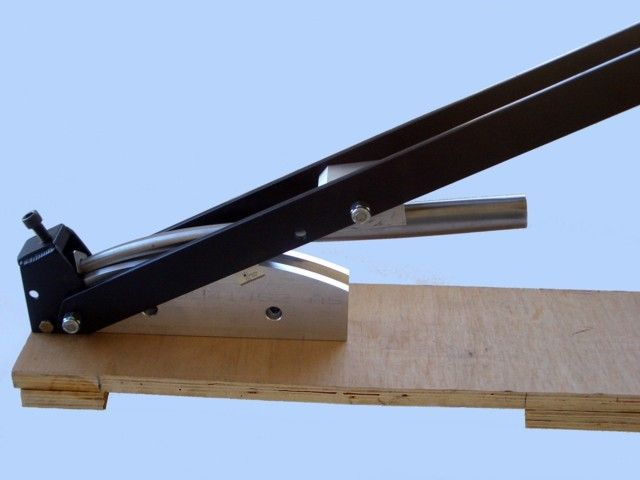
You need to find somebody with a fork blade bender and the appropriate ramp.
 10-31-12 | 08:49 PM
#3

Senior Member


Joined: May 2010
Posts: 3,904
Likes: 36
From: Hurricane Alley , Florida
Bikes: Treks (USA), Schwinn Paramount, Schwinn letour,Raleigh Team Professional, Gazelle GoldLine Racing, 2 Super Mondias, Carlton Professional.
Your going to need to find someone with a Fork alignment jig, and drop out alignment tools.
10-31-12 | 09:00 PM
#4
Senior Member

Joined: Nov 2004
Posts: 23,212
Likes: 3,122
Having a fork alignment gauge greatly facilitates the process but it can be done without one, unless you want to be very precise. Before we start into a discusssion on aligning the blades we need to determine the root cause.
Non-centered wheels can also caused by incorrect wheel dish. If so, flipping the wheel will cause the problem to be off-center to the other side of the fork.
A higher dropout due to blade bend will also cause one dropout to be more forward, If so, the wheel, when viewed along the axis of the steering tube, will not sit at a right angle to the fork crown.
If the wheel is at a right angle to the crown, then the one dropout could be inserted further into the blade or at an angle or it could have a deeper slot. This can be determined by tracing the outline of one dropout and the lower for blade and then laying the other fork bade over the tracing to see if it matchs.
The final possibility is that the splay angle (lateral angle relative to the steering tube) is different between the blades. To check this you need to remove the fork, so we leave this step until last. Place a piece of 2 x 4 on a table and hold the steering tube in contact with the top of the block, with the blades overhanging the end of the block. Align the two blades vertically to the table surface using a carpenter's square. Then measure the distance from the table surface to the dropout. Now repeat for the other blade. If there is a difference in splay, the measurements will be different.
Non-centered wheels can also caused by incorrect wheel dish. If so, flipping the wheel will cause the problem to be off-center to the other side of the fork.
A higher dropout due to blade bend will also cause one dropout to be more forward, If so, the wheel, when viewed along the axis of the steering tube, will not sit at a right angle to the fork crown.
If the wheel is at a right angle to the crown, then the one dropout could be inserted further into the blade or at an angle or it could have a deeper slot. This can be determined by tracing the outline of one dropout and the lower for blade and then laying the other fork bade over the tracing to see if it matchs.
The final possibility is that the splay angle (lateral angle relative to the steering tube) is different between the blades. To check this you need to remove the fork, so we leave this step until last. Place a piece of 2 x 4 on a table and hold the steering tube in contact with the top of the block, with the blades overhanging the end of the block. Align the two blades vertically to the table surface using a carpenter's square. Then measure the distance from the table surface to the dropout. Now repeat for the other blade. If there is a difference in splay, the measurements will be different.
11-01-12 | 02:42 AM
#5

Senior Member
Joined: Apr 2010
Posts: 3,081
Likes: 10
From: vermont
Bikes: Many
T-mar has it right. You find out what is wrong with the fork. Most used forks are get bent legs in the top few inches or get a twist in the crown. When forks are manufactured incorrectly, the often take a little rake out of one leg to try to make it usable. What matters is where the wheel axle is in relation to the steerer tube. adding or removing rake from a leg should take a bit of consideration before attempting.
11-01-12 | 08:21 AM
#6

Senior Member

Joined: Aug 2003
Posts: 13,973
Likes: 145
From: Tampa, Florida
Very rarely do you come across a frok with one leg bent 'straighter' than the other which implies each blade has a different curvature. In most instances one of the legs is bent within a few inches on the crown or the crown itself is bent as mentioned by ftwelder.
Follow TMar's advice and check everything else first. Is a blade forward or is the othe back? This can be trcky to acertain with out know the forks original rake.
I rigged a simple jig on my kitchen table using quarters. I rested each side of the crown on 4 or 5 of them and then added spacers under the steerer tube to level the steerer. From there I measured the distance of each end to the table. If you draw a straight line on a piece of paper and align the steere with this line you can tell if one or both legs is mis0aligned lateraly.
Follow TMar's advice and check everything else first. Is a blade forward or is the othe back? This can be trcky to acertain with out know the forks original rake.
I rigged a simple jig on my kitchen table using quarters. I rested each side of the crown on 4 or 5 of them and then added spacers under the steerer tube to level the steerer. From there I measured the distance of each end to the table. If you draw a straight line on a piece of paper and align the steere with this line you can tell if one or both legs is mis0aligned lateraly.
01-02-14 | 01:00 AM
#7

Senior Member
Joined: Jun 2013
Posts: 258
Likes: 0
From: E TN MTS
Bikes: 1989 TREK 400, Suntour accushift drivetrain. 80's Raleigh mtb all Suntour.
Thanks
Having a fork alignment gauge greatly facilitates the process but it can be done without one, unless you want to be very precise. Before we start into a discusssion on aligning the blades we need to determine the root cause.
Non-centered wheels can also caused by incorrect wheel dish. If so, flipping the wheel will cause the problem to be off-center to the other side of the fork.
A higher dropout due to blade bend will also cause one dropout to be more forward, If so, the wheel, when viewed along the axis of the steering tube, will not sit at a right angle to the fork crown.
If the wheel is at a right angle to the crown, then the one dropout could be inserted further into the blade or at an angle or it could have a deeper slot. This can be determined by tracing the outline of one dropout and the lower for blade and then laying the other fork bade over the tracing to see if it matchs.
The final possibility is that the splay angle (lateral angle relative to the steering tube) is different between the blades. To check this you need to remove the fork, so we leave this step until last. Place a piece of 2 x 4 on a table and hold the steering tube in contact with the top of the block, with the blades overhanging the end of the block. Align the two blades vertically to the table surface using a carpenter's square. Then measure the distance from the table surface to the dropout. Now repeat for the other blade. If there is a difference in splay, the measurements will be different.
Non-centered wheels can also caused by incorrect wheel dish. If so, flipping the wheel will cause the problem to be off-center to the other side of the fork.
A higher dropout due to blade bend will also cause one dropout to be more forward, If so, the wheel, when viewed along the axis of the steering tube, will not sit at a right angle to the fork crown.
If the wheel is at a right angle to the crown, then the one dropout could be inserted further into the blade or at an angle or it could have a deeper slot. This can be determined by tracing the outline of one dropout and the lower for blade and then laying the other fork bade over the tracing to see if it matchs.
The final possibility is that the splay angle (lateral angle relative to the steering tube) is different between the blades. To check this you need to remove the fork, so we leave this step until last. Place a piece of 2 x 4 on a table and hold the steering tube in contact with the top of the block, with the blades overhanging the end of the block. Align the two blades vertically to the table surface using a carpenter's square. Then measure the distance from the table surface to the dropout. Now repeat for the other blade. If there is a difference in splay, the measurements will be different.

I know this is an old thread, but this post is awesome. I emailed it to myself. Thanks a bunch....

