


What's that wooden plug for ?
 11-02-12 | 07:14 AM
#1

Thread Starter
Senior Member
Joined: Apr 2005
Posts: 16,748
Likes: 138
From: Wherever
What's that wooden plug for ?
I noticed in an auction description by Dale Brown, list master of the Classic Rendezvous email list, who recently sold a beautiful NOS '76 Motobecane Le Champion frame, this detail; includes "even the original front fork wooden support as shipped from France is still in the fork!" I thought that somewhat strange. A "support"?
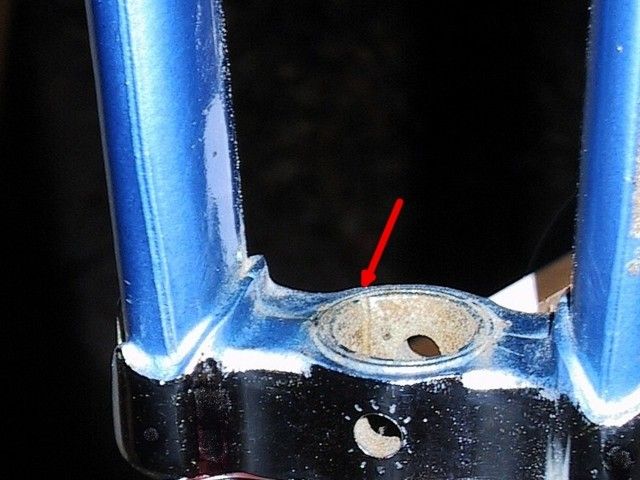
I'm working on a mid '70s French bike at the moment that had a 3 inch long plug in the bottom of the steerer. Never really knew what these were for but assumed they were designed to keep water and debris out of the bottom of the steerer tube. The one on this bike turned out to be a moisture trap. The inside of the steerer showed rust and the stem binder bolt and expander nut were badly rusted.
What bikes have you seen that has one of these wooden plugs? Was this only "French thing" ?
I'm working on a mid '70s French bike at the moment that had a 3 inch long plug in the bottom of the steerer. Never really knew what these were for but assumed they were designed to keep water and debris out of the bottom of the steerer tube. The one on this bike turned out to be a moisture trap. The inside of the steerer showed rust and the stem binder bolt and expander nut were badly rusted.
What bikes have you seen that has one of these wooden plugs? Was this only "French thing" ?

 11-02-12 | 07:27 AM
#5

Senior Member


Joined: Apr 2007
Posts: 12,564
Likes: 2,739
From: Thunder Bay, Ontario, Canada - burrrrr!
Bikes: 1958 Rabeneick 120D, 1968 Legnano Gran Premio, 196? Torpado Professional, 2000 Marinoni Piuma
This is the plastic fork support used for shipping bicycles, these days...

In the back, I stabilize the rear drops with a piece of 1"x3" board securely attached with screws...

In the back, I stabilize the rear drops with a piece of 1"x3" board securely attached with screws...
__________________
"98% of the bikes I buy are projects".
"98% of the bikes I buy are projects".
11-02-12 | 07:28 AM
#6

Senior Member

Joined: Jun 2008
Posts: 13,765
Likes: 3,936
From: Louisville, KY
Extra support to keep the steerer tube from coming out of the lug?
__________________
Bikes: 1996 Eddy Merckx Titanium EX, 1989/90 Colnago Super(issimo?) Piu(?),1990 Concorde Aquila(hit by car while riding), others in build queue "when I get the time"
Bikes: 1996 Eddy Merckx Titanium EX, 1989/90 Colnago Super(issimo?) Piu(?),
 11-02-12 | 07:35 AM
#8
Thread Starter
Senior Member
Joined: Apr 2005
Posts: 16,748
Likes: 138
From: Wherever
Getting a little off track here. Yes, I've seen the supports between the dropouts to protect during shipping. I'm talking about a wooden plug up inside the fork steerer. Usually has a hole drilled through it to accommodate the brake through bolt, which serves to hold the plug in place. Maybe this wasn't all that common.
11-02-12 | 07:38 AM
#9
Senior Member
Joined: Jun 2010
Posts: 7,579
Likes: 6
From: Pearland, Texas
Bikes: Cannondale, Trek, Raleigh, Santana
rootboy, I remember finding one in a friend's '70s Italian frame when we were repairing a flat. It was well recessed into the steerer tube and quite tightly fit so it would've required driving out from the top to remove. No clue as to why it was there.
Brad
Brad
 11-02-12 | 07:39 AM
#11

Senior Member
Joined: Mar 2011
Posts: 1,698
Likes: 6
From: Tampa Bay, Florida
Bikes: 87 Bridgestone 550 (Shocking Electric Metallic Pink)
I have also seen a cork in the top of a seat post (cheap open tube type) I guess to keep back wheel spray from going down the tube onto the BB.
Would a wood post stiffen the steer tube enough to matter? Dampen vibrations? Only a French thing? Question is, OK, it fits in the steering tube, but DOES it fit between the dropouts? Just a convenient place to store the spacer?
Would a wood post stiffen the steer tube enough to matter? Dampen vibrations? Only a French thing? Question is, OK, it fits in the steering tube, but DOES it fit between the dropouts? Just a convenient place to store the spacer?
Last edited by RubberLegs; 11-02-12 at 07:42 AM.
 11-02-12 | 08:09 AM
#13


Decrepit Member
Joined: Aug 2005
Posts: 10,488
Likes: 92
From: Santa Rosa, California
Bikes: Waterford 953 RS-22, several Paramounts
 11-02-12 | 08:28 AM
#14
Senior Member
Joined: Jun 2008
Posts: 13,765
Likes: 3,936
From: Louisville, KY
My suggestion was based on something someone had said recently about seeing this in the 70's/80's to prevent steer tubes sheering off the fork in a thread where someone's alloy steerer came off their CF fork (or something like that, my memory's a bit hazy on the subject), but I think misguided attempt at moisture protection makes as much sense.
__________________
Bikes: 1996 Eddy Merckx Titanium EX, 1989/90 Colnago Super(issimo?) Piu(?),1990 Concorde Aquila(hit by car while riding), others in build queue "when I get the time"
Bikes: 1996 Eddy Merckx Titanium EX, 1989/90 Colnago Super(issimo?) Piu(?),
11-02-12 | 08:38 AM
#15
Thread Starter
Senior Member
Joined: Apr 2005
Posts: 16,748
Likes: 138
From: Wherever
Rubberlegs: Nope, won't fit between the fork ends. As seen in the Colonel's pic, just a plug up inside the steering tube.
On the bike I'm currently working on, up inside the steerer was the only place on the bike with appreciable rust, which I attributed to the wooden plug holding moisture in there. Need to get one of those brake hone thingees that'll fit inside a one inch tube, I guess.
11-02-12 | 08:39 AM
#16
Thread Starter
Senior Member
Joined: Apr 2005
Posts: 16,748
Likes: 138
From: Wherever
11-02-12 | 08:56 AM
#17
Thread Starter
Senior Member
Joined: Apr 2005
Posts: 16,748
Likes: 138
From: Wherever
OK. I made a mistake reading his auction. I wrote to Dale asking what he was referring to and he said he was referring to a support between the fork ends to support the fork blades. Said that particular frame had no wooden plug up in the steering tube.
OK. Never mind .
Nevertheless, I'm leaving this sucker out when I re-assemble the bike. Or, maybe I'll make a custom graphite impregnated resin one just in case the "in case of crash" theory holds water.
OK. Never mind .
Nevertheless, I'm leaving this sucker out when I re-assemble the bike. Or, maybe I'll make a custom graphite impregnated resin one just in case the "in case of crash" theory holds water.
 11-02-12 | 09:09 AM
#19

What??? Only 2 wheels?
Joined: Apr 2010
Posts: 13,496
Likes: 940
From: Boston-ish, MA
Bikes: 72 Peugeot UO-8, 82 Peugeot TH8, 87 Bianchi Brava, 76? Masi Grand Criterium, 74 Motobecane Champion Team, 86 & 77 Gazelle champion mondial, 81? Grandis, 82? Tommasini, 83 Peugeot PF10
11-02-12 | 09:22 AM
#20

Senior Member

Joined: Jul 2005
Posts: 7,571
Likes: 223
And you gave a short quote from the auction which clubman and I interpreted correctly. Nanny nanny poo poo.
11-02-12 | 10:08 AM
#21

I'm surprise that I had not inserted my 2 cents in that previous thread, but now I will:
I know the subject of this was a wooden dowel used as fork-blade brace for shipping, but since it's been hijacked to the practice of "wooden plug inserted into base of steerer" and cross-drilled for brake through-bolt...
This was indeed a common practice with primarily French manufacturers, but also known to have been done by a few Italians, as well. Didn't ever catch on with Brits, AFAIK. It was not reserved only for "racers" but that's who it was aimed at.
The theory (debunked or not) was that since many forks were seen to fail at the juncture of the steerer base and crown, and since such failures could be swift and devastating to the rider, this practice of fitting a tight hardwood plug into the base of the steerer (and drilling it to be further held by the brake bolt) was adopted.
The desired safety effect was that, upon catastrophically breaking, the plug-with-bolt would hold the pieces together long enough for the rider to stop safely...but in practice it can be argued that there's very little guarantee that this would work as intended: all depends on how and where the break occurred, and how tight that plug holds to the broken steerer.
It might have worked (once or occasionally), but was probably more "insurance" to the rider than practical safety device.
What I can say from personal experience is that a tight wooden plug does and did function as a great moisture trap and rust generator for the few steerers I found them in.
I say remove them and leave them out!
I know the subject of this was a wooden dowel used as fork-blade brace for shipping, but since it's been hijacked to the practice of "wooden plug inserted into base of steerer" and cross-drilled for brake through-bolt...
This was indeed a common practice with primarily French manufacturers, but also known to have been done by a few Italians, as well. Didn't ever catch on with Brits, AFAIK. It was not reserved only for "racers" but that's who it was aimed at.
The theory (debunked or not) was that since many forks were seen to fail at the juncture of the steerer base and crown, and since such failures could be swift and devastating to the rider, this practice of fitting a tight hardwood plug into the base of the steerer (and drilling it to be further held by the brake bolt) was adopted.
The desired safety effect was that, upon catastrophically breaking, the plug-with-bolt would hold the pieces together long enough for the rider to stop safely...but in practice it can be argued that there's very little guarantee that this would work as intended: all depends on how and where the break occurred, and how tight that plug holds to the broken steerer.
It might have worked (once or occasionally), but was probably more "insurance" to the rider than practical safety device.
What I can say from personal experience is that a tight wooden plug does and did function as a great moisture trap and rust generator for the few steerers I found them in.
I say remove them and leave them out!
11-02-12 | 10:28 AM
#22
Senior Member
Joined: Jun 2008
Posts: 13,765
Likes: 3,936
From: Louisville, KY
My problem with the backup theory, is that, if it's left in there, if people don't regularly inspect their bikes, how will they know the steerer broke and they're just riding with a dowel holding it together (assuming it fit tight enough to maintain steering). Then, eventually your dowel breaks catastrophically, and you're back where you started with a nasty accident.
__________________
Bikes: 1996 Eddy Merckx Titanium EX, 1989/90 Colnago Super(issimo?) Piu(?),1990 Concorde Aquila(hit by car while riding), others in build queue "when I get the time"
Bikes: 1996 Eddy Merckx Titanium EX, 1989/90 Colnago Super(issimo?) Piu(?),
11-02-12 | 11:09 AM
#24
Decrepit Member
Joined: Aug 2005
Posts: 10,488
Likes: 92
From: Santa Rosa, California
Bikes: Waterford 953 RS-22, several Paramounts
It seems some French manufacturers used less expensive straight gauge tubing for the steerer tube (rather than butted tubing) and then brazed in a split sleeve at the crown end to strengthen the steerer to crown joint. The structural problem with this approach is that in a crash with lots of stress on that joint, the split sleeve brazing could fail leaving just the thin straight gauge steerer tube wall, which would be more likely to bend or break off at the crown. Bad news.
So, to prevent the split sleeve braze from failing, the wooden dowel was tightly fitted to the bottom two or three inches of the steerer tube.
 11-02-12 | 11:12 AM
#25
Thread Starter
Senior Member
Joined: Apr 2005
Posts: 16,748
Likes: 138
From: Wherever
 I had steerer plug on the brain.