


What's that wooden plug for ?
 11-02-12 | 11:18 AM
#26

Senior Member
Joined: Jul 2009
Posts: 11,128
Likes: 39
Bikes: 1986 Alan Record Carbonio, 1985 Vitus Plus Carbone 7, 1984 Peugeot PSV, 1972 Line Seeker, 1986(est.) Medici Aerodynamic (Project), 1985(est.) Peugeot PY10FC
Geeze,......and I thought we only had to worry about rust on our steel French C&V bikes....now we also have to watch out for termites too??


Chombi
Chombi
 11-02-12 | 11:22 AM
#27

Thread Starter
Senior Member
Joined: Apr 2005
Posts: 16,748
Likes: 138
From: Wherever
That's interesting, Scooper. As far as Chas' split sleeve theory, I'll have to look. As far as the straight gage theory, very interesting too. The steerer on the Moto I'm working on has "Reynolds 531" stamped right on it, but still may be straight gage tubing I suppose.
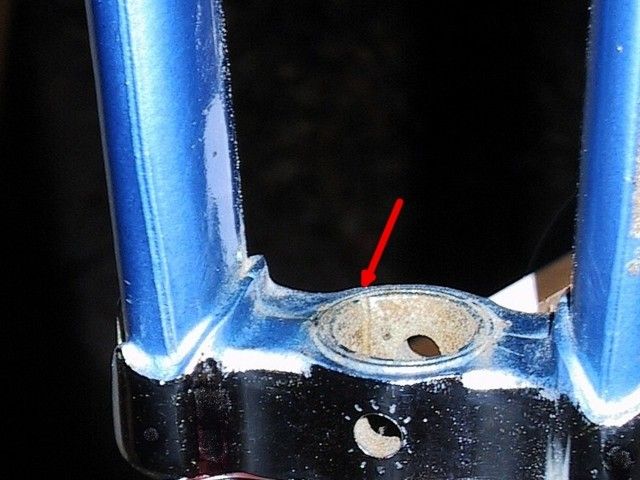
BTW, the wooden plug in this steerer was quite loose, but may have been snug when installed. Wood shrinks, after all.
BTW, the wooden plug in this steerer was quite loose, but may have been snug when installed. Wood shrinks, after all.
11-02-12 | 11:24 AM
#28
Thread Starter
Senior Member
Joined: Apr 2005
Posts: 16,748
Likes: 138
From: Wherever


 I had steerer plug on the brain.
 11-02-12 | 12:35 PM
#30
Senior Member

Joined: May 2006
Posts: 2,180
Likes: 16
I had a bike that I wanted to re-finish, and being super anal I removed the wood and it was a huge job, it was like petrified and because of the hardness and the "rifling" of the Columbus steerer I had to drill and chisel it out.
11-02-12 | 12:59 PM
#31


I started poking around and found this thread on the Gitane USA Forum. It makes as much sense (or more, actually) than other explanations I've seen.
It seems some French manufacturers used less expensive straight gauge tubing for the steerer tube (rather than butted tubing) and then brazed in a split sleeve at the crown end to strengthen the steerer to crown joint. The structural problem with this approach is that in a crash with lots of stress on that joint, the split sleeve brazing could fail leaving just the thin straight gauge steerer tube wall, which would be more likely to bend or break off at the crown. Bad news.
So, to prevent the split sleeve braze from failing, the wooden dowel was tightly fitted to the bottom two or three inches of the steerer tube.
It seems some French manufacturers used less expensive straight gauge tubing for the steerer tube (rather than butted tubing) and then brazed in a split sleeve at the crown end to strengthen the steerer to crown joint. The structural problem with this approach is that in a crash with lots of stress on that joint, the split sleeve brazing could fail leaving just the thin straight gauge steerer tube wall, which would be more likely to bend or break off at the crown. Bad news.
So, to prevent the split sleeve braze from failing, the wooden dowel was tightly fitted to the bottom two or three inches of the steerer tube.
The thing I kept thinking is: how many "All 531" frames used something other than the 531 steerer (which AFAIK WAS supplied as part of a complete tube set)?
Whether cheap split and rolled mild steel or a "butted Nervor" steerer, you can't call that "tout 531" in my book.
 11-02-12 | 01:34 PM
#33

Decrepit Member
Joined: Aug 2005
Posts: 10,488
Likes: 92
From: Santa Rosa, California
Bikes: Waterford 953 RS-22, several Paramounts
Thanks for posting the interesting link: some good arguments and I'm half-way to believing in this as best practice (for a specific and limited application).
The thing I kept thinking is: how many "All 531" frames used something other than the 531 steerer (which AFAIK WAS supplied as part of a complete tube set)?
Whether cheap split and rolled mild steel or a "butted Nervor" steerer, you can't call that "tout 531" in my book.
The thing I kept thinking is: how many "All 531" frames used something other than the 531 steerer (which AFAIK WAS supplied as part of a complete tube set)?
Whether cheap split and rolled mild steel or a "butted Nervor" steerer, you can't call that "tout 531" in my book.
 11-02-12 | 03:04 PM
#34

My PX10 still has the wooden plug in the steer tube. It's short, loose and would do absolutely nothing to support anything in a crash. The only explanation for it that makes sense to me is that it keeps water from the tire out of the steerer.
11-03-12 | 10:20 AM
#35
Senior Member
Joined: Dec 2009
Posts: 221
Likes: 11
From: Germany
My 8 top-level Peugeots (PX/PY, 1962 - early 1978) all have this wooden dowel inserted into the steerer tube. It's tight fit on all of them, one has to drive this thingy out with a hammer. The plug is 5cm / 2 inch long and made of hard wood.
3 tubes Reynolds Peugeots (PR) and gaspipe PAs don't have such plug (same fork on PR and PA, as far as I know).
To me it seems to be more of a racer's accessory.
PX and PY do not have a split sleeve brazed into the steerer tube's end (-> # 24 & 31 / very interesting nonetheless!).
In my opinion this wooden dowel must be a safety device.
On my early 60s PX10s I also found a wooden plug inserted halfway into the seattube. My best guess here is that it's to keep away water and grime from the BB internals. None of these bikes had a sleeve around axle and bearings when I dismantled the BB.
Maybe these plastic sleeves were introduced around the mid 60s - just a guess - I never found any information on this.
(Fortunately no rust damage to forks and seattubes)
3 tubes Reynolds Peugeots (PR) and gaspipe PAs don't have such plug (same fork on PR and PA, as far as I know).
To me it seems to be more of a racer's accessory.
PX and PY do not have a split sleeve brazed into the steerer tube's end (-> # 24 & 31 / very interesting nonetheless!).
In my opinion this wooden dowel must be a safety device.
On my early 60s PX10s I also found a wooden plug inserted halfway into the seattube. My best guess here is that it's to keep away water and grime from the BB internals. None of these bikes had a sleeve around axle and bearings when I dismantled the BB.
Maybe these plastic sleeves were introduced around the mid 60s - just a guess - I never found any information on this.
(Fortunately no rust damage to forks and seattubes)
11-03-12 | 11:39 AM
#36

Senior Member
Joined: Apr 2009
Posts: 10,303
Likes: 60
From: Detroit
Obviously, it is there to prevent the jagged pieces of your broken stem from falling out and causing a blow-out at high speed.
(Once again, it goes to show how the French were thinking about your safety, whereas the Brits and Japanese would have you ride plugless, and at your own peril.)
(Once again, it goes to show how the French were thinking about your safety, whereas the Brits and Japanese would have you ride plugless, and at your own peril.)
__________________
- Auchen
- Auchen
11-03-12 | 02:34 PM
#37

Senior Member

Joined: Feb 2011
Posts: 841
Likes: 655
From: Brussels
Yes, you have to drive a wooden stake through the heart of these French Death Forks (garlic obviously being part of the problem)!
https://tandem.noir.pagesperso-orange...s/tandem-f.htm
This French blogger points out that the plugs were made from cornel wood. For serious restorations.
https://tandem.noir.pagesperso-orange...s/tandem-f.htm
This French blogger points out that the plugs were made from cornel wood. For serious restorations.
Last edited by CMAW; 11-03-12 at 05:40 PM. Reason: thanks Scooper


Thread
Thread Starter
Forum
Replies
Last Post
Syncmaster
Bicycle Mechanics
4
03-20-20 07:12 AM
