

Senior Member
Quote:
.5mm is .009
.
Nine thousands of one inch. Originally Posted by Sixty Fiver
.5mm is .009
.
A half a millimeter.
Man. As for my bikes, Ive got better things to spend time on, frankly.
I'm all for accuracy and everything, but that figure is almost negligible
in a pre-built wheel. And I can be a persnickety bastid.

Not quite there yet
Quote:
A half a millimeter.
Man. As for my bikes, Ive got better things to spend time on, frankly.
I'm all for accuracy and everything, but that figure is almost negligible
in a pre-built wheel. And I can be a persnickety bastid.
Originally Posted by rootboy
Nine thousands of one inch. A half a millimeter.
Man. As for my bikes, Ive got better things to spend time on, frankly.
I'm all for accuracy and everything, but that figure is almost negligible
in a pre-built wheel. And I can be a persnickety bastid.
As old's'cool pointed out, a half mm is 0.02 inches, an easy error to see - and not much trouble to correct. On a built wheel, nothing to fret about, but on a wheel being built or trued - just take care of it.
Senior Member
Ah yes. Nothing quite like quoting a mistake.  But still. May be visible, but nothing I'd lose sleep over, as the OP stipulated a built set of wheels.
But still. May be visible, but nothing I'd lose sleep over, as the OP stipulated a built set of wheels.
Bicycle Repair Man !!!
Quote:
We of all people should have our metric to Imperial conversions sorted out.
Last time I checked, 1"=25.4mm. Hence, 0.5mm = approximately 0.020" Since your conversion of 0.005" to 0.13mm is correct to two figures, I assume there was a glitch somewhere in your conversion 0.5mm to inches. Don't worry, it happens to the best of us.
Put it down to a lack of coffee. Originally Posted by old's'cool
Sixty Fiver, as a fellow Canadian I'm surprised at you! We of all people should have our metric to Imperial conversions sorted out.Last time I checked, 1"=25.4mm. Hence, 0.5mm = approximately 0.020" Since your conversion of 0.005" to 0.13mm is correct to two figures, I assume there was a glitch somewhere in your conversion 0.5mm to inches. Don't worry, it happens to the best of us.
.5mm is .01968503937 inches or .020 (rounded).

Getting a wheel to .5 mm is good enough for union work and many wheels won't get any better than that and some are not worth the effort.
I have a few wheel sets that were built to 0/0... and they are still running within a few thousandths of their original build and the biggest contributor to that has been very good quality machined rims with high build tolerances and high quality spokes and our special process for removing all build tension and wind up.

Zinger
Trek 500 Kid
close

04-21-26
- Join DateFeb 2013
- LocationSpokane WA
- Posts:2,563
-
iTrader Positive Feedback0
-
iTrader Feedback Score(0)
-
Likes:587
-
Liked:399 Times in 319 Posts
Quote:
This is how I does it.Originally Posted by iab
Depending on your setup with the dismantled frame, all you have to do is reverse the wheel in the drop outs to dish quickly. I can't say for sure as I do not now exactly what you have, but you only need one side to be a fixed measurement and it is pretty easy to do.

iab
Senior Member
close


05-01-26
- Join DateJun 2006
- LocationNW Burbs, Chicago
- Posts:12,853
-
iTrader Positive Feedback0
-
iTrader Feedback Score(0)
-
Likes:1
-
Liked:5,374 Times in 1,892 Posts
Quote:
Lacing and truing can be pleasant, but without a tension meter, how does one gauge "correct" tension.
And, even with a gauge, are there good discussions/guides to the appropriate tension when "tuning up" old (C&V legacy) wheel sets? I would presume new stuff can take higher tensions, while some of our veteran wheels may not be up to such. Yes?
Yes.Originally Posted by LeicaLad
Now that! is some quotable suggestions.Lacing and truing can be pleasant, but without a tension meter, how does one gauge "correct" tension.
And, even with a gauge, are there good discussions/guides to the appropriate tension when "tuning up" old (C&V legacy) wheel sets? I would presume new stuff can take higher tensions, while some of our veteran wheels may not be up to such. Yes?
With experience, I tension with sound. Front sounds like the rear drive side. Non drive rear is a lower pitch.
A wheel's tension is good when a quarter turn moves that rim a lot. That is when you back off to true. Also, listen to a wheel under proper tension, match the pitch of the pluck. Gauge and crossings will affect pitch.
repechage
Senior Member
close

05-01-26
- Join DateJun 2006
- Posts:21,792
-
iTrader Positive Feedback0
-
iTrader Feedback Score(0)
-
Likes:851
-
Liked:3,695 Times in 2,545 Posts
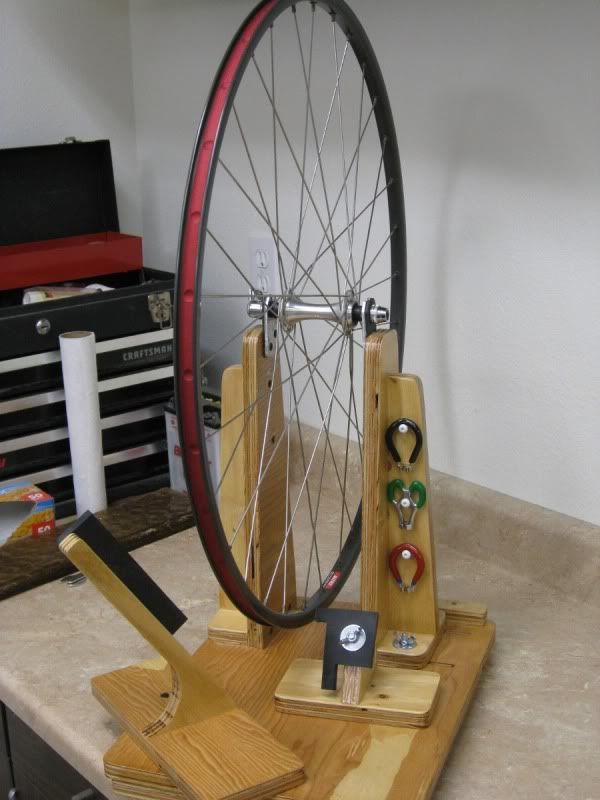
My current truing stand is similar in function and form just made from Aluminum. It is okay. I really want the same vintage cast iron stand I had early in my bike shop career. It was better in my view as the uprights returned back toward the user about 4 to 5 inches, what this did was that the upright was beyond the axle center. What this did was allowed more movement of your hand directly below the axle, a small ergonomic consideration but it just made it that much easier to use. I missed an auction a few years ago on one before snipe programs and really wish I had won it. Worth its weight to ship. A friend has one, and he knows of its value too, no amount of money I could offer would change his mind. A modification some guys liked was placing a neon green or orange section of cardstock below the sight line of the indicator, easier to see what was going on with the bright dayglow background.

Quote:
We of all people should have our metric to Imperial conversions sorted out.
Last time I checked, 1"=25.4mm. Hence, 0.5mm = approximately 0.020" Since your conversion of 0.005" to 0.13mm is correct to two figures, I assume there was a glitch somewhere in your conversion 0.5mm to inches. Don't worry, it happens to the best of us.
Sort of off-topic, but WTH: ... in collegial defence of SixtyFiver:Originally Posted by old's'cool
Sixty Fiver, as a fellow Canadian I'm surprised at you! We of all people should have our metric to Imperial conversions sorted out.Last time I checked, 1"=25.4mm. Hence, 0.5mm = approximately 0.020" Since your conversion of 0.005" to 0.13mm is correct to two figures, I assume there was a glitch somewhere in your conversion 0.5mm to inches. Don't worry, it happens to the best of us.
In the 80's, I was one of two or three Vancouver, Kitsilano neigbourhood automotive jobbers working in an old garage keeping the neigbours' motorcycles and cars alive while the weasels and rich were reaping, and the rest of us were losing traction. I still have my instruments that measure 'Imperial', even though Canada was long ways into metric. The pro tool wholesalers were still distributing conversion cards for everything. If SixtyFiver is still using the old Imperial, I can understand why. You just stick to what you think in. I am still using a psi tire-gauge instead of one in thingy-puffer-Pascals, even though I live in metric Japan. Conversely, I think I've forgotten how to think in thou' measures.
Why did I ship drawers full of a useless fortune in fractional spanners and sockets all the way across the Pacific. Sigh! — I dunno. I did gave-away all my BSA and BSF hardware to a friend who restores ancient Vincent motorcycles. Yep ... some of us on C&V are that old. Ancient Brit tools were used to work on a Triton road-racer way back in the days when my balls were bigger than my brain. (Age seems to mercifully reverse this condition.) Those relics might have been useful to work on ancient Brit bikes, but I don't have any. I may still have a couple of spanners Dad used on his Bates
All in good fun — on with the show. Antiquarianism is where a lot of us are at anyway.
I am gratefully enjoying all the comments so far — grazia tante!
Bicycle Repair Man !!!
My most used stand...

The Hozan... one of those lovely cast iron trueing stands.

The Hozan... one of those lovely cast iron trueing stands.
Quote:
Thanks for posting. I'd like to see some more pics, if possible. They are very are nice and atmospheric. But, I can't see exactly how you constructed the basic steel and affixed the instruments. Was the steering tube welded/brazed to a steel or iron ingot? I am interested in this cuz I should be able to dig up a fork from a junked shopping bike (mama-chari). Originally Posted by Sixty Fiver
My most used stand...
QUESTION: So what do you do? Front hubs are 100 mm — like the fork-spread (duh). What about rear wheels: 110-135 mm. Do you use the Hozan for rears? In which case I am not getting something because you say that you use the forks most of the time. I'm very interested in any reply — at your convenience.
As for the Hozan
 YES!!! About a year ago, I found one on Japan Yahoo auction. I got a J-friend to help me bid. I was prepared to beat down any other bidders, and there were only one or two. But gall-durn
 — we messed up on the clock and missed the end of the bidding.
  It would have been so cool in my Japanese pre-fab bike garage!
Bicycle Repair Man !!!
Quote:
QUESTION: So what do you do? Front hubs are 100 mm — like the fork-spread (duh). What about rear wheels: 110-135 mm. Do you use the Hozan for rears? In which case I am not getting something because you say that you use the forks most of the time. I'm very interested in any reply — at your convenience.
As for the HozanYES!!! About a year ago, I found one on Japan Yahoo auction. I got a J-friend to help me bid. I was prepared to beat down any other bidders, and there were only one or two. But gall-durn — we messed up on the clock and missed the end of the bidding. It would have been so cool in my Japanese pre-fab bike garage!
The fork (1 inch threaded) is mounted to that piece of channel stock, the only issue for some would be to be able to drill a one inch hole to mount it.Originally Posted by Lenton58
Thanks for posting. I'd like to see some more pics, if possible. They are very are nice and atmospheric. But, I can't see exactly how you constructed the basic steel and affixed the instruments. Was the steering tube welded/brazed to a steel or iron ingot? I am interested in this cuz I should be able to dig up a fork from a junked shopping bike (mama-chari). QUESTION: So what do you do? Front hubs are 100 mm — like the fork-spread (duh). What about rear wheels: 110-135 mm. Do you use the Hozan for rears? In which case I am not getting something because you say that you use the forks most of the time. I'm very interested in any reply — at your convenience.
As for the Hozan
YES!!! About a year ago, I found one on Japan Yahoo auction. I got a J-friend to help me bid. I was prepared to beat down any other bidders, and there were only one or two. But gall-durn — we messed up on the clock and missed the end of the bidding. It would have been so cool in my Japanese pre-fab bike garage!
The lateral dial is mounted to the canti boss (it is a 700c touring fork) and the vertical dial is on a magnetic base which sticks to the channel stock. With the lateral dial fixed to the fork's brake boss it remains static so when I flip a wheel to measure dish it does not move although the fork can swivel in it's base.
The stand can be moved and can stand alone although I use a c clamp to keep it in place.
For rear wheels I mount the wheel on the outside of one fork leg.... there are commercial stands that only have one arm and they use the same principle.
The Hozan is good for servicing and checking wheels (union work) but is not quite as precise as my DIY stand... as the shop's wheel-builder I have to work to a very high standard and people pay serious money for our wheel sets as well as the wheels I build for my own end of things.
It is also nice to have multiple stands so I can step away from a build and check wheels in the Hozan.
In the end, you can build great wheels with nothing but the bike's frame as a guide and I have done this and then sent the wheels off on 10,000 km tours with no issues... as long as you can mount the axle in a secure fixture and have a reliable measuring device (zip ties are awesome) it then becomes a matter of skill.
Quote:
Thank you for the interesting description. Originally Posted by Sixty Fiver
>>>SNIP >>> In the end, you can build great wheels with nothing but the bike's frame as a guide and I have done this and then sent the wheels off on 10,000 km tours with no issues... as long as you can mount the axle in a secure fixture and have a reliable measuring device (zip ties are awesome) it then becomes a matter of skill.
As for the frame and zip ties — for the time being, that is what I will be using. IMHO, one advantage of the frame/fork over some cheaper wheel-stands is that you can cinch down the hub with the skewers and be sure that any slack is out of the bearings. This may not be an issue in the likes of say Campy, Dura Ace, Ultegra and other better hubs, but it may work to an advantage over lesser production. I have noted that bearing tension can vary in some hubs when the hubs are secured in the d-o's — all according to what some manuals have recorded. If we are considering tolerances that some people are in favour of here in this thread, would not that margin ascribed to the secured tension be at least a marginal factor and at most a caution lest the most fussy adjustments be in vain?
(BTW — today the winter front has just clanged come down around us early here in Northern Honshu. So for months I guess it will be a ski parka, two pairs of socks, and long johns under lycra tights. So much for climate change: recently we have sub-tropical summers and sub-arctic winters.)

Senior Member
3alarmer
Senior Member
close
09-18-24
- Join DateNov 2010
- LocationSacramento, CA
- Posts:22,994
-
iTrader Positive Feedback0
-
iTrader Feedback Score(0)
-
Likes:4,986
-
Liked:10,496 Times in 7,266 Posts
...very often, here on teh Biekforums, we get into these discussions of accuracy and measurement.
I can think of one thread where the OP was incensed that his wheels had been built in such a manner
that the hub labels were not visible through the valve hole. That was a classic.
Another occurred in a discussion of bearings, when the old Campy "hand matched bearings" claim came up.
I guess my own take on this is that, overall, I try to make my bicycles ride as straight and true as
I can, given my own abilities, time, and tools for measurement and adjustment.
I like the feeling of a road bike that "disappears under you". Sometimes, if I do everything right, that happens.
But the purpose of dishing and truing a wheel is to get those tire contact points exactly centered within
your mass as bike and rider, and the wheels pointing straight on a plane that, ideally splits you up the center.
And most, if not all of the older bikes I've reworked for my own use have required adjustment of the
frame and fork alignment to take advantage of those trued wheels....and some have been off by way
more than a few mm's when I got them, and I'm usually good on frame alignment if I can get it to within
about 1mm. So when you assemble the whole package, how well it works depends on additional things other
than your wheel, and how well it's dished.
Anyway, that's my own take from my own experience. And I still don't believe Campy hand matched their bearings.
I can think of one thread where the OP was incensed that his wheels had been built in such a manner
that the hub labels were not visible through the valve hole. That was a classic.
Another occurred in a discussion of bearings, when the old Campy "hand matched bearings" claim came up.
I guess my own take on this is that, overall, I try to make my bicycles ride as straight and true as
I can, given my own abilities, time, and tools for measurement and adjustment.
I like the feeling of a road bike that "disappears under you". Sometimes, if I do everything right, that happens.
But the purpose of dishing and truing a wheel is to get those tire contact points exactly centered within
your mass as bike and rider, and the wheels pointing straight on a plane that, ideally splits you up the center.
And most, if not all of the older bikes I've reworked for my own use have required adjustment of the
frame and fork alignment to take advantage of those trued wheels....and some have been off by way
more than a few mm's when I got them, and I'm usually good on frame alignment if I can get it to within
about 1mm. So when you assemble the whole package, how well it works depends on additional things other
than your wheel, and how well it's dished.
Anyway, that's my own take from my own experience. And I still don't believe Campy hand matched their bearings.

jimmuller
What??? Only 2 wheels?
close

05-01-26
- Join DateApr 2010
- LocationBoston-ish, MA
- Posts:13,496
-
iTrader Positive Feedback0
-
iTrader Feedback Score(0)
-
Likes:166
-
Liked:936 Times in 279 Posts
Nicely stated, 3a.
The point being that you should strive to perfection but sometimes all that matters is that it is good enough. None of us is perfect.
Quote:
your mass as bike and rider, and the wheels pointing straight on a plane that, ideally splits you up the center.
FWIW, back in my early days I used to notice that my bike always seemed a bit offset to my eye as I was riding. Various frame measurement never showed anything untoward however. Then I picked up a few other nice bikes along the way. Dang if they didn't have the same problem! But of course the explanation is simple - I'm not terribly symmetric myself. Scoliosis is a genetic feature of the family, though usually a mother/daughter thing. I must be holding myself a bit cocked to one side. No matter, it never seems to be a problem with the bike's tracking.Originally Posted by 3alarmer
But the purpose of dishing and truing a wheel is to get those tire contact points exactly centered withinyour mass as bike and rider, and the wheels pointing straight on a plane that, ideally splits you up the center.
The point being that you should strive to perfection but sometimes all that matters is that it is good enough. None of us is perfect.

dddd
Ride, Wrench, Swap, Race
close
05-01-26
- Join DateJan 2010
- LocationNorthern California
- Posts:9,808
-
iTrader Positive Feedback0
-
iTrader Feedback Score(0)
-
Likes:203
-
Liked:1,781 Times in 1,172 Posts
Quote:
I used a pair of inverted forks for wheel truing for years, one was standard and the other was spread out and had the dtopout slots enlarged to take rear wheels. I remember one of them came from a black Ross, the other one was chromed and was pretty bent to begin with, having "survived" having a front wheel touch down while the bike was mounted on the trunk rack of a car that was backing out of a steep driveway.Originally Posted by Sixty Fiver
...My trueing stand is an inverted road fork that has had caliper mounts and a base added.... have been using this for years for trueing and dishing wheels...
I sometimes bias a rear wheel's dish to the left side when the wheel is going to be of marginal strength for the anticipated usage, or to put a badly compromised wheel back into service until the owner can afford a new one.
My CX bike in particular has a rearward weight bias and has a history of bending rear wheels when I manage to "save" a slideout out on the course.
A 1mm bias to the left of perfect dish makes the wheel stronger, so I can get 2-3 years out of an $80 Open Pro rim on average. I previously used 15/16g spokes, and so also switched to thicker 14/15g spokes.
I have to say that I've never noticed any effect of the dish on how the bike rides, but I could easily adjust the frame's rear dropout alignment to compensate for the skewed dish.
My bike's rear spacing was originally 114mm, with a 5-speed Pellisier hubset, but I've increased it to 132mm in the most recent adjustment and simply added 2mm worth of washers to the left end of the current 8sp Ultegra hub's axle.
Bicycle Repair Man !!!
Making the hub label visible through the valve hole, or as close to it as possible is just a matter of the builder paying attention to those little details.
Bicycle Repair Man !!!
Quote:
I often bias the dish to the left side when a wheels is going to be of marginal strength for the anticipated usage.
My CX bike in particular has a rearward weight bias and has a history of bending rear wheels when I manage to "save" a slideout out on the course.
A 1mm bias to the left of perfect dish makes the wheel stronger, so I can get 2-3 years out of an $80 Open Pro rim on average. I previously used 15/16g spokes, and so also switched to thicker 14/15g spokes.
I have to say that I've never noticed any effect of the dish on how the bike rides, but I could easily adjust the frame's rear dropout alignment to compensate for the skewed dish.
My bike's rear spacing was 114mm with a 5-speed Pellisier hubset, but I've increased it to 132mm in the most recent adjustment and simply added 2mm worth of washers to the left end of the Ultegra hub's axle.
My partner has been building tandem and touring frames with a small deliberate offset for decades as this lets you build a stronger wheel when you are using hubs with standard spacing. The only issue is that well meaning shop rats will want to re- true the wheel and then "straighten" the frame because it is 5mm off. Originally Posted by dddd
I used a pair of inverted forks for years, one was standard and the other was spread out and had the dtopout slots enlarged to take rear wheels.I often bias the dish to the left side when a wheels is going to be of marginal strength for the anticipated usage.
My CX bike in particular has a rearward weight bias and has a history of bending rear wheels when I manage to "save" a slideout out on the course.
A 1mm bias to the left of perfect dish makes the wheel stronger, so I can get 2-3 years out of an $80 Open Pro rim on average. I previously used 15/16g spokes, and so also switched to thicker 14/15g spokes.
I have to say that I've never noticed any effect of the dish on how the bike rides, but I could easily adjust the frame's rear dropout alignment to compensate for the skewed dish.
My bike's rear spacing was 114mm with a 5-speed Pellisier hubset, but I've increased it to 132mm in the most recent adjustment and simply added 2mm worth of washers to the left end of the Ultegra hub's axle.
I built my touring bike with a similar offset to increase wheel strength and chainline... no-one but me can tell and no-one else will work on it and it tracks straight and true.
A better solution is to build single bikes with tandem spacing and with a little frame offset and then you can build zero dish 9 speed wheels with standard parts.

Senior Member
Very interesting read, to one who has just started to fumble around building/rebuilding wheels, this. There's a lot of knowledge and experinece in here.
iab
Senior Member
close
05-01-26
- Join DateJun 2006
- LocationNW Burbs, Chicago
- Posts:12,853
-
iTrader Positive Feedback0
-
iTrader Feedback Score(0)
-
Likes:1
-
Liked:5,374 Times in 1,892 Posts
Quote:
I know I'm guilty of that offence. I also make the rim and hub logos both are in the proper orientation with respect to each other. Rim logo should be read from the drive side and the hub logo should be read from the back of the bike.Originally Posted by Sixty Fiver
Making the hub label visible through the valve hole, or as close to it as possible is just a matter of the builder paying attention to those little details.
Some builders prefer the hub logo to be read from the front.
Quote:
I hope we can see an illustrated thread of your frame alignment techniques some day. I've stung up some of frames, and although not perfect, they have thus far been pretty close. In some cases, this was after the frame builder adjusted my drop outs and stays.Originally Posted by 3alarmer
>>> SNIP >>> ... and I'm usually good on frame alignment if I can get it to within about 1mm. So when you assemble the whole package, how well it works depends on additional things other than your wheel, and how well it's dished. >>> SNIP>>>
Senior Member
3alarmer
Senior Member
close
09-18-24
- Join DateNov 2010
- LocationSacramento, CA
- Posts:22,994
-
iTrader Positive Feedback0
-
iTrader Feedback Score(0)
-
Likes:4,986
-
Liked:10,496 Times in 7,266 Posts
Quote:
Some builders prefer the hub logo to be read from the front.
... they now have some effective medications for this.Originally Posted by iab
I know I'm guilty of that offence. I also make the rim and hub logos both are in the proper orientation with respect to each other. Rim logo should be read from the drive side and the hub logo should be read from the back of the bike.Some builders prefer the hub logo to be read from the front.


Senior Member
Quote:
Commercial? If a bike shop isn't using a TS-2 or better truing stand I think a person should look for a different bike shop.Originally Posted by Sixty Fiver
For rear wheels I mount the wheel on the outside of one fork leg.... there are commercial stands that only have one arm and they use the same principle.
Quote:
True, but no one will tell you they regret buying a proper truing stand.Originally Posted by Sixty Fiver
In the end, you can build great wheels with nothing but the bike's frame as a guide and I have done this and then sent the wheels off on 10,000 km tours with no issues... as long as you can mount the axle in a secure fixture and have a reliable measuring device (zip ties are awesome) it then becomes a matter of skill.
Bicycle Repair Man !!!
Quote:
True, but no one will tell you they regret buying a proper truing stand.
I agree completely and that is why I opted for a better stand than the TS2 for building wheels and my customers have had no complaints... at our main shop the wheel building stands are also built from retired forks and frames and fitted with dial indicators. This is what happens when machinists build wheels. Originally Posted by ColonelJLloyd
Commercial? If a bike shop isn't using a TS-2 or better truing stand I think a person should look for a different bike shop.True, but no one will tell you they regret buying a proper truing stand.

I can count the wheel failures of the past 5 years on one hand... one failed when it got hit by a pickup truck and the other got run over by a car when it was forgotten behind it after the bike was loaded on the roof. I have yet to have anyone exercise the lifetime warranty I offer on wheels where the wheel has failed under normal use.
The TS2 is a good stand but some folks don't need anyone to sell them a jig that is actually quite easy to make that does the same thing... I will admit that the Park blue impresses people when they walk in the door.

SJX426
Senior Member
close
04-28-26
- Join DateMay 2008
- LocationFredericksburg, Va
- Posts:10,106
-
iTrader Positive Feedback0
-
iTrader Feedback Score(0)
-
Likes:2,625
-
Liked:2,757 Times in 1,343 Posts
I recently bought a wheel set with Campy LF hubs and GP4's. I decided to take the Colnago out for a run with the "new" wheel set. It was a great ride but when I removed my hands form the bars, I hand to cant to one side. I checked the dish on the front wheel on a Spin Doctor stand I picked up last year for $25. The delta was about 1/8". The rear was the same. I can't figure out what frame would justify an off set on both wheels unless they were off set left and right! That would be a twisted frame, or would it still be symetrical? The other discouvery was that the tension was way down around 20 or 5/6 on the park tension guage! fixed both problems.
New learning (or reminder, can't remember) for an old guy, just because the parts are quality doesn't mean the workmanship is.
I assume dish implies average offset. Axial variation is another subject.
Even with tubulars mounted with variation of the tread centerline, the average centerline of the tread will be dictated by the off set of the rim.
New learning (or reminder, can't remember) for an old guy, just because the parts are quality doesn't mean the workmanship is.
I assume dish implies average offset. Axial variation is another subject.
Even with tubulars mounted with variation of the tread centerline, the average centerline of the tread will be dictated by the off set of the rim.