


The death of a Brooks B15
 08-24-14 | 04:03 PM
#1

Thread Starter
RUSA #3100


Joined: Feb 2012
Posts: 857
Likes: 549
From: Oregon City
Bikes: Yes
The death of a Brooks B15
A sad failure of my Brooks B15 on its maiden voyage after several decades on non use.

This saddle came off of a virtually unridden 1972 Schwinn Sports Tourer. It looked to be in good shape and I spent several months treating it first with Lexol, a well known leather treatment that we have used to preserve 100 year old Horse saddles, and then with mink oil which is my primary treatment for all of my Brooks saddles. It felt reasonably supple and pliable and I thought it would be okay. After a 20 mile jaunt today this is the result. I guess you cant save them all!
This saddle came off of a virtually unridden 1972 Schwinn Sports Tourer. It looked to be in good shape and I spent several months treating it first with Lexol, a well known leather treatment that we have used to preserve 100 year old Horse saddles, and then with mink oil which is my primary treatment for all of my Brooks saddles. It felt reasonably supple and pliable and I thought it would be okay. After a 20 mile jaunt today this is the result. I guess you cant save them all!
__________________
https://utahrandonneur.wordpress.com
https://utahrandonneur.wordpress.com

 08-24-14 | 05:36 PM
#3

Phyllo-buster

Joined: Jan 2010
Posts: 9,282
Likes: 2,703
From: Nova Scotia
Bikes: roadsters, club bikes, fixed and classic
(here we go again) There's 2 schools of thought. The first does as the OP did, treat them with stuff to make them "pliable".
The second school never soaks them with stuff because pliable = early demise. I subscribe to this. Hard, cracked and old is just fine, just put the occasional swipe of proofhide on top and go. This works for me and I continue ride some very old saddles with great success.
I know it's just an anecdote and some saddles do fail. B-15's are definitely lighter duty than other models.
The second school never soaks them with stuff because pliable = early demise. I subscribe to this. Hard, cracked and old is just fine, just put the occasional swipe of proofhide on top and go. This works for me and I continue ride some very old saddles with great success.
I know it's just an anecdote and some saddles do fail. B-15's are definitely lighter duty than other models.
08-24-14 | 05:47 PM
#4

Senior Member
Joined: Aug 2011
Posts: 22,676
Likes: 2,643
From: CID
Bikes: 1991 Bianchi Eros, 1964 Armstrong, 1988 Diamondback Ascent, 1988 Bianchi Premio, 1987 Bianchi Sport SX, 1980s Raleigh mixte (hers), All-City Space Horse (hers)
Given several decades to dry out, I have to think there's only so much you can do to rejuvenate a saddle. I bought a NOS 1979 B5N, and used a fietsbob trick to saturate it with Proofide months before riding. After 3000 miles or so, it's serving me well, but I inspect it regularly and won't be 100% surprised if a crack develops eventually.
08-24-14 | 06:19 PM
#5

Old fart


Joined: Nov 2004
Posts: 26,411
Likes: 5,350
From: Appleton WI
Bikes: Several, mostly not name brands.
I suspect the saddle was over-treated, degrading the leather. I have Brooks saddles older than that still holding up fine. My commuter has a 1972 B-66, and my fixed gear has a 1967 Professional and gets regularly ridden on 40-100 mile rides.
While Lexol and mink oil may be fine for treating 100 year old horse saddles, keep in mind that horse saddles don't suspend your body weight between two fixed ends. Bike saddles need to retain strength to support your body over the saddle frame, and this means different leather treatment to preserve that strength.
While Lexol and mink oil may be fine for treating 100 year old horse saddles, keep in mind that horse saddles don't suspend your body weight between two fixed ends. Bike saddles need to retain strength to support your body over the saddle frame, and this means different leather treatment to preserve that strength.
Last edited by JohnDThompson; 08-24-14 at 06:23 PM.
08-24-14 | 06:53 PM
#6
Thread Starter
RUSA #3100
Joined: Feb 2012
Posts: 857
Likes: 549
From: Oregon City
Bikes: Yes
I disagree. The saddle lived in southern California heat its whole life and was neglected just like the bike. Although that climate can help preserve a bike I think it is death to untreated leather. Lexol is specifically to restore strength to leather. I used a slow and methodical process over several months to treat it. I finished it with mink oil to add suppleness. In my experience, mink oil is the absolute best leather treatment out there. I now believe that this saddle was simply too degraded from its environment to save.
I must disagree again! Sure, on the seat, skirt and pommel of a equine saddle there is little stress, but the stirrup straps, girth, bridle and reins all have significant points of stress and must remain strong as well as supple. We have equine saddles which are 100 years old and have been well cared for over the many decades. The leather remains supple and strong and have never seen a modern leather treatment. The important element in preserving leather is regular care, whichever your preferred method.
I hope that I am not being too disagreeable!
While Lexol and mink oil may be fine for treating 100 year old horse saddles, keep in mind that horse saddles don't suspend your body weight between two fixed ends. Bike saddles need to retain strength to support your body over the saddle frame, and this means different leather treatment to preserve that strength.
I hope that I am not being too disagreeable!
__________________
https://utahrandonneur.wordpress.com
https://utahrandonneur.wordpress.com
08-24-14 | 06:59 PM
#7
Senior Member
Joined: Sep 2007
Posts: 6,944
Likes: 853
From: Wilmette, IL
The death of a Brooks B15
I've had similar failures. You just never know. Some saddles get so dried out. I had a Brooks Pro from the early 70's, from a Gitane TDF I bought last year, that was never reslly broken in. Put proofhide on it and rode it for a few hundred miles. The saddle just started developing cracks all over it. Weirdest thing I ever saw. Really upsetting as it seemed to be a perfect saddle.
When I get a dried out saddle now, I treat with mink oil and put the saddle in a plastic bag. Let it sit for several weeks and then give it a go. I did this to a 1950's Follis branded saddle that I thought had little hope, but it rehydrated and is holding up well.
When I get a dried out saddle now, I treat with mink oil and put the saddle in a plastic bag. Let it sit for several weeks and then give it a go. I did this to a 1950's Follis branded saddle that I thought had little hope, but it rehydrated and is holding up well.
08-24-14 | 07:25 PM
#8

Senior Member
Joined: Jul 2009
Posts: 11,128
Likes: 39
Bikes: 1986 Alan Record Carbonio, 1985 Vitus Plus Carbone 7, 1984 Peugeot PSV, 1972 Line Seeker, 1986(est.) Medici Aerodynamic (Project), 1985(est.) Peugeot PY10FC
I'm no leather expert, but I suspect, being an organic material, from different cows from different places and different family lines, that each piece of leather, are slightly different from each other at the cellular level. Some stronger than others, some weaker than others. Some able to take on a lot of tension stress without tearing , and some not being able to as well. Put on top of that the possible non consistent tanning/processing of the leather before it gets to the saddle factories, and you can expect that the leather can sometime not perform as well as one might expect, no matter what you do to it or how gentle you treat it.....
JMOs
JMOs
08-24-14 | 10:24 PM
#9


multimodal commuter
Joined: Nov 2006
Posts: 19,810
Likes: 597
From: NJ, NYC, LI
Bikes: 1940s Fothergill, 1959 Allegro Special, 1963? Claud Butler Olympic Sprint, Lambert 'Clubman', 1974 Fuji "the Ace", 1976 Holdsworth 650b conversion rando bike, 1983 Trek 720 tourer, 1984 Counterpoint Opus II, 1993 Basso Gap, 2010 Downtube 8h, and...
Thanks for posting this!
I've been working with leather for a couple years, now. I'm gradually learning what you can do, and what you can't do. Making an old piece of leather into a new one, that's not an option, sorry to say it.
I've been working with leather for a couple years, now. I'm gradually learning what you can do, and what you can't do. Making an old piece of leather into a new one, that's not an option, sorry to say it.
__________________
www.rhmsaddles.com.
www.rhmsaddles.com.
08-24-14 | 10:30 PM
#10

Senior Member

Joined: Dec 2004
Posts: 15,427
Likes: 8,348
From: Seattle area
Bikes: Bikes??? Thought this was social media?!?
Steel balls while riding on the rivet.
My B15 has thinner leather (thank goodness) than either of the 2 B17s that are (gratefully) gone. I almost never treat the leather, then lightly. But then I rotate 5 roadies, so mileage is not so great. Garage storage. Not in a desert climate. I also like my Palace saddle. The Troxel and the Belt are ride-able but nearing the end.
All good things must pass.
My B15 has thinner leather (thank goodness) than either of the 2 B17s that are (gratefully) gone. I almost never treat the leather, then lightly. But then I rotate 5 roadies, so mileage is not so great. Garage storage. Not in a desert climate. I also like my Palace saddle. The Troxel and the Belt are ride-able but nearing the end.
All good things must pass.
__________________
Vintage, modern, e-road. It is a big cycling universe.
Vintage, modern, e-road. It is a big cycling universe.
Last edited by Wildwood; 08-24-14 at 10:36 PM.
08-25-14 | 04:57 AM
#11

Senior Member
Joined: Apr 2005
Posts: 16,748
Likes: 138
From: Wherever
I'l toss in my 2 centavos. Why not? Opinions are cheap.
This sentence is the key, to me:
"The saddle lived in southern California heat its whole life and was neglected just like the bike."
I think that once the leather has dried out to a certain point, it's pretty much dead. No amount of oiling will resurrect it. I think what it has lost over so many years of neglect is not its natural oils, but those are oxidized and gone too, but moisture content.
As I remember, Tony Colegrave, the man who contracted Brooks' repair and recovering service for many years, has "re-hydrated" some old leather saddles to a point where they don't tear apart.
This sentence is the key, to me:
"The saddle lived in southern California heat its whole life and was neglected just like the bike."
I think that once the leather has dried out to a certain point, it's pretty much dead. No amount of oiling will resurrect it. I think what it has lost over so many years of neglect is not its natural oils, but those are oxidized and gone too, but moisture content.
As I remember, Tony Colegrave, the man who contracted Brooks' repair and recovering service for many years, has "re-hydrated" some old leather saddles to a point where they don't tear apart.
08-25-14 | 05:37 AM
#12
Senior Member
Joined: May 2008
Posts: 10,106
Likes: 2,762
From: Fredericksburg, Va
Bikes: ? Proteous, '65 Frejus TDF, '73 Bottecchia Giro d'Italia, '83 Colnago Superissimo, '84 Trek 610, '84 Trek 760, '88 Pinarello Veneto, '88 De Rosa Pro, '89 Pinarello Montello, 'Litespeed Catalyst'94 Burley Duet, 97 Specialized RockHopper, 2010 Langster
[MENTION=101154]big chainring[/MENTION] - Your TDF saddle must have been of the same lot as mine that came on a Motobecane Le Champion. Although it has not failed it is extrememly cracked but still rides well. I have a couple of backkups when it goes. It will be a big disappointment when it does beacuse it is so comfortable.
08-25-14 | 05:38 AM
#13

Get off my lawn!
Joined: Nov 2010
Posts: 6,035
Likes: 119
From: The Garden State
Bikes: 1917 Loomis, 1923 Rudge, 1930 Hercules Renown, 1947 Mclean, 1948 JA Holland, 1955 Hetchins, 1957 Carlton Flyer, 1962 Raleigh Sport, 1978&81 Raleigh Gomp GS', 2010 Raliegh Clubman
Interesting as I just proofhide the bottom and forgetaboutit. my saddles seem to also age well. In reference to the OP, I truly believe saddle life is determined by the care given by the first user. Once saddle is made it's all down hill....some rides are slower and graceful, others seem to crash and burn.
08-25-14 | 05:44 AM
#14

Freewheel Medic

Joined: Oct 2005
Posts: 13,578
Likes: 3,329
From: An Island on the Coast of GA!
Bikes: Snazzy* Schwinns, Classy Cannondales & a Super Pro Aero Lotus (* Ed.)
Always a sad day when a Brooks comes to the end of its life. 
__________________
Bob
Enjoying the GA coast all year long!
Thanks for visiting my website: www.freewheelspa.com
Bob
Enjoying the GA coast all year long!
Thanks for visiting my website: www.freewheelspa.com
08-25-14 | 06:20 AM
#15
Senior Member
Joined: Apr 2005
Posts: 16,748
Likes: 138
From: Wherever
I must disagree again! Sure, on the seat, skirt and pommel of a equine saddle there is little stress, but the stirrup straps, girth, bridle and reins all have significant points of stress and must remain strong as well as supple. We have equine saddles which are 100 years old and have been well cared for over the many decades. The leather remains supple and strong and have never seen a modern leather treatment. The important element in preserving leather is regular care, whichever your preferred method.
I hope that I am not being too disagreeable!
And I can't claim to have any 'sperience with horse tack other than having sat a horse a handful of times. And thrown off only once.

I think about it like this, though. Some parts of an equine saddle do indeed take some stress. One can stand up in the stirrups and place one's whole weight on them, occasionally. But think about a suspension leather bike saddle. A piece of leather stretched between two points, maybe 10 inches apart, with the full weight of the average human being sitting on it, all that weight concentrated on two points, essentially about the size of golf balls. The "sit bones". Give or take the shape of said butt. That's 150 to 250 pounds sitting on that little piece of stretched, suspended, leather. With nothing underneath for support but air.
Although the same weight is placed on a horse saddle, and there is a narrow gap down the center of a saddle tree, nowhere on a horse saddle is there that kind of stress put on the leather of the seat of the saddle, which is usually covered by two and sometimes 3 layers of leather. I think there is a big difference between the two designs, thus, a difference in how the leather of the two designs "should" be treated.
But I'm just postulating here.
Last edited by rootboy; 08-25-14 at 06:51 AM.
08-25-14 | 07:46 AM
#16
Phyllo-buster
Joined: Jan 2010
Posts: 9,282
Likes: 2,703
From: Nova Scotia
Bikes: roadsters, club bikes, fixed and classic
[QUOTE=big chainring;17067166]I've had similar failures. You just never know. Some saddles get so dried out. I had a Brooks Pro from the early 70's, from a Gitane TDF I bought last year, that was never reslly broken in. Put proofhide on it and rode it for a few hundred miles. The saddle just started developing cracks all over it. Weirdest thing I ever saw. Really upsetting as it seemed to be a perfect saddle.
/QUOTE]
Like this? 70's pr0 off of a trashed Moto. Looks like reptile skin but it's what I do most of my "training" rides on. As bad as it looks, it's hard, comfortable as all get out (for me) and never been tensioned. Just token proofhide and it's been in regular use for 15 years now. The cracks are only skin deep, nyuk.


/QUOTE]
Like this? 70's pr0 off of a trashed Moto. Looks like reptile skin but it's what I do most of my "training" rides on. As bad as it looks, it's hard, comfortable as all get out (for me) and never been tensioned. Just token proofhide and it's been in regular use for 15 years now. The cracks are only skin deep, nyuk.
Last edited by clubman; 08-25-14 at 07:58 AM.
08-26-14 | 10:46 PM
#18

Senior Member
Joined: Mar 2009
Posts: 1,480
Likes: 9
I have an old ideal saddle that was tossed in the trash by a bike shop, while still connected to its 531 main frame Puch. I sold the Puch, but kept the saddle that was dried almost flat, looked like old grey beef jerky. Originally I planned on putting new leather on it, but decided to play with it a bit. Soaked it in water and reshaped it, while massaging pure lanolin into the leather. treated it of and on for about two weeks, slowly rubbing the lanolin in. The flare never really went out, so laced it. Now it gets proofide once a year. Don't really trust it for a multi day tour, but will do fifty milers on it fairly often. someday it will probably fail, but I did manage to give it a few more years and a few thousand miles of life. My picture is pretty crappy, but its the only one I have.

08-27-14 | 06:28 AM
#19
Old fart
Joined: Nov 2004
Posts: 26,411
Likes: 5,350
From: Appleton WI
Bikes: Several, mostly not name brands.
Like this? 70's pr0 off of a trashed Moto. Looks like reptile skin but it's what I do most of my "training" rides on. As bad as it looks, it's hard, comfortable as all get out (for me) and never been tensioned. Just token proofhide and it's been in regular use for 15 years now. The cracks are only skin deep, nyuk.
 08-27-14 | 06:33 AM
#20
Senior Member
Joined: Apr 2005
Posts: 16,748
Likes: 138
From: Wherever
I have a '67 Pro too. And yours looks to be in pretty good condition, JDT.
I've often wondered what makes some of them crack on the surface like that. I guess the leather just gets to a certain point and goes over the edge. I wish I could find that thing written by Tony Colegrave on "re-hydrating" old saddles. But I think he soaks his too, like Shipwreck mentions. For a couple of days, maybe. Allowing the water to fully penetrate each cell of the leather, which takes some time. And then shaping and sealing in the moisture with oiled waxes, etc.
I've often wondered what makes some of them crack on the surface like that. I guess the leather just gets to a certain point and goes over the edge. I wish I could find that thing written by Tony Colegrave on "re-hydrating" old saddles. But I think he soaks his too, like Shipwreck mentions. For a couple of days, maybe. Allowing the water to fully penetrate each cell of the leather, which takes some time. And then shaping and sealing in the moisture with oiled waxes, etc.
08-27-14 | 07:45 AM
#21
Senior Member
Joined: May 2008
Posts: 10,106
Likes: 2,762
From: Fredericksburg, Va
Bikes: ? Proteous, '65 Frejus TDF, '73 Bottecchia Giro d'Italia, '83 Colnago Superissimo, '84 Trek 610, '84 Trek 760, '88 Pinarello Veneto, '88 De Rosa Pro, '89 Pinarello Montello, 'Litespeed Catalyst'94 Burley Duet, 97 Specialized RockHopper, 2010 Langster
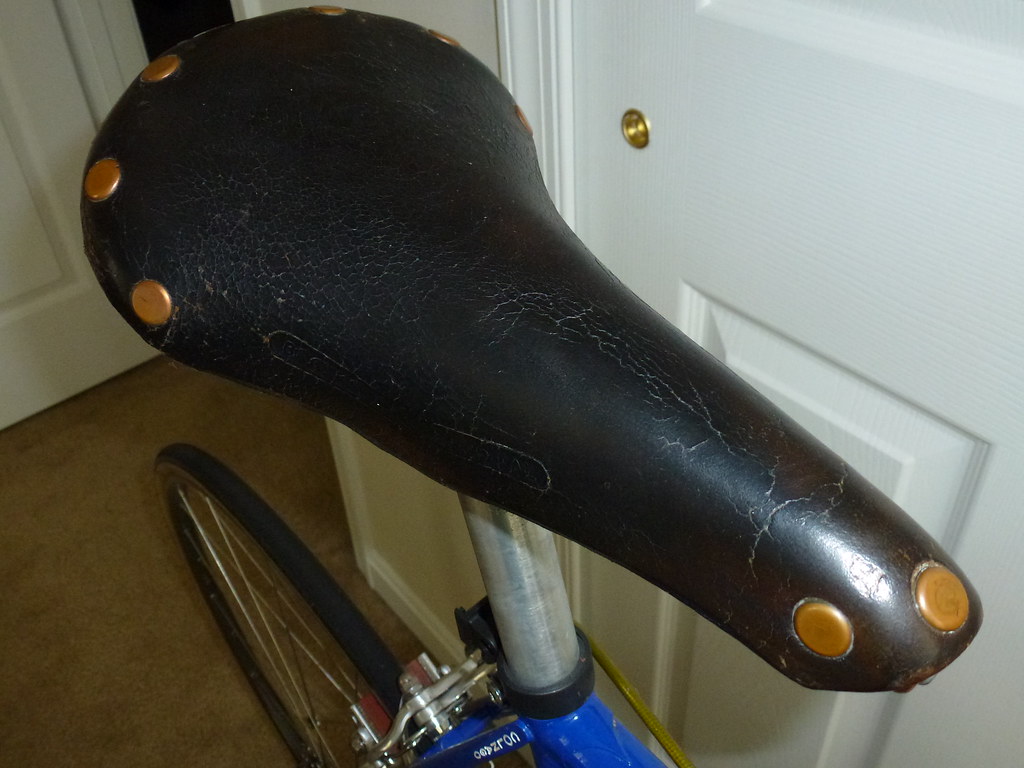
1973 Brooks Pro. Worse today than this picture from last year.
08-27-14 | 02:12 PM
#22
Senior Member
Joined: Jan 2010
Posts: 813
Likes: 170
From: Adelaide, Australia
reproduced below in a more reader friendly format
[table="width: 600, class: outer_border"]
[tr]
[td]As I seem to have been drawn into this thread (by proxy, if you will), I feel that it’s appropriate that I should try to correct one or two misapprehensions regarding my views on the matter under discussion, albeit somewhat late in the day. E-mail correspondence is, IMO, an unsatisfactory medium in which to express oneself in a lucid and precise manner, and one which tends to exacerbate the old trans-Atlantic ‘two nations, divided ....’ syndrome, but, as it seems that this stuff is archived (?verb) for posterity, I’ll try to make myself plain(er).
I don’t think that soaking a saddle for longer than 24 hours will really enhance the process - overnight should be more than adequate. Longer soaking may initially improve the appearance of a ‘badly cracked’ saddle, but no amount of soaking will do anything to ‘heal’ these defects - if defects they are; most of us, especially if we’re of a ‘certain age’ (only slightly older than most of the saddles that we’re considering, in the main?), will have acquired a few cracks and creases of our own, but, although we’re told that our living tissue can be ‘repaired’ to some extent that is not possible with dead animal skin, most (I hope) will prefer to see these ‘defects’ as conferring a degree of distinction.
But, I digress... The best ‘treatment’ for a badly cracked leather saddle, provided that it is stll structurally sound, is to ride it regularly, with love and the occasional light dressing of ‘Proofide’. Most of these things have languished, unloved and neglected, for many years, and it can be surprising (sometimes, but not always) just how well they’ll respond to a bit of TLC.
I think Jerry has mis-understood my comments about the leather ‘tearing at the rivet holes’ (which is where it usually occurs, of course). ‘Abuse and overtightening’ implies to me an active assault on the saddle, but I think that most of these things have been damaged simply by neglect; a leather saddle which has been kept in an unsuitable environment, often unused for many years, may well have ‘lost it’s nature’, and the fibers (?American sp.) become brittle - once this has happened, nothing can feasibly be done to ‘revive’ it.
Little mention has been made of my concomitant advice that, after soaking and assessing that it’s probable that the saddle still has a life worth saving, it’s nearly always important to cleanse the leather with saddle soap; I do this in mildly warm water and, having rinsed the resulting crud away, I rub more soap into the leather and leave it to dry - saddle soap these days seems to contain considerably more glycerine than domestic soaps, and this will probably provide all the ‘essential oil’ that the saddle needs.
As regards drying, I certainly don’t advise the use of excessive heat, but I’d think that ‘in a dark room’ is probably taking it too far the other way; ideally, you’ll need a good flow of air in a warm-ish environment - say, by an open window, on a Summer’s day and out of direct sunlight, and it should be ready to dress (lightly, and topside only, I’d suggest) with ‘Proofide’ within 24 hours.
However, ‘in a dark room’ may well be a very suitable environment for maintaining any such saddle when it’s not in use; what I’d suggest is ideal, is a slightly damp cellar, with good air-flow and constant mild temperature - certainly no central heating. Might not suit the rest of the bike, though.
One thing that Jerry has most certainly mis-understood, is my opinion regarding the quality of the leather that Brooks are using for their current production. It’s quite true that concerns have been expressed regarding the raw material available to tanners these days, and it may well be that even the best finished product ‘lacks substance’ compared with that available in the past (as has been suggested to me recently, regarding the stuff that I’m using), but I’m quite convinced that the leather used by Brooks (especially that awful material that those poor devils in B’ham are having to use to make the so-called ‘aged’ models) is nothing like the best that is currently available. I have had conversations with the Italian management of the Company, but I don’t think it appropriate that I should discuss these in this forum - even if I had the time, which I really don’t have at present.
Tony Colegrave, Northiam, E.Sussex, U.K[/td]
[/tr]
[/table]
Last edited by Big Block; 08-27-14 at 02:18 PM. Reason: formatting

Thread
Thread Starter
Forum
Replies
Last Post
deepinahartatx
Classic & Vintage
5
11-10-13 11:48 AM
Standard Issue
Classic and Vintage Bicycles: Whats it Worth? Appraisals.
7
10-13-11 08:58 AM
