Whats the secret??
 01-24-16 | 12:23 AM
#1
Thread Starter
Senior Member
Joined: May 2014
Posts: 180
Likes: 0
From: Nashville TN
Bikes: 2011 Giant Seek 1, 1995 Mongoose Alta, 2002 Raleigh M80, 2014 Scott Metrix 40, 1999 Trek 820
Whats the secret??
As some of you know we here in Nashville got a little snow. I have been waiting for it all winter long. I have a mountain bike all rigged with studded tires just to commute to work.
The snow came, all 6 or 8 inches of it which is an enormous amount for us. It was still coming down when I left for work. This was my first ride in the snow and I could not stay upright. At least it was hard to stay upright. I started to get a little use to it but had to call it quits when I found my MUP was not plowed at all. I turned around and road back home. It was about three miles total.
Driving to work I reached down town Nashville. I ran into a man riding a bicycle which was not meant for snow, talking on a cell phone with one hand, and the other hand on his handle bars. I rolled down my window and asked how do you do it? His response was it took practice and he road off.
Practice in the snow is something we will not get much of here. I assume like most people here he was from somewhere else. I am just wondering how do you guys and girls ride in this stuff? It was fresh snow so it was not packed so maybe that has something to do with it but really is there a secret or what? How long does it take to get it down like that guy?
The snow came, all 6 or 8 inches of it which is an enormous amount for us. It was still coming down when I left for work. This was my first ride in the snow and I could not stay upright. At least it was hard to stay upright. I started to get a little use to it but had to call it quits when I found my MUP was not plowed at all. I turned around and road back home. It was about three miles total.
Driving to work I reached down town Nashville. I ran into a man riding a bicycle which was not meant for snow, talking on a cell phone with one hand, and the other hand on his handle bars. I rolled down my window and asked how do you do it? His response was it took practice and he road off.
Practice in the snow is something we will not get much of here. I assume like most people here he was from somewhere else. I am just wondering how do you guys and girls ride in this stuff? It was fresh snow so it was not packed so maybe that has something to do with it but really is there a secret or what? How long does it take to get it down like that guy?
 01-24-16 | 12:34 AM
#2

Senior Member
Joined: Apr 2015
Posts: 168
Likes: 0
From: O'ahu, Hawai'i
Bikes: BMC Time Machine TMR01
I'm from Nashville. Lived there 21 years. Anyone who says they had practice is a transplant. With all the new money in town I don't even see how that isn't the most likely scenario. If you tried to ride a bike in the snow you probably aren't from Nashville either. Lol.
01-24-16 | 01:16 AM
#3

Me duelen las nalgas

Joined: Aug 2015
Posts: 13,519
Likes: 2,832
From: Texas
Bikes: Centurion Ironman, Trek 5900, Univega Via Carisma, Globe Carmel
I'm not sure that practice is enough. Levitation or hover-tire skills might be involved. There's a video from the NYC blizzard showing bicycle delivery guys trying to ride, giving up and just pushing or straddle-walking their bikes. Maybe this is their first east coast winter, who knows.
Still waiting for our first snowfall to see if I can ride. Gonna start on the nearby vacant lots and open fields for a softer landing. Yep, gonna video it because it'll be hilarious if I'm not killed.
Still waiting for our first snowfall to see if I can ride. Gonna start on the nearby vacant lots and open fields for a softer landing. Yep, gonna video it because it'll be hilarious if I'm not killed.
01-24-16 | 05:45 AM
#4
Full Member
Joined: May 2013
Posts: 430
Likes: 7
From: Indiana
Bikes: Giant ATX Lite & Schwinn Mesa
I've rode in the snow but don't know if it was eight inches. All I can say is that my mountain biking skills helped. Could fear of the situation prevented you from handling it? If it's something you want to do practice when getting to work isn't involved. A mountain bike is the perfect bike to do it on. Be safe and have fun.
01-24-16 | 06:04 AM
#5

bentrider
Joined: Jan 2016
Posts: 290
Likes: 0
From: Helena, Montana
Bikes: Trek R200, Bike Friday NWT, Radius Hornet 2, Cruzbike Sofrider, Vision R-40 BF/ R-42, Actionbent Litespeed/ Jetstream, Bacchetta Giro (20 and 26), Tern Verge P9, Ryan Vanguard, Burley Limbo, Rans Stratus/ Wave/ V-Rex, Dahon Helios, others...
I drop my tire pressure. No studs on my tires. Trick is too ride and power through deep sections of snow trying to keep your body upright in a straight line. Turning and leaning can lead to falling. Corners need to be taken much more slowly and upright. Plus I use a beater Bianchi so am not so concerned about avoiding snow and ice. Just go right over it. Like I said, it's the flinch/ over correction/ veering to avoid obstacless that make you wipe out in snow. Keep those wheels straight as much as possible. That will require more use of upper body strength to keep your bar going straight. Snow like to push the wheel sideways. It requires much more fitness to ride through snow I have found. Especially single track where you have no idea what lies underneath. A 10 mile ride can feel like 20.
Last edited by hatrack71; 01-24-16 at 07:01 AM.
01-24-16 | 06:58 AM
#7
bentrider
Joined: Jan 2016
Posts: 290
Likes: 0
From: Helena, Montana
Bikes: Trek R200, Bike Friday NWT, Radius Hornet 2, Cruzbike Sofrider, Vision R-40 BF/ R-42, Actionbent Litespeed/ Jetstream, Bacchetta Giro (20 and 26), Tern Verge P9, Ryan Vanguard, Burley Limbo, Rans Stratus/ Wave/ V-Rex, Dahon Helios, others...
01-24-16 | 09:00 AM
#8
Thread Starter
Senior Member
Joined: May 2014
Posts: 180
Likes: 0
From: Nashville TN
Bikes: 2011 Giant Seek 1, 1995 Mongoose Alta, 2002 Raleigh M80, 2014 Scott Metrix 40, 1999 Trek 820
I've rode in the snow but don't know if it was eight inches. All I can say is that my mountain biking skills helped. Could fear of the situation prevented you from handling it? If it's something you want to do practice when getting to work isn't involved. A mountain bike is the perfect bike to do it on. Be safe and have fun.
01-24-16 | 09:03 AM
#9
Thread Starter
Senior Member
Joined: May 2014
Posts: 180
Likes: 0
From: Nashville TN
Bikes: 2011 Giant Seek 1, 1995 Mongoose Alta, 2002 Raleigh M80, 2014 Scott Metrix 40, 1999 Trek 820
I drop my tire pressure. No studs on my tires. Trick is too ride and power through deep sections of snow trying to keep your body upright in a straight line. Turning and leaning can lead to falling. Corners need to be taken much more slowly and upright. Plus I use a beater Bianchi so am not so concerned about avoiding snow and ice. Just go right over it. Like I said, it's the flinch/ over correction/ veering to avoid obstacless that make you wipe out in snow. Keep those wheels straight as much as possible. That will require more use of upper body strength to keep your bar going straight. Snow like to push the wheel sideways. It requires much more fitness to ride through snow I have found. Especially single track where you have no idea what lies underneath. A 10 mile ride can feel like 20.
01-24-16 | 10:34 AM
#10

Senior Member
Joined: Apr 2011
Posts: 15,278
Likes: 342
From: Alpharetta, GA
Bikes: Nashbar Road
More than about 3 inches stops me, too hard to push through it and still have traction. That happens once every 4 or 5 years here 
The road bike with skinny tires just cuts through the snow if it's no deeper than that, and not frozen and rutted underneath. Don't ask me about mtb with big tires on snow because I've never tried it, but I do know that it's easier riding on top of it after it's re-frozen and has that kind of crunchy feel. The half dozen or so times we've had those conditions here
The road bike with skinny tires just cuts through the snow if it's no deeper than that, and not frozen and rutted underneath. Don't ask me about mtb with big tires on snow because I've never tried it, but I do know that it's easier riding on top of it after it's re-frozen and has that kind of crunchy feel. The half dozen or so times we've had those conditions here
01-24-16 | 11:14 AM
#11

Senior Member
Joined: Dec 2014
Posts: 4,347
Likes: 22
Bikes: Felt TK2, Felt Z5
It really depends on the snow. The amount of moisture in it, the amount of pack it has to it and the depth of it. Liken it to riding a bike on the beach. Away from the water, it is very fine and gritty and offers very little traction. Down by the water, it is more hard packed and you don't sink into it like you do away from the water. The snow is a lot like that. 4" of fresh powder with nothing underneath and a mountain bike should go through it fairly well. 4" of wet snow will be the exact opposite.
Last year I rode my fat bike to work in the snow. It was snowing and there was probably about 3-4" of fresh powder on the MUP. I was blazing along at 17mph with no issue at all. Tire pressure was dropped slightly since I wanted the added traction. I never slipped once, never lost traction, never gave it a second thought. Well, it kept snowing that day and into the night. When I rode back home 6 hours later, there was a foot of snow and it was still coming down. The snow consistency had changed drastically to a much wet and thicker snow similar to mashed potatoes. My fat tires were getting no traction at all. I couldn't manage to stay upright on the bike for more than a mile before falling. After the 7th time I went down, I stopped counting. The last mile I had to push the bike through a foot or more of drifted snow back to my complex. I couldn't even get on the bike and start pedaling at this point. The snow was too deep, and it was way too wet and heavy.
Last year I rode my fat bike to work in the snow. It was snowing and there was probably about 3-4" of fresh powder on the MUP. I was blazing along at 17mph with no issue at all. Tire pressure was dropped slightly since I wanted the added traction. I never slipped once, never lost traction, never gave it a second thought. Well, it kept snowing that day and into the night. When I rode back home 6 hours later, there was a foot of snow and it was still coming down. The snow consistency had changed drastically to a much wet and thicker snow similar to mashed potatoes. My fat tires were getting no traction at all. I couldn't manage to stay upright on the bike for more than a mile before falling. After the 7th time I went down, I stopped counting. The last mile I had to push the bike through a foot or more of drifted snow back to my complex. I couldn't even get on the bike and start pedaling at this point. The snow was too deep, and it was way too wet and heavy.
01-24-16 | 11:36 AM
#12
Banned
Joined: Jun 2010
Posts: 43,586
Likes: 1,380
From: NW,Oregon Coast
Bikes: 8
I have to either slice thru fresh fallen snow to firmer stuff underneath, or a Fat bike to ride on top.. , scrunch as You go ..
Or follow wheel ruts of the cars .. But Im spoiled on the NW Coast we get Ice & snow briefly and not annually.
Like last month, Up High and Inland they had Black Ice on the highways and streets, We skipped .
Or follow wheel ruts of the cars .. But Im spoiled on the NW Coast we get Ice & snow briefly and not annually.
Like last month, Up High and Inland they had Black Ice on the highways and streets, We skipped .
01-24-16 | 11:58 AM
#13

LET'S ROLL
Joined: Nov 2009
Posts: 4,789
Likes: 59
From: NEW YORK, NY - USA
Bikes: 2014 BMC Gran Fondo, 2013 Brompton S6L-X
I only ride fresh snow that's less than an inch and hasn't gone through a freeze/melt cycle.
Rim brakes will be affected by snow; keep this in mind when stopping.
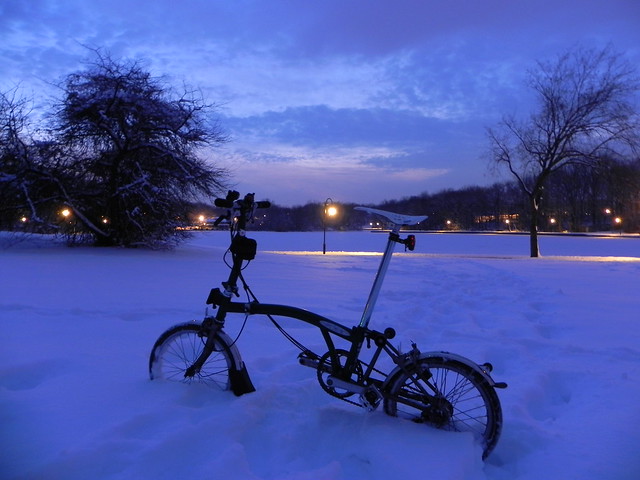 My Snowmobile by 1nterceptor, on Flickr
Rim brakes will be affected by snow; keep this in mind when stopping.
My Snowmobile by 1nterceptor, on Flickr
__________________
One day: www.youtube.com/watch?v=20X43026ukY&list=UUHyRS8bRu6zPoymgKaIoDLA&index=1
One day: www.youtube.com/watch?v=20X43026ukY&list=UUHyRS8bRu6zPoymgKaIoDLA&index=1
01-24-16 | 12:22 PM
#14

mechanically sound
Joined: Jan 2007
Posts: 1,610
Likes: 87
From: Dover, NH
Bikes: Indy Fab steel deluxe, Aventon cordoba, S-works stumpy fsr, Masi vincere, Dahon mu uno, Outcast 29 commuter
New englander here. Commuted through snowmageddon last year. The secret is to visualize your traction(the ground) six inches (or perhaps more)below what you see, and pedal your ass off.
__________________

01-24-16 | 08:44 PM
#15


Plays in traffic
Joined: May 2006
Posts: 6,971
Likes: 15
From: Rochester, NY
Bikes: 1996 Litespeed Classic, 2006 Trek Portland, 2013 Ribble Winter/Audax, 2016 Giant Talon 4
There could be several things.
First studs don't do a thing for you if they don't have something solid and unyielding--pavement, ice--to bite into. Studs do squat when you're floating over soft and loose stuff.
Second, when you do float over soft and loose stuff, sometimes as it packs under your tires, that packed snow will itselfl slip on the surface beneath. But since your tires are gripping the snow that's now sliding, there's not much you can do.
These are two of the reasons I prefer narrower tires for commuting. I want to sink through to the road so the studs can get a good bite. Off-road, you generally want the opposite--to float.
More generally, cycling in snow quickly reveals how well you hold your line, and whether you've learned to keep your balance by shifting your weight or by steering. (The former hold their line straighter, the latter weave a lot.) If you keep your balance by steering, you'll be considerably less stable in the snow.
Weight distribution matters. Shift your weight back on the bike. When folks say they use MTB skills, this is the first one they use. My first winter I used a hybrid where most of my weight was on the back. It was a rock. In my second winter, I nearly gave up on my Portland because the roadie position put so much more weight on the front. It wanted to plow rather than steer. Once I learned to shift my weight to the back, it stabilized.
Also, if you carry your weight on your butt instead of your toes, you'll be less stable. In other words, support yourself on your legs (and fingertips), not plopped on the saddle like a reclining chair. Another way this is commonly stated is to ride light in the saddle.
Spin, don't mash. It helps you recover your balance faster during the inevitable sideslips.
Try these things in addition to those suggested above and I'm sure things will get better.
First studs don't do a thing for you if they don't have something solid and unyielding--pavement, ice--to bite into. Studs do squat when you're floating over soft and loose stuff.
Second, when you do float over soft and loose stuff, sometimes as it packs under your tires, that packed snow will itselfl slip on the surface beneath. But since your tires are gripping the snow that's now sliding, there's not much you can do.
These are two of the reasons I prefer narrower tires for commuting. I want to sink through to the road so the studs can get a good bite. Off-road, you generally want the opposite--to float.
More generally, cycling in snow quickly reveals how well you hold your line, and whether you've learned to keep your balance by shifting your weight or by steering. (The former hold their line straighter, the latter weave a lot.) If you keep your balance by steering, you'll be considerably less stable in the snow.
Weight distribution matters. Shift your weight back on the bike. When folks say they use MTB skills, this is the first one they use. My first winter I used a hybrid where most of my weight was on the back. It was a rock. In my second winter, I nearly gave up on my Portland because the roadie position put so much more weight on the front. It wanted to plow rather than steer. Once I learned to shift my weight to the back, it stabilized.
Also, if you carry your weight on your butt instead of your toes, you'll be less stable. In other words, support yourself on your legs (and fingertips), not plopped on the saddle like a reclining chair. Another way this is commonly stated is to ride light in the saddle.
Spin, don't mash. It helps you recover your balance faster during the inevitable sideslips.
Try these things in addition to those suggested above and I'm sure things will get better.
Last edited by tsl; 01-24-16 at 08:52 PM.
01-24-16 | 10:19 PM
#16

Senior Member
Joined: Oct 2013
Posts: 6,119
Likes: 13
From: D'uh... I am a Cutter
Bikes: '17 Access Old Turnpike Gravel bike, '14 Trek 1.1, '13 Cannondale CAAD 10, '98 CAD 2, R300
I'll have to try again.
01-25-16 | 11:24 AM
#17

aka Tom Reingold


Joined: Jan 2009
Posts: 44,138
Likes: 6,363
From: New York, NY, and High Falls, NY, USA
Bikes: 1962 Rudge Sports, 1971 Raleigh Super Course, 1971 Raleigh Pro Track, 1974 Raleigh International, 1975 Viscount Fixie, 1982 McLean, 1996 Lemond (Ti), 2002 Burley Zydeco tandem
Snow has so many possible depths and consistencies that a technique that works in one combination won't work in another. Urban legend says the eskimos have 21 words for snow. This is where more words would come in handy, because how to ride in snow is not an adequate question.
I went out during the blizzard on Saturday just for fun. The mayor and governor had just enacted a ban on motor vehicles at 2:30, so I expected traffic to be light because of that and because the streets were so impassable anyway. That worked out well. The first street was difficult, and I kept losing traction and had to restart from a standstill a few times.
On the second street, the snow's depth varied widely because the street hadn't been plowed for hours, and at its deepest was over six inches but it went down to an inch or two in the tire tracks left by cars. But the tire tracks also varied a lot in depth. I tried a dozen times to get momentum from a standstill and just couldn't do it. Someone in a shop stepped out to watch me try and fail. He yelled simply, "Bike!"
The next streets weren't as bad, and I was able to roll most of the distance though still stopping and restarting a few times per block.
Once I got to the bike path along the Hudson River, the depth was completely consistent, three inches or less. The radio said the snow was falling at three inches per hour, so maybe the city had plowed the bike path an hour or so ago. I don't think I stopped once, and I went up the path for a mile and back.
Still, even when I was able to keep my momentum, the bike slipped left and right. I was able to keep it up with steering and balance corrections. That may be a skill you lack, but if the snow's depth or consistency was inconsistent, you may not have had a chance at all.
I went out during the blizzard on Saturday just for fun. The mayor and governor had just enacted a ban on motor vehicles at 2:30, so I expected traffic to be light because of that and because the streets were so impassable anyway. That worked out well. The first street was difficult, and I kept losing traction and had to restart from a standstill a few times.
On the second street, the snow's depth varied widely because the street hadn't been plowed for hours, and at its deepest was over six inches but it went down to an inch or two in the tire tracks left by cars. But the tire tracks also varied a lot in depth. I tried a dozen times to get momentum from a standstill and just couldn't do it. Someone in a shop stepped out to watch me try and fail. He yelled simply, "Bike!"
The next streets weren't as bad, and I was able to roll most of the distance though still stopping and restarting a few times per block.
Once I got to the bike path along the Hudson River, the depth was completely consistent, three inches or less. The radio said the snow was falling at three inches per hour, so maybe the city had plowed the bike path an hour or so ago. I don't think I stopped once, and I went up the path for a mile and back.
Still, even when I was able to keep my momentum, the bike slipped left and right. I was able to keep it up with steering and balance corrections. That may be a skill you lack, but if the snow's depth or consistency was inconsistent, you may not have had a chance at all.
__________________
Tom Reingold, tom@noglider.com
New York City and High Falls, NY
Blogs: The Experienced Cyclist; noglider's ride blog
“When man invented the bicycle he reached the peak of his attainments.” — Elizabeth West, US author
Please email me rather than PM'ing me. Thanks.
Tom Reingold, tom@noglider.com
New York City and High Falls, NY
Blogs: The Experienced Cyclist; noglider's ride blog
“When man invented the bicycle he reached the peak of his attainments.” — Elizabeth West, US author
Please email me rather than PM'ing me. Thanks.
01-25-16 | 06:02 PM
#18

Keepin it Wheel

Joined: Aug 2011
Posts: 10,962
Likes: 5,207
From: San Diego
Bikes: Surly CrossCheck, Krampus
I drop my tire pressure. No studs on my tires. Trick is too ride and power through deep sections of snow trying to keep your body upright in a straight line. Turning and leaning can lead to falling. Corners need to be taken much more slowly and upright. Plus I use a beater Bianchi so am not so concerned about avoiding snow and ice. Just go right over it. Like I said, it's the flinch/ over correction/ veering to avoid obstacless that make you wipe out in snow. Keep those wheels straight as much as possible. That will require more use of upper body strength to keep your bar going straight. Snow like to push the wheel sideways. It requires much more fitness to ride through snow I have found. Especially single track where you have no idea what lies underneath. A 10 mile ride can feel like 20.
 01-25-16 | 08:58 PM
#19

Senior Member
Joined: May 2005
Posts: 6,301
Likes: 14
From: La La Land (We love it!)
Bikes: Gilmour road, Curtlo road; both steel (of course)
The secret is to live somewhere with better climate, but don't come here to Socal; the traffic is bad enough as it is... 
__________________
Today, I believe my jurisdiction ends here...
Today, I believe my jurisdiction ends here...
01-26-16 | 10:47 AM
#21
aka Tom Reingold
Joined: Jan 2009
Posts: 44,138
Likes: 6,363
From: New York, NY, and High Falls, NY, USA
Bikes: 1962 Rudge Sports, 1971 Raleigh Super Course, 1971 Raleigh Pro Track, 1974 Raleigh International, 1975 Viscount Fixie, 1982 McLean, 1996 Lemond (Ti), 2002 Burley Zydeco tandem
[MENTION=373035]Bikerdave222[/MENTION], I asked your question a year ago. You may want to see my thread. There was a lot of useful information, and it led to my building my new winter bike.
Teach me how to ride in snow.
Teach me how to ride in snow.
__________________
Tom Reingold, tom@noglider.com
New York City and High Falls, NY
Blogs: The Experienced Cyclist; noglider's ride blog
“When man invented the bicycle he reached the peak of his attainments.” — Elizabeth West, US author
Please email me rather than PM'ing me. Thanks.
Tom Reingold, tom@noglider.com
New York City and High Falls, NY
Blogs: The Experienced Cyclist; noglider's ride blog
“When man invented the bicycle he reached the peak of his attainments.” — Elizabeth West, US author
Please email me rather than PM'ing me. Thanks.
01-28-16 | 11:52 AM
#22
Thread Starter
Senior Member
Joined: May 2014
Posts: 180
Likes: 0
From: Nashville TN
Bikes: 2011 Giant Seek 1, 1995 Mongoose Alta, 2002 Raleigh M80, 2014 Scott Metrix 40, 1999 Trek 820
There could be several things.
First studs don't do a thing for you if they don't have something solid and unyielding--pavement, ice--to bite into. Studs do squat when you're floating over soft and loose stuff.
Second, when you do float over soft and loose stuff, sometimes as it packs under your tires, that packed snow will itselfl slip on the surface beneath. But since your tires are gripping the snow that's now sliding, there's not much you can do.
These are two of the reasons I prefer narrower tires for commuting. I want to sink through to the road so the studs can get a good bite. Off-road, you generally want the opposite--to float.
More generally, cycling in snow quickly reveals how well you hold your line, and whether you've learned to keep your balance by shifting your weight or by steering. (The former hold their line straighter, the latter weave a lot.) If you keep your balance by steering, you'll be considerably less stable in the snow.
Weight distribution matters. Shift your weight back on the bike. When folks say they use MTB skills, this is the first one they use. My first winter I used a hybrid where most of my weight was on the back. It was a rock. In my second winter, I nearly gave up on my Portland because the roadie position put so much more weight on the front. It wanted to plow rather than steer. Once I learned to shift my weight to the back, it stabilized.
Also, if you carry your weight on your butt instead of your toes, you'll be less stable. In other words, support yourself on your legs (and fingertips), not plopped on the saddle like a reclining chair. Another way this is commonly stated is to ride light in the saddle.
Spin, don't mash. It helps you recover your balance faster during the inevitable sideslips.
Try these things in addition to those suggested above and I'm sure things will get better.
First studs don't do a thing for you if they don't have something solid and unyielding--pavement, ice--to bite into. Studs do squat when you're floating over soft and loose stuff.
Second, when you do float over soft and loose stuff, sometimes as it packs under your tires, that packed snow will itselfl slip on the surface beneath. But since your tires are gripping the snow that's now sliding, there's not much you can do.
These are two of the reasons I prefer narrower tires for commuting. I want to sink through to the road so the studs can get a good bite. Off-road, you generally want the opposite--to float.
More generally, cycling in snow quickly reveals how well you hold your line, and whether you've learned to keep your balance by shifting your weight or by steering. (The former hold their line straighter, the latter weave a lot.) If you keep your balance by steering, you'll be considerably less stable in the snow.
Weight distribution matters. Shift your weight back on the bike. When folks say they use MTB skills, this is the first one they use. My first winter I used a hybrid where most of my weight was on the back. It was a rock. In my second winter, I nearly gave up on my Portland because the roadie position put so much more weight on the front. It wanted to plow rather than steer. Once I learned to shift my weight to the back, it stabilized.
Also, if you carry your weight on your butt instead of your toes, you'll be less stable. In other words, support yourself on your legs (and fingertips), not plopped on the saddle like a reclining chair. Another way this is commonly stated is to ride light in the saddle.
Spin, don't mash. It helps you recover your balance faster during the inevitable sideslips.
Try these things in addition to those suggested above and I'm sure things will get better.
01-28-16 | 11:53 AM
#23
Thread Starter
Senior Member
Joined: May 2014
Posts: 180
Likes: 0
From: Nashville TN
Bikes: 2011 Giant Seek 1, 1995 Mongoose Alta, 2002 Raleigh M80, 2014 Scott Metrix 40, 1999 Trek 820
@Bikerdave222, I asked your question a year ago. You may want to see my thread. There was a lot of useful information, and it led to my building my new winter bike.
Teach me how to ride in snow.
Teach me how to ride in snow.
01-29-16 | 03:24 PM
#24

Senior Member
Joined: Jul 2008
Posts: 30,447
Likes: 4,541
From: 25 miles northwest of Boston
Bikes: Bottecchia Sprint, GT Timberline 29r, Marin Muirwoods 29er, Trek FX Alpha 7.0
wait for the plows, then ride in the right tire track. use narrow studded tires (so a hybrid "35" would be better than a MTB "2.0")