


Have you given up the car?
 12-04-18 | 09:12 AM
#201

born again cyclist
Joined: Jun 2010
Posts: 2,412
Likes: 88
From: Chicago
Bikes: I have five of brikes
I walk often to get around when I travel -- sometimes a couple or three miles one-way. Areas built out during the 1970s and later are pretty much awful. Sidewalks randomly start and stop, one is forced to walk in breakdown lanes, poles come up in the middle of narrow sidewalks, walk buttons are fifteen or 20 feet from intersections one wishes to cross, buildings are built with their butt-ends toward the streets. Getting between neighboring businesses sometimes requires climbing grassy embankments, walking through weed and debris filled open space, and I've even climbed banks of rip-rap-rock to get where I'm going. Chicago's Loop and New York's Manhattan are nirvana by comparison.
i would feel so locked-in and isolated if i had to live in an area like my sister's where a simple walk to pick-up a 6 pack of beer is such a time-consuming ordeal that no one in practice ever actually does it. everything is so far away from everything else that everyone just drives everywhere anyway, so why even bother to provide consistent pedestrian infrastructure. cars, CARS, CARS!
Last edited by Steely Dan; 12-04-18 at 09:20 AM.
 12-04-18 | 09:20 AM
#202

Keepin it Wheel


Joined: Aug 2011
Posts: 10,969
Likes: 5,247
From: San Diego
Bikes: Surly CrossCheck, Krampus
And why does everyone drive everywhere anyway? Maybe because there's no pedestrian infrastructure? Vicious cycle.
Hey "vicious cycle" should be the new name for the LCF subforum. Or maybe A&S
12-04-18 | 09:25 AM
#203

Senior Member


Joined: Apr 2007
Posts: 4,129
Likes: 56
From: Munising, Michigan, USA
Bikes: Priority 600, Priority Continuum, Devinci Dexter
One of my favorite stories in that vein involves a serendipitous discovery of the Bangladesh Consulate in Queens as a result of missing my subway stop and choosing to walk back by surface streets. Subsequent reading led me to discover that there is a large concentration of Bangladesh people in Queens. I had not known! And that information primed me to try out a Bangladeshi restaurant that I happened across during some random walking on a later visit to the city. None of that discovery would have occurred had I taken a cab. Walking lets me enjoy the journey and pick up some much needed exercise at the same time.
12-04-18 | 09:52 AM
#204
born again cyclist
Joined: Jun 2010
Posts: 2,412
Likes: 88
From: Chicago
Bikes: I have five of brikes
it's really a time period thing more than anything else, at least in the US.
pre WWII: there's a good chance for decent, cohesive walkability
post WWII: odds decrease precipitously.
12-04-18 | 10:04 AM
#205
born again cyclist
Joined: Jun 2010
Posts: 2,412
Likes: 88
From: Chicago
Bikes: I have five of brikes
she lives on a former 500 acre corn field that was plowed into 1,000 tract homes, with absolutely nothing else. one way in/one way out, off of busy busy high speed county highway with no sidewalks. within her subdivision there are sidewalks for people to stroll around on and walk their dogs, but there's nothing within it to actually walk TO. that's probably the biggest part of the problem with contemporary suburban planning: the complete and total lack of use-mixing.
"we'll put 2,000 houses over here, then we'll put the shopping center 2 miles down the road over there, and the 200 acre office park will go in back of that, and we'll connect them all with high-speed 6 lane highways."
12-04-18 | 10:21 AM
#206

Senior Member
Joined: May 2008
Posts: 7,381
Likes: 219
I walk often to get around when I travel -- sometimes a couple or three miles one-way. Areas built out during the 1970s and later are pretty much awful. Sidewalks randomly start and stop, one is forced to walk in breakdown lanes, poles come up in the middle of narrow sidewalks, walk buttons are fifteen or 20 feet from intersections one wishes to cross, buildings are built with their butt-ends toward the streets.
Getting between neighboring businesses sometimes requires climbing grassy embankments, walking through weed and debris filled open space, and I've even climbed banks of rip-rap-rock to get where I'm going.
Chicago's Loop and New York's Manhattan are nirvana by comparison.
Getting between neighboring businesses sometimes requires climbing grassy embankments, walking through weed and debris filled open space, and I've even climbed banks of rip-rap-rock to get where I'm going.
Chicago's Loop and New York's Manhattan are nirvana by comparison.
i admire your adventurous spirit, but your post exemplifies why i so greatly enjoy living in an urban city neighborhood with a fully interconnected street grid where there's no such thing a street without a sidewalk for miles in any direction around me.
i would feel so locked-in and isolated if i had to live in an area like my sister's where a simple walk to pick-up a 6 pack of beer is such a time-consuming ordeal that no one in practice ever actually does it. everything is so far away from everything else that everyone just drives everywhere anyway, so why even bother to provide consistent pedestrian infrastructure.
cars, CARS, CARS!
i would feel so locked-in and isolated if i had to live in an area like my sister's where a simple walk to pick-up a 6 pack of beer is such a time-consuming ordeal that no one in practice ever actually does it. everything is so far away from everything else that everyone just drives everywhere anyway, so why even bother to provide consistent pedestrian infrastructure.
cars, CARS, CARS!
People walk a lot more in places where there is somewhere to walk. But in much of the US, housing is relatively far from anywhere people want to go. And if you want to walk from your home to a nearby restaurant and that involves crossing a six lane highway and walking across a large parking lot, the journey is much less appealing.
Some cities are seeing revitalization of urban neighborhoods that allow people to walk to shops and restaurants. But these will never accommodate more than a small percentage of the population.
The best way to encourage people to do things without a car is to put those things closer to their homes. But the US has developed in such a way that it's now much harder to do that
Some cities are seeing revitalization of urban neighborhoods that allow people to walk to shops and restaurants. But these will never accommodate more than a small percentage of the population.
The best way to encourage people to do things without a car is to put those things closer to their homes. But the US has developed in such a way that it's now much harder to do that
Some cities never lost those neighborhoods, like Boston.
It seems to me that in order to be an attractive place to support a variety of restaurants and shops to which to walk (and not drive to visit that neighborhood0… a neighborhood must be a large area with a substantial, dense population living there, likely that evolved in the pre-automotive era.
I think a lot of urban revitalization projects tend to create enclaves as driving destinations to walk around in such large cities like in my native Detroit
It seems to me that in order to be an attractive place to support a variety of restaurants and shops to which to walk (and not drive to visit that neighborhood0… a neighborhood must be a large area with a substantial, dense population living there, likely that evolved in the pre-automotive era.
I think a lot of urban revitalization projects tend to create enclaves as driving destinations to walk around in such large cities like in my native Detroit
I often tout Boston as the epitome of LCF/LCL in America, not to brag, but illustrate the possibilities. When I take visitors on a 4-5 mile walking tour of downtown Boston, I introduce it with this explanation:
Several years ago, the architectural critic of the Boston Globe, Robert Campbell, was visiting Southfield, Michigan, a town I know well, and described it as the “City of Towers and Cars” (including “busy highways and vast parking lots" [and tall office buildings, and sprawling office and retail parks]).
In his article, he contrasted that that to the “City of Outdoor Rooms” (Boston) which is visited as one would visit a person’s home, passing through the various portals, from room to room, admiring the furnishings within.
That’s the motif I use on my tours as we start in the Back Bay, and pass through the Public Garden, Boston Common, Washington St and Quincy Market, the North End, Beacon Hill and back to Back Bay. The walk becomes the destination.
Several years ago, the architectural critic of the Boston Globe, Robert Campbell, was visiting Southfield, Michigan, a town I know well, and described it as the “City of Towers and Cars” (including “busy highways and vast parking lots" [and tall office buildings, and sprawling office and retail parks]).
In his article, he contrasted that that to the “City of Outdoor Rooms” (Boston) which is visited as one would visit a person’s home, passing through the various portals, from room to room, admiring the furnishings within.
That’s the motif I use on my tours as we start in the Back Bay, and pass through the Public Garden, Boston Common, Washington St and Quincy Market, the North End, Beacon Hill and back to Back Bay. The walk becomes the destination.
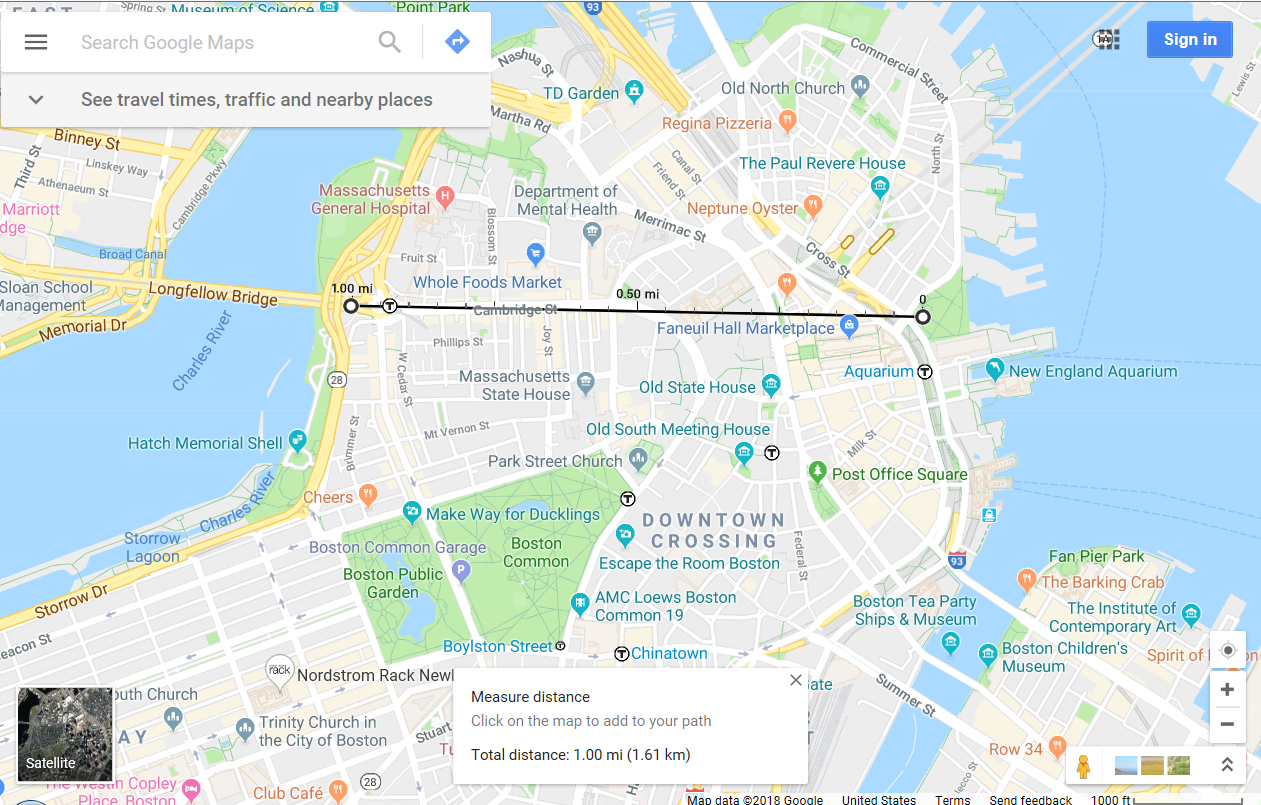
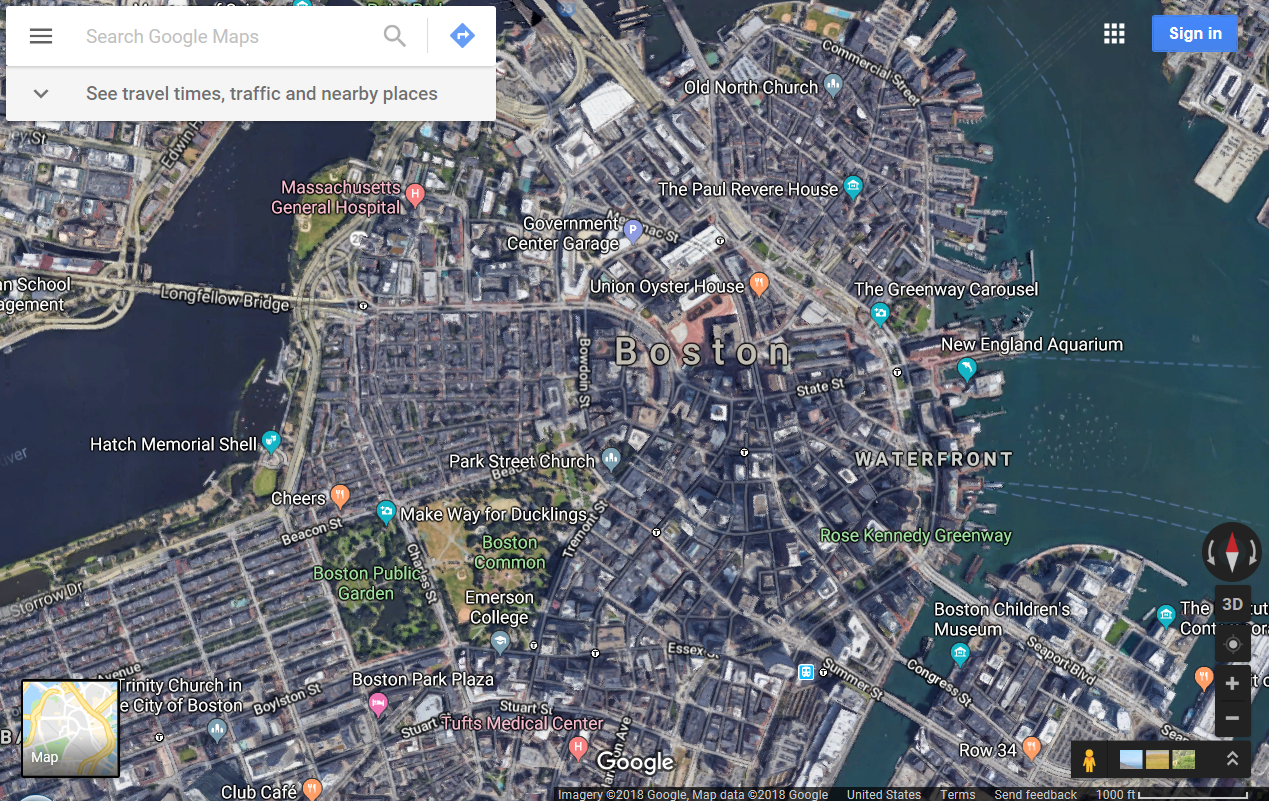
Last edited by Jim from Boston; 12-04-18 at 10:38 AM. Reason: added maps
12-04-18 | 10:33 AM
#207
Senior Member
Joined: Apr 2007
Posts: 4,129
Likes: 56
From: Munising, Michigan, USA
Bikes: Priority 600, Priority Continuum, Devinci Dexter
I was in Boston earlier this year to work an exhibit booth at a small conference. Nice area. Some sort of university nearby, with a Shake Shack in the neighborhood. I recall a tall round thing in some sort of park area outside my hotel window. Indeed a very walkable neighborhood. I can't recall now the precise area. There was a Dalton Street. I remember that much, and I may have crossed a bridge over a river while walking from rail line to my hotel.
12-04-18 | 10:42 AM
#208
born again cyclist
Joined: Jun 2010
Posts: 2,412
Likes: 88
From: Chicago
Bikes: I have five of brikes
it's not a city vs. city thing in my mind.
the issue of walkability is much more of an urban neighborhood vs. suburban neighborhood thing.
12-04-18 | 10:51 AM
#209
Banned
Joined: Jul 2010
Posts: 8,543
Likes: 42
From: England / CPH
Bikes: 2010 Cube Acid / 2013 Mango FGSS
We're on Portsea Island, which is within the middle of the photograph.
And, in a lot of ways in like Boston, as the population growth is constrained by natural boundaries. We haven't initiated a "big dig" here (I remember that as a child) but instead use hovercrafts and ferries between the islands (we're old fashioned.)

 12-04-18 | 12:25 PM
#210
Senior Member
Joined: May 2008
Posts: 7,381
Likes: 219
I referred to Detroit, and its suburb of Southfield as the “City of Towers and Cars,” although Ann Arbor, 40 miles away is a City of Outdoor Rooms." :
...Back in the 60’s in the Motor City, I had an “English Racer,’ and longed to tour at about age 14, but then joined the car culture....
In Ann Arbor MI in the 70’s I really realized the utility of bicycles for commuting, and began touring on a five-speed Schwinn Suburban, but soon bought a Mercier as did my girlfriend, later my wife. We toured in Michigan and Ontario…
In Ann Arbor MI in the 70’s I really realized the utility of bicycles for commuting, and began touring on a five-speed Schwinn Suburban, but soon bought a Mercier as did my girlfriend, later my wife. We toured in Michigan and Ontario…
12-04-18 | 12:54 PM
#211
born again cyclist
Joined: Jun 2010
Posts: 2,412
Likes: 88
From: Chicago
Bikes: I have five of brikes
I see your point, but it seems that even cities proper are walkable/liveable sans car, or not, and suburbs follow suit, e.g NYC and Brooklyn (admittedly a borough I have never visited); Boston and inner suburbs, e,g, Brookline, Cambridge; San Francisco and (?) Berkley,
to understand how i'm using the words "urban" and "suburban", let's go back to the two examples from chicagoland that i used on the previous page:
A) Lincoln Square (chicago neighborhood) - "urban" - https://www.google.com/maps/@41.9721.../data=!3m1!1e3
B) Niles, Illinois - "suburban" - https://www.google.com/maps/@42.0613.../data=!3m1!1e3
in A we have a tight and fully-connected street grid, with tightly packed multi-family residential buildings mixed with single family homes and commercial, retail, and institutional uses mixed into the urban fabric along the major street corridors with a minimum of parking lots to encourage pedestrian activity which in turn encourages a real sense of place.
in B we have residential, commercial, retail, and institutional uses all segregated from each other into their own super-blocks, with very poor interconnectivity, and as such very poor walkability. because everyone drives everywhere, each discreet destination needs to accommodate large amounts of car storage and we end up with parking lot hell.
12-04-18 | 01:05 PM
#212
Senior Member
Joined: May 2008
Posts: 7,381
Likes: 219
There are also natural geographical constraints that one often forgets.[.]There are also natural geographical constraints that one often forgets]We're on Portsea Island, which is within the middle of the photograph.
And, in a lot of ways in like Boston, as the population growth is constrained by natural boundaries. We haven't initiated a "big dig" here (I remember that as a child) but instead use hovercrafts and ferries between the islands (we're old fashioned.)
And, in a lot of ways in like Boston, as the population growth is constrained by natural boundaries. We haven't initiated a "big dig" here (I remember that as a child) but instead use hovercrafts and ferries between the islands (we're old fashioned.)
However, even in a mecca like Boston, walkable areas to live without a car are limited, though sizeable enclaves:
...However, even in Metro Boston, last weekend I spent two hours in freeway traffic on a normally one hour errand. 

12-04-18 | 01:13 PM
#213
Banned
Joined: Jul 2010
Posts: 8,543
Likes: 42
From: England / CPH
Bikes: 2010 Cube Acid / 2013 Mango FGSS
from my understanding of the word "suburban", i would never describe places like brooklyn or cambridge or brookline as "suburban".
to understand how i'm using the words "urban" and "suburban", let's go back to the two examples from chicagoland that i used on the previous page:
A) Lincoln Square (chicago neighborhood) - "urban" - https://www.google.com/maps/@41.9721.../data=!3m1!1e3
B) Niles, Illinois - "suburban" - https://www.google.com/maps/@42.0613.../data=!3m1!1e3
in A we have a tight and fully-connected street grid, with tightly packed multi-family residential buildings mixed with single family homes and commercial, retail, and institutional uses mixed into the urban fabric along the major street corridors with a minimum of parking lots to encourage pedestrian activity which in turn encourages a real sense of place.
in B we have residential, commercial, retail, and institutional uses all segregated from each other into their own super-blocks, with very poor interconnectivity, and as such very poor walkability. because everyone drives everywhere, each discreet destination needs to accommodate large amounts of car storage and we end up with parking lot hell.
to understand how i'm using the words "urban" and "suburban", let's go back to the two examples from chicagoland that i used on the previous page:
A) Lincoln Square (chicago neighborhood) - "urban" - https://www.google.com/maps/@41.9721.../data=!3m1!1e3
B) Niles, Illinois - "suburban" - https://www.google.com/maps/@42.0613.../data=!3m1!1e3
in A we have a tight and fully-connected street grid, with tightly packed multi-family residential buildings mixed with single family homes and commercial, retail, and institutional uses mixed into the urban fabric along the major street corridors with a minimum of parking lots to encourage pedestrian activity which in turn encourages a real sense of place.
in B we have residential, commercial, retail, and institutional uses all segregated from each other into their own super-blocks, with very poor interconnectivity, and as such very poor walkability. because everyone drives everywhere, each discreet destination needs to accommodate large amounts of car storage and we end up with parking lot hell.
**shivers**
It might as well be LA.
You win, I think the post-automobile cities are mmmm.
I'll take a Boston any day.
12-04-18 | 01:37 PM
#214
Keepin it Wheel
Joined: Aug 2011
Posts: 10,969
Likes: 5,247
From: San Diego
Bikes: Surly CrossCheck, Krampus
12-04-18 | 01:50 PM
#215
Banned
Joined: Jul 2010
Posts: 8,543
Likes: 42
From: England / CPH
Bikes: 2010 Cube Acid / 2013 Mango FGSS
 12-04-18 | 01:53 PM
#216
born again cyclist
Joined: Jun 2010
Posts: 2,412
Likes: 88
From: Chicago
Bikes: I have five of brikes
i guess boston, NYC, philly, and DC might as well be LA too.
it's all just sprawl and it's all horrendous according to resident "expert" on US urbansim.
boston @ 7 miles outside of downtown: https://www.google.com/maps/@42.2726.../data=!3m1!1e3
NYC @ 7 miles outside of downtown: https://www.google.com/maps/@40.6326.../data=!3m1!1e3
philly @ 7 miles outside of downtown: https://www.google.com/maps/@40.0181.../data=!3m1!1e3
DC @ 4 miles outside of downtown: https://www.google.com/maps/@38.9273.../data=!3m1!1e3 (DC gets too suburban at 7 miles out to have much in the way of pre-war urban neighborhoods at that distance)
for reference:
chicago @ 7 miles outside downtown https://www.google.com/maps/@41.9721.../data=!3m1!1e3
it's all just sprawl and it's all horrendous according to resident "expert" on US urbansim.
boston @ 7 miles outside of downtown: https://www.google.com/maps/@42.2726.../data=!3m1!1e3
NYC @ 7 miles outside of downtown: https://www.google.com/maps/@40.6326.../data=!3m1!1e3
philly @ 7 miles outside of downtown: https://www.google.com/maps/@40.0181.../data=!3m1!1e3
DC @ 4 miles outside of downtown: https://www.google.com/maps/@38.9273.../data=!3m1!1e3 (DC gets too suburban at 7 miles out to have much in the way of pre-war urban neighborhoods at that distance)
for reference:
chicago @ 7 miles outside downtown https://www.google.com/maps/@41.9721.../data=!3m1!1e3
Last edited by Steely Dan; 12-04-18 at 02:40 PM.
12-04-18 | 01:59 PM
#217
Senior Member
Joined: May 2008
Posts: 7,381
Likes: 219
from my understanding of the word "suburban", i would never describe places like brooklyn or cambridge or brookline as "suburban".
to understand how i'm using the words "urban" and "suburban", let's go back to the two examples from chicagoland that i used on the previous page:
A) Lincoln Square (chicago neighborhood) - "urban" - https://www.google.com/maps/@41.9721.../data=!3m1!1e3
B) Niles, Illinois - "suburban" - https://www.google.com/maps/@42.0613.../data=!3m1!1e3
in A we have a tight and fully-connected street grid, with tightly packed multi-family residential buildings mixed with single family homes and commercial, retail, and institutional uses mixed into the urban fabric along the major street corridors with a minimum of parking lots to encourage pedestrian activity which in turn encourages a real sense of place.
in B we have residential, commercial, retail, and institutional uses all segregated from each other into their own super-blocks, with very poor interconnectivity, and as such very poor walkability. because everyone drives everywhere, each discreet destination needs to accommodate large amounts of car storage and we end up with parking lot hell.
to understand how i'm using the words "urban" and "suburban", let's go back to the two examples from chicagoland that i used on the previous page:
A) Lincoln Square (chicago neighborhood) - "urban" - https://www.google.com/maps/@41.9721.../data=!3m1!1e3
B) Niles, Illinois - "suburban" - https://www.google.com/maps/@42.0613.../data=!3m1!1e3
in A we have a tight and fully-connected street grid, with tightly packed multi-family residential buildings mixed with single family homes and commercial, retail, and institutional uses mixed into the urban fabric along the major street corridors with a minimum of parking lots to encourage pedestrian activity which in turn encourages a real sense of place.
in B we have residential, commercial, retail, and institutional uses all segregated from each other into their own super-blocks, with very poor interconnectivity, and as such very poor walkability. because everyone drives everywhere, each discreet destination needs to accommodate large amounts of car storage and we end up with parking lot hell.
In Detroit, I think that becomes nearly impossible without some kind of access to a car or other motorized vehicle.
Nonetheless, I have quipped,
...I am occasionally asked by suburban colleagues who live closer to work, why I don’t move out there from downtown. My reply is that for cycling purposes, the distance and routes are perfect, meanwhile thinking to myself, “Why do you think they call it ‘sub-urban’ living (like ‘sub-human’)”? 
12-04-18 | 02:02 PM
#218
Banned
Joined: Jul 2010
Posts: 8,543
Likes: 42
From: England / CPH
Bikes: 2010 Cube Acid / 2013 Mango FGSS
i guess boston, NYC, philly, and DC might as well be LA too. it's all just sprawl and it's all "horrendous".
boston @ 7 miles outside of downtown: https://www.google.com/maps/@42.2726.../data=!3m1!1e3
NYC@ 7 miles outside of downtown: https://www.google.com/maps/@40.6326.../data=!3m1!1e3
philly @ 7 miles outside of downtown: https://www.google.com/maps/@40.0181.../data=!3m1!1e3
DC @ 4 miles outside of downtown: https://www.google.com/maps/@38.9273.../data=!3m1!1e3 (DC gets too suburban at 7 miles out to have much in the way of pre-war urban neighborhoods at that distance)
boston @ 7 miles outside of downtown: https://www.google.com/maps/@42.2726.../data=!3m1!1e3
NYC@ 7 miles outside of downtown: https://www.google.com/maps/@40.6326.../data=!3m1!1e3
philly @ 7 miles outside of downtown: https://www.google.com/maps/@40.0181.../data=!3m1!1e3
DC @ 4 miles outside of downtown: https://www.google.com/maps/@38.9273.../data=!3m1!1e3 (DC gets too suburban at 7 miles out to have much in the way of pre-war urban neighborhoods at that distance)
12-04-18 | 02:52 PM
#219
born again cyclist
Joined: Jun 2010
Posts: 2,412
Likes: 88
From: Chicago
Bikes: I have five of brikes
Thanks for you comments. I don't know the geography of other cities to comment on "far" suburbs, but in Boston outer suburbs are doable "car free," but proximity to the town center becomes more important. Perhaps that holds for the outer suburbs of other "carfee" metropolitan areas, e.g NYC
as a general rule, the more urban the environment one lives within, the less inconvenience one will have to tolerate.
there are lots of traditional town centers built around commuter rail stations throughout suburban chicagoland, places like Elmhurst being a fairly representative example: https://www.google.com/maps/@41.8919.../data=!3m1!1e3
these places offer a good tweener environment between my previous A (city neighborhood) and B (auto-centric suburbia) examples.
though they're still probably better as car light than entirely car-free for your average person.
Last edited by Steely Dan; 12-04-18 at 02:56 PM.
12-04-18 | 06:37 PM
#220
Senior Member
Joined: Mar 2012
Posts: 4,869
Likes: 1,108
From: Tallahassee, FL
All cities that saw a great deal of their growth from the 60s onward. After everyone had a car. The immediate post war expansion in the 40s and 50s tended to hold to more urban density development patterns.
12-04-18 | 10:15 PM
#221
Newbie
Joined: May 2018
Posts: 53
Likes: 14
Bikes: Surly Disc Trucker, 1977 Motobecane Super Mirage
Lincoln Park in Chicago has a 24hr subway stop and continuous bike lanes on major thoroughfares all the way to the loop. Seems pretty accessible to me...
12-05-18 | 02:00 AM
#222
Banned
Joined: Jul 2010
Posts: 8,543
Likes: 42
From: England / CPH
Bikes: 2010 Cube Acid / 2013 Mango FGSS
Baufritz (Germany) comes to mind: https://www.baufritz.com/uk/architecture-and-homes/
Riedberg (suburb of Frankfurt) has some interesting high-density units like:
so.what: https://www.bien-ries.de/referenz/so-what/
take.5: https://www.bien-ries.de/referenz/take-5/
But, I guess that taste is very personal. Some people won't like these.
12-05-18 | 06:46 AM
#223
Senior Member
Joined: May 2008
Posts: 7,381
Likes: 219
I incessantly post about Boston as a walking "nirvana,” as often as [MENTION=195860]Steely Dan[/MENTION] touts Chicago, and decries other American cities
i don't really decry other cities though.
it's not a city vs. city thing in my mind.
the issue of walkability is much more of an urban neighborhood vs. suburban neighborhood thing.
it's not a city vs. city thing in my mind.
the issue of walkability is much more of an urban neighborhood vs. suburban neighborhood thing.
I see your point, but it seems that even cities proper are walkable/liveable sans car, or not, and suburbs follow suit, e.g NYC and Brooklyn (admittedly a borough I have never visited); Boston and inner suburbs, e,g, Brookline, Cambridge; San Francisco and (?) Berkley,
I referred to Detroit, and its suburb of Southfield as the “City of Towers and Cars,” although Ann Arbor, 40 miles away is a City of Outdoor Rooms…
When I visited Chicago, I thought Lincoln Park was a walkable/liveable sans car area though seemingly removed from the downtown,
I referred to Detroit, and its suburb of Southfield as the “City of Towers and Cars,” although Ann Arbor, 40 miles away is a City of Outdoor Rooms…
When I visited Chicago, I thought Lincoln Park was a walkable/liveable sans car area though seemingly removed from the downtown,
from my understanding of the word "suburban", i would never describe places like brooklyn or cambridge or brookline as "suburban".
to understand how i'm using the words "urban" and "suburban", let's go back to the two examples from chicagoland that i used on the previous page:…
to understand how i'm using the words "urban" and "suburban", let's go back to the two examples from chicagoland that i used on the previous page:…
]i guess boston, NYC, philly, and DC might as well be LA too.
it's all just sprawl and it's all horrendous according to resident "expert" on US urbansim.
boston @ 7 miles outside of downtown: https://www.google.com/maps/@42.2726109,-71.135576,834a,35y,21.75h,49.08t/data=!3m1!1e3 …
(DC gets too suburban at 7 miles out to have much in the way of pre-war urban neighborhoods at that distance)
for reference:
chicago @ 7 miles outside downtown https://www.google.com/maps/@41.9721.../data=!3m1!1e3
it's all just sprawl and it's all horrendous according to resident "expert" on US urbansim.
boston @ 7 miles outside of downtown: https://www.google.com/maps/@42.2726109,-71.135576,834a,35y,21.75h,49.08t/data=!3m1!1e3 …
(DC gets too suburban at 7 miles out to have much in the way of pre-war urban neighborhoods at that distance)
for reference:
chicago @ 7 miles outside downtown https://www.google.com/maps/@41.9721.../data=!3m1!1e3
it's theoretically possible to live car-free anywhere, it's just a matter of how much inconvenience one is willing to tolerate relative to where they live.
as a general rule, the more urban the environment one lives within, the less inconvenience one will have to tolerate.
there are lots of traditional town centers built around commuter rail stations throughout suburban chicagoland, places like Elmhurst being a fairly representative example: https://www.google.com/maps/@41.8919.../data=!3m1!1e3
these places offer a good tweener environment between my previous A (city neighborhood) and B (auto-centric suburbia) examples.
though they're still probably better as car light than entirely car-free for your average person.
as a general rule, the more urban the environment one lives within, the less inconvenience one will have to tolerate.
there are lots of traditional town centers built around commuter rail stations throughout suburban chicagoland, places like Elmhurst being a fairly representative example: https://www.google.com/maps/@41.8919.../data=!3m1!1e3
these places offer a good tweener environment between my previous A (city neighborhood) and B (auto-centric suburbia) examples.
though they're still probably better as car light than entirely car-free for your average person.
In Boston; Brookline, Cambridge, and Newton, etc are examples. In fact the prosperous inner suburb of Newton is said to be a coalescence of nine villages each served by a light rail / Commuter Rail stop.
The aerial view you posted of Boston included the Town Center of Roslindale, a neighborhood in Boston City Proper, and nicely serviced by bus and Commuter Rail. In fact, "Rozzie" is about midway on my cycle commute to an outer Boston suburb where I work, 14 miles from home. Having a reverse commuter route is a nice situation.
From my limited Chicago experience, Lincoln Park and Oak Park seem to be such. In Detroit, there are nice inner, and slightly removed walkable suburbs such as the Grosse Pointes, Royal Oak, and Birmingham, but they lack a good regional mass transit.
So besides the first compartment of Metropolitan urban living, downtown, city proper; the second of “outer” suburbs; the third of inner suburbs / town centers, I think there is also a fourth “compartment” of Metropolitan urban living, I call exurbia; less walkable, and at the periphery of the regional mass transit, but good for road cycling. I can be in Boston’s exurbia in about one hour on a training ride, and,
… On a happier note, the Transportation Authority (MBTA) allows bikes on subways and commuter trains [and buses] with certain restrictions and that's a nice way to get out of town without city riding. MBTA > Riding the T > Bikes on the T
For me,
...I am occasionally asked by suburban colleagues who live closer to work, why I don’t move out there from downtown. My reply is that for cycling purposes, the distance and routes are perfect, meanwhile thinking to myself, “Why do you think they call it ‘sub-urban’ living (like ‘sub-human’)”?

Last edited by Jim from Boston; 12-05-18 at 07:08 AM.
12-11-18 | 11:29 AM
#224
Newbie

Joined: Nov 2018
Posts: 68
Likes: 33
I'm 36 and I've never owned a car although I have driving license since turning 18. I live in a rather small town, around 80k people and most of the places can be reached on foot or by cycling. Despite that, not many people cycle. They would rather sit in a car and drive 500 meters. To me it is some kind of absurd to see a young man or woman sitting in her car driving around instead of using his or her legs. People are more isolated from other people and nature that way. I've grown up in a family that didn't own a car too. It's not that I can't afford a car, I can of course but my needs are very simple and I like the exercise of cycling. Also, it's super fun and has always been. Sometimes it's hassle without a car especially if you want to carry heavy stuff or regularly commute to nearby city due to work, but I don't have to do that since I work from home. I lived abroad as well in a city with over a million for long 9 years and managed it without a car. Cycled there as much as I could. I guess at one point I might be really tempted to buy a car if I have a kid, but I say again, we as a family were perfectly fine without a vehicle. I might accept electric car much more easily than a fossil fuel one, it seems cleaner technology though...
12-11-18 | 12:17 PM
#225
Keepin it Wheel
Joined: Aug 2011
Posts: 10,969
Likes: 5,247
From: San Diego
Bikes: Surly CrossCheck, Krampus
I totally agree with this. I find there's even a big difference between driving with windows open or closed. With windows closed, even though I can see out, external sounds are muffled, my stereo is probably playing something just for me, and I feel like I'm in my own cocoon (like everybody else). But with windows open, I've often got an elbow sticking outside, eye contact through the open window feels more direct, I am hearing the stereos of any other people that might have their windows open, and more conscious that my stereo is audible to others, etc. Maybe more importantly, I drive slower, and feel more like I'm 'cruising' or 'touring' the neighborhood, participating in road use along with the others around me, rather than with windows closed I'm driving faster and focused on getting 'through' or 'out' of the neighborhood, competing for roadshare with others around me.
It's not hard to understand how this leads to a lot of bad cager behavior.
It's not hard to understand how this leads to a lot of bad cager behavior.