


How far is your commute?
 04-15-25 | 07:21 AM
#51

Commuter, roadie


Joined: Jun 2022
Posts: 2,747
Likes: 2,244
From: SE Wisconsin, USA
Bikes: Trek: Domane AL3, Checkpoint SL7; Priority Apollo 11, ZiZZO Forte + eBikes

On a multi-use path (MUP) this past winter. 26x4" tires at about 15 psi for this.
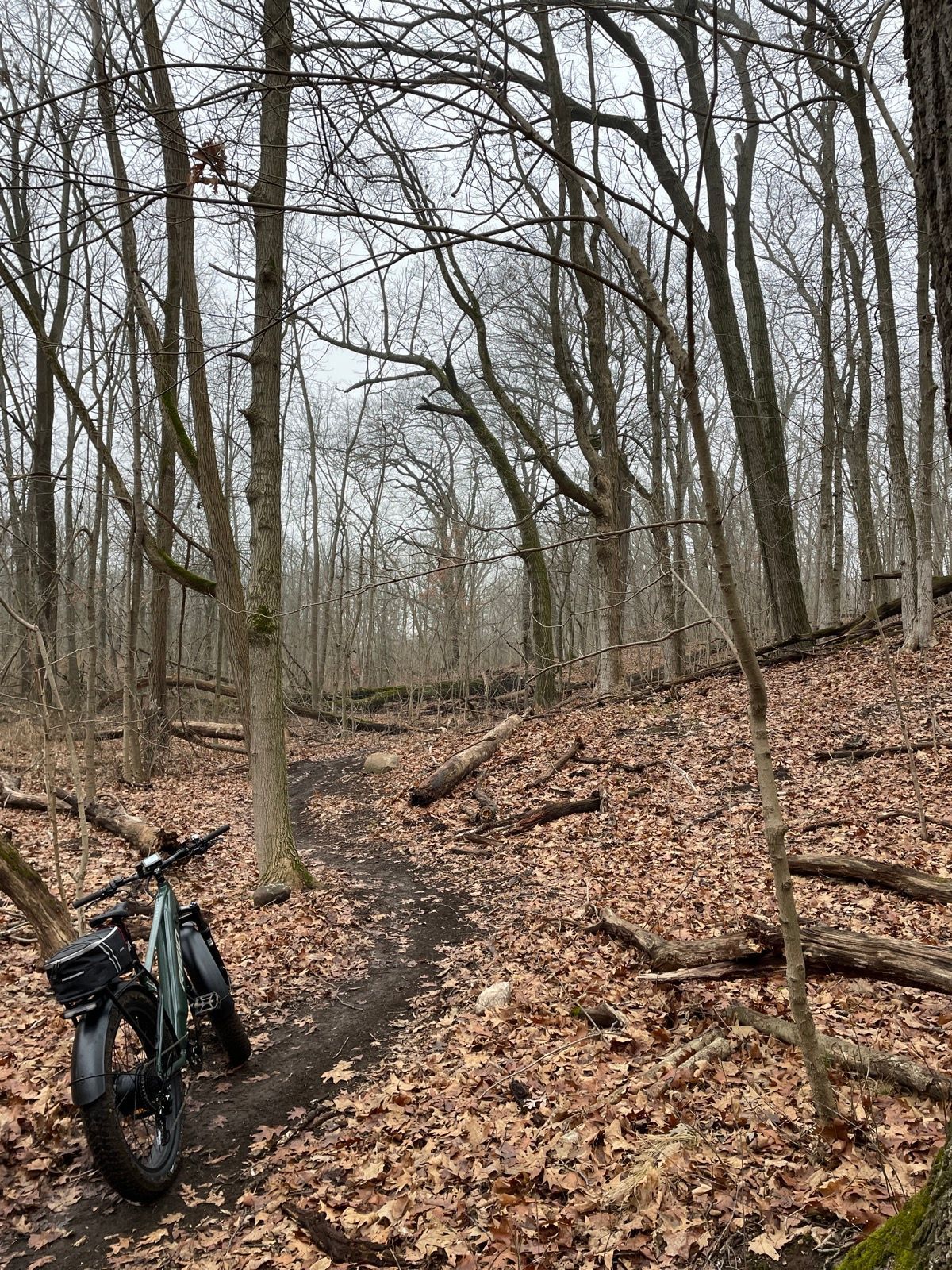
Tires were at 5 psi for this MTB trail.
You could bike commute daily with such a rig; it would pay for itself quickly.
I calculated that for my commuter eBike, which cost $2300 new, it would pay for itself in 3 years if I commute on it 3 days per week and do one shopping trip per week on it.
I have a lot of bikes & eBikes, but this is my most popular commuter, it will probably take 5 years.
__________________
-Jeremy
-Jeremy
 04-15-25 | 09:47 AM
#52


Been Around Awhile

Joined: Oct 2004
Posts: 30,651
Likes: 1,973
From: Burlington Iowa
Bikes: Vaterland and Ragazzi
You could bike commute daily with such a rig; it would pay for itself quickly.
I calculated that for my commuter eBike, which cost $2300 new, it would pay for itself in 3 years if I commute on it 3 days per week and do one shopping trip per week on it.
I have a lot of bikes & eBikes, but this is my most popular commuter, it will probably take 5 years.
I calculated that for my commuter eBike, which cost $2300 new, it would pay for itself in 3 years if I commute on it 3 days per week and do one shopping trip per week on it.
I have a lot of bikes & eBikes, but this is my most popular commuter, it will probably take 5 years.
04-15-25 | 09:56 AM
#53
Junior Member
Joined: Feb 2021
Posts: 103
Likes: 53
1. walk (cost of shoes at 10-14km/day walking)
2. free bus with my staff car ... (zero cost)
3. train for one station each way ... £4/day
4. non-free bus other route and less stops (£4/day)
5. bicycle rental (£0.18/min + 99p unlock)
6. e-scooter rental (£0.18/min + 99p unlock)
7. Uber (£10/day)
8. Drive (not much for fuel but to park legally around £10)
Bicycle seems like the best option with the sunk cost and proximity to home/office.
I did do a test of car ownership over 10 years / 150k miles and came up with this ...
https://www.******.com/r/Volkswagen/...rs_150k_miles/
all in it was about £0.30/mi or $0.39/mi
04-15-25 | 10:04 AM
#54
Been Around Awhile
Joined: Oct 2004
Posts: 30,651
Likes: 1,973
From: Burlington Iowa
Bikes: Vaterland and Ragazzi
I found this hard to calculate as I have many options:
1. walk (cost of shoes at 10-14km/day walking)
2. free bus with my staff car ... (zero cost)
3. train for one station each way ... £4/day
4. non-free bus other route and less stops (£4/day)
5. bicycle rental (£0.18/min + 99p unlock)
6. e-scooter rental (£0.18/min + 99p unlock)
7. Uber (£10/day)
8. Drive (not much for fuel but to park legally around £10)
Bicycle seems like the best option with the sunk cost and proximity to home/office.
I did do a test of car ownership over 10 years / 150k miles and came up with this ...
https://www.******.com/r/Volkswagen/...rs_150k_miles/
all in it was about £0.30/mi or $0.39/mi
1. walk (cost of shoes at 10-14km/day walking)
2. free bus with my staff car ... (zero cost)
3. train for one station each way ... £4/day
4. non-free bus other route and less stops (£4/day)
5. bicycle rental (£0.18/min + 99p unlock)
6. e-scooter rental (£0.18/min + 99p unlock)
7. Uber (£10/day)
8. Drive (not much for fuel but to park legally around £10)
Bicycle seems like the best option with the sunk cost and proximity to home/office.
I did do a test of car ownership over 10 years / 150k miles and came up with this ...
https://www.******.com/r/Volkswagen/...rs_150k_miles/
all in it was about £0.30/mi or $0.39/mi
04-15-25 | 10:06 AM
#55
Junior Member
Joined: Feb 2021
Posts: 103
Likes: 53
The total cost of car ownership including depreciation was $0.39/miles over 10 years and 150k miles (petrol is expensive here).
04-15-25 | 10:39 AM
#56
Commuter, roadie
Joined: Jun 2022
Posts: 2,747
Likes: 2,244
From: SE Wisconsin, USA
Bikes: Trek: Domane AL3, Checkpoint SL7; Priority Apollo 11, ZiZZO Forte + eBikes
https://docs.google.com/spreadsheets...it?usp=sharing
I allowed someone editing access who I think added or revised the bottom part. I just removed his permission to edit. I guess I need to lock down certain cells before allowing others to edit.
__________________
-Jeremy
-Jeremy
Last edited by Smaug1; 04-15-25 at 10:42 AM.
04-15-25 | 01:35 PM
#57
Been Around Awhile
Joined: Oct 2004
Posts: 30,651
Likes: 1,973
From: Burlington Iowa
Bikes: Vaterland and Ragazzi
Thanks for your response. The top half of your spreadsheet is straightforward showing the savings on fuel when the ebike is used for commuting and shopping rather than your car, assuming electric charging for you is free.
The bottom half revised by somebody else seems to assume that you no longer will be paying $5,100/year for car insurance and car payment, and that $600/year will cover all your non e-bike transportation expenses to include the 1/4 year when you are not using the ebike at all, as well as all travel expenses for the rest of the year if you commute more than 3 times/week, or go more than 10 miles/week to anywhere else not on the ebike.
$5,100 year for car payment and insurance (plus licensing and maintenance costs) seems unnecessarily wasteful for a person only using the car to travel 40 miles/week for commuting and shopping and without any other travel requirements that require more than walking or conventional bicycling. I think that a used car capable of reliable transportation for approximately 2,000 miles a year could be found for much less annual cost and not need to be replaced for 20 years or so with such little use.
The bottom half revised by somebody else seems to assume that you no longer will be paying $5,100/year for car insurance and car payment, and that $600/year will cover all your non e-bike transportation expenses to include the 1/4 year when you are not using the ebike at all, as well as all travel expenses for the rest of the year if you commute more than 3 times/week, or go more than 10 miles/week to anywhere else not on the ebike.
$5,100 year for car payment and insurance (plus licensing and maintenance costs) seems unnecessarily wasteful for a person only using the car to travel 40 miles/week for commuting and shopping and without any other travel requirements that require more than walking or conventional bicycling. I think that a used car capable of reliable transportation for approximately 2,000 miles a year could be found for much less annual cost and not need to be replaced for 20 years or so with such little use.
Last edited by I-Like-To-Bike; 04-15-25 at 01:38 PM.
04-15-25 | 03:26 PM
#58

aka Tom Reingold

Joined: Jan 2009
Posts: 44,123
Likes: 6,340
From: New York, NY, and High Falls, NY, USA
Bikes: 1962 Rudge Sports, 1971 Raleigh Super Course, 1971 Raleigh Pro Track, 1974 Raleigh International, 1975 Viscount Fixie, 1982 McLean, 1996 Lemond (Ti), 2002 Burley Zydeco tandem
Back in 2011, Mr. Money Mustache wrote an article called The True Cost of Commuting and he meant the cost of car commuting. In the article, he uses the federal allowance for driving which was 51 cents at the time. Currently, it's 70 per mile. Some people think that the cost of driving is not linear per mile, but Mr. Money Mustache argues that it is. Fixed costs are believed to be purchase and insurance, but the less you drive, the less often you need to replace your car. The same goes for repairs. Calculating the only the fuel cost for your distance is wrong. So when you ride 10 miles instead of driving 10 miles, you're saving $7 off your car expenses. I don't know what bike expenses per mile are, but maybe acidfast7_2 does, since he did a study of it (with a sample size of one) a few years ago.
__________________
Tom Reingold, tom@noglider.com
New York City and High Falls, NY
Blogs: The Experienced Cyclist; noglider's ride blog
“When man invented the bicycle he reached the peak of his attainments.” — Elizabeth West, US author
Please email me rather than PM'ing me. Thanks.
Tom Reingold, tom@noglider.com
New York City and High Falls, NY
Blogs: The Experienced Cyclist; noglider's ride blog
“When man invented the bicycle he reached the peak of his attainments.” — Elizabeth West, US author
Please email me rather than PM'ing me. Thanks.
04-16-25 | 02:53 AM
#59
Junior Member
Joined: Feb 2021
Posts: 103
Likes: 53
that thread is here:
New BSO long-term test!
the last calculation is here. quickly (that included the bike itself, extra fenders, lights, bike lock, all parts, maintenance) but didn't include the helmet or any clothes. I was hit once on the bike and needed a new rear wheel and some other bits (I think that comes under maintenance as I ride in dense urban areas usually). I needed new bars as I went from drops to flats. the lights still charge and work (USB after 12 years and the lock is still good). I could ride it some more, but I want the MTB for the kiddos on the back.
I could've bought a cheaper bike but I wanted to try a coloured FGSS bike and this was the cheapest on the market at the time.
episode 521
5521km/3430mi/264.16h
£605.76/€679.05/$777.27 total
£2.293/€2.570/$2.942 per hour
£0.1097/€0.1229/$0.2266 per km/mi
£1.162/€1.303/$1.492per RT commute
When I compared this the cost of having a car in the UK for 10 years and 150k miles, all-in, it was 30p/mi or $0.39/mi. (including all running costs and depreciation). we still use that car but not as much as longer (163k miles now and needs a service next month £300 for a yearly MOT, oil change and two new rear tyres). obviously, you can take 5 people in the Golf and only two on the bike easily, so per person it's likely closer than the gap suggests. 25-40% of those miles are likely with multiple people.
New BSO long-term test!
the last calculation is here. quickly (that included the bike itself, extra fenders, lights, bike lock, all parts, maintenance) but didn't include the helmet or any clothes. I was hit once on the bike and needed a new rear wheel and some other bits (I think that comes under maintenance as I ride in dense urban areas usually). I needed new bars as I went from drops to flats. the lights still charge and work (USB after 12 years and the lock is still good). I could ride it some more, but I want the MTB for the kiddos on the back.
I could've bought a cheaper bike but I wanted to try a coloured FGSS bike and this was the cheapest on the market at the time.
episode 521
5521km/3430mi/264.16h
£605.76/€679.05/$777.27 total
£2.293/€2.570/$2.942 per hour
£0.1097/€0.1229/$0.2266 per km/mi
£1.162/€1.303/$1.492per RT commute
When I compared this the cost of having a car in the UK for 10 years and 150k miles, all-in, it was 30p/mi or $0.39/mi. (including all running costs and depreciation). we still use that car but not as much as longer (163k miles now and needs a service next month £300 for a yearly MOT, oil change and two new rear tyres). obviously, you can take 5 people in the Golf and only two on the bike easily, so per person it's likely closer than the gap suggests. 25-40% of those miles are likely with multiple people.
Last edited by acidfast7_2; 04-16-25 at 02:59 AM.
04-16-25 | 07:38 AM
#60
Been Around Awhile
Joined: Oct 2004
Posts: 30,651
Likes: 1,973
From: Burlington Iowa
Bikes: Vaterland and Ragazzi
Back in 2011, Mr. Money Mustache wrote an article called The True Cost of Commuting and he meant the cost of car commuting. In the article, he uses the federal allowance for driving which was 51 cents at the time. Currently, it's 70 per mile. Some people think that the cost of driving is not linear per mile, but Mr. Money Mustache argues that it is. Fixed costs are believed to be purchase and insurance, but the less you drive, the less often you need to replace your car. The same goes for repairs. Calculating the only the fuel cost for your distance is wrong. So when you ride 10 miles instead of driving 10 miles, you're saving $7 off your car expenses. I don't know what bike expenses per mile are, but maybe acidfast7_2 does, since he did a study of it (with a sample size of one) a few years ago.
The reduction in vehicle maintenance costs or for replacement frequency for someone who reduces its use by 2000 miles/year by commuting and shopping with some other method like the OP's example is almost insignificant, and there would be little or no reduction in the fixed ownership costs as long as the commuter still owns the vehicle.
The OP's calculations for actual $ savings considering reduction in fuel, parking and toll expenses for commuting by bicycle instead of car provide a much more accurate portrayal of the potential cost savings realized by bicycle commuting than Mr. Money's misleading version.
04-16-25 | 07:56 AM
#61
Junior Member
Joined: Feb 2021
Posts: 103
Likes: 53
The OP's calculations for actual $ savings considering reduction in fuel, parking and toll expenses for commuting by bicycle instead of car provide a much more accurate portrayal of the potential cost savings realized by bicycle commuting than Mr. Money's misleading version.
However, that doesn't tell the full story as the US/UK aren't really comparable, but I think the end result of car ownership is (about one net median month's salary per year).
1) Car seems to be less expensive over here (especially used cars as being LHD means they have a small second-hand market). I bought 3-year old VW Golf (cash) with 6k miles for 50% of the original price of £17k.
2) Wages are lower nationwide. Median wage for a full-time employee is £37k (pre-tax) or £2450/mo after tax.
3) We use cars less and the average yearly distance is 7400 miles, which would be £2200/year in my calculation (or about one month of net salary)
I propose that the median salary is higher and a similar result would occur (one net median month's of salary would be required).
04-16-25 | 08:11 AM
#62
Been Around Awhile
Joined: Oct 2004
Posts: 30,651
Likes: 1,973
From: Burlington Iowa
Bikes: Vaterland and Ragazzi
That figure wouldn't accurately represent the savings you would get by reducing your car mileage by 2000 miles a year,since your major fixed costs (depreciation, insurance, registration) would not be reduced at all. Outside of fuel costs and parking costs, if any, at work site you would not see much savings at all.
04-16-25 | 08:18 AM
#63
Junior Member
Joined: Feb 2021
Posts: 103
Likes: 53
Your $0.39/mi figure appears to be derived from dividing your total yearly car costs (both fixed and variable costs) by your total mileage driven, and it is not a figure that represents the rate for each additional mile driven, or conversely the amount that would have been saved for each mile not driven.
That figure wouldn't accurately represent the savings you would get by reducing your car mileage by 2000 miles a year,since your major fixed costs (depreciation, insurance, registration) would not be reduced at all. Outside of fuel costs and parking costs, if any, at work site you would not see much savings at all.
That figure wouldn't accurately represent the savings you would get by reducing your car mileage by 2000 miles a year,since your major fixed costs (depreciation, insurance, registration) would not be reduced at all. Outside of fuel costs and parking costs, if any, at work site you would not see much savings at all.
I'd also wager than my car is getting close to it's overall lifespan and I'll be lucky to get 200k out of it. I'll need another clutch soon and most of the original mechatronics are wearing out (door locks, windows, etc...)
Used parts are cheap (£6 for a use Golf door lock and labour is cheap as we £60/h) but how many parts can be replaced before a new car is purchased.
04-16-25 | 12:04 PM
#64
aka Tom Reingold
Joined: Jan 2009
Posts: 44,123
Likes: 6,340
From: New York, NY, and High Falls, NY, USA
Bikes: 1962 Rudge Sports, 1971 Raleigh Super Course, 1971 Raleigh Pro Track, 1974 Raleigh International, 1975 Viscount Fixie, 1982 McLean, 1996 Lemond (Ti), 2002 Burley Zydeco tandem
We've discussed this before and Mr. Money's argument that the "Federal Allowance for driving" (actually the IRS deduction for business use of a vehicle) represents the variable cost of driving each additional mile for personal use was flawed in 2011 and remains just as inaccurate, if not more so today because it (like the widely publicized AAA cost per mile rates) is based on not only the variable costs of mileage (fuel, tires, wear and tear replacement of parts and some maintenance), but much more so on the fixed costs of ownership such as insurance, loan interest, registration and depreciation with the expectation of frequent replacement (every 5 years for the AAA model) with a new vehicle. What is the standard mileage deduction
The reduction in vehicle maintenance costs or for replacement frequency for someone who reduces its use by 2000 miles/year by commuting and shopping with some other method like the OP's example is almost insignificant, and there would be little or no reduction in the fixed ownership costs as long as the commuter still owns the vehicle.
The OP's calculations for actual $ savings considering reduction in fuel, parking and toll expenses for commuting by bicycle instead of car provide a much more accurate portrayal of the potential cost savings realized by bicycle commuting than Mr. Money's misleading version.
The reduction in vehicle maintenance costs or for replacement frequency for someone who reduces its use by 2000 miles/year by commuting and shopping with some other method like the OP's example is almost insignificant, and there would be little or no reduction in the fixed ownership costs as long as the commuter still owns the vehicle.
The OP's calculations for actual $ savings considering reduction in fuel, parking and toll expenses for commuting by bicycle instead of car provide a much more accurate portrayal of the potential cost savings realized by bicycle commuting than Mr. Money's misleading version.
So if we've discussed this in the past, I have not come to agree that vehicle costs are nonlinear. There are fixed costs, but they are smaller than the marginal costs.
__________________
Tom Reingold, tom@noglider.com
New York City and High Falls, NY
Blogs: The Experienced Cyclist; noglider's ride blog
“When man invented the bicycle he reached the peak of his attainments.” — Elizabeth West, US author
Please email me rather than PM'ing me. Thanks.
Tom Reingold, tom@noglider.com
New York City and High Falls, NY
Blogs: The Experienced Cyclist; noglider's ride blog
“When man invented the bicycle he reached the peak of his attainments.” — Elizabeth West, US author
Please email me rather than PM'ing me. Thanks.
04-16-25 | 02:57 PM
#65
Been Around Awhile
Joined: Oct 2004
Posts: 30,651
Likes: 1,973
From: Burlington Iowa
Bikes: Vaterland and Ragazzi
IRS mileage rates for 2025
Beginning Jan. 1, 2025, the standard mileage rates for the use of a car, van, pickup or panel truck will be:
70 cents per mile driven for business use, up 3 cents from 2024.
21 cents per mile driven for medical purposes, the same as in 2024.
21 cents per mile driven for moving purposes for qualified active-duty members of the Armed Forces, unchanged from last year.
14 cents per mile driven in service of charitable organizations, equal to the rate in 2024.
The rates apply to fully-electric and hybrid automobiles, as well as gasoline and diesel-powered vehicles.
While the mileage rate for charitable use is set by statute, the mileage rate for business use is based on an annual study of the fixed and variable costs of operating an automobile. The rate for medical and moving purposes, meanwhile, is based on only the variable costs from the annual study.
70 cents per mile driven for business use, up 3 cents from 2024.
21 cents per mile driven for medical purposes, the same as in 2024.
21 cents per mile driven for moving purposes for qualified active-duty members of the Armed Forces, unchanged from last year.
14 cents per mile driven in service of charitable organizations, equal to the rate in 2024.
The rates apply to fully-electric and hybrid automobiles, as well as gasoline and diesel-powered vehicles.
While the mileage rate for charitable use is set by statute, the mileage rate for business use is based on an annual study of the fixed and variable costs of operating an automobile. The rate for medical and moving purposes, meanwhile, is based on only the variable costs from the annual study.
04-17-25 | 10:11 AM
#66
aka Tom Reingold
Joined: Jan 2009
Posts: 44,123
Likes: 6,340
From: New York, NY, and High Falls, NY, USA
Bikes: 1962 Rudge Sports, 1971 Raleigh Super Course, 1971 Raleigh Pro Track, 1974 Raleigh International, 1975 Viscount Fixie, 1982 McLean, 1996 Lemond (Ti), 2002 Burley Zydeco tandem
Insurance costs can also be reduced in some cases of light use of a car.
It's not cut and dry. One of my points is that fuel costs alone are not a good way to estimate the cost of driving.
I think it's fine to say it costs Person A 55 cents a mile to drive and Person B 45 cents. Or whatever. I just think people tend to underestimate the costs of driving and car ownership.
Also, it's interesting that the government allows the same rate for electric vehicles as for ICE vehicles. I think we don't yet know how they compare. Certainly the fuel costs are much lower. Some claim that repair costs will prove to be lower over time, but we probably don't have enough data. Tires tend to cost more for EVs, as EVs need heavier tires and wear them out faster. Until we know, I guess it makes sense to keep the rates the same.
__________________
Tom Reingold, tom@noglider.com
New York City and High Falls, NY
Blogs: The Experienced Cyclist; noglider's ride blog
“When man invented the bicycle he reached the peak of his attainments.” — Elizabeth West, US author
Please email me rather than PM'ing me. Thanks.
Tom Reingold, tom@noglider.com
New York City and High Falls, NY
Blogs: The Experienced Cyclist; noglider's ride blog
“When man invented the bicycle he reached the peak of his attainments.” — Elizabeth West, US author
Please email me rather than PM'ing me. Thanks.
04-17-25 | 03:14 PM
#67
Junior Member
Joined: Nov 2020
Posts: 163
Likes: 75
From: Madison, WI
Bikes: Surly Big Dummy, Priority Classic Plus Gotham-Edition
I think the costs of purchasing a car might be inflated, especially if you accept the vehicle replacement rate of 5 years. That interval is crazy. I've owned a few vehicles, and I always bought them used. I kept them until they were older than 10 years, so replacement every 5 years is silly. Still, the cost of ownership is proportional to distance driven. Vehicles don't rot from disuse unless they're driven less than 1,000 miles a year, and I just made that number up, so if you want to adjust it, please do.
So if we've discussed this in the past, I have not come to agree that vehicle costs are nonlinear. There are fixed costs, but they are smaller than the marginal costs.
So if we've discussed this in the past, I have not come to agree that vehicle costs are nonlinear. There are fixed costs, but they are smaller than the marginal costs.
04-18-25 | 05:21 AM
#68
Senior Member
Joined: Apr 2025
Posts: 683
Likes: 682
You might consider a fat tire eBike for the future. I commute year-round here in Wisconsin. I ride more often in the winter than in the spring, as I prefer riding in a little snow than in rain. (a lot of snow is something different)
On a multi-use path (MUP) this past winter. 26x4" tires at about 15 psi for this.
Tires were at 5 psi for this MTB trail.
You could bike commute daily with such a rig; it would pay for itself quickly.
I calculated that for my commuter eBike, which cost $2300 new, it would pay for itself in 3 years if I commute on it 3 days per week and do one shopping trip per week on it.
I have a lot of bikes & eBikes, but this is my most popular commuter, it will probably take 5 years.
On a multi-use path (MUP) this past winter. 26x4" tires at about 15 psi for this.
Tires were at 5 psi for this MTB trail.
You could bike commute daily with such a rig; it would pay for itself quickly.
I calculated that for my commuter eBike, which cost $2300 new, it would pay for itself in 3 years if I commute on it 3 days per week and do one shopping trip per week on it.
I have a lot of bikes & eBikes, but this is my most popular commuter, it will probably take 5 years.
04-18-25 | 07:51 AM
#69
aka Tom Reingold
Joined: Jan 2009
Posts: 44,123
Likes: 6,340
From: New York, NY, and High Falls, NY, USA
Bikes: 1962 Rudge Sports, 1971 Raleigh Super Course, 1971 Raleigh Pro Track, 1974 Raleigh International, 1975 Viscount Fixie, 1982 McLean, 1996 Lemond (Ti), 2002 Burley Zydeco tandem
My difficulty with winter riding is preparation. I'm in New York City, and we get less snow and ice than other places, especially now with the changed climate. It's exceptional weather, and it's hard to prepare for an exceptional day. I need to know what to use and how to use it. I have studded tires, and it turns out that I bought them needlessly. They're hard to put on, and we haven't had conditions that require them for several years. I learned the hard way that they don't help in the snow except hard-packed snow. We don't get hard-packed snow here. We had complete covers of ice a few years ago but none since then.
__________________
Tom Reingold, tom@noglider.com
New York City and High Falls, NY
Blogs: The Experienced Cyclist; noglider's ride blog
“When man invented the bicycle he reached the peak of his attainments.” — Elizabeth West, US author
Please email me rather than PM'ing me. Thanks.
Tom Reingold, tom@noglider.com
New York City and High Falls, NY
Blogs: The Experienced Cyclist; noglider's ride blog
“When man invented the bicycle he reached the peak of his attainments.” — Elizabeth West, US author
Please email me rather than PM'ing me. Thanks.
04-18-25 | 08:12 AM
#70
Senior Member
Joined: Oct 2023
Posts: 1,656
Likes: 979
From: New Jersey
I have studded tires, and it turns out that I bought them needlessly. They're hard to put on, and we haven't had conditions that require them for several years. I learned the hard way that they don't help in the snow except hard-packed snow. We don't get hard-packed snow here. We had complete covers of ice a few years ago but none since then.
That being said, this past winter was very cold and I rode at least one studded tire for a couple weeks.
04-18-25 | 08:19 AM
#71
Senior Member
Joined: Oct 2023
Posts: 1,656
Likes: 979
From: New Jersey
If you own a car, its hard to convince me that you save any money at all by getting into all the bicycling expenses on top of your (reduced) car expenses. Kind of like spending $60 to save money at BJ's or Costco. Also, going car free isn't realistic for a lot of people because cars do lots of things that cars can't, and they do it pretty efficiently.
The real savings I see is replacing a family's second car with a bike or bikes. You get so many diminishing returns on the second car when you have the first.
The real savings I see is replacing a family's second car with a bike or bikes. You get so many diminishing returns on the second car when you have the first.
04-18-25 | 12:09 PM
#72
aka Tom Reingold
Joined: Jan 2009
Posts: 44,123
Likes: 6,340
From: New York, NY, and High Falls, NY, USA
Bikes: 1962 Rudge Sports, 1971 Raleigh Super Course, 1971 Raleigh Pro Track, 1974 Raleigh International, 1975 Viscount Fixie, 1982 McLean, 1996 Lemond (Ti), 2002 Burley Zydeco tandem
If you own a car, its hard to convince me that you save any money at all by getting into all the bicycling expenses on top of your (reduced) car expenses. Kind of like spending $60 to save money at BJ's or Costco. Also, going car free isn't realistic for a lot of people because cars do lots of things that cars can't, and they do it pretty efficiently.
The real savings I see is replacing a family's second car with a bike or bikes. You get so many diminishing returns on the second car when you have the first.
The real savings I see is replacing a family's second car with a bike or bikes. You get so many diminishing returns on the second car when you have the first.
But you would agree that you'd save fuel costs, right? And each mile you don't take is a portion of your next oil change bill. It also defers your next tire purchase, right?
I think it's fair to say that it depends on the situation.
__________________
Tom Reingold, tom@noglider.com
New York City and High Falls, NY
Blogs: The Experienced Cyclist; noglider's ride blog
“When man invented the bicycle he reached the peak of his attainments.” — Elizabeth West, US author
Please email me rather than PM'ing me. Thanks.
Tom Reingold, tom@noglider.com
New York City and High Falls, NY
Blogs: The Experienced Cyclist; noglider's ride blog
“When man invented the bicycle he reached the peak of his attainments.” — Elizabeth West, US author
Please email me rather than PM'ing me. Thanks.
04-18-25 | 01:22 PM
#73
Senior Member
Joined: Oct 2023
Posts: 1,656
Likes: 979
From: New Jersey
I also don't completely buy the oil change thing either. If you are financially at the point where you are looking to save money riding a bike, you have long since given up on newer cars and professional oil changes. You are driving a beater that might not make it to the next oil change, and if you do change it yourself, it's going to get the cheapest oil/filter you can find.
The tire thing is about even. Four cheap tires for the car might cost $400 and go 40,000 miles. If you get 4000 miles out of a set of bike tires, you'd need ten sets at $40/set to match the cost of car tires.
As you say, it all depends on what you spend. I'm just pointing out the fallacy of assuming cycling is necessarily cheaper.
04-18-25 | 01:29 PM
#74
Been Around Awhile
Joined: Oct 2004
Posts: 30,651
Likes: 1,973
From: Burlington Iowa
Bikes: Vaterland and Ragazzi
There are some winter days where the snow is too much or the wind is too strong and I don't have a problem driving on those says. I don't bike commute to save money and I don't bike commute to prove how hardcore I am, I bike commute just for fun, exercise and enjoyment. I am also not interested in fat bikes or electric assist bikes at this point because a regular bike is good enough for me.
 04-18-25 | 01:57 PM
#75
Been Around Awhile
Joined: Oct 2004
Posts: 30,651
Likes: 1,973
From: Burlington Iowa
Bikes: Vaterland and Ragazzi
I also don't completely buy the oil change thing either. If you are financially at the point where you are looking to save money riding a bike, you have long since given up on newer cars and professional oil changes. You are driving a beater that might not make it to the next oil change, and if you do change it yourself, it's going to get the cheapest oil/filter you can find.
Reducing the yearly mileage by 2000 miles/year for either new or beater cars would result in a relatively insignificant reduction in maintenance or fixed costs; only fuel and perhaps parking fees.
Only by eliminating the ownership of a car previously used for the commuting/shopping and other local travel and replacing the car for local travel with an inexpensive travel mode like pedestrian or bicycle are there any significant $ savings to "advocate" for bicycling besides cost of fuel not use.