
Banned.
Quote:

It's not safe for cyclists to ride up the side (where the white car is parked) of that, and adding a line of paint (at apparently significant expense) does nothing to change that!
Well of course it's not safe there, their all driving on the wrong side of the road!!Originally Posted by whatsmyname
I think you're missing the point of what the road is - it's a big, high-speed divided highway, like this:It's not safe for cyclists to ride up the side (where the white car is parked) of that, and adding a line of paint (at apparently significant expense) does nothing to change that!


Quote:
I see a speed limit sign that says 100 km/h (62 mph).
I ride a two narrow lane, opposing directions, 60 mph speed limit highway every day that I ride to work. With nothing like the paved shoulders that highway has. And another two narrow lane highway that has a 55 mph speed limit with no paved shoulders.
The highway in the above photo would be a piece of cake. There's not even any opposing direction traffic to watch for.
I'd ride it too, no worries. The road in that pic is my neck of the woods though, and bikes are prohibited from it. That said, I've never had the need or the inclination to ride it either.Originally Posted by CommuterRun
^^Why not?I see a speed limit sign that says 100 km/h (62 mph).
I ride a two narrow lane, opposing directions, 60 mph speed limit highway every day that I ride to work. With nothing like the paved shoulders that highway has. And another two narrow lane highway that has a 55 mph speed limit with no paved shoulders.
The highway in the above photo would be a piece of cake. There's not even any opposing direction traffic to watch for.
The chances of a collision are no greater than any other road I ride on, and in fact it's probably quite a bit safer than some of the 60-80km/h 'arterials' around Brisbane that bikes are premitted to ride on. I've never really understood this point. There's plenty of other factors than mere speed differentials that make roads safe or unsafe, but the lawmaker's seem to be driven by pure emotion. The mere idea of putting bikes on a highway with high speed traffic, but very wide shoulders and fantastic sightliness puts them in a panic about our safety, but they're quite happy to let us ride on shoulderless, narrow roads with unsignalled intersections and 80km/h traffic.
Conservative Hippie
Quote:
Sometimes creative use of existing roads works great -- adding a bike lane to a wide, residential street often works well as a traffic calming measure, and the resulting drop in driver speed is probably the best thing for traffic safety all around. (I often avoid the bike lanes anyway, but that's been hashed out in other threads.) Plopping a line on a highway strikes me as nothing more than a token gesture.
If you are impressed by me, you completely missed the point. Of course no one should ride in conditions they aren't comfortable with, but don't try to pull off a blanket "Oh, that doesn't seem safe for me, so it's not safe for anyone." That BS don't fly.Originally Posted by kyselad
I'm sure we're all very impressed, but that doesn't sound remotely safe. An encounter with a vehicle under such conditions could easily prove fatal. Leaving aside stories about "this one time" where someone was killed in a 25 mph zone, the link between speed and fatalities inside cars is well established, and it doesn't get any prettier when a bike is on the receiving end.Sometimes creative use of existing roads works great -- adding a bike lane to a wide, residential street often works well as a traffic calming measure, and the resulting drop in driver speed is probably the best thing for traffic safety all around. (I often avoid the bike lanes anyway, but that's been hashed out in other threads.) Plopping a line on a highway strikes me as nothing more than a token gesture.
Actually, under the conditions I described above, the main thing to do is be highly visible and predictable at all times. The main thing to be aware of is on-coming traffic moving into your lane to pass other on-coming traffic, vehicles approaching from the rear can be secondary to this. There's just too much to go wrong to allow an on-coming pass under these conditions. I did it once, that was a mistake that won't happen again. Riding in a lane controlling position is very important to increase awareness of your presence. I have had on-coming drivers pull into my lane to pass, realize that I'm in the middle of the lane, they have no room to execute the maneuver, so they abort the pass, slow and get back into their lane. I'm sure they don't like it, but who cares? If they don't have the space, they don't have the space. They should have checked more carefully before pulling out.
I have no way of knowing how many, because they took notice of my lane position, didn't start a pass until after they got past me.
The design of most of the roads in this area that are usable for Point A to Point B travel give the cyclist a choice:
a) Ride VC
b) Don't Ride
Adding a stripe to the above highway is a meaningless gesture, and a waste of money.
All bike lanes do is move cyclists aside for the convenience of motorists.
Conservative Hippie
Quote:
Absolutely.Originally Posted by Allister
The chances of a collision are no greater than any other road I ride on, and in fact it's probably quite a bit safer than some of the 60-80km/h 'arterials' around Brisbane that bikes are premitted to ride on. I've never really understood this point. There's plenty of other factors than mere speed differentials that make roads safe or unsafe, but the lawmaker's seem to be driven by pure emotion. The mere idea of putting bikes on a highway with high speed traffic, but very wide shoulders and fantastic sightliness puts them in a panic about our safety, but they're quite happy to let us ride on shoulderless, narrow roads with unsignalled intersections and 80km/h traffic.


Quote:
Actually, under the conditions I described above, the main thing to do is be highly visible and predictable at all times. ...
Yeah, I get it. I understand and ride VC, but thanks for the handy lecture. But I don't do it in the middle of a 55+ mph road. Things happen, regardless of how well or responsibly I, you, or anyone else rides. Even excellent drivers get into accidents, and at those speeds, it's a big enough mess with plenty of steel and air bags as a buffer.Originally Posted by CommuterRun
If you are impressed by me, you completely missed the point. Of course no one should ride in conditions they aren't comfortable with, but don't try to pull off a blanket "Oh, that doesn't seem safe for me, so it's not safe for anyone." That BS don't fly.Actually, under the conditions I described above, the main thing to do is be highly visible and predictable at all times. ...
I also don't understand the whiny comment about things not being safe for me not being safe for anyone. I'm saying it's unsafe. Not that it's unsafe for me, but that it's just unsafe. I'll gladly make "blanket statements" about the physics of momentum, which I'm certain apply quite generally. So please don't try to pull off a blanket "Oh, that will never happen to me, because it's just unsafe for the way other people ride." That BS don't fly. Neither does that conjugation, fwiw.
Conservative Hippie
Don't try to make it sound all scientific when you're only speaking from your own perspective, "physics of momentum." 
Of course "it" can happen to me, "it" can happen to anyone regardless of precautions taken, including limiting oneself to lower speed limit roads.
So what you're saying is, cyclists shouldn't be allowed on any road with a speed limit over 20 mph?
Is that a personal parameter of your riding?
Of course "it" can happen to me, "it" can happen to anyone regardless of precautions taken, including limiting oneself to lower speed limit roads.
So what you're saying is, cyclists shouldn't be allowed on any road with a speed limit over 20 mph?
Is that a personal parameter of your riding?

Senior Member
Quote:
Wow. This can be marginally insulting to those of us who have been doing it 20-plus years. But thanks for the encouragement!Originally Posted by Mr. Underbridge
The government can kiss my ass before I start working 2nd shift.
Senior Member
Quote:
I see a speed limit sign that says 100 km/h (62 mph).
I ride a two narrow lane, opposing directions, 60 mph speed limit highway every day that I ride to work. With nothing like the paved shoulders that highway has. And another two narrow lane highway that has a 55 mph speed limit with no paved shoulders.
The highway in the above photo would be a piece of cake. There's not even any opposing direction traffic to watch for.
I agree that using the shoulder in this manner for bicycles seems very cost effective. Markers are in place along the fog line to alert a driver who might stray across them. The maximum speed for the vehicles is moderate. Freedom implies the willingness to assume some risk. However, painting a line to divide the shoulder for bicycles seems ridiculous and a waste of money. All roads should be constructed similarly, i.e. utilizing the shoulder (emergency lane) for low speed conveyances.Originally Posted by CommuterRun
^^Why not?I see a speed limit sign that says 100 km/h (62 mph).
I ride a two narrow lane, opposing directions, 60 mph speed limit highway every day that I ride to work. With nothing like the paved shoulders that highway has. And another two narrow lane highway that has a 55 mph speed limit with no paved shoulders.
The highway in the above photo would be a piece of cake. There's not even any opposing direction traffic to watch for.
A safer and vastly more expensive alternative would consist of widening the shoulder further and then dividing it with a physical barrier with the low speed traffic on the outermost part of the barrier and isolated from the higher speed traffic.
Senior Member
Quote:
If actual pavement width is being added, it is good use of money.
Since lanes that motorists can use are being removed, I suspect it is the former.
Al
+1 Originally Posted by noisebeam
It's a waste of money if only stripes are being added.If actual pavement width is being added, it is good use of money.
Since lanes that motorists can use are being removed, I suspect it is the former.
Al
I love a wide outer lane. A paint stripe won't improve it.

Senior Member
Sure he is going to complain about the costs of bike infrastructure. He is paid by the auto industry. For that matter so is the newspaper in which the article appeared, (look at the top of the webpage, there you will find a link called "AUTO"). You could argue with their data. Surely more than 25 people will use the bike path. Also, are there not businesses that could see an increase in sales along the routes as cyclist stop for drinks and snacks? What about the neighborhoods along the corridor? Do they want more smog and noise, or would they rather have a place to ride bikes? What about carbon foot prints? Each car that is not used, reduces the co2 and carbon amount by tons—literally. What about gas price increases? It seems more likely that cycling will increase in popularity as gas prices soar.
It is as if the guy doesn’t care about children and the environment, but only about justifying his group's goals.
It is as if the guy doesn’t care about children and the environment, but only about justifying his group's goals.

Senior Member
I've been reading nothing but complaints pertaining to Australia's respect to cycling. Has
Australia surpasses the US as the first world's cycling sphincter?
Australia surpasses the US as the first world's cycling sphincter?
Senior Member
Quote:
Of course it's cost effective, it's not doing anything!Originally Posted by tpreitzel
I agree that using the shoulder in this manner for bicycles seems very cost effective.
Quote:
Sorry, no insult intended (and you're misinterpreting my point). My point isn't that there's anything at all wrong with second shift; my point is the government can go to hell before they tell me where/when I can work, because this isn't the Soviet Union and all. I was none too sold on the OP's notion that the government can easily tell a few million of us to start working different schedules than the ones we've chosen.Originally Posted by Lot's Knife
Wow. This can be marginally insulting to those of us who have been doing it 20-plus years. But thanks for the encouragement!
I apologize for any confusion - working hard at any job is a good thing, I'd never imply otherwise.
Quote:
My own perspective? Did you ever take a high school physics class? Scratch that -- have you ever hit anything with a car? roflmao your heart out, but maybe take a quick poll of fifth graders about cars and bikes at various speeds. You don't need an advanced degree to understand that a full ton of steel is going to, in the words of a good friend, f*** s*** up, and that it does a really good job of it at higher speed. You can draw a line to the side and stay there, or you can ride down the middle. Either way, when something happens to a bike on a highway, it's very ugly. The numbers are reflected in some lovely motor vehicle fatality statistics, and cars seem to be rather vehicular. And it's the high end of the spectrum where things get dangerous quickly -- our national experiment with speed limits showed a ~25% difference in vehicle fatalities associated with a mere 5-10 mph shift in speed limit (a repeatable result observed both when the limit was decreased and later increased). 38% for a 10 mph increase in New Zealand. Originally Posted by CommuterRun
Don't try to make it sound all scientific when you're only speaking from your own perspective, "physics of momentum."
So I avoid highways. I'm sure you'll be surprised to learn that many other cyclists do the same. I ride on plenty of roads with speed limits above 20 mph, and the danger associated with a collision rises steadily with the speed. 55 mph is well beyond the risk I'm willing to accommodate. Your decisions are obviously your own. But you chose to challenge another member's assertion that the road was unsafe.
Oh, and because this is apparently a helpful way of posing an argument:

Quote:
This approach works great, and I can think of a few places where such a separated roadway gets plenty of non-motorized traffic. Then again, I can think of plenty of places that would never pay for it; if there just aren't enough people that would use it, I can hardly blame them.Originally Posted by tpreitzel
A safer and vastly more expensive alternative would consist of widening the shoulder further and then dividing it with a physical barrier with the low speed traffic on the outermost part of the barrier and isolated from the higher speed traffic.
Conservative Hippie
Quote:
Right, because a road, any road, in and of itself, cannot be unsafe. Steps can be taken to mitigate the risk, however risk cannot be eliminated anywhere vehicles share space. Regardless of the speed limit.Originally Posted by kyselad
...But you chose to challenge another member's assertion that the road was unsafe...
Just because someone decides they don't want to ride under certain circumstances, does not automatically render those particular circumstances unsafe.
Take the left side of the lane in a blind curve to increase sight lines from drivers coming from either direction to you, giving them more time to slow?
Or
Hug the inside of the curve as far to the right as possible, cross your fingers, and hope the driver approaching from the rear isn't also hugging the inside of the curve?
Quote:
Well said, and I agree. You should not ride in circumstances that make you feel uncomfortable.Originally Posted by kyselad
55 mph is well beyond the risk I'm willing to accommodate.
Quote:
Good for you. Must be nice to live in an area where you can get from here to there without using them. On the other hand I have only three stop signs in a 7+ mile commute on my way to work, two are in the first mile, only two in the first mile on the way home, and nothing to otherwise slow me down except my own ability. I also have all the hunting, fishing (fresh and in-shore saltwater) and golf that I care to do within cycling distance. Wouldn't have all that if I chose to live in an area where all my cycling could be off highway, now would I?Originally Posted by kyselad
So I avoid highways.
But maybe you're right. Maybe cycling under these circumstances is too dangerous. Maybe, just to be safe, I should get rid of my bikes and trailers and buy a full size 4x4 SUV. NOT!!

Senior Member
Quote:
Good for you. Must be nice to live in an area where you can get from here to there without using them. On the other hand I have only three stop signs in a 7+ mile commute on my way to work, two are in the first mile, only two in the first mile on the way home, and nothing to otherwise slow me down except my own ability. I also have all the hunting, fishing (fresh and in-shore saltwater) and golf that I care to do within cycling distance. Wouldn't have all that if I chose to live in an area where all my cycling could be off highway.
But maybe you're right. Maybe cycling under these circumstances is too dangerous. Maybe, just to be safe, I should get rid of my bikes and trailers and buy a full size 4x4 SUV. NOT!!
Safety and Comfort level are two different things. Between the ages of 12 and 16 I lived in a small town and rode my bike everywhere. The idea of riding in a city would have freaked me out. Now that I live in a city, it doesn't bother me. Of course I no longer like the idea of riding on a highway with cars buzzing by me at 60 mph+. ;-)Originally Posted by CommuterRun
...Good for you. Must be nice to live in an area where you can get from here to there without using them. On the other hand I have only three stop signs in a 7+ mile commute on my way to work, two are in the first mile, only two in the first mile on the way home, and nothing to otherwise slow me down except my own ability. I also have all the hunting, fishing (fresh and in-shore saltwater) and golf that I care to do within cycling distance. Wouldn't have all that if I chose to live in an area where all my cycling could be off highway.
But maybe you're right. Maybe cycling under these circumstances is too dangerous. Maybe, just to be safe, I should get rid of my bikes and trailers and buy a full size 4x4 SUV. NOT!!
To be fair though when I was younger the highways I rode on weren't all that busy and the shoulders were ample.
Quote:
Just because someone decides they don't want to ride under certain circumstances, does not automatically render those particular circumstances unsafe.
Take the left side of the lane in a blind curve to increase sight lines from drivers coming from either direction to you, giving them more time to slow?
Or
Hug the inside of the curve as far to the right as possible, cross your fingers, and hope the driver approaching from the rear isn't also hugging the inside of the curve?
Well said, and I agree. You should not ride in circumstances that make you feel uncomfortable.
Good for you. Must be nice to live in an area where you can get from here to there without using them. On the other hand I have only three stop signs in a 7+ mile commute on my way to work, two are in the first mile, only two in the first mile on the way home, and nothing to otherwise slow me down except my own ability. I also have all the hunting, fishing (fresh and in-shore saltwater) and golf that I care to do within cycling distance. Wouldn't have all that if I chose to live in an area where all my cycling could be off highway.
I agree with most everything you state. And I think it has nothing to do with the fact that higher speeds are more dangerous. Redirecting the discussion to a description of VC (again, thanks for the pointers on how to ride) doesn't bear on the point. Neither does the fact that risk can't be eliminated. Higher speeds = higher risk. So maybe this is a semantic issue and everyone can go home happy by simply indicating that high speeds make things less safe for cyclists, and we each have our own threshold. For some people, a road lined with broken glass, razor wire, and Cher impersonators wouldn't count as unsafe, confirming your assertion that no road can be inherently unsafe.Originally Posted by CommuterRun
Right, because a road, any road, in and of itself, cannot be unsafe. Steps can be taken to mitigate the risk, however risk cannot be eliminated anywhere vehicles share space. Regardless of the speed limit.Just because someone decides they don't want to ride under certain circumstances, does not automatically render those particular circumstances unsafe.
Take the left side of the lane in a blind curve to increase sight lines from drivers coming from either direction to you, giving them more time to slow?
Or
Hug the inside of the curve as far to the right as possible, cross your fingers, and hope the driver approaching from the rear isn't also hugging the inside of the curve?
Well said, and I agree. You should not ride in circumstances that make you feel uncomfortable.
Good for you. Must be nice to live in an area where you can get from here to there without using them. On the other hand I have only three stop signs in a 7+ mile commute on my way to work, two are in the first mile, only two in the first mile on the way home, and nothing to otherwise slow me down except my own ability. I also have all the hunting, fishing (fresh and in-shore saltwater) and golf that I care to do within cycling distance. Wouldn't have all that if I chose to live in an area where all my cycling could be off highway.
I do in fact choose where to live based on bike-friendliness. I also have highway-free access to the same recreational activities you describe, though I assume you're duck hunting with the bike.
Quote:
What?Originally Posted by CommuterRun
Maybe, just to be safe, I should get rid of my bikes and trailers and buy a full size 4x4 SUV.
Conservative Hippie
Cher impersonators?
Now that would be enough to scare me off any route.
Yes, ducks.
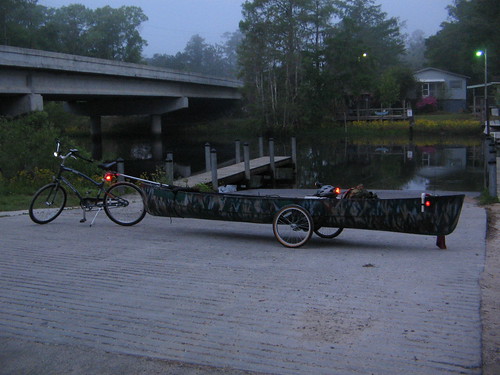
I use another trailer for deer, hogs and small game. Our deer are small.
And yes. I have towed this rig on that 60 mph highway, no worries.
Higher speeds = higher risk also depends on other factors. Is the road flat and straight (better sight lines)? Narrow? Wide shoulders? Hills or sharp curves? There's more to it than just speed.
Now that would be enough to scare me off any route.
Yes, ducks.
I use another trailer for deer, hogs and small game. Our deer are small.
And yes. I have towed this rig on that 60 mph highway, no worries.
Higher speeds = higher risk also depends on other factors. Is the road flat and straight (better sight lines)? Narrow? Wide shoulders? Hills or sharp curves? There's more to it than just speed.
Senior Member
Quote:
Australia surpasses the US as the first world's cycling sphincter?
Originally Posted by jimisnowhere
I've been reading nothing but complaints pertaining to Australia's respect to cycling. Has Australia surpasses the US as the first world's cycling sphincter?
I don't know about that, Melbourne is a reasonably bike friendly city (IMO, at least), and the country towns I have previously lived in when I was a kid were great for cycling in too.
Perhaps us Aussies just like to moan about things too much!


Senior Member
Was at a book store last night thumbing through the latest Bicycling magazine. I ended up buying it mostly because of their feature report called: "What you can do to fix America's traffic laws - and why you should".
There was a lot of text devoted to several people that that been killed or sustained permanent, life altering injuries. They were struck by drunk drivers or in one case, a driver trying to grab something out of a bag in her back seat. All of the cyclists had been riding on a wide shoulder or in a bike lane and had been hit from behind.
The article seemed to focus more on stonger penalties for people who kill or injure cyclists and not so much on new laws. There were a lot of interesting statistics. For example cities with more cyclists had a lower percentage of fatal collisions. Another thing they mentioned that is absolutely true is that in the U.S. there is little or no driver training related to being on the road with cyclists. There's also little formal training for cyclists on how to ride safely in the street. Both are sorely needed.
One good idea though was implemented in Kansas. Apparently when you renew your license in that state there is a written test. A guy there was able to successfully get the state to insure that there would be at least one question related to cyclists on the test. The current version has a multiple choice question on how many feet you must leave between your car and the cyclist when passing. In Kansas, it's 4 feet.
Anyway, the whole article definitely made me a little more nervous about riding with fast moving traffic. I still contend that segregated bike lanes are the way to go. You can't legislate away lapses in judgement and attention.
There was a lot of text devoted to several people that that been killed or sustained permanent, life altering injuries. They were struck by drunk drivers or in one case, a driver trying to grab something out of a bag in her back seat. All of the cyclists had been riding on a wide shoulder or in a bike lane and had been hit from behind.
The article seemed to focus more on stonger penalties for people who kill or injure cyclists and not so much on new laws. There were a lot of interesting statistics. For example cities with more cyclists had a lower percentage of fatal collisions. Another thing they mentioned that is absolutely true is that in the U.S. there is little or no driver training related to being on the road with cyclists. There's also little formal training for cyclists on how to ride safely in the street. Both are sorely needed.
One good idea though was implemented in Kansas. Apparently when you renew your license in that state there is a written test. A guy there was able to successfully get the state to insure that there would be at least one question related to cyclists on the test. The current version has a multiple choice question on how many feet you must leave between your car and the cyclist when passing. In Kansas, it's 4 feet.
Anyway, the whole article definitely made me a little more nervous about riding with fast moving traffic. I still contend that segregated bike lanes are the way to go. You can't legislate away lapses in judgement and attention.

I don't live in whatsmyname's area and haven't ridden on that particular road but have ridden on plenty similar (and worse) and don't see it as especially dangerous. The bike lane/breakdown lane in nice and wide, even enough room (just) to pass a broken down car without moving into the traffic lane. I guess some people are more easily intimidated by traffic than others. I try to ride alert but not alarmed.
Quote:
Beautiful reply, mate, and especially the last bit.Originally Posted by Falchoon
I don't live in whatsmyname's area and haven't ridden on that particular road but have ridden on plenty similar (and worse) and don't see it as especially dangerous. The bike lane/breakdown lane in nice and wide, even enough room (just) to pass a broken down car without moving into the traffic lane. I guess some people are more easily intimidated by traffic than others. I try to ride alert but not alarmed.
Maybe if more money was spent on training wannabe cyclists rather than providing them with "safe" separated facilities, we'd all be a lot better off.