


bad weather bikes
 11-19-11 | 09:47 PM
#26

Tractorlegs
Joined: Oct 2011
Posts: 3,185
Likes: 60
From: El Paso, TX
Bikes: Schwinn Meridian Single-Speed Tricycle
Living in El Paso Texas, I just need one bike - we have an 11 month summer, followed by a one month "almost" summer. Actually, it does get a little coldish in the winter months, but riding conditions vary so little between the seasons one bicycle is fine. The major bicycle-related weather issue here is the springtime winds. We receive a "serious" snowstorm on the average of once every five or six years. My second bike is a 1985 Trek 520 touring bicycle, but I don't consider it a backup - just a second bicycle.
__________________
********************************
Trikeman
Trikeman
 11-19-11 | 11:22 PM
#27

Senior Member
Joined: Jun 2007
Posts: 8,101
Likes: 17
From: Minneapolis
Speak for yourself, sir. Unless of course you think I'm a "nobody".
My best bike is my commuter. It has to be since I'm car-free. It needs to be 100% dependable and reliable in all conditions and all four seasons. It's the bike that gets ridden most often, for the most hours, and for the most miles of all my bikes. My commuter is the only bike I own that I bought new, and I bought it specifically with the intent to use it for its designed purpose--all conditions commuting. My other bikes are playthings. And I bought them all second-hand.
It had only around 1,000 miles on it when the studs first went on and we went to work in the slush. Thirteen-thousand miles later, we're entering our fifth winter. It's still mistaken sometimes for showroom new. Nothing has disintegrated, fallen off, melted, or turned to excrement--all those things some people would have you believe happens when you ride a bike anytime it's not a sunny summer day. I've replaced only normal wear and tear items--cables, brake pads, chains, cassette.
So if you like to ride a decent bike, here's the truth--you don't have to settle for second best in the winter.
No matter what somebody would have you think.
My best bike is my commuter. It has to be since I'm car-free. It needs to be 100% dependable and reliable in all conditions and all four seasons. It's the bike that gets ridden most often, for the most hours, and for the most miles of all my bikes. My commuter is the only bike I own that I bought new, and I bought it specifically with the intent to use it for its designed purpose--all conditions commuting. My other bikes are playthings. And I bought them all second-hand.
It had only around 1,000 miles on it when the studs first went on and we went to work in the slush. Thirteen-thousand miles later, we're entering our fifth winter. It's still mistaken sometimes for showroom new. Nothing has disintegrated, fallen off, melted, or turned to excrement--all those things some people would have you believe happens when you ride a bike anytime it's not a sunny summer day. I've replaced only normal wear and tear items--cables, brake pads, chains, cassette.
So if you like to ride a decent bike, here's the truth--you don't have to settle for second best in the winter.
No matter what somebody would have you think.

Do you or do you not have have a bike hook mounted in your shower to help keep your bikes clean?
Unfortunately I do not, and, as supportive as my lovely wife has been in regards to my bike habit, I think she'd draw the line at me showering with one.
Anyway, I agree that if you're willing to put in the extra time to frequently wash the crud and salt off your bike you can ride an expensive bike year round and it will do just fine. If your not willing and able to do that, you end up with a bike that looks like this:
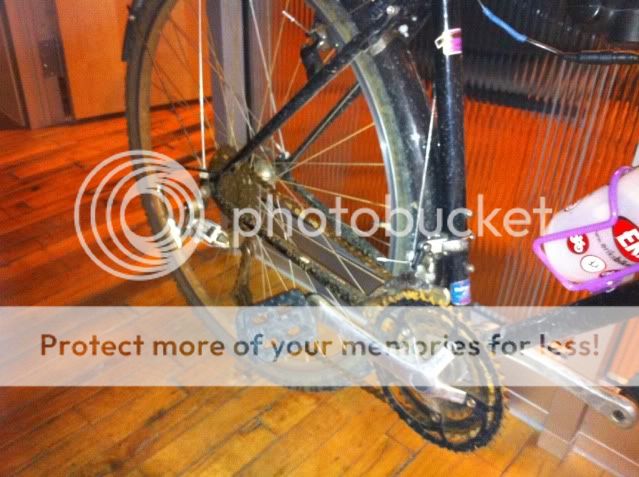
Now, that's not really a bad bike in the picture. The rear derailleur is a few year old XT that I bought especially because I thought it would deal with rough conditions better than lesser derailleurs. For the most part it came through OK, but as I've mentioned in several other threads, this year I'm going to be using a bike with an IGH.
I have two bikes, but it's not quite correct to say that one is a bad weather bike and the other one is the fair weather bike. One of them is a road bike and the other is my everything else bike. The everything else bike is the one I use in the winter or when I want to go off road. The road bike I'll ride in any weather excluding ice and and snow. It doesn't have clearance for the tires I like to use in those conditions.
Last edited by tjspiel; 11-19-11 at 11:37 PM.
11-20-11 | 12:51 AM
#28
Senior Member
Joined: Oct 2011
Posts: 151
Likes: 0
From: Florida, U.S.A.
Bikes: sport touring with small front back baskets. 17 mph
11-20-11 | 01:04 AM
#29
Senior Member
Joined: Jun 2007
Posts: 8,101
Likes: 17
From: Minneapolis
You don't rinse your bike off when it's that cold. Weather varies from winter to winter quite a bit but we can easily go several weeks with temps never getting above freezing. So unless I want to drag my bike into the basement and attempt to wash it off there, it's not going to happen.
The rust you see is almost entirely from the chain. It splatters rust everywhere else. I can clean/lube a chain and it can look like that a few days later. It can also stay clean for weeks depending on the temps and how much salty slush is on the roads. Cold and dry is best. Now, it's not like I don't ever clean the bike off. Here's how it looked this afternoon:
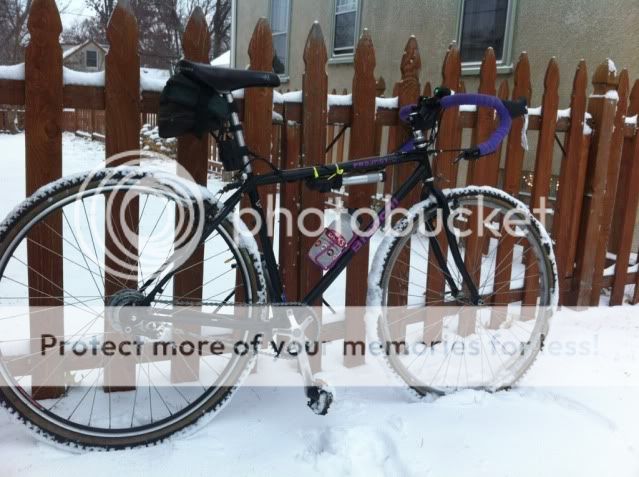
But with two young kids at home, having a clean bike has fallen pretty low on the list of priorities.
Last edited by tjspiel; 11-20-11 at 01:07 AM.
 11-20-11 | 07:59 AM
#31
Banned
Joined: Feb 2008
Posts: 8,701
Likes: 2,506
From: Mississauga/Toronto, Ontario canada
Bikes: I have 3 singlespeed/fixed gear bikes
No such thing as winter beater for me. I have three bikes which get used all year round , I ride everyday, no matter how bad the weather. Bicycles are meant to be ridden... not hung on a wall as a souvenier.
11-20-11 | 09:17 AM
#32


Plays in traffic
Joined: May 2006
Posts: 6,971
Likes: 15
From: Rochester, NY
Bikes: 1996 Litespeed Classic, 2006 Trek Portland, 2013 Ribble Winter/Audax, 2016 Giant Talon 4
Jeepers. Spend five bucks on a bottle and take five minutes a week to apply it. It ain't rocket surgery.
The church next door to me has a bike mission. I go over there and help out once in a while. The homeless guys who ride all winter and leave their bikes outside have better looking drivetrains on their POS 70s bikes.
As for full disclosure, I admitted to performing routine maintenance and replacing worn parts.
Last edited by tsl; 11-20-11 at 09:22 AM.
11-20-11 | 04:31 PM
#33
Senior Member
Joined: Jun 2007
Posts: 8,101
Likes: 17
From: Minneapolis
No, that's what a drivetrain looks like if you're unwilling to lube the chain.
Jeepers. Spend five bucks on a bottle and take five minutes a week to apply it. It ain't rocket surgery.
The church next door to me has a bike mission. I go over there and help out once in a while. The homeless guys who ride all winter and leave their bikes outside have better looking drivetrains on their POS 70s bikes.
As for full disclosure, I admitted to performing routine maintenance and replacing worn parts.
Jeepers. Spend five bucks on a bottle and take five minutes a week to apply it. It ain't rocket surgery.
The church next door to me has a bike mission. I go over there and help out once in a while. The homeless guys who ride all winter and leave their bikes outside have better looking drivetrains on their POS 70s bikes.
As for full disclosure, I admitted to performing routine maintenance and replacing worn parts.
When this bike had a 7 speed drive train I was able to use some rust resistant chains that I found for a good price. Those faired much better but they were too wide for the 8 speed drive train I had last year. That's one reason I'm stoked about using an IGH because inexpensive rust resistant chains for single speeds are easy to find.
And it's not just me. The bikes I see in the bike room every day at work during the winter look pretty much the same. The bikes that are there less often look better.
It's not a matter of how much a bike is left outside, it's how much salt it's exposed to. In fact it's probably better to leave a bike outside in the winter all the time unless you get the salt off. Bringing a salt covered bike inside to warmer temps only speeds up the corrosion process.
Last edited by tjspiel; 11-21-11 at 12:00 AM.
11-20-11 | 06:44 PM
#34

I Biked Today
Joined: Oct 2010
Posts: 252
Likes: 0
From: My Place
Bikes: 1998 Lemond Zurich, Redline Conquest Pro, Kilo TT
I ride my bike for a living...so I have 3 bikes...road..fixed...and 29er....the 29er comes out in the snow...fixed in the rain...the road bike on a sunny dry day. That being said..it just takes a few mins to lube your bike proper!
11-20-11 | 11:35 PM
#35
Senior Member
Joined: Jun 2007
Posts: 8,101
Likes: 17
From: Minneapolis
And for me lubing takes more than a few minutes simply because I have no room to work on the bike unless I pull the car out of the garage. We have a small house with very little storage. All the outdoor goodies like those fun but not very compact inflatable sliding tubes get kept in the garage. All I ask for from my family is a clear path from where I keep my bike to the door and that's about all I get.
In the summer I'll often do my maintenance work outdoors but during the winter it's too dark. Aside from the lack of space, it's not much warmer in the garage than it is outside. That means single digits or colder a lot of the time. Not great conditions for applying lube. I'll do it, but honestly, time is one of the most precious things to me and I'd rather not spend any more time lubing the chain than I already do. I'd really like not to have to worry about it all.
And while the chain is the thing most visibly affected by the exposure to road salt, it is far from the only thing. I've had some real problems with corrosion on the brakes. 5 minutes lubing the chain each week will do nothing for that. So my new build is going to have roller brakes on the rear and a disk brake up front. Hopefully that will help.
11-21-11 | 07:46 AM
#36
Plays in traffic
Joined: May 2006
Posts: 6,971
Likes: 15
From: Rochester, NY
Bikes: 1996 Litespeed Classic, 2006 Trek Portland, 2013 Ribble Winter/Audax, 2016 Giant Talon 4
Thoroughly coat everything inside the caliper with anti-seize. Not grease, anti-seize. The caliper body, the sliders, the piston, the works. Then reinstall the pads and spring.
IME corrosion on the sliders causes the pads to stick and not retract, thus causing the brake to drag. The pads also corrode to the piston, which makes them hard to change. An ounce of prevention...
IME corrosion on the sliders causes the pads to stick and not retract, thus causing the brake to drag. The pads also corrode to the piston, which makes them hard to change. An ounce of prevention...
11-21-11 | 08:04 AM
#37

Senior Member
Joined: Oct 2011
Posts: 169
Likes: 0
From: Australia
Bikes: Scott Sub 50
I use my scott sub 50 for all weather riding, sadly to say it's nuts and bolts are rusted and I think the rear cog is rusted ( some cheat single speed cog ). I leave it out in the rain as there isn't sheltered bike racks. Our winter doesn't have snow so no comment on that but apart from that, one bike is good enough for all my needs.
11-21-11 | 08:28 AM
#38
Senior Member
Joined: Jun 2007
Posts: 8,101
Likes: 17
From: Minneapolis
Thoroughly coat everything inside the caliper with anti-seize. Not grease, anti-seize. The caliper body, the sliders, the piston, the works. Then reinstall the pads and spring.
IME corrosion on the sliders causes the pads to stick and not retract, thus causing the brake to drag. The pads also corrode to the piston, which makes them hard to change. An ounce of prevention...
IME corrosion on the sliders causes the pads to stick and not retract, thus causing the brake to drag. The pads also corrode to the piston, which makes them hard to change. An ounce of prevention...
I just picked up the disc brake Friday, it's still in the box so the advice is timely. Sticking brakes and fused pads are exactly the sorts of problems I had with the cantis. I had hoped that because the brake mechanism was located farther from the rim and the fender that it wouldn't get quite as much crap thrown on it.
11-21-11 | 11:09 AM
#39
Plays in traffic
Joined: May 2006
Posts: 6,971
Likes: 15
From: Rochester, NY
Bikes: 1996 Litespeed Classic, 2006 Trek Portland, 2013 Ribble Winter/Audax, 2016 Giant Talon 4
Thanks for the tip !
I just picked up the disc brake Friday, it's still in the box so the advice is timely. Sticking brakes and fused pads are exactly the sorts of problems I had with the cantis. I had hoped that because the brake mechanism was located farther from the rim and the fender that it wouldn't get quite as much crap thrown on it.
I just picked up the disc brake Friday, it's still in the box so the advice is timely. Sticking brakes and fused pads are exactly the sorts of problems I had with the cantis. I had hoped that because the brake mechanism was located farther from the rim and the fender that it wouldn't get quite as much crap thrown on it.
BTW, anti-seize is an absolute mess to work with. No matter how hard you try, you will get some on the pads. (Or at least I do.) I found it wears off after a few stops. It's about the same reduction in braking as breaking-in and seating the pads.



 11-21-11 | 02:54 PM
#42

Senior Member
Joined: Mar 2010
Posts: 23,208
Likes: 10,653
From: Seattle, WA
I found it at a used bike shop; they wanted $1,000 but took my CX bike in trade, giving me $500 for it. Better still, they let me do a weekend test ride. So, I was out putting the rain bike / commuter through its paces, and some lady yelled at me what a lovely bike it was. Since I hadn't 100 % made up my mind yet, I stopped and asked her opinion. She said "From a woman's perspective, it's a beautiful bike. I especially like the red." Now it has red bar tape and cable housing (the old tape and housing was in awful shape!) and, since I'd been riding it 45 minutes when that happened, I extrapolate going forward.
That's how I get by on a beater like that.
Commuting home on this one is fun. Mostly uphill on the way to work, and down hill on the way back.
That's how I get by on a beater like that.
Commuting home on this one is fun. Mostly uphill on the way to work, and down hill on the way back.
11-21-11 | 02:58 PM
#43
Senior Member
Joined: Mar 2009
Posts: 737
Likes: 0
From: Edmonton, Canada
Personally, I ride an older MTB in winter, which was a perfectly decent bike when it was new. It's better suited to rough roads, and fits a decent sized studded tire to boot.
You don't need two bikes, but having bikes specialised for different conditions can make riding in diverse weather more pleasant. The more bikes you have, the less tradeoffs you have to make.
Last edited by neil; 11-21-11 at 03:02 PM.

