


Recommended e-Bike Conversion Kits
 10-07-24 | 01:00 PM
#1

Thread Starter
Senior Member
Joined: Mar 2024
Posts: 1,950
Likes: 784
From: San Diego
Bikes: Columbine, Lynskey GR300, Paramount Track Bike, Colnago Super (4), Santana Tandems (1995 & 2007), Gary Fisher Piranha (retired), Bianchi Track Bike, a couple of Honda mountain bikes
Recommended e-Bike Conversion Kits
What's the latest on good e-bike conversion kits?
I'm looking for something for my better half as she can't keep up with me on a single and there are some rides we'd like to do on singles rather than our tandem.
I think I'd prefer a front hub conversion as it seems like it would be easy to remove and re-install, but I'm open to ideas. I saw an article about Cytronex on Cycling Weekly, and it seems impressive, and the Bafang units seem OK.
Any experience anyone could share would be appreciated!
I'm looking for something for my better half as she can't keep up with me on a single and there are some rides we'd like to do on singles rather than our tandem.
I think I'd prefer a front hub conversion as it seems like it would be easy to remove and re-install, but I'm open to ideas. I saw an article about Cytronex on Cycling Weekly, and it seems impressive, and the Bafang units seem OK.
Any experience anyone could share would be appreciated!
 10-07-24 | 01:41 PM
#2

ignominious poltroon
Joined: Jan 2022
Posts: 6,027
Likes: 5,378
Mid-drive is the best. Front hub is the worst and arguably the most hazardous.
I used a cyc photon conversion kit. The most popular are the Bafang BBSO2 and similar variants.
I used a cyc photon conversion kit. The most popular are the Bafang BBSO2 and similar variants.
10-07-24 | 02:49 PM
#3

Bike Sorceress

Joined: Apr 2008
Posts: 1,244
Likes: 475
From: MPLS
Bikes: Yes
I've got a Bafang BBS02, it has done it's job quite well. Only real complaints are the very small amount of threads that are left for the lockring to grab if you install it in a 73mm bottom bracket shell, and that it only has a cadence sensor instead of a torque sensor. Feels like you are spinning your feet to activate the motor, rather feeling like the motor is adding power to your pedal stroke like on a bike with a torque sensor. The kit can put out more power than I feel safe using on the bike it is installed on, but you can just use it at lower power levels.
Another option would be to get yourself a bike that is more upright, makes it much easier to go at a pace that is slow enough for someone else to keep up.
Another option would be to get yourself a bike that is more upright, makes it much easier to go at a pace that is slow enough for someone else to keep up.
10-07-24 | 03:32 PM
#5
Thread Starter
Senior Member
Joined: Mar 2024
Posts: 1,950
Likes: 784
From: San Diego
Bikes: Columbine, Lynskey GR300, Paramount Track Bike, Colnago Super (4), Santana Tandems (1995 & 2007), Gary Fisher Piranha (retired), Bianchi Track Bike, a couple of Honda mountain bikes
Mid-drive is the best. Front hub is the worst and arguably the most hazardous.
I used a cyc photon conversion kit. The most popular are the Bafang BBSO2 and similar variants.
I used a cyc photon conversion kit. The most popular are the Bafang BBSO2 and similar variants.
10-07-24 | 03:34 PM
#6
Thread Starter
Senior Member
Joined: Mar 2024
Posts: 1,950
Likes: 784
From: San Diego
Bikes: Columbine, Lynskey GR300, Paramount Track Bike, Colnago Super (4), Santana Tandems (1995 & 2007), Gary Fisher Piranha (retired), Bianchi Track Bike, a couple of Honda mountain bikes
I tried talking her into that and it was a hard “no”.
10-07-24 | 11:55 PM
#7
Senior Member

Joined: Jul 2014
Posts: 5,070
Likes: 1,290
From: socal
Bikes: DIY
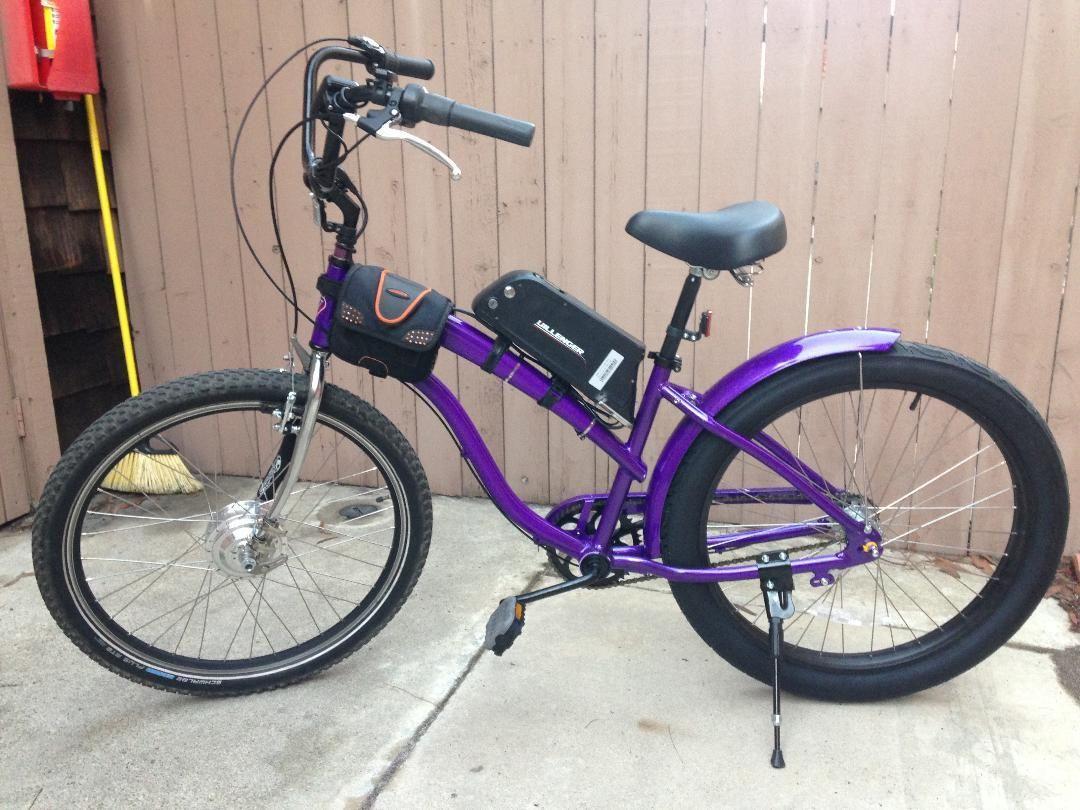
My first "e" was a 36V, 350w Dillenger kit on a rigid MTB, and it was great fun on and off road. The power built gradually and the front end never spun the tire. The same can't be said about my latest conversion with a 48V, 500w Bafang kit on the same bike (my daughter wanted an e-bike and I transferred the kit to a cruiser for her). There's good advice above about just building a mid, but other options may be viable too.
10-08-24 | 11:01 PM
#8
Thread Starter
Senior Member
Joined: Mar 2024
Posts: 1,950
Likes: 784
From: San Diego
Bikes: Columbine, Lynskey GR300, Paramount Track Bike, Colnago Super (4), Santana Tandems (1995 & 2007), Gary Fisher Piranha (retired), Bianchi Track Bike, a couple of Honda mountain bikes
My first "e" was a 36V, 350w Dillenger kit on a rigid MTB, and it was great fun on and off road. The power built gradually and the front end never spun the tire. The same can't be said about my latest conversion with a 48V, 500w Bafang kit on the same bike (my daughter wanted an e-bike and I transferred the kit to a cruiser for her). There's good advice above about just building a mid, but other options may be viable too.
10-09-24 | 05:58 AM
#9

I don't know.

Joined: May 2003
Posts: 2,370
Likes: 1,233
From: South Meriden, CT
Bikes: '90 B'stone RB-1, '92 B'stone RB-2, '89 SuperGo Access Comp, '03 Access 69er, '23 Trek 520, '14 Ritchey Road Logic, '09 Kestrel Evoke, '08 Windsor Tourist, '17 Surly Wednesday, '89 Centurion Accordo, '15 CruX, '17 Ridley X-Night, '89 Marinoni
This contraption seems kind of neat.
10-09-24 | 09:15 AM
#10
Senior Member
Joined: Jul 2014
Posts: 5,070
Likes: 1,290
From: socal
Bikes: DIY
[QUOTE=PromptCritical;23367289]Did the front wheel drive cause any other handling problems? We only want the motor to put out a maximum of 150w and wouldn’t be using a hand throttle so wheel spin shouldn’t be a problem.[
No, that system functions perfectly even after 10 years. The Shenghi motor, in concert with its controller seems designed well for a front application. The only reason I don't recommend Dilleneger these days is they seem to have pretty much abandoned the US market and their batteries may have been sitting around a while, although the one on that bike is seven or eight years old.
No, that system functions perfectly even after 10 years. The Shenghi motor, in concert with its controller seems designed well for a front application. The only reason I don't recommend Dilleneger these days is they seem to have pretty much abandoned the US market and their batteries may have been sitting around a while, although the one on that bike is seven or eight years old.
10-11-24 | 11:17 AM
#12
Thread Starter
Senior Member
Joined: Mar 2024
Posts: 1,950
Likes: 784
From: San Diego
Bikes: Columbine, Lynskey GR300, Paramount Track Bike, Colnago Super (4), Santana Tandems (1995 & 2007), Gary Fisher Piranha (retired), Bianchi Track Bike, a couple of Honda mountain bikes
Front fork may also break with a novice install.
When I started my first ebike conversion in August, 2015. I proudly submitted this very photo to this forum.. It's a rear mount on a Diamondback alloy frame. You can see where they leave out metal for some reason. Anyway, forum members said I needed torque arms to reinforce the axle.
Rather than do that, I moved the motor to a steel frame bike. And ever since, I use torque arms on the rear, if it is aluminum.
When I started my first ebike conversion in August, 2015. I proudly submitted this very photo to this forum.. It's a rear mount on a Diamondback alloy frame. You can see where they leave out metal for some reason. Anyway, forum members said I needed torque arms to reinforce the axle.
Rather than do that, I moved the motor to a steel frame bike. And ever since, I use torque arms on the rear, if it is aluminum.
10-11-24 | 05:35 PM
#13
Senior Member
Joined: Jul 2014
Posts: 5,070
Likes: 1,290
From: socal
Bikes: DIY
Many (most) individuals think a torque arm is necessary with rear hubs to keep the steel axle from rotating in the softer aluminum dropouts. I ran a 1000w rear system in aluminum dropouts for several years without a torque arm, but put one on my daughter's much less powerful front hub. There's nothing esoteric about kit installations IMO, but front end failures can be catastrophic, so if you end up with one, I wouldn't install on a carbon fork and aluminum only with a torque arm.
 10-11-24 | 09:51 PM
#14
Senior Member
Joined: Jul 2006
Posts: 946
Likes: 2
From: beantown
Bikes: '89 Specialized Hardrock Fixed Gear Commuter; 1984? Dawes Atlantis
Grin Technologies ( eBikes.ca) out of Vancouver, B.C. Canada offers a wide variety of hub-based e-motors. Very informative website, but likely best if you have some knowledge of lower voltage electrical.
10-11-24 | 10:23 PM
#15
Thread Starter
Senior Member
Joined: Mar 2024
Posts: 1,950
Likes: 784
From: San Diego
Bikes: Columbine, Lynskey GR300, Paramount Track Bike, Colnago Super (4), Santana Tandems (1995 & 2007), Gary Fisher Piranha (retired), Bianchi Track Bike, a couple of Honda mountain bikes

Last edited by PromptCritical; 10-11-24 at 10:27 PM.
10-17-24 | 01:20 PM
#16
Newbie
Joined: Jan 2022
Posts: 71
Likes: 7
From: Western NV
Bikes: 2021 Wart Hog 750MD, 2024 Juggernaut 750, 2009 Montague Comfort
Guys, If I can ask a question,
I have this bike I want to add a Bafang 02 motor to, it has 21 sp 3x7,
that I would prefer to keep, I like pedaling this lite weight bike.
There plenty of room to mount the motor, and keep the folding aspects,
can I still keep the 21 speeds?
The 48v 17.5 a battery will fit on the down tube just upstream from the motor.
See more info on this bike here:
https://www.montaguebikes.com/cx-com...ing-bike-2009/
Thoughts or suggestions,
Tia
I have this bike I want to add a Bafang 02 motor to, it has 21 sp 3x7,
that I would prefer to keep, I like pedaling this lite weight bike.
There plenty of room to mount the motor, and keep the folding aspects,
can I still keep the 21 speeds?
The 48v 17.5 a battery will fit on the down tube just upstream from the motor.
See more info on this bike here:
https://www.montaguebikes.com/cx-com...ing-bike-2009/
Thoughts or suggestions,
Tia
10-17-24 | 10:37 PM
#17
Senior Member
Joined: Jul 2014
Posts: 5,070
Likes: 1,290
From: socal
Bikes: DIY
If you mean a BBS02 motor, you'll have only one chainring up front, ergo a 1 X 7 system. You may be able to fit a Microshift cassette, derailleur and shifter and have 11 X 46 gearing (AIR); about $75 for these components at Universal Cycle. This will increase your gearing range with one of the various 30 - 52 or so front chainrings available for the BBS02.
10-21-24 | 09:51 AM
#18

Senior Member
Joined: Jun 2014
Posts: 3,547
Likes: 459
From: SF Bay Area
Bikes: Now: HPV Gecko FX 20 w/ assist.. Old: Trident Spike 2 recumbent trike w/ e-assist
Sounds like she might be a candidate for a switch bike kit. search her for switch bike kit and you will find plenty of info. if you do the presubscribe and can wait a couple months you can get them cheap.
11-22-24 | 02:52 PM
#19

Full Member

Joined: Jun 2007
Posts: 264
Likes: 53
From: Russell Township, Ohio, USA
Bikes: 1975 Paris Sport 700, 2007 Dahon Mu P8 (folding bicycle), 1984 Miyata 210, 2024 Tenways CGO600 Pro e-bike
Did you mean Swytch bike kit?
__________________
If something doesn't ache, I could be trying harder.
If something doesn't ache, I could be trying harder.
12-01-24 | 03:27 AM
#21
Newbie
Joined: Apr 2023
Posts: 19
Likes: 20
Front motors get a lot of bad publicity, but they can be quite good if you manage your expectations. PromptCritical since you are planning on low power, you won't be experiencing any handling issues of any kind. Also, you have already been pointed to Grin Technologies. Look to their V5 torque arm. Its a $20 insurance policy you should use REGARDLESS of whether you install to an alloy or chromoly fork. Steel fork dropouts can still be damaged by a front motor. Instead of breaking like they typically do on an alloy fork, they spread so they are no longer parallel, and once the metal has fatigued like that it will forever do so relatively easily, so the fork is effectively destroyed. I learned this the hard way back in I think 2015 on my first awd ebike build.
Never under any circumstances put a front motor on a bike with a suspension fork. There are actually some circumstances where it can be done safely, and your low power scenario is one of them, but I would not recommend to a beginner builder to try this. If you do some looking around you will find that the alloy dropouts on suspension forks are infamous for snapping clean off. Plus no fork is designed to be pulled on, and you can watch a suspension fork try to pull itself apart under powered acceleration. Here again your low power no throttle config would be likely safe, but I still would never recommend a beginner take on this level of risk.
You'll hear a lot of talk about how front motors have traction issues versus a rear motor, which is the wheel that is carrying all the weight. In reality, on a mild-duty street bike, this is a complete non-issue. It will pull just fine and in fact a powered front wheel with your legs powering the back wheel creates a mild awd bike, and the benefits of distributed traction are really a bit of a beautiful thing, but you'll find plenty of keyboard riders who pooh-pooh the concept. If you are looking for a light-duty assist on a bike you primarily pedal and don't expect to throttle you around, a front wheel on a solid steel fork is hard to beat. Especially for your first project.
But... Do a torque arm no matter what. I have lived the dream of destroying a fork and for under thirty bucks for a quality product consider it cheap insurance (read Grin Tech's torque arm info page and stay far, far away from the Chinesium clones of their v1.0 design that you can find all over Amazon and Ebay).
I would suggest a 48v system and a geared hub motor. In particular, a Bafang G020 which is a 45 Nm geared hub motor. Put a KT controller on it and set C5=00 on the controller for its mildest slow-start setting. You will have a very tame motor that will effectively last forever. A 48v system is one that, with a low power controller (say a KT brand 15a which would be very mild) that motor would sip power so gently almost any battery you use will effectively give you all the range you could ever ask for. A 48v system on PAS level 1 will output about 50w so you'll likely never see Level 5 which is going to be pumping out an entirely theoretical 800w as a peak. KT controllers also do not give you cadence sensing pedal assist that is the hated on/off switch that runs away from you.
The hub motor setup would be lowest-cost and easiest to install. More difficult but also more capable would be a BBS02. I am a huge fan of mid drives, and have written build guides designed specifically to get the beginner past most of the dumb mistakes that builders make that give mids a bad rep insofar as reliability and increased wear and tear are concerned. However, hub motors have their place and for beginning builders and mild duty cycles (flat land and no steep hills!) they can be a fine choice.
This and a separate article on the same site about riding technique cover the potential pitfalls. It is aimed more squarely at the BBSHD, but everything applies the same for a BBS02. The consequences are just less severe.
How to Build a Mid Drive Ebike That Doesn't Break
My next article coming out in the not so distant future is going to be entitled something along the lines of 'how to add a hub motor to your bike all by yourself' or something like that. I've pretty much beaten to death the mid drive subject.
Never under any circumstances put a front motor on a bike with a suspension fork. There are actually some circumstances where it can be done safely, and your low power scenario is one of them, but I would not recommend to a beginner builder to try this. If you do some looking around you will find that the alloy dropouts on suspension forks are infamous for snapping clean off. Plus no fork is designed to be pulled on, and you can watch a suspension fork try to pull itself apart under powered acceleration. Here again your low power no throttle config would be likely safe, but I still would never recommend a beginner take on this level of risk.
You'll hear a lot of talk about how front motors have traction issues versus a rear motor, which is the wheel that is carrying all the weight. In reality, on a mild-duty street bike, this is a complete non-issue. It will pull just fine and in fact a powered front wheel with your legs powering the back wheel creates a mild awd bike, and the benefits of distributed traction are really a bit of a beautiful thing, but you'll find plenty of keyboard riders who pooh-pooh the concept. If you are looking for a light-duty assist on a bike you primarily pedal and don't expect to throttle you around, a front wheel on a solid steel fork is hard to beat. Especially for your first project.
But... Do a torque arm no matter what. I have lived the dream of destroying a fork and for under thirty bucks for a quality product consider it cheap insurance (read Grin Tech's torque arm info page and stay far, far away from the Chinesium clones of their v1.0 design that you can find all over Amazon and Ebay).
I would suggest a 48v system and a geared hub motor. In particular, a Bafang G020 which is a 45 Nm geared hub motor. Put a KT controller on it and set C5=00 on the controller for its mildest slow-start setting. You will have a very tame motor that will effectively last forever. A 48v system is one that, with a low power controller (say a KT brand 15a which would be very mild) that motor would sip power so gently almost any battery you use will effectively give you all the range you could ever ask for. A 48v system on PAS level 1 will output about 50w so you'll likely never see Level 5 which is going to be pumping out an entirely theoretical 800w as a peak. KT controllers also do not give you cadence sensing pedal assist that is the hated on/off switch that runs away from you.
The hub motor setup would be lowest-cost and easiest to install. More difficult but also more capable would be a BBS02. I am a huge fan of mid drives, and have written build guides designed specifically to get the beginner past most of the dumb mistakes that builders make that give mids a bad rep insofar as reliability and increased wear and tear are concerned. However, hub motors have their place and for beginning builders and mild duty cycles (flat land and no steep hills!) they can be a fine choice.
This and a separate article on the same site about riding technique cover the potential pitfalls. It is aimed more squarely at the BBSHD, but everything applies the same for a BBS02. The consequences are just less severe.
How to Build a Mid Drive Ebike That Doesn't Break
My next article coming out in the not so distant future is going to be entitled something along the lines of 'how to add a hub motor to your bike all by yourself' or something like that. I've pretty much beaten to death the mid drive subject.
Last edited by m@Robertson; 12-01-24 at 03:31 AM.
12-01-24 | 10:39 PM
#22

Senior Member
Joined: Jul 2015
Posts: 1,596
Likes: 392
From: Chicago Suburbs
Bikes: GT Transeo & a half dozen ebike conversions.
I've done two front drive ebikes. First one was a 20" minivello. Rode it several years with an alloy fork. Small Q100H motor. It had 13:1 gearing and with the 20" rims, very good torque. Occasionally, I'd feel the front wheel slip going up hills with wet surfaces. Being a man that worries too much about his bikes exploding, I now have a steel fork.
The second front drive is a 26" cruiser bike with a steel fork. It was only a rim brake fork, so I fabbed a torque arm that held the motor and disk calipers on one side and a torque arm on the other,. Shouldn't explode. The bafang motor axles allowed the use of a torque wrench so I set the nuts to 25 ft-lbs. To my surprise, I found that what felt tight on my other hub motors was only around 20 ft-lbs. Now I use a torque wrench on all of them, employing an open end crows foot wrench if the nut has a cable thru it, With the bigger wheel, traction issues only if starting out on wet leaves. Hardly ever on road.
Still, I'll advise new DYI types to go with rear drive, even though many of us have done front rive, and some have done it with suspension forks, Not knowing a strangers mechanical aptitude and sense for safety. it's just better to avoid FWD..
The second front drive is a 26" cruiser bike with a steel fork. It was only a rim brake fork, so I fabbed a torque arm that held the motor and disk calipers on one side and a torque arm on the other,. Shouldn't explode. The bafang motor axles allowed the use of a torque wrench so I set the nuts to 25 ft-lbs. To my surprise, I found that what felt tight on my other hub motors was only around 20 ft-lbs. Now I use a torque wrench on all of them, employing an open end crows foot wrench if the nut has a cable thru it, With the bigger wheel, traction issues only if starting out on wet leaves. Hardly ever on road.
Still, I'll advise new DYI types to go with rear drive, even though many of us have done front rive, and some have done it with suspension forks, Not knowing a strangers mechanical aptitude and sense for safety. it's just better to avoid FWD..
Last edited by Doc_Wui; 12-01-24 at 10:53 PM.
01-18-25 | 12:54 PM
#24
Senior Member
Joined: Jul 2015
Posts: 1,596
Likes: 392
From: Chicago Suburbs
Bikes: GT Transeo & a half dozen ebike conversions.
Might see UL-recognized batteries for kits this year. .I think Grin has them now with the pricing to match.
For the kind of bikes I ride these days, I like the torque sensing mid drive kits. I have two TSDZ2's, but they needed some electrical tweaking to fit my wife/me, and have a rep for high maintenance, I' hoping the ToSeven DM02 I bought can replace them and add some performance too,
01-26-25 | 01:23 AM
#25

Electricbike Enthusiast
Joined: Jan 2025
Posts: 11
Likes: 3
From: Oregon
Hi, When choosing a conversion kit, here are a few factors to keep in mind:
Power Output: Select a power output between 250W and 500W when you need light-use capabilities. Bikes with motors exceeding 500W may require extra frame reinforcement to handle the increased power.
Battery Placement: A front hub motor and rear-rack battery configuration achieve superior weight balance compared to mounting the battery on the front.
Ease of Installation: Installation ease varies between kits since Cytronex models provide plug-and-play functionality, but Bafang mid-drives need additional mechanical skills or professional installation support.
Ride Style: Riders report that front hub motors experience a pulling sensation on loose ground, whereas mid-drives deliver superior control and traction.
The Cytronex serves as an outstanding choice for those who value straightforward operation and periodic usage while also requiring an attractive appearance and quick removal capability. The Bafang front hub kit provides a stronger option for partners who need more torque or who intend to climb hills. Mid-drive options such as the Bafang BBS02 or Tongsheng TSDZ2 deliver top performance and versatility but require additional effort during installation.
Power Output: Select a power output between 250W and 500W when you need light-use capabilities. Bikes with motors exceeding 500W may require extra frame reinforcement to handle the increased power.
Battery Placement: A front hub motor and rear-rack battery configuration achieve superior weight balance compared to mounting the battery on the front.
Ease of Installation: Installation ease varies between kits since Cytronex models provide plug-and-play functionality, but Bafang mid-drives need additional mechanical skills or professional installation support.
Ride Style: Riders report that front hub motors experience a pulling sensation on loose ground, whereas mid-drives deliver superior control and traction.
The Cytronex serves as an outstanding choice for those who value straightforward operation and periodic usage while also requiring an attractive appearance and quick removal capability. The Bafang front hub kit provides a stronger option for partners who need more torque or who intend to climb hills. Mid-drive options such as the Bafang BBS02 or Tongsheng TSDZ2 deliver top performance and versatility but require additional effort during installation.
