


e Bike Conversion
 02-08-26 | 08:51 PM
#1

Thread Starter
Full Member

Joined: May 2012
Posts: 457
Likes: 1
From: Harlingen, TX Warmshowers Host
Bikes: Fuji, Specialized, Surly, BMC
e Bike Conversion
So after looking at prices of new e bikes that meet my criteria...I would like to investigate doing a conversion.
I am an avid cyclist that usually rides 5-7,000 a year. I'm turning 73 this year so looking at getting a little help on one of my bikes to keep my knees from totally going out.
I have a couple bikes with completely interchangeable wheels. Disc, 700C and same cassette.
2013 Surly Disc Trucker
2020 Salsa Journeyman (which I ride most of the time)
I do some light to medium touring and have all the gear.
Here are my thoughts.
- Class one if possible
- I'd like to consider a hub conversion, but which wheel is better
- I don't think I need a lot of power would prefer longer range
- Are there any options/kits that include the wheel already setup?
In theory if I had a good setup I could use it on either bike just have to have the associated electronics
Any suggestions or links are appreciated. Thanks
I am an avid cyclist that usually rides 5-7,000 a year. I'm turning 73 this year so looking at getting a little help on one of my bikes to keep my knees from totally going out.
I have a couple bikes with completely interchangeable wheels. Disc, 700C and same cassette.
2013 Surly Disc Trucker
2020 Salsa Journeyman (which I ride most of the time)
I do some light to medium touring and have all the gear.
Here are my thoughts.
- Class one if possible
- I'd like to consider a hub conversion, but which wheel is better
- I don't think I need a lot of power would prefer longer range
- Are there any options/kits that include the wheel already setup?
In theory if I had a good setup I could use it on either bike just have to have the associated electronics
Any suggestions or links are appreciated. Thanks
 02-09-26 | 12:36 AM
#2
Senior Member
Joined: Jul 2014
Posts: 5,058
Likes: 1,283
From: socal
Bikes: DIY
If you do a hub conversion, many "experts" would suggest a rear conversion (read the tutorials at Grin (ebikesca) for info, but I wouldn't suggest buying from them since their prices are steep). A mid-drive (Bafang BBS02 or equivalent) is also a good consideration and very helpful when ascending since the bike's gears offer a multiplication factor. None of these conversions permit relatively easy transfer from bike to bike IMO. Best bet is to ride a few examples of various "e's", then proceed. You'll get more assistance here if you provide information relative to the amount you are committing to the project, projected usage, whether you need to carry the bike upstairs etc.
02-09-26 | 07:37 PM
#3
Thread Starter
Full Member
Joined: May 2012
Posts: 457
Likes: 1
From: Harlingen, TX Warmshowers Host
Bikes: Fuji, Specialized, Surly, BMC
If you do a hub conversion, many "experts" would suggest a rear conversion (read the tutorials at Grin (ebikesca) for info, but I wouldn't suggest buying from them since their prices are steep). A mid-drive (Bafang BBS02 or equivalent) is also a good consideration and very helpful when ascending since the bike's gears offer a multiplication factor. None of these conversions permit relatively easy transfer from bike to bike IMO. Best bet is to ride a few examples of various "e's", then proceed. You'll get more assistance here if you provide information relative to the amount you are committing to the project, projected usage, whether you need to carry the bike upstairs etc.
02-10-26 | 12:01 AM
#4
Senior Member
Joined: Jul 2014
Posts: 5,058
Likes: 1,283
From: socal
Bikes: DIY
That's about the minimum you can spend and get a decent system. My first conversion was a DillengerUS kit for about that amount (11+ years ago) and it was excellent. I'm not aware of their quality now, but many front or rear hub kits are about $250 - no battery (try yescom or ebikling) to $750 with battery.
Last edited by 2old; 02-10-26 at 12:09 AM.
02-10-26 | 09:14 PM
#5

Senior Member
Joined: Jul 2015
Posts: 1,589
Likes: 391
From: Chicago Suburbs
Bikes: GT Transeo & a half dozen ebike conversions.
I'll come in here with a late opinion. Avid bikers often get along better with a torque sensor mid drive bike, Mid drives make better use of the gears, although you often lose the front derailleur. Torque sensors offer the enthusiast a btter pedal fell, although they can give good assist at higher levels, In the past, good torque sensor bikes were high end, but I feel the Toseven DM02 conversion kit offers good value,
I own three mid drive kits, the BBS02B cadence, Tong Sheng TSDZ2 and Toseven DM02. First is very strong but is cadence sense. Second needs extensive tweaking. Last one fits in the middle and gives a nice riding experience. It runs well on 36V or 48V, and will work on smaller batteries.
I started riding hub motor kits 10 years ago and have put over 16k miles on them, About 4K on the mid drives mostly in the last two years.
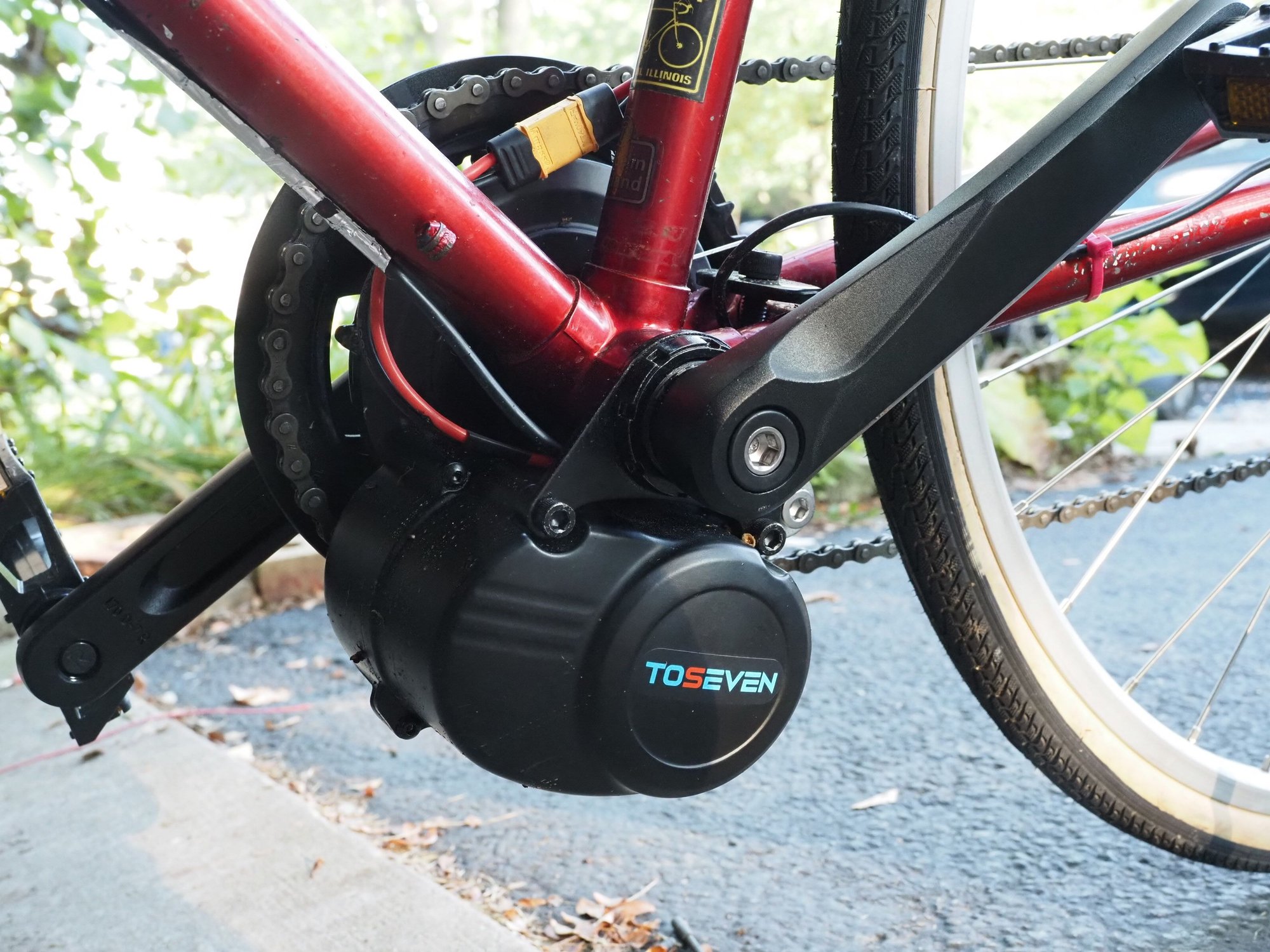
I own three mid drive kits, the BBS02B cadence, Tong Sheng TSDZ2 and Toseven DM02. First is very strong but is cadence sense. Second needs extensive tweaking. Last one fits in the middle and gives a nice riding experience. It runs well on 36V or 48V, and will work on smaller batteries.
I started riding hub motor kits 10 years ago and have put over 16k miles on them, About 4K on the mid drives mostly in the last two years.
02-10-26 | 09:51 PM
#6

Mister Geezer to you


Joined: Mar 2004
Posts: 1,244
Likes: 921
From: Glendora, CA
Bikes: Croll '94 & Cannondale Supersix '15
I occasionally ride a Swytch front wheel Class 1 conversion kit, utilizing both throttle and pedal assist sensor (PAS).
Once you get past their long shipping delay, the kit works very well. It adds roughly ten pounds, turning an 18lb bike into 28lbs.
I chose their Go+ kit, spec'd at 40 miles. They came up with that rating, based on level terrain with the PAS at the lowest setting.
Typically, my mileage reaches closer to sixty miles, since I easily adjust the setting to zero for downhills or easy stretches. Very similar to drafting in a group ride.
A trip up a long, steep climb would require much more pedal assist, although going downhill means turning the unit off. Gets me forty miles, tho.
It would work well on a tour, especially if your overnight stay allows you to recharge. Or carry a spare six pound battery.
Overall, driving the front proves far simpler than mid or rear drive. Pedaling to drive the rear, it essentially gives you two-wheel drive. Firmly planted front.
Once you get past their long shipping delay, the kit works very well. It adds roughly ten pounds, turning an 18lb bike into 28lbs.
I chose their Go+ kit, spec'd at 40 miles. They came up with that rating, based on level terrain with the PAS at the lowest setting.
Typically, my mileage reaches closer to sixty miles, since I easily adjust the setting to zero for downhills or easy stretches. Very similar to drafting in a group ride.
A trip up a long, steep climb would require much more pedal assist, although going downhill means turning the unit off. Gets me forty miles, tho.
It would work well on a tour, especially if your overnight stay allows you to recharge. Or carry a spare six pound battery.
Overall, driving the front proves far simpler than mid or rear drive. Pedaling to drive the rear, it essentially gives you two-wheel drive. Firmly planted front.
 02-12-26 | 07:09 PM
#7
Thread Starter
Full Member
Joined: May 2012
Posts: 457
Likes: 1
From: Harlingen, TX Warmshowers Host
Bikes: Fuji, Specialized, Surly, BMC
I'll come in here with a late opinion. Avid bikers often get along better with a torque sensor mid drive bike, Mid drives make better use of the gears, although you often lose the front derailleur. Torque sensors offer the enthusiast a btter pedal fell, although they can give good assist at higher levels, In the past, good torque sensor bikes were high end, but I feel the Toseven DM02 conversion kit offers good value,
I own three mid drive kits, the BBS02B cadence, Tong Sheng TSDZ2 and Toseven DM02. First is very strong but is cadence sense. Second needs extensive tweaking. Last one fits in the middle and gives a nice riding experience. It runs well on 36V or 48V, and will work on smaller batteries.
I started riding hub motor kits 10 years ago and have put over 16k miles on them, About 4K on the mid drives mostly in the last two years.
I own three mid drive kits, the BBS02B cadence, Tong Sheng TSDZ2 and Toseven DM02. First is very strong but is cadence sense. Second needs extensive tweaking. Last one fits in the middle and gives a nice riding experience. It runs well on 36V or 48V, and will work on smaller batteries.
I started riding hub motor kits 10 years ago and have put over 16k miles on them, About 4K on the mid drives mostly in the last two years.
02-12-26 | 07:26 PM
#8
Thread Starter
Full Member
Joined: May 2012
Posts: 457
Likes: 1
From: Harlingen, TX Warmshowers Host
Bikes: Fuji, Specialized, Surly, BMC
I occasionally ride a Swytch front wheel Class 1 conversion kit, utilizing both throttle and pedal assist sensor (PAS).
Once you get past their long shipping delay, the kit works very well. It adds roughly ten pounds, turning an 18lb bike into 28lbs.
I chose their Go+ kit, spec'd at 40 miles. They came up with that rating, based on level terrain with the PAS at the lowest setting.
Typically, my mileage reaches closer to sixty miles, since I easily adjust the setting to zero for downhills or easy stretches. Very similar to drafting in a group ride.
A trip up a long, steep climb would require much more pedal assist, although going downhill means turning the unit off. Gets me forty miles, tho.
It would work well on a tour, especially if your overnight stay allows you to recharge. Or carry a spare six pound battery.
Overall, driving the front proves far simpler than mid or rear drive. Pedaling to drive the rear, it essentially gives you two-wheel drive. Firmly planted front.
Once you get past their long shipping delay, the kit works very well. It adds roughly ten pounds, turning an 18lb bike into 28lbs.
I chose their Go+ kit, spec'd at 40 miles. They came up with that rating, based on level terrain with the PAS at the lowest setting.
Typically, my mileage reaches closer to sixty miles, since I easily adjust the setting to zero for downhills or easy stretches. Very similar to drafting in a group ride.
A trip up a long, steep climb would require much more pedal assist, although going downhill means turning the unit off. Gets me forty miles, tho.
It would work well on a tour, especially if your overnight stay allows you to recharge. Or carry a spare six pound battery.
Overall, driving the front proves far simpler than mid or rear drive. Pedaling to drive the rear, it essentially gives you two-wheel drive. Firmly planted front.
02-12-26 | 08:24 PM
#9
Mister Geezer to you
Joined: Mar 2004
Posts: 1,244
Likes: 921
From: Glendora, CA
Bikes: Croll '94 & Cannondale Supersix '15
It easily plugs and unplugs with the ample all-in-one cable Swytch provides. This cable splits off for the PAS, display, and throttle.
When doing this - or repairing a motor wheel puncture - always turn off the battery power first.
With the spare battery, one could strap it to a rear rack, instead. Theoretically, you could bring the long cable back to it to plug in.
Currently, Swytch's lead time puts it four months out. That totally stinks. I recommend the basic LED display and thumb throttle.
Forgot to mention a big benefit: in a few short minutes, you can remove the kit and swap out the front wheel to return your bike to regular pedal power.
This, of course, works if you deplete the battery and need to pedal home a heavier bike.

Feel free to PM me thru BF's messaging center. We can exchange proper e-mails for me to share photos.
02-18-26 | 06:18 PM
#10
Thread Starter
Full Member
Joined: May 2012
Posts: 457
Likes: 1
From: Harlingen, TX Warmshowers Host
Bikes: Fuji, Specialized, Surly, BMC
Thanks everyone for the info and suggestions. After doing a lot of research it's looking like I will just consider getting a new bike that is class 1. There are some good options starting to pop up. I really don't want a throttle based bike.
I'll do some more looking.
I'll do some more looking.
