


Hub dynamo on tire
 11-12-24 | 04:06 PM
#1

Thread Starter
Enamoured of bicycles
Joined: Jan 2005
Posts: 99
Likes: 0
From: Huesca, NE Spain
Bikes: Oxia, bespoke comoly 29er all terrain tourer; 1993 Scott Boulder turned into 650b gravel; 2005 Maxx RoadMaxx; 2023 Kona Rove AL700
Hub dynamo on tire
Hi, Friends:
I intend to try the configuration shown below.
It is a hub dynamo that spins against the tire’s outer rubber. This would allow the dynamo to be shared with different bikes and easily be removed when not needed.
Do you think the hub or lights would stand the ~10✕ increased spin speed?
Thanks for your insights.

I intend to try the configuration shown below.
It is a hub dynamo that spins against the tire’s outer rubber. This would allow the dynamo to be shared with different bikes and easily be removed when not needed.
Do you think the hub or lights would stand the ~10✕ increased spin speed?
Thanks for your insights.
 11-12-24 | 07:10 PM
#2
Senior Member


Joined: Aug 2010
Posts: 12,726
Likes: 2,105
From: Madison, WI
Bikes: 1961 Ideor, 1966 Perfekt 3 Speed AB Hub, 1994 Bridgestone MB-6, 2006 Airnimal Joey, 2009 Thorn Sherpa, 2013 Thorn Nomad MkII, 2015 VO Pass Hunter, 2017 Lynskey Backroad, 2017 Raleigh Gran Prix, 1980s Bianchi Mixte on a trainer. Others are now gone.
Have you tried to turn a dynohub by hand when it was not attached to a rim? It takes a lot of energy to start to turn it. I doubt your tire will have sufficient grip. And even if it did, you might not be able to go very fast on the bike.
11-12-24 | 11:10 PM
#3
Randomhead
Joined: Aug 2008
Posts: 25,930
Likes: 4,825
From: Happy Valley, Pennsylvania
Sanyo used to make a dyno that worked like this. It was probably the best dyno of its time.
How well your dyno works depends on the windings.
On edit: okay, I missed your idea of using at dynohub. Might be okay. I would still find a sanyo, they are out there.
How well your dyno works depends on the windings.
On edit: okay, I missed your idea of using at dynohub. Might be okay. I would still find a sanyo, they are out there.
11-12-24 | 11:46 PM
#4

Senior Member

Joined: Dec 2016
Posts: 2,937
Likes: 1,797
From: Long Island, NY
Bikes: Trek 800 x 2, Schwinn Heavy Duti, Schwinn Traveler, Schwinn Le Tour Luxe, Schwinn Continental, Cannondale M400 and Lambert, Schwinn Super Sport
The Dynohub or other hub style dynamo may indeed spin too fast for proper output, but it can be limited if you build a voltage limiter into it. I will also agree with @Unterhousen that for what you are looking for the Sanyo, and there was another manufacturer with a similar design dynamo that rode on the tread of the tire, would be a better way to go. Here is one on Ebay Sanyo Dynamo going for $45.
With that said, I have a Sanyo dynamo that I only use infrequently. It creates more drag than I would like and I prefer to use a battery powered light. At the time, the late '70's, this was pretty good. Battery powered lights needed the batteries replaced often, rechargeable batteries weren't that good and the traditional bottle dynamo had issues with drag, alignment and wearing the side wall. And the DynaHub output was marginal. Very clever design though.
One more thing about riding on the tire tread, the Sanyo slipped when it got wet leaving you with no light, or intermittent light at the worst possible time.
With that said, I have a Sanyo dynamo that I only use infrequently. It creates more drag than I would like and I prefer to use a battery powered light. At the time, the late '70's, this was pretty good. Battery powered lights needed the batteries replaced often, rechargeable batteries weren't that good and the traditional bottle dynamo had issues with drag, alignment and wearing the side wall. And the DynaHub output was marginal. Very clever design though.
One more thing about riding on the tire tread, the Sanyo slipped when it got wet leaving you with no light, or intermittent light at the worst possible time.
11-13-24 | 06:49 AM
#5
Thread Starter
Enamoured of bicycles
Joined: Jan 2005
Posts: 99
Likes: 0
From: Huesca, NE Spain
Bikes: Oxia, bespoke comoly 29er all terrain tourer; 1993 Scott Boulder turned into 650b gravel; 2005 Maxx RoadMaxx; 2023 Kona Rove AL700

Your suggestion seems quite reasonable to me, Tourist in MSN. After all, light output always comes at an energy cost.
It didn’t occur to me that the dynohub spinning drag must be much higher than that of a side bottle dyno and that it is only overcome due to the rim diameter leverage. According to that, I also gather that in my configuration the dynohub should be much heavier than they are or that some kind of compression spring would be needed (quite a claptrap to my mind) to force it down to hold grip against the tire tread. That weight, plus the added drag of an oversped dynohub is what would work against acceleration and speed.
Anyway, thank you very much for your enlightening reflection (unintended pun). A trashed bad idea saves time and money.
Cheers to your health.
11-13-24 | 10:57 AM
#6
Senior Member
Joined: Feb 2007
Posts: 1,834
Likes: 548
Bizikleto: Velogical has a lightweight rim dynamo that has less friction than a dyno hub and doesn't slip like the old bottle dynamos. I considered it when I was ordering my bicycle. I went with the dyno hub instead because it is not noisy and I new the durability was very good.
11-13-24 | 04:51 PM
#7
Randomhead
Joined: Aug 2008
Posts: 25,930
Likes: 4,825
From: Happy Valley, Pennsylvania
I have sometimes been tempted to buy a velogical.
One issue with removable dynamos is the lights still need wires. I used to use a dyno/headlight combo. Those were the bad old days of lights, but it did get me to work and back.
At some point, dynos saturate. I don't know what happens to drag at that point. I know SoN made a different dyno for small wheeled bikes, but it was pretty popular with people who used 700c bikes and I think they may have removed the distinction.
One issue with removable dynamos is the lights still need wires. I used to use a dyno/headlight combo. Those were the bad old days of lights, but it did get me to work and back.
At some point, dynos saturate. I don't know what happens to drag at that point. I know SoN made a different dyno for small wheeled bikes, but it was pretty popular with people who used 700c bikes and I think they may have removed the distinction.
11-14-24 | 07:03 AM
#8
Senior Member
Joined: Aug 2010
Posts: 12,726
Likes: 2,105
From: Madison, WI
Bikes: 1961 Ideor, 1966 Perfekt 3 Speed AB Hub, 1994 Bridgestone MB-6, 2006 Airnimal Joey, 2009 Thorn Sherpa, 2013 Thorn Nomad MkII, 2015 VO Pass Hunter, 2017 Lynskey Backroad, 2017 Raleigh Gran Prix, 1980s Bianchi Mixte on a trainer. Others are now gone.
I think the small wheel bike model was renamed the Delux model. That said, I heard it on the internet, so that could easily be wrong.
11-14-24 | 07:34 AM
#9
Francophile

Joined: Nov 2015
Posts: 4,788
Likes: 2,101
From: Seattle
Bikes: Lots
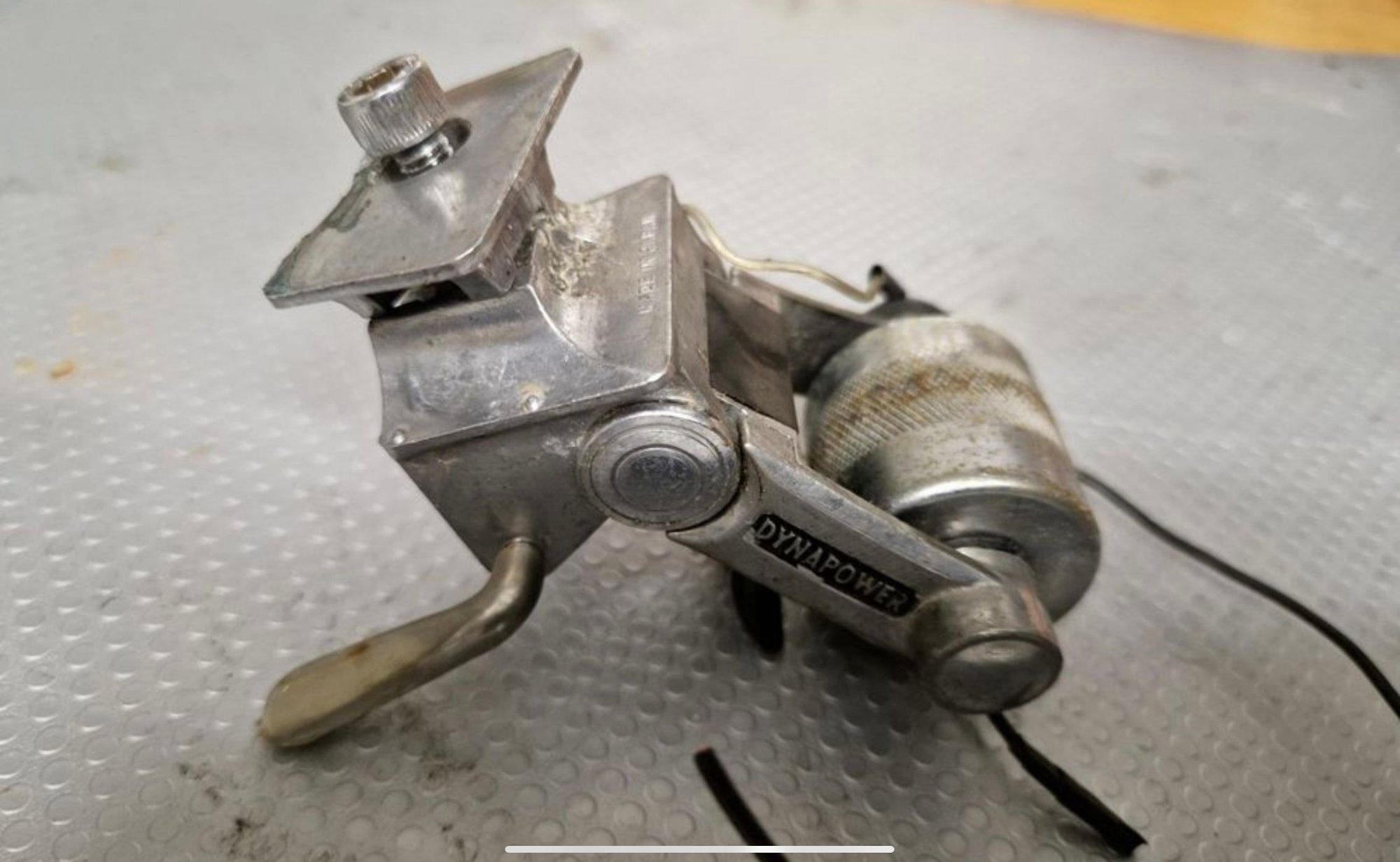
They worked better than bottle dynamos but not as well as a hub dynamo.
__________________
Keeping Seattle’s bike shops in business since 1978
Keeping Seattle’s bike shops in business since 1978
11-14-24 | 04:04 PM
#10
Senior Member
Joined: Aug 2010
Posts: 12,726
Likes: 2,105
From: Madison, WI
Bikes: 1961 Ideor, 1966 Perfekt 3 Speed AB Hub, 1994 Bridgestone MB-6, 2006 Airnimal Joey, 2009 Thorn Sherpa, 2013 Thorn Nomad MkII, 2015 VO Pass Hunter, 2017 Lynskey Backroad, 2017 Raleigh Gran Prix, 1980s Bianchi Mixte on a trainer. Others are now gone.
My point is that if you have several bikes that have the same wheel size and same type of axle, you could get by with one dynohub wheel. Then later if you like it enough, get more. If you had some bikes with rim brake and some with disc, you could have a wheel built up with a disc hub and rim brake rim, so that the wheel would work on both. I have one such wheel, although the only reason I built the wheel that way was that the hub that I wanted was out of stock so I got the hub that also worked with disk.
But the axle could be an issue if some are thru axle, some are quick release. There are ways to make a through axle wheel work on a quick release bike, but that gets more complicated with adapters.
Side note: I use a bolt on skewer on my dynohub wheels, not a quick release skewer. I suspect most thieves in my community do not know what a dynohub is, but I am sure some do. I want to make sure that the opportunist thief can't grab my wheel. Thus, that type of skewer. I keep a 5mm allen wrench for my skewer packed with my spare tube.
11-15-24 | 02:55 PM
#11

aka Tom Reingold


Joined: Jan 2009
Posts: 44,160
Likes: 6,381
From: New York, NY, and High Falls, NY, USA
Bikes: 1962 Rudge Sports, 1971 Raleigh Super Course, 1971 Raleigh Pro Track, 1974 Raleigh International, 1975 Viscount Fixie, 1982 McLean, 1996 Lemond (Ti), 2002 Burley Zydeco tandem
I installed one on my spouse's bike. She rarely needs lights, but when she does, I can be sure she hasn't charged them, so this was a good choice. The drag annoys her, so I might eventually replace it with a hub dynamo. She doesn't want me to because of the weight, but she probably won't notice the difference.
__________________
Tom Reingold, tom@noglider.com
New York City and High Falls, NY
Blogs: The Experienced Cyclist; noglider's ride blog
“When man invented the bicycle he reached the peak of his attainments.” — Elizabeth West, US author
Please email me rather than PM'ing me. Thanks.
Tom Reingold, tom@noglider.com
New York City and High Falls, NY
Blogs: The Experienced Cyclist; noglider's ride blog
“When man invented the bicycle he reached the peak of his attainments.” — Elizabeth West, US author
Please email me rather than PM'ing me. Thanks.
11-16-24 | 01:34 PM
#12

Senior Member
Joined: Feb 2008
Posts: 5,309
Likes: 4,809
From: Peoria, IL
I had the same question.
I assume that it is reference to the steel core saturating? i.e. unable to become further magnetized.
If it was an inductor and you were applying current to the winding, then saturation is an issue. For a dynamo, the level of magnetic flux in the core is determined by the magnets. It doesn't seem likely that the designer would use magnets so strong that the core would saturate.
I have a vague memory of someone running tests in a manner similar to what the OP is suggesting. The open circuit voltage did rise in proportion to the dynamo's rotational speed.
For the OP's application, there's no particular value to the extra open circuit voltage, since the winding inductance will still limit current to about a half amp, and most lights are designed to just draw a half amp and don't care about what the dynamo's open circuit voltage might be.
Personally... for a dynamo that can be swapped between bikes, I was always fond of the old block dynamos of yore. They attached to a bracket on the fork and could be removed by taking out a single bolt. Yeah, it's still a bottle dynamo with all of their issues, but it was convenient. No wires either, unless you wanted to wire up a tail light.
My old Jos block dynamo...

Steve in Peoria
I assume that it is reference to the steel core saturating? i.e. unable to become further magnetized.
If it was an inductor and you were applying current to the winding, then saturation is an issue. For a dynamo, the level of magnetic flux in the core is determined by the magnets. It doesn't seem likely that the designer would use magnets so strong that the core would saturate.
I have a vague memory of someone running tests in a manner similar to what the OP is suggesting. The open circuit voltage did rise in proportion to the dynamo's rotational speed.
For the OP's application, there's no particular value to the extra open circuit voltage, since the winding inductance will still limit current to about a half amp, and most lights are designed to just draw a half amp and don't care about what the dynamo's open circuit voltage might be.
Personally... for a dynamo that can be swapped between bikes, I was always fond of the old block dynamos of yore. They attached to a bracket on the fork and could be removed by taking out a single bolt. Yeah, it's still a bottle dynamo with all of their issues, but it was convenient. No wires either, unless you wanted to wire up a tail light.
My old Jos block dynamo...
Steve in Peoria
11-16-24 | 02:06 PM
#13
Randomhead
Joined: Aug 2008
Posts: 25,930
Likes: 4,825
From: Happy Valley, Pennsylvania
Saturate isn't the right word, but I'm pretty sure they won't just increase in power output ad infinitum. Drag might increase to the level of slippage though. Open circuit voltage isn't super important unless you are switching on the light while rolling.
11-17-24 | 06:06 AM
#14
Senior Member
Joined: Aug 2010
Posts: 12,726
Likes: 2,105
From: Madison, WI
Bikes: 1961 Ideor, 1966 Perfekt 3 Speed AB Hub, 1994 Bridgestone MB-6, 2006 Airnimal Joey, 2009 Thorn Sherpa, 2013 Thorn Nomad MkII, 2015 VO Pass Hunter, 2017 Lynskey Backroad, 2017 Raleigh Gran Prix, 1980s Bianchi Mixte on a trainer. Others are now gone.
From that I realized that if you had a USB charger in the circuit but were not using it to charge any batteries, you had better have a circuit that could handle pretty high voltage input. That was the day I decided to give up trying to build one and to buy one that was designed by someone that knew a lot more than I did about designing those things.
...
Personally... for a dynamo that can be swapped between bikes, I was always fond of the old block dynamos of yore. They attached to a bracket on the fork and could be removed by taking out a single bolt. Yeah, it's still a bottle dynamo with all of their issues, but it was convenient. No wires either, unless you wanted to wire up a tail light.
My old Jos block dynamo...
Steve in Peoria
Personally... for a dynamo that can be swapped between bikes, I was always fond of the old block dynamos of yore. They attached to a bracket on the fork and could be removed by taking out a single bolt. Yeah, it's still a bottle dynamo with all of their issues, but it was convenient. No wires either, unless you wanted to wire up a tail light.
My old Jos block dynamo...
Steve in Peoria
I had one on my errand bike. In fall after the end of daylight savings time, I often was riding home after dark. I was riding on well light streets, the incandescent light was not very bright but it was bright enough to be a good to-be-seen type of light.
I recall adding some zener diodes to it to prevent the bulbs from blowing out, but that was a long time ago, do not recall the details.
Not sure if you can still find used ones like these, it has been a long time since these were in common use.
11-17-24 | 12:44 PM
#16
Thread Starter
Enamoured of bicycles
Joined: Jan 2005
Posts: 99
Likes: 0
From: Huesca, NE Spain
Bikes: Oxia, bespoke comoly 29er all terrain tourer; 1993 Scott Boulder turned into 650b gravel; 2005 Maxx RoadMaxx; 2023 Kona Rove AL700
Bizikleto: Velogical has a lightweight rim dynamo that has less friction than a dyno hub and doesn't slip like the old bottle dynamos. I considered it when I was ordering my bicycle. I went with the dyno hub instead because it is not noisy and I new the durability was very good.
By the way, the web I have linked to above is a comparison between dynohub charging sets with these last gen rim dynos commented by pro world tourer Alee Denham.
__________________
11-17-24 | 12:50 PM
#17
Thread Starter
Enamoured of bicycles
Joined: Jan 2005
Posts: 99
Likes: 0
From: Huesca, NE Spain
Bikes: Oxia, bespoke comoly 29er all terrain tourer; 1993 Scott Boulder turned into 650b gravel; 2005 Maxx RoadMaxx; 2023 Kona Rove AL700
Thanks again, Tourist. The thing is that I have a through axle boost hub in one bike and a quick release one the other bikes.As a reference, Alee Denham compares here (https://www.cyclingabout.com/rim-dyn...n-hub-dynamos/) dynohub charging sets with last gen rim dynos to a great advantage of the latter.
Cheers.
Cheers.
11-18-24 | 11:54 AM
#18
Senior Member
Joined: Feb 2008
Posts: 5,309
Likes: 4,809
From: Peoria, IL

I'm going to guess that someone in Germany knows what fails first when trying to maximize output power at high speeds. Maybe the copper wire gets warm enough to produce shorts in the enamel insulation? There is probably some hysteretic core loss at high speed that would contribute to heating the wire.
As for open-circuit voltage... the headlight circuit design would determine how sensitive it is to high voltage. I took apart a dead B&M Lumotec Eyc for fun. It uses a little momentary switch to control the function, so some internal circuitry is always powered up. It has a bidirectional protection zener at the dynamo input. It appears to be a 100V transorb. That would make you think the circuitry is rated to handle 100V, but the transorb is located at the input to the full wave bridge rectifier, and at the output of the bridge rectifier is a 680uF, 10V cap. I'm not sure what the transorb is protecting if that cap is only rated for 10V. I can't decide whether there is enough current draw by the Eyc to keep the dynamo voltage pulled down to a low, safe level, ... or whether B&M assumes that no one is going very fast.
I think the question about whether open-circuit voltage matters will end up being the standard engineering answer.... "it depends".
Steve in Peoria
11-20-24 | 09:28 AM
#20

Palmer
Joined: Mar 2007
Posts: 9,153
Likes: 2,263
From: Parts Unknown
Bikes: Mike Melton custom, Alex Moulton AM, Dahon Curl
11-20-24 | 02:07 PM
#21
Senior Member
Joined: Feb 2008
Posts: 5,309
Likes: 4,809
From: Peoria, IL
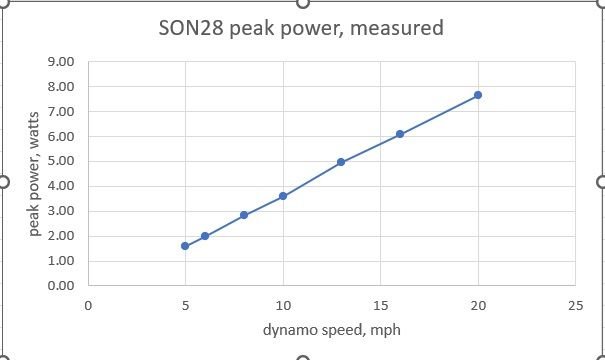
My measurements of a first generation SON28 only goes up to 20mph, but doesn't suggest that the peak power doesn't increase linearly with speed.
Steve in Peoria
11-20-24 | 04:01 PM
#22
Randomhead
Joined: Aug 2008
Posts: 25,930
Likes: 4,825
From: Happy Valley, Pennsylvania
What load were you driving? I could always be wrong, and I could also be misinterpreting the charts I found. I found people complaining that the data was from a resistive load.
I just looked on the interwebs for dyno output charts that were driving a resistive load. I'll have to go back into my search history to find my exact search terms.
I just looked on the interwebs for dyno output charts that were driving a resistive load. I'll have to go back into my search history to find my exact search terms.
11-20-24 | 09:02 PM
#23
Senior Member
Joined: Feb 2008
Posts: 5,309
Likes: 4,809
From: Peoria, IL
Voltage was measured with a Fluke 179.
Speed was measured with a Cateye Mity, I believe.
The raw data:

Steve in Peoria
11-21-24 | 08:10 AM
#24
Senior Member
Joined: Aug 2010
Posts: 12,726
Likes: 2,105
From: Madison, WI
Bikes: 1961 Ideor, 1966 Perfekt 3 Speed AB Hub, 1994 Bridgestone MB-6, 2006 Airnimal Joey, 2009 Thorn Sherpa, 2013 Thorn Nomad MkII, 2015 VO Pass Hunter, 2017 Lynskey Backroad, 2017 Raleigh Gran Prix, 1980s Bianchi Mixte on a trainer. Others are now gone.

Above screen print from this article. Article describes testing apparatus, and includes some discussion on difference between LEDs and resistors.
https://www.cyclinguk.org/sites/defa...ub-dynamos.pdf
Reading this article was one of the pieces of info out there that convinced me to buy my first dynohub. So, although it is over a decade old, I remember the article for that reason.
11-21-24 | 11:45 AM
#25
Senior Member
Joined: Feb 2008
Posts: 5,309
Likes: 4,809
From: Peoria, IL
This data is over a decade old. Screen print below:
Above screen print from this article. Article describes testing apparatus, and includes some discussion on difference between LEDs and resistors.
https://www.cyclinguk.org/sites/defa...ub-dynamos.pdf
Reading this article was one of the pieces of info out there that convinced me to buy my first dynohub. So, although it is over a decade old, I remember the article for that reason.
Above screen print from this article. Article describes testing apparatus, and includes some discussion on difference between LEDs and resistors.
https://www.cyclinguk.org/sites/defa...ub-dynamos.pdf
Reading this article was one of the pieces of info out there that convinced me to buy my first dynohub. So, although it is over a decade old, I remember the article for that reason.
Looking through the text, their testing was done with a 12 ohm load on the dynamo under test. That's a very reasonable way to do it.
The results show power increasing up to a certain speed, and then increasing at a much slower rate. I see this in my own data.
For instance, this is the data for a 10 ohm load....

We usually think of dynamos as being current limited, which would suggest that the output power would reach a limit once the dynamo was putting out its rated current. If you assume a half amp limit, then the output power is 3 watts into a 12 ohm load. In truth, the current isn't strictly limited, but does increase slightly with speed.
I should point out that my first graph showed the peak power as speed varied, and that assumes that the load resistance is adjusted in order to obtain the peak power. At most speeds, a load resistance of something other than 12 ohms will allow you to get more power out of the dynamo.
Steve in Peoria