


GPS accuracy
 01-07-08 | 06:44 AM
#26
Senior Member
Joined: Aug 2006
Posts: 1,952
Likes: 2
I just got this program "SportTracks" which aligns your GPS data with Google satellite imagery.
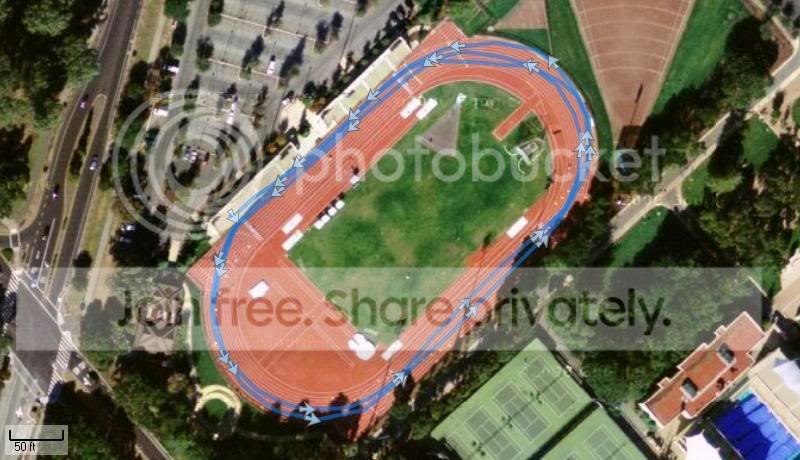
This is how accurate the Garmin 305 is during my track workout. There was a "blocker bar" across the inside 3 lanes at various parts of the track to prevent runners from over-using the inside 3 lanes, so I was forced to run pretty much on the outside lines. I did at least one warmup lap on the most outer lane, then moved into the middle lanes as I sped up and passed people. I also took one "clothing" removal stop where I headed into the bleachers on the straightaway for about 10 seconds to ditch my extra jacket.
You can see EVERY single one of these moves (including the jacket stop!) aligned on the map below. I did no manual editing to this mapped course - it was just pulled directly from my watch and sync'd with Gmaps via SportTracks.
VERY VERY accurate, in my opinion, and the Garmin is known to perform WORST on curvy courses like this one. In fact, the track is probably one of the LEAST accurate courses to use the Garmin GPS (due to undersampling on the curves), yet it's obviously stil very, very good. Take in on the roads, and it should be near-perfect.
This is how accurate the Garmin 305 is during my track workout. There was a "blocker bar" across the inside 3 lanes at various parts of the track to prevent runners from over-using the inside 3 lanes, so I was forced to run pretty much on the outside lines. I did at least one warmup lap on the most outer lane, then moved into the middle lanes as I sped up and passed people. I also took one "clothing" removal stop where I headed into the bleachers on the straightaway for about 10 seconds to ditch my extra jacket.
You can see EVERY single one of these moves (including the jacket stop!) aligned on the map below. I did no manual editing to this mapped course - it was just pulled directly from my watch and sync'd with Gmaps via SportTracks.
VERY VERY accurate, in my opinion, and the Garmin is known to perform WORST on curvy courses like this one. In fact, the track is probably one of the LEAST accurate courses to use the Garmin GPS (due to undersampling on the curves), yet it's obviously stil very, very good. Take in on the roads, and it should be near-perfect.
 01-08-08 | 10:46 AM
#27
Recreational rider
Joined: Aug 2007
Posts: 115
Likes: 0
From: Phoenix, AZ
Bikes: 2007 Specialized Globe
That sounds about right as car odometers are often a bit optimistic when displaying velocity/distance
If you really want to measure the distance, calibrate a bicycle computer and ride the distance or get a paper map with a ruler or use a computer map that measures distance.
If you really want to measure the distance, calibrate a bicycle computer and ride the distance or get a paper map with a ruler or use a computer map that measures distance.
01-08-08 | 06:44 PM
#28

Thread Starter
Healthy and active
Joined: Mar 2007
Posts: 887
Likes: 4
From: Caldwell, Idaho USA
Bikes: mid-60's Dunelt 10-speed, Specialized Allez Sport Tripple, Trek 7.2 FX
I calibrate my cyclometers by the roll out method. One needs to be done again. Where others read 14.4 miles, it reads 14.3 miles. And, I plotted my route at www.bikely.com. It agreed it is 14.4 miles.
I am eager to ride with this GPS on some other routes in daylight when I can watch the icon that tells me if I have a connection with satellites. I will also do a roll out check on the cyclometer setting just before I ride. And, I will check the route on Bikely.com. Unfortunately, that will have to wait for better weather.
Thank you, all, for your suggestions.
01-12-08 | 12:05 PM
#29


Senior Member

Joined: Apr 2005
Posts: 17,196
Likes: 761
From: Ann Arbor, MI
Bikes: 1980 Masi, 1984 Mondonico, 1984 Trek 610, 1980 Woodrup Giro, 2005 Mondonico Futura Leggera ELOS, 1967 PX10E, 1971 Peugeot UO-8
On several cars so far I've checked the speedo reading against a stopwatch-timed flying mile. I use the highway mile markers as a distance reference. I think I'm getitng time within a second. I assume the State of Michigan can measure distance within say 10 feet. At highway speeds I usually find the car speedo reading high by 3 mph, which is around 4% at 70 mph. I haven't seen one read low, only read high. Instrument cluster designers I've worked with have told me that car companies try to err in the directio of overreading, to help customers avoid traffic tickets.
Road fan
Road fan
01-12-08 | 02:51 PM
#30
Senior Member
Joined: Feb 2007
Posts: 155
Likes: 0
From: Cottonwood Heights, Utah (Salt Lake City suburb)
Bikes: Cannondale CAAD9, Co-motion Americano
I'd try finding a straight stretch of road one mile long as measured on a USGS topo map. Ride that and compare to GPS readings.
That's also how I calibrate my bike computer.
That's also how I calibrate my bike computer.
01-14-08 | 05:25 PM
#31
Thread Starter
Healthy and active
Joined: Mar 2007
Posts: 887
Likes: 4
From: Caldwell, Idaho USA
Bikes: mid-60's Dunelt 10-speed, Specialized Allez Sport Tripple, Trek 7.2 FX
I thought maybe my GPS unit gives faulty readings in miles, but might possibly give a correct reading in kilometers. It was made in a country that uses the metric system. Perhaps they got the software wrong for expressing in miles. But, alas, my normal ride should register as 23 km. My unit showed 21.2 km. The error is right at 8%.
During my ride today I noted the reading between two points that show as one mile exactly on www.bikely.com. My speedometer showed one mile at the end of that stretch. My GPS showed less than the equivalent of a mile (about 1.3 km, if I remember correctly). I glanced periodically at the symbol indicating satellite acquisitiion. It indicated I had satellites every time I looked at it.
An 8% error is not too bad, if the unit is consistent. I can factor to find my true distance covered. But, there have been times when readings have not been consistent.
During my ride today I noted the reading between two points that show as one mile exactly on www.bikely.com. My speedometer showed one mile at the end of that stretch. My GPS showed less than the equivalent of a mile (about 1.3 km, if I remember correctly). I glanced periodically at the symbol indicating satellite acquisitiion. It indicated I had satellites every time I looked at it.
An 8% error is not too bad, if the unit is consistent. I can factor to find my true distance covered. But, there have been times when readings have not been consistent.
01-25-08 | 08:35 AM
#32
Videre non videri
Joined: Sep 2004
Posts: 3,208
Likes: 4
From: Gothenburg, Sweden
Bikes: 1 road bike (simple, light), 1 TT bike (could be more aero, could be lighter), 1 all-weather commuter and winter bike, 1 Monark 828E ergometer indoor bike
The average error of any non-augmented GPS system is between 15-25 ft (this means that for every time the GPS unit checks its position, it will on average be 15-25 ft off). GPS units are far less accurate than commonly thought. I wouldn't rely on them for anything but navigation. They can't even come close to the accuracy of a properly calibrated bike computer.
01-25-08 | 06:36 PM
#33
Senior Member
Joined: Aug 2006
Posts: 1,952
Likes: 2
I've read about the 15-25ft GPS error, but in practice, I really find that it's much more accurate than that. It might be a software averaging thing, where it can align several contiguous points, but when I use my Garmin 305, which is a "small" GPS unit, it overlays on GMaps consistently to under 15 feet. It rarely has me overlaid in the middle of street if I'm running on the right hand side - 25 feet error would surely put me into the street if it were consistently that much off.
I put the "track" graphic up above, and keep in mind that those track lanes are less than 5 feet wide each, and the unit NEVER has me drifting into lanes 1-3, which were blocked by a bar, over a 40 minute run. It's performed similarly in tree cover on trails and on streets when I upload to Sportracks and overlay Gmaps. At least from my actual usage experience in the past few months, it's rarely off by 15-25 feet, and if anything, closer to 5-10 feet.
I put the "track" graphic up above, and keep in mind that those track lanes are less than 5 feet wide each, and the unit NEVER has me drifting into lanes 1-3, which were blocked by a bar, over a 40 minute run. It's performed similarly in tree cover on trails and on streets when I upload to Sportracks and overlay Gmaps. At least from my actual usage experience in the past few months, it's rarely off by 15-25 feet, and if anything, closer to 5-10 feet.
01-26-08 | 09:11 AM
#34
Recreational rider
Joined: Aug 2007
Posts: 115
Likes: 0
From: Phoenix, AZ
Bikes: 2007 Specialized Globe
I noticed the same thing as the above poster when looking at the tracklog of my ride yesterday. One of my trails is a MUP that runs on one side of a canal. The path is paved about 8-10 feet wide, I started down it around 5pm, and crossed the same point coming back around 6pm, which is plenty of time for satelite drift, ionosphere change, barometric and temperature change, and so on.
Still, looking at the track log, you could very clearly tell which line was out and which was back because I always ride on the right-side edge of the path and the GPS was consistent enough in its accuracy to determine if I was on the east or west edge of a single MUP.
GPS isn't perfect, no. I know this from geocaching that when you're sitting stationary, it can take a good 30 to 60 seconds for it to figure out exactly where within that 10-15 foot range you are, but for cycling I've been amazed with how NOT inaccurate the tracklogs seem to be. It's almost as if it has better accuracy when you're moving than when stationary. Go figure.
Still, looking at the track log, you could very clearly tell which line was out and which was back because I always ride on the right-side edge of the path and the GPS was consistent enough in its accuracy to determine if I was on the east or west edge of a single MUP.
GPS isn't perfect, no. I know this from geocaching that when you're sitting stationary, it can take a good 30 to 60 seconds for it to figure out exactly where within that 10-15 foot range you are, but for cycling I've been amazed with how NOT inaccurate the tracklogs seem to be. It's almost as if it has better accuracy when you're moving than when stationary. Go figure.
