


65-85+ Thread
 10-15-24 | 08:02 AM
#3951

Senior Member

Joined: Jun 2005
Posts: 2,891
Likes: 971
From: Kentucky
Bikes: 06 Lemond Reno, 98 GT Timberline
Was my off road bike trying to tell me something. Only a couple of months until 74. Sunday (10/13) went out for a trail ride with a neighborhood friend (10 yrs younger). Been a while since I had the old (98) mtn bike out. The suspension fork is a basic coil/oil Manitou from 2004 with a port (similar to a grease fitting but diff) so the stanchions slide freely. Didn't notice until we got back to the truck that the port was stuck open, letting fork oil/grease to run down the fork, and onto the tire and rim. Have it fixed now. Enjoyed the ride, 5.6 miles of rooty and rocky singletrack, but the hardtail and basic fork beat me up a bit. Maybe the bike was telling me I have no business on trails like that, or maybe need a dual susp (ain't happenin" at this age--good ones are $$$$!)
 10-15-24 | 09:40 AM
#3952

Senior Member


Joined: Dec 2004
Posts: 15,371
Likes: 8,287
From: Seattle area
Bikes: Bikes??? Thought this was social media?!?
Why post in 65+ thread? Unless you want caution for replies. At your age, I would not be riding rocky & rooty. And since I am your age, I would stick to smoother trails or gravel roads. And friends along....
__________________
Vintage, modern, e-road. It is a big cycling universe.
Vintage, modern, e-road. It is a big cycling universe.
10-15-24 | 12:19 PM
#3953
Newbie
Joined: Dec 2003
Posts: 65
Likes: 84
From: Corn Field County, Illinois
Bikes: 2024 Cervelo ZFS-5 2023 Cervelo Soloist 2007 Specialized Tricross 2017 Colnago CRS 2001 Schwinn Homegrown
10-15-24 | 07:41 PM
#3954

Newbie
Joined: Nov 2023
Posts: 52
Likes: 31
From: N. Illinois
Bikes: `07 Trek Pilot 5.0 w/ 105 triple, carbon, road; Windsor Super Carrera`81 vintage, Ozark Trail Explorer G1e 10 speed road; Fuji Sunfire knobby: Specialized Sirrus X 2.0
I tried posting pics. Didn't seem to post. Frustrated with it, after finally getting to 10 posts, after a year.
10-15-24 | 08:18 PM
#3955

Just Pedaling
Joined: Oct 2021
Posts: 1,472
Likes: 1,101
 10-24-24 | 09:52 AM
#3956

Senior Member

Joined: May 2015
Posts: 4,048
Likes: 124
Bikes: 2015 22 Speed

Then, e.g., 'From Device'
Last edited by McBTC; 10-24-24 at 10:59 AM.
10-24-24 | 12:36 PM
#3957
Newbie
Joined: Nov 2023
Posts: 52
Likes: 31
From: N. Illinois
Bikes: `07 Trek Pilot 5.0 w/ 105 triple, carbon, road; Windsor Super Carrera`81 vintage, Ozark Trail Explorer G1e 10 speed road; Fuji Sunfire knobby: Specialized Sirrus X 2.0
Thanks. Figuring my way around.

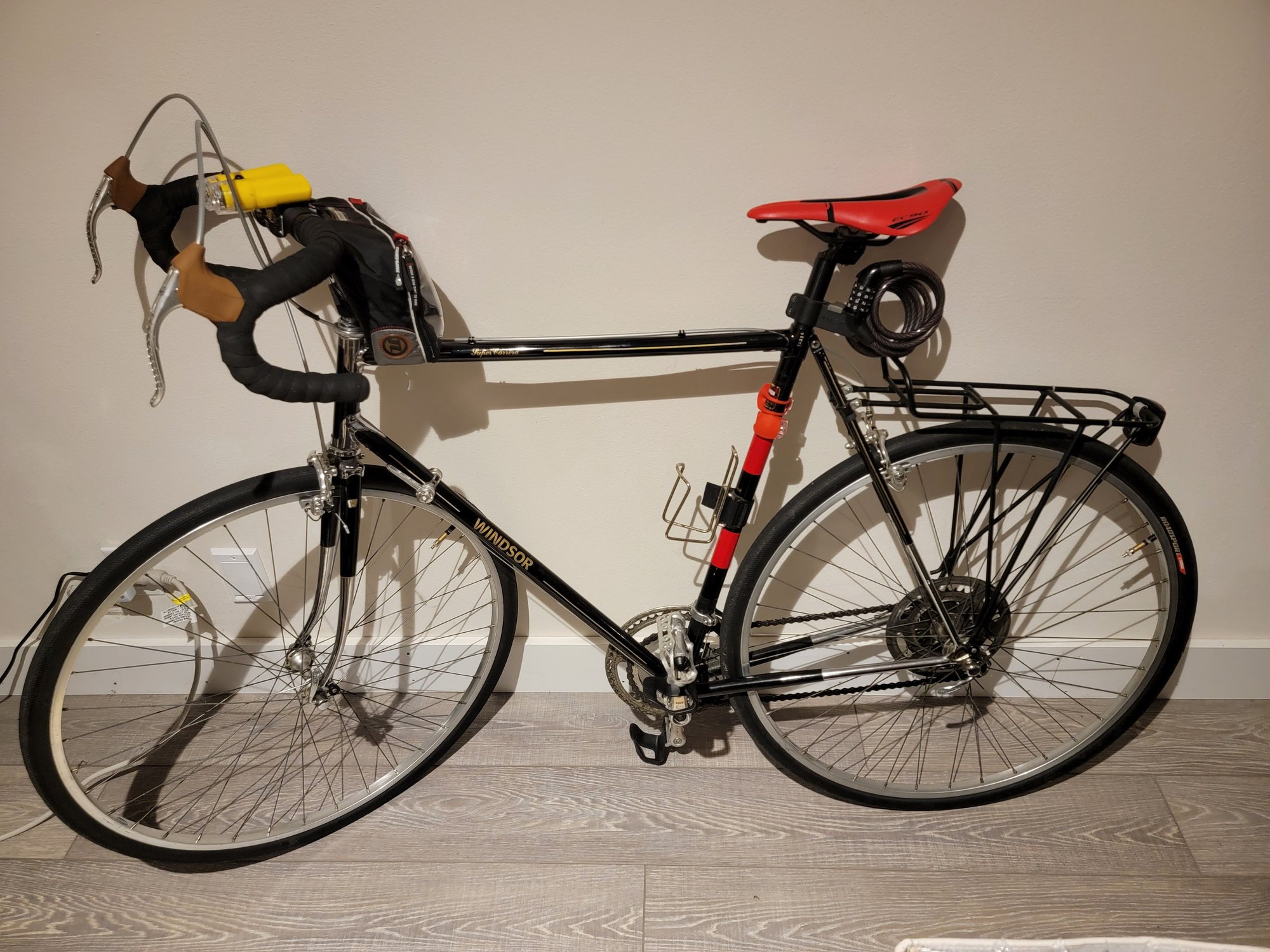

My bikes:
Fuji for dirt railways.
Windsor Chrome-Moly from early 80's. Ten speed, made in Mexico.
'07 Trek Pilot 5.0 carbon, Ultegra, 105 triple. 10 tooth cluster. Pilot was an upright geometry frame bike. But, wheels have too large pitch for long durability. Back wheel cracked. Replaced under warrenty. Otherwise no issues. Made in Wisconsin. Now made in Taiwan, according to a dealer.
Gave away my Shimano cleats. No longer want to be attached to bike. If I were to get hit.
My bikes:
Fuji for dirt railways.
Windsor Chrome-Moly from early 80's. Ten speed, made in Mexico.
'07 Trek Pilot 5.0 carbon, Ultegra, 105 triple. 10 tooth cluster. Pilot was an upright geometry frame bike. But, wheels have too large pitch for long durability. Back wheel cracked. Replaced under warrenty. Otherwise no issues. Made in Wisconsin. Now made in Taiwan, according to a dealer.
Gave away my Shimano cleats. No longer want to be attached to bike. If I were to get hit.
Last edited by Old Guy8; 10-25-24 at 09:25 AM.
10-24-24 | 05:13 PM
#3958
Senior Member
Joined: May 2015
Posts: 4,048
Likes: 124
Bikes: 2015 22 Speed
Loved my Pilot triple (comfort geo and only CF)- retroed it to get a one-to-one... current rig is the first bike I've had that wasn't a triple (and first alloy) but... retroed to get my one-to-one. Don't use cleats anymore either but do use large cages... with shorter cranks (165s) so no dragging issues (good for better RPMs too).
Last edited by McBTC; 10-24-24 at 05:26 PM.
10-28-24 | 06:14 PM
#3959

Veteran Racer

Joined: Jul 2009
Posts: 11,854
Likes: 913
From: Ciudad de Vacas, Tejas
Bikes: 34 frames + 80 wheels
Well, I’ve decided that I don’t need an 11 tooth cassette cog anymore on any of my road bikes. Gotta be going over 40 mph to use it, and that just ain’t happening anymore. What I do need is lower gears so that I can get up all the hills in my area sitting down. So, I’ve re-geared three of my road bikes as follows:
1) 10 speed 34-50 front: 11-28 to 12-30
2) 11 speed 36-52 front: 11-25 to 12-28
3) 12 speed 36-52 front: 11-30 to 12-34
Now, I do have a 1 x 12 hybrid bike with an 11T high gear, but the chainring is only 38T, so it’s actually usable. Today I rode the 12 speed up a hill that peaks at a 10 percent grade into a 15 mph headwind and really appreciated the new 34T low gear. On the way back down the hill with a tailwind, I maxed out at 38 mph in the 12T high gear w/o spinning out, and was nowhere near needing an 11T.
When I began riding in the 1960s, 11T cogs didn’t even exist, or even 12T cogs for that matter. In fact, I didn’t even own a road bike with an 11T cog until twenty years ago. I’ve always been more of a spinner than a gear masher, and routinely beat the latter in sprints where they were trying to push much higher gears. Nowadays, I go on fitness rides where I try to keep my cadence at a 80 rpm minimum with a lot of over 100 rpms, even when riding uphill. I’m not concerned with how fast I’m riding, just how much cardio I’m getting. Anyway, it’s adios 11T forever.
1) 10 speed 34-50 front: 11-28 to 12-30
2) 11 speed 36-52 front: 11-25 to 12-28
3) 12 speed 36-52 front: 11-30 to 12-34
Now, I do have a 1 x 12 hybrid bike with an 11T high gear, but the chainring is only 38T, so it’s actually usable. Today I rode the 12 speed up a hill that peaks at a 10 percent grade into a 15 mph headwind and really appreciated the new 34T low gear. On the way back down the hill with a tailwind, I maxed out at 38 mph in the 12T high gear w/o spinning out, and was nowhere near needing an 11T.
When I began riding in the 1960s, 11T cogs didn’t even exist, or even 12T cogs for that matter. In fact, I didn’t even own a road bike with an 11T cog until twenty years ago. I’ve always been more of a spinner than a gear masher, and routinely beat the latter in sprints where they were trying to push much higher gears. Nowadays, I go on fitness rides where I try to keep my cadence at a 80 rpm minimum with a lot of over 100 rpms, even when riding uphill. I’m not concerned with how fast I’m riding, just how much cardio I’m getting. Anyway, it’s adios 11T forever.
__________________
What, Me Worry? - Alfred E. Neuman
I see the light at the end of the tunnel, but the tunnel keeps getting longer - me
What, Me Worry? - Alfred E. Neuman
I see the light at the end of the tunnel, but the tunnel keeps getting longer - me
Last edited by TejanoTrackie; 10-28-24 at 07:46 PM.
10-29-24 | 09:44 AM
#3960
Just Pedaling
Joined: Oct 2021
Posts: 1,472
Likes: 1,101
Well, I’ve decided that I don’t need an 11 tooth cassette cog anymore on any of my road bikes. Gotta be going over 40 mph to use it, and that just ain’t happening anymore. What I do need is lower gears so that I can get up all the hills in my area sitting down. So, I’ve re-geared three of my road bikes as follows:
1) 10 speed 34-50 front: 11-28 to 12-30
2) 11 speed 36-52 front: 11-25 to 12-28
3) 12 speed 36-52 front: 11-30 to 12-34
1) 10 speed 34-50 front: 11-28 to 12-30
2) 11 speed 36-52 front: 11-25 to 12-28
3) 12 speed 36-52 front: 11-30 to 12-34
 I'm not a spinner though, so speed for me is in the 25-30 mph range.
10-29-24 | 11:10 AM
I'm not a spinner though, so speed for me is in the 25-30 mph range.
10-29-24 | 11:10 AM
#3961
Senior Member
Joined: May 2015
Posts: 4,048
Likes: 124
Bikes: 2015 22 Speed
For re-gearing, for anyone who may be interested, Shimano now provides (actually, a couple years ago) the 105 12-speed 11-34 tooth cassette that can be retroed to an 11-speed freewheel hub. That'll give anyone with an inner chain ring of 34T a one-to-one.
10-29-24 | 01:13 PM
#3962
Senior Member
Joined: May 2015
Posts: 4,048
Likes: 124
Bikes: 2015 22 Speed
Interesting little factoid that some may find that even AI may provide erroneous information, depending how the question is asked. But, irrespective of what AI might say, shortening your crank length essentially has the same effect as increasing the teeth on a chain ring or decreasing the teeth on a cluster. It all of course has to do with the loss of leverage, so... more RPMs are required. Accordingly, if you shorten your crank length, you would need to increase the teeth on your free wheel, or decrease the teeth on your chainring, to maintain a constant power output (albeit, at a higher RPM). That is why I find a one-to-one as useful now as back in the day when touring and climbing a mountain with full load with the usual 175 mm cranks. People argue the issue but nevertheless, there is science on the matter, such that it, that accords with findings that 145 mm cranks provide the maximum power output irrespective of the fitness of the rider and the total amount of power the rider is capable of producing.hile both can affect your gear ratio, shortening the crank length generally means you'll need a slightly smaller chainring to maintain the same gear, as it reduces your leverage and requires a higher cadence to maintain the same power output.
Last edited by McBTC; 10-29-24 at 01:20 PM.
10-29-24 | 09:11 PM
#3963

just another gosling
Joined: Feb 2007
Posts: 20,554
Likes: 2,667
From: Everett, WA
Bikes: CoMo Speedster 2003, Trek 5200, CAAD 9, Fred 2004
I'm running a 26 X 30 low gear on my single and a 26 X 40 on our tandem. 1 X 1 used to be OK . I went to this ratio on my single at about 70 and the low ratio on the tandem at 75. At 69 & 65, we rode RAMROD on the tandem with 26 X 34. Cayuse Pass was hard but we finished strong. I do long climbs at about 83 cadence on my single and 78 on the tandem. 175 cranks on the tandem, 170 on the single. I don't notice any difference in crank feel between the bikes.
If 145mm were the most powerful setup, the pros would all be using it, i.e. there are drawbacks. My experience with cadence is that oxygen consumption increases with a higher cadence at the same power. That improves somewhat with specific training but doesn't go away. That might mean though that folks with a very high VO2max could benefit from shorter cranks. I think we saw that in the last TdF.
If 145mm were the most powerful setup, the pros would all be using it, i.e. there are drawbacks. My experience with cadence is that oxygen consumption increases with a higher cadence at the same power. That improves somewhat with specific training but doesn't go away. That might mean though that folks with a very high VO2max could benefit from shorter cranks. I think we saw that in the last TdF.
__________________
Results matter
Results matter
10-29-24 | 10:00 PM
#3964

Senior Member
Joined: Mar 2024
Posts: 1,948
Likes: 782
From: San Diego
Bikes: Columbine, Lynskey GR300, Paramount Track Bike, Colnago Super (4), Santana Tandems (1995 & 2007), Gary Fisher Piranha (retired), Bianchi Track Bike, a couple of Honda mountain bikes
I'm running a 26 X 30 low gear on my single and a 26 X 40 on our tandem. 1 X 1 used to be OK . I went to this ratio on my single at about 70 and the low ratio on the tandem at 75. At 69 & 65, we rode RAMROD on the tandem with 26 X 34. Cayuse Pass was hard but we finished strong. I do long climbs at about 83 cadence on my single and 78 on the tandem. 175 cranks on the tandem, 170 on the single. I don't notice any difference in crank feel between the bikes.
If 145mm were the most powerful setup, the pros would all be using it, i.e. there are drawbacks. My experience with cadence is that oxygen consumption increases with a higher cadence at the same power. That improves somewhat with specific training but doesn't go away. That might mean though that folks with a very high VO2max could benefit from shorter cranks. I think we saw that in the last TdF.
If 145mm were the most powerful setup, the pros would all be using it, i.e. there are drawbacks. My experience with cadence is that oxygen consumption increases with a higher cadence at the same power. That improves somewhat with specific training but doesn't go away. That might mean though that folks with a very high VO2max could benefit from shorter cranks. I think we saw that in the last TdF.
10-29-24 | 10:12 PM
#3965
Newbie
Joined: Oct 2024
Posts: 9
Likes: 22
From: McMinnville Or.
Bikes: 12 70s steel road bikes .raleigh international 77, Raleigh super course ,73.Peugeot px-10 72 2 103 Carbo frame course and corbier 75,78. motobecane. jubilee sport, and grand touring . 84-78. bianchi special 80. centurion lemans 84.scapin 86
Back at i t after major weight loss
I gained a lot of weight over twenty five yrs. Starting in my late 30s at 250 lbs .by 62 I was 585 lbs and near death. I made a drastic change in diet when told I was going to be a grandpa. By 64 I was under 300 lbs and decided to pick up a bike to help w/ exercise . I bought a trek marlin 5. For next yr I used it dropping down to 215 lbs . At 65 I started collecting road bikes and using them to build strength. Today I own a dozen vintage 70s steel frame bikes. At 66 and down to 175 lbs ,I ride a different bike each day. I try to ride 20 miles a day . Biking and walking everyday has helped me greatly.i lost a total of 410 lbs ,put my diabetes into remission ,and gave myself a satisfying hobby to fill my time.

 10-30-24 | 02:55 AM
#3966


Pogacar has at least two distinctions as a current bike racer: he's on track to being considered the best road racer ever and, at 5'9" tall, he uses 165-mm cranks. Most of his fellow racers likely use 170 mm or longer, or else his crank length wouldn't be cited as being unusual.
10-30-24 | 08:15 AM
#3967
Senior Member
Joined: May 2015
Posts: 4,048
Likes: 124
Bikes: 2015 22 Speed
'Despite various leg lengths for different heights, Track Cyclists commonly stick to 165mm or 170mm Crank Lengths. The shorter 165mm Crank Length encourages a greater pedaling efficiency as your pedaling cadence (RPM - Revolutions per Minute) will be higher.'
https://www.velodrome.shop
https://www.velodrome.shop
10-30-24 | 08:45 AM
#3968
Senior Member
Joined: Mar 2024
Posts: 1,948
Likes: 782
From: San Diego
Bikes: Columbine, Lynskey GR300, Paramount Track Bike, Colnago Super (4), Santana Tandems (1995 & 2007), Gary Fisher Piranha (retired), Bianchi Track Bike, a couple of Honda mountain bikes
I gained a lot of weight over twenty five yrs. Starting in my late 30s at 250 lbs .by 62 I was 585 lbs and near death. I made a drastic change in diet when told I was going to be a grandpa. By 64 I was under 300 lbs and decided to pick up a bike to help w/ exercise . I bought a trek marlin 5. For next yr I used it dropping down to 215 lbs . At 65 I started collecting road bikes and using them to build strength. Today I own a dozen vintage 70s steel frame bikes. At 66 and down to 175 lbs ,I ride a different bike each day. I try to ride 20 miles a day . Biking and walking everyday has helped me greatly.i lost a total of 410 lbs ,put my diabetes into remission ,and gave myself a satisfying hobby to fill my time.

That's incredible! 400# in 4 years! That's absolutely amazing.
10-30-24 | 09:10 AM
#3969
just another gosling
Joined: Feb 2007
Posts: 20,554
Likes: 2,667
From: Everett, WA
Bikes: CoMo Speedster 2003, Trek 5200, CAAD 9, Fred 2004
__________________
Results matter
Results matter
10-30-24 | 09:19 AM
#3970
just another gosling
Joined: Feb 2007
Posts: 20,554
Likes: 2,667
From: Everett, WA
Bikes: CoMo Speedster 2003, Trek 5200, CAAD 9, Fred 2004
'Despite various leg lengths for different heights, Track Cyclists commonly stick to 165mm or 170mm Crank Lengths. The shorter 165mm Crank Length encourages a greater pedaling efficiency as your pedaling cadence (RPM - Revolutions per Minute) will be higher.'
https://www.velodrome.shop
https://www.velodrome.shop
__________________
Results matter
Results matter
Last edited by Carbonfiberboy; 10-30-24 at 09:36 AM.
11-01-24 | 09:46 AM
#3971
Senior Member
Joined: May 2015
Posts: 4,048
Likes: 124
Bikes: 2015 22 Speed
There is an issue that's hard to talk about when discussing crank length and RPM- it's confusingly ticklish to the extent it apparently is impossible to understand but exist nonetheless.
It's natural to think of decreasing crank length as increasing RPMs to maintain the same power output and and so apparently, vice versa, but the reverse also seems to true.
At any given RPM, at a longer crank length, the foot speed is significantly higher, i.e., the longer the crank, the more distance the foot travels in a single revolution. Foot speed does not seem to be anything mythical when thinking about the difference between a fast vs slow runner but... how it applies to cycling is a big mystery.
Where it gets ticklish is, e.g., you decrease the crank length so now the leverage is less in any given gear so you have to increase the RPMs to maintain the same output In that gear but.. that isn't what necessarily happens because everyone's different and certain foot speeds seem more natural and it might 'feel' to be a more natural response to the decrease in leverage to lower the gear to maintain foot speed. But then, that means the rider must be putting in more power to maintain the same power output in response to the loss of leverage, no?
Well, apparently The answer is, 'yes' or that is at least what the science is saying- your output is greater at a lower crank length.
The explanation may be the example of the optimum shovel size, e.g., a bigger shovel will move more coal, but the person moving the shovel might move more coal using the smaller shovel.
It's natural to think of decreasing crank length as increasing RPMs to maintain the same power output and and so apparently, vice versa, but the reverse also seems to true.
At any given RPM, at a longer crank length, the foot speed is significantly higher, i.e., the longer the crank, the more distance the foot travels in a single revolution. Foot speed does not seem to be anything mythical when thinking about the difference between a fast vs slow runner but... how it applies to cycling is a big mystery.
Where it gets ticklish is, e.g., you decrease the crank length so now the leverage is less in any given gear so you have to increase the RPMs to maintain the same output In that gear but.. that isn't what necessarily happens because everyone's different and certain foot speeds seem more natural and it might 'feel' to be a more natural response to the decrease in leverage to lower the gear to maintain foot speed. But then, that means the rider must be putting in more power to maintain the same power output in response to the loss of leverage, no?
Well, apparently The answer is, 'yes' or that is at least what the science is saying- your output is greater at a lower crank length.
The explanation may be the example of the optimum shovel size, e.g., a bigger shovel will move more coal, but the person moving the shovel might move more coal using the smaller shovel.
Last edited by McBTC; 11-01-24 at 10:01 AM.
11-01-24 | 12:33 PM
#3972
'Despite various leg lengths for different heights, Track Cyclists commonly stick to 165mm or 170mm Crank Lengths. The shorter 165mm Crank Length encourages a greater pedaling efficiency as your pedaling cadence (RPM - Revolutions per Minute) will be higher.'
https://www.velodrome.shop
https://www.velodrome.shop
11-01-24 | 05:28 PM
#3973
Senior Member
Joined: May 2015
Posts: 4,048
Likes: 124
Bikes: 2015 22 Speed
Opposed to that idea however, if you think of a piston being similar to foot speed, many high performance race car teams choose short stroke, high revving engines to lower piston speeds at high revs.
11-04-24 | 03:11 AM
#3974
Junior Member

Joined: Jun 2017
Posts: 109
Likes: 39
Bikes: Riese & Müller Multicharger GT 750; Dahon Jetstream EX
Well, I’ve decided that I don’t need an 11 tooth cassette cog anymore on any of my road bikes. Gotta be going over 40 mph to use it, and that just ain’t happening anymore. What I do need is lower gears so that I can get up all the hills in my area sitting down. So, I’ve re-geared three of my road bikes as follows:
1) 10 speed 34-50 front: 11-28 to 12-30
2) 11 speed 36-52 front: 11-25 to 12-28
3) 12 speed 36-52 front: 11-30 to 12-34
Now, I do have a 1 x 12 hybrid bike with an 11T high gear, but the chainring is only 38T, so it’s actually usable. Today I rode the 12 speed up a hill that peaks at a 10 percent grade into a 15 mph headwind and really appreciated the new 34T low gear. On the way back down the hill with a tailwind, I maxed out at 38 mph in the 12T high gear w/o spinning out, and was nowhere near needing an 11T.
When I began riding in the 1960s, 11T cogs didn’t even exist, or even 12T cogs for that matter. In fact, I didn’t even own a road bike with an 11T cog until twenty years ago. I’ve always been more of a spinner than a gear masher, and routinely beat the latter in sprints where they were trying to push much higher gears. Nowadays, I go on fitness rides where I try to keep my cadence at a 80 rpm minimum with a lot of over 100 rpms, even when riding uphill. I’m not concerned with how fast I’m riding, just how much cardio I’m getting. Anyway, it’s adios 11T forever.
1) 10 speed 34-50 front: 11-28 to 12-30
2) 11 speed 36-52 front: 11-25 to 12-28
3) 12 speed 36-52 front: 11-30 to 12-34
Now, I do have a 1 x 12 hybrid bike with an 11T high gear, but the chainring is only 38T, so it’s actually usable. Today I rode the 12 speed up a hill that peaks at a 10 percent grade into a 15 mph headwind and really appreciated the new 34T low gear. On the way back down the hill with a tailwind, I maxed out at 38 mph in the 12T high gear w/o spinning out, and was nowhere near needing an 11T.
When I began riding in the 1960s, 11T cogs didn’t even exist, or even 12T cogs for that matter. In fact, I didn’t even own a road bike with an 11T cog until twenty years ago. I’ve always been more of a spinner than a gear masher, and routinely beat the latter in sprints where they were trying to push much higher gears. Nowadays, I go on fitness rides where I try to keep my cadence at a 80 rpm minimum with a lot of over 100 rpms, even when riding uphill. I’m not concerned with how fast I’m riding, just how much cardio I’m getting. Anyway, it’s adios 11T forever.
I had a touring bike in college (decades ago) with even a triple front derailleur. I needed the granny gear to get up mountains with panniers full of camping gear.
Now you hardly see a front derailleur. Why?
11-04-24 | 07:30 AM
#3975
Senior Member
Joined: May 2015
Posts: 4,048
Likes: 124
Bikes: 2015 22 Speed
'The Rise of the Compact Crank (aka “The Death of the Triple")' ~Bikehugger
... that and freewheels w/ 12 cassettes....
And, another thing you don't see since those days (not since the '80s)... downtube shifters!
... that and freewheels w/ 12 cassettes....
And, another thing you don't see since those days (not since the '80s)... downtube shifters!
Last edited by McBTC; 11-04-24 at 07:38 AM.