


Training at 68
 01-06-15 | 11:03 AM
#1
Thread Starter
Junior Member
Joined: Dec 2014
Posts: 6
Likes: 0
From: North Louisiana
Training at 68
This is only my second post I hope I am not asking too many questions. I will be 68 in February - I have a background in weight training and running (5K's). My post-grad work is in strength and conditioning and working with special needs children with motor issues. I find that cycling is a different animal than weights and running in that is takes a lot of time to train. I am training for the Dirty Kanza 100 mile version. My sons are giving me lots of advice but they are twenty years younger than I am. So I am here trying to get an idea of how people nearer my age are training. I live in Louisiana on the border of Arkansas so I ride in both states. The hills around here are 300-400 feet high, so I do get a bit of hill training. Outside I ride from 50-70 miles at a about 13.5 mph pace (Steilacoom RCX). Most of my riding is backroads, some paved some gravel. Right now I am training inside a lot (Trek 820) because I don't like to ride in the cold. I do three types of indoor rides: 1. 2 Hours of simulated hills-I do four 30 minute sets where I do 10 minutes at each level of resistance (5/6/7 on the cassette). I try to keep my heart rate in the 150's for an average. My maximum heart rate is probably 175 or so. 2. Power - I ride for an hour at heaviest resistance. 3. Intervals - I ride an hour doing one minute intervals every five minutes (1/5). I hope my indoor workout are at least keeping me at my current level of fitness. My indoor workouts much more intense than my outside ones. Any input will be appreciated.
Thanks
Thanks
 01-06-15 | 11:06 AM
#2

Galveston County Texas
Joined: Nov 2007
Posts: 33,335
Likes: 1,286
From: In The Wind
Bikes: 02 GTO, 2011 Magnum
Started at 65 here....Took 10,000 miles to feel I was in Great Shape. Did 11,200 miles the first year.
The 9,000 mile mark.
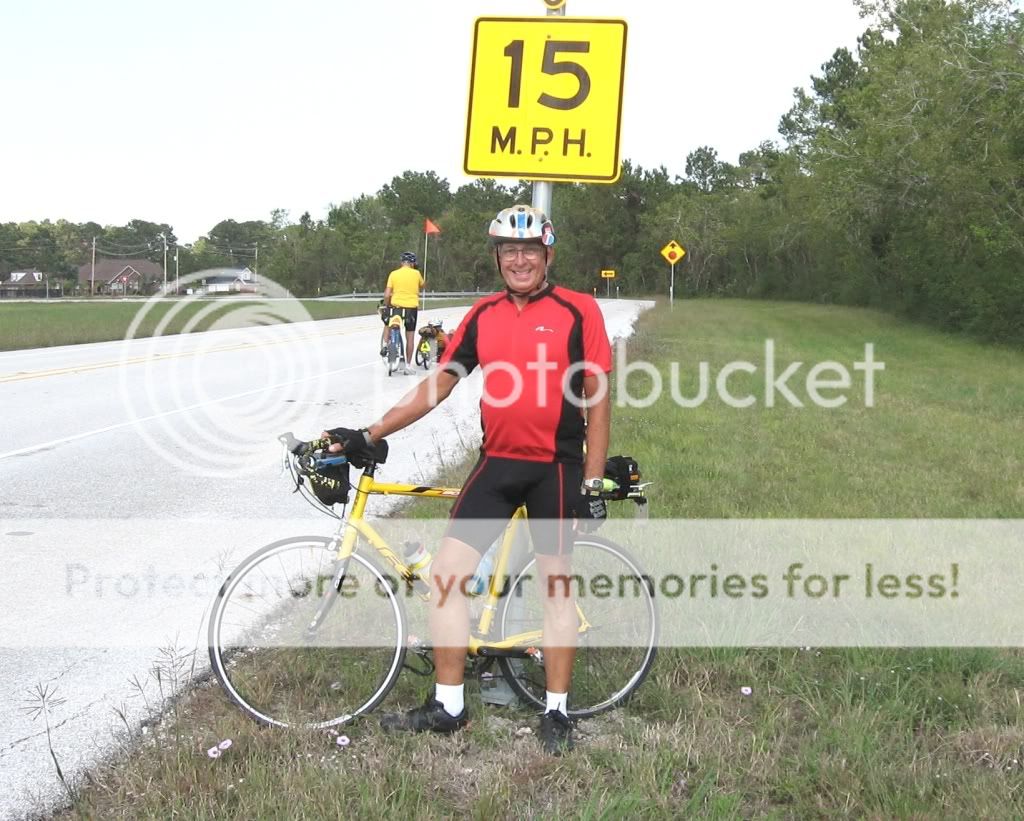
The 9,000 mile mark.

__________________
Fred "The Real Fred"
Fred "The Real Fred"
Last edited by 10 Wheels; 01-06-15 at 11:10 AM.
01-06-15 | 11:18 AM
#3
Full Member
Joined: Aug 2005
Posts: 287
Likes: 0
From: paradise
Bikes: Waterford, Orbea, Giant
This is only my second post I hope I am not asking too many questions. I will be 68 in February - I have a background in weight training and running (5K's). My post-grad work is in strength and conditioning and working with special needs children with motor issues. I find that cycling is a different animal than weights and running in that is takes a lot of time to train. I am training for the Dirty Kanza 100 mile version. My sons are giving me lots of advice but they are twenty years younger than I am. So I am here trying to get an idea of how people nearer my age are training. I live in Louisiana on the border of Arkansas so I ride in both states. The hills around here are 300-400 feet high, so I do get a bit of hill training. Outside I ride from 50-70 miles at a about 13.5 mph pace (Steilacoom RCX). Most of my riding is backroads, some paved some gravel. Right now I am training inside a lot (Trek 820) because I don't like to ride in the cold. I do three types of indoor rides: 1. 2 Hours of simulated hills-I do four 30 minute sets where I do 10 minutes at each level of resistance (5/6/7 on the cassette). I try to keep my heart rate in the 150's for an average. My maximum heart rate is probably 175 or so. 2. Power - I ride for an hour at heaviest resistance. 3. Intervals - I ride an hour doing one minute intervals every five minutes (1/5). I hope my indoor workout are at least keeping me at my current level of fitness. My indoor workouts much more intense than my outside ones. Any input will be appreciated.
Thanks
Thanks
Sooo, I'm 65 and have trained hard for years and still do. The training you should do really depends on your goal. Being fit enough for a century is pretty easy to do so just ride. BUT to do more serious training IMO you really need a power meter. There are tons of resources available as to how to use it. The book "Training and Racing with a Powermeter" is a great place to start and many consider it the bible for power training. Good luck!
01-06-15 | 11:34 AM
#4

Senior Member

Joined: Dec 2004
Posts: 12,560
Likes: 799
From: Middle of da Mitten
Bikes: Trek 7500, RANS V-Rex, Optima Baron, Velokraft NoCom, M-5 Carbon Highracer, Bacchetta Quattro, Catrike Speed
The way cycling is different is that it requires a LOT of time building aerobic capacity. A lot like swimming. It sounds like you're doing that, but how are you doing on your interval work?
01-06-15 | 11:45 AM
#5
Thread Starter
Junior Member
Joined: Dec 2014
Posts: 6
Likes: 0
From: North Louisiana
I do some intervals outside, but right now inside I am doing one minute all out and then back to a normal pace for four minutes. I repeat that pattern for an hour. The next level will be all out one minute with 2 minutes normal pace. That will eventually help increase my pace. At least it worked that way in running.
01-06-15 | 08:51 PM
#6
Senior Member
Joined: May 2008
Posts: 2,712
Likes: 1
Well, I was 71 when I made the transition from Kick Around the Neighborhood to Cyclist. I too was fairly fit and did weights. So, I was a bit older but still in the same ballpark.
I quickly discovered the old adage that you aren't competent until you've done a task 10,000 times is true. So, I abandoned any attempt at the currently in vogue training methods. Instead I did two things. First, I rode a lot. Well, as much as the climate would let me which wasn't that much actually; about a 1000 miles that summer. Second, I resurrected my old running training methods that had been successful. I used Effort of Breathing as a measure of exercise effort. I made sure I included all breathing regimes in every ride. Third, I really, really, paid attention to my diet. That was easy because I was already following excellent rules.
The people who promote specific training regimens mostly confuse what is necessary for racers with what is useful for people who just want to be all they can be. Racers are spending a lot of time working at the margins. This isn't a competition with anyone else but ones self. Folks like me, and I assume you, are working at the mainstream. Important to have the proper mindset.
Good fortune to you.
I quickly discovered the old adage that you aren't competent until you've done a task 10,000 times is true. So, I abandoned any attempt at the currently in vogue training methods. Instead I did two things. First, I rode a lot. Well, as much as the climate would let me which wasn't that much actually; about a 1000 miles that summer. Second, I resurrected my old running training methods that had been successful. I used Effort of Breathing as a measure of exercise effort. I made sure I included all breathing regimes in every ride. Third, I really, really, paid attention to my diet. That was easy because I was already following excellent rules.
The people who promote specific training regimens mostly confuse what is necessary for racers with what is useful for people who just want to be all they can be. Racers are spending a lot of time working at the margins. This isn't a competition with anyone else but ones self. Folks like me, and I assume you, are working at the mainstream. Important to have the proper mindset.
Good fortune to you.
01-06-15 | 09:35 PM
#7


rebmeM roineS
Joined: Jan 2006
Posts: 16,231
Likes: 366
From: Metro Indy, IN
Bikes: Bacchetta Giro A20, RANS V-Rex, RANS Screamer
Had to google Dirty Kanza to find out that it's a gravel road race. In Kansas. One hundred miles on gravel? Racing? None for me, thanks!
Sounds as if you are doing a serious job of preparation.
Sounds as if you are doing a serious job of preparation.
__________________
Bacchetta Giro A20, RANS V-Rex, RANS Screamer
Bacchetta Giro A20, RANS V-Rex, RANS Screamer
01-07-15 | 03:30 AM
#8

Senior Member


Joined: Dec 2004
Posts: 15,400
Likes: 8,319
From: Seattle area
Bikes: Bikes??? Thought this was social media?!?
Your max HR of 175 means you can get that ticker clickin pretty high. What's your resting HR in the mornings?
Sounds like you know what you are doing. I always advise that you allow time for recovery (at 63, my doc has advised no more than 3 challenging rides per week and a couple of short spinners) and listen to your body.
For rough road rides, I sometimes double glove and the choice of riding shorts leans toward slightly more padding.
Did you mention your weight? Less is more (within reason) in distance cycling.
edit: others may disagree, but as you get closer to your cycling event, taper off most other exercises and focus on the bike exclusively.

me at my best during this past summer of hiking & biking & some kayaking.
Since ski patrolling at Snoqualmie Pass is over a month late, I'm up 8 lbs from the pic (a big family Holiday season now gone).
Sounds like you know what you are doing. I always advise that you allow time for recovery (at 63, my doc has advised no more than 3 challenging rides per week and a couple of short spinners) and listen to your body.
For rough road rides, I sometimes double glove and the choice of riding shorts leans toward slightly more padding.
Did you mention your weight? Less is more (within reason) in distance cycling.
edit: others may disagree, but as you get closer to your cycling event, taper off most other exercises and focus on the bike exclusively.
me at my best during this past summer of hiking & biking & some kayaking.
Since ski patrolling at Snoqualmie Pass is over a month late, I'm up 8 lbs from the pic (a big family Holiday season now gone).
__________________
Vintage, modern, e-road. It is a big cycling universe.
Vintage, modern, e-road. It is a big cycling universe.
Last edited by Wildwood; 01-07-15 at 03:44 AM.
 01-07-15 | 06:33 AM
#9
Full Member
Joined: Dec 2014
Posts: 346
Likes: 3
From: Retired to Penang Malaysia originally from UK
Bikes: My 1978 Raleigh from new, 1995 Trek, & constant changing & rebuilding of other bike projects.
Being of the same age group slightly older, the standard calculation for your 100% heart rate is 220 - your age you should be looking at 152 ? so 175 seems very high were you given this figure, or what calculation did you arrive at 175.
I always wear my Polar heart rate monitor, & that governs my road speed & when to change down on hills.
I always wear my Polar heart rate monitor, & that governs my road speed & when to change down on hills.
01-07-15 | 07:03 AM
#10
Don from Austin Texas
Joined: Jul 2009
Posts: 1,211
Likes: 1
From: Austin, Texas
Bikes: Schwinn S25 "department store crap" FS MTB, home-made CF 26" hybrid, CF road bike with straight bar, various wierd frankenbikes
That standard calculation has been established to be worthless.
Don in Austin
Don in Austin
01-07-15 | 07:20 AM
#11

Senior Member

Joined: Jul 2006
Posts: 9,158
Likes: 1,743
From: Lebanon (Liberty Hill), CT
Bikes: Canyon Aeroad, CAAD 12, MASI Gran Criterium S, Colnago World Cup CX, Guru steel & Guru Photon
I am also 68 and after an 8 yr. layoff I got back on the bike at age 59. So, I've been back riding for 9 yrs. now. To begin with it seems to me you are doing some good stuff in your training. When I started riding again I was 195 lbs and at 5'9" that's significantly overweight for a cyclist. You may not face the same issue but it was big for me. What I found is that losing weight and just putting in miles is the starting place for training. Last year I broke my neck and had my spine fused. In the process I got down to 180 lbs and then had my best year of cycling. I was faster and stronger. Once your body is fit I think learning technique and strategies for training......like LSD, intervals and maybe some TTs will be helpful. Seems to me you are on the right track.
01-07-15 | 08:53 AM
#12

Senior Member

Joined: Sep 2005
Posts: 29,462
Likes: 13,480
From: In the foothills of Los Angeles County
I'm 60, a bit overweight at 200#, and a slacker, (ie; eat whatever and whenever I want, don't train in any specific manner, don't use a HR monitor or any electronics), and I can do a century with climbing at any time, as long as I have been riding.
I last did 105 miles with about 4000 feet (not a lot of climbing) at Christmas and I felt pretty good at the end despite only riding on the weekends in the weeks prior.
My point is with enough saddle time you can complete a tough ride without overthinking it. Training will make it easier and/or faster. Just work up to it, 50 miles, then 75 or 80, etc.
I last did 105 miles with about 4000 feet (not a lot of climbing) at Christmas and I felt pretty good at the end despite only riding on the weekends in the weeks prior.
My point is with enough saddle time you can complete a tough ride without overthinking it. Training will make it easier and/or faster. Just work up to it, 50 miles, then 75 or 80, etc.
01-07-15 | 09:38 AM
#13

just another gosling
Joined: Feb 2007
Posts: 20,577
Likes: 2,683
From: Everett, WA
Bikes: CoMo Speedster 2003, Trek 5200, CAAD 9, Fred 2004
I'm 69, been training for a long time. My advice is to do volume, lots of volume, all you can tolerate, at lower levels, zones 1 and 2. Never go hard enough to breathe hard or fast. Gradually ramp up the mileage. When you're doing 200 miles/week, you can drop 1 or 2 days base training and substitute 1 set of 4 X 8' zone 5 intervals (over lactate threshold, as hard as you can tolerate for 8') on those days. Avoid overtraining by monitoring your morning resting and morning standing heart rates. A 6-8 beat increase in resting or a 10 beat increase in standing indicates a need to take it easier for a couple days or until it comes back down a bit.
Since you have a background in weight training, I wouldn't recommend doing any of that. Just ride your bike.
Since you have a background in weight training, I wouldn't recommend doing any of that. Just ride your bike.
01-07-15 | 09:50 AM
#14
Banned.
Joined: May 2010
Posts: 8,651
Likes: 3
From: Uncertain
You don't say how frequent your indoor rides are. Assuming you do a couple of them a week, I'd say you were doing fine as far as intensity is concerned.
I'd suggest that you wrap up warm and overcome your dislike of riding in the cold, though. There really is no substitute for long, steady distance rides for building aerobic capacity.
You make a couple of mentions of HR. If you want to get more specific about your training without investing in a powermeter, it would be worth testing for your lactate threshold heart rate (LTHR). You can do it on the trainer indoors. Warm up for ten minutes, then switch on the HRM and go as hard as you can sustain for 20 minutes. Your average HR for that 20 minutes will be a reasonable approximation of your LTHR. You can then structure your training around time and intensity, using HR zones - Z1 65% to 80% of LTHR, Z2 80%-88%, Z3 89%-93%, Z4 94%-99%, z5 (for supra-threshold intervals) > 100%.
I'm eight years younger than you. I spend maybe 80% of my training time in Z2 - an even higher percentage than that, in the winter. Once a week i'll do an hour at tempo (Z3), and once or at most twice a week I'll do a high-intensity interval session of one sort or another. I like "over-unders" - two minutes in Z4 followed by two in Z5, repeated four times, then five minutes easy spinning. Three blocks of these make a very solid session. Use Z1 for recovery rides.
But that's just me. There's any number of variations on a theme. To get fit enough for a century you really don't need to do anything special beyond spending enough time on the bike. Further is much easier than faster, it's surprisingly easy to cycle big distances when just cruising at your own pace. But if you want to get significantly faster, that's where building in the intensity pays dividends.
Incidentally, pay no attention to the 220 minus age or other formulae for calculating max HR. Your max HR is what it is, and it varies hugely between individuals. At 60, mine is around 180 and my LTHR is 162. Your mileage will most definitely vary.
I'd suggest that you wrap up warm and overcome your dislike of riding in the cold, though. There really is no substitute for long, steady distance rides for building aerobic capacity.
You make a couple of mentions of HR. If you want to get more specific about your training without investing in a powermeter, it would be worth testing for your lactate threshold heart rate (LTHR). You can do it on the trainer indoors. Warm up for ten minutes, then switch on the HRM and go as hard as you can sustain for 20 minutes. Your average HR for that 20 minutes will be a reasonable approximation of your LTHR. You can then structure your training around time and intensity, using HR zones - Z1 65% to 80% of LTHR, Z2 80%-88%, Z3 89%-93%, Z4 94%-99%, z5 (for supra-threshold intervals) > 100%.
I'm eight years younger than you. I spend maybe 80% of my training time in Z2 - an even higher percentage than that, in the winter. Once a week i'll do an hour at tempo (Z3), and once or at most twice a week I'll do a high-intensity interval session of one sort or another. I like "over-unders" - two minutes in Z4 followed by two in Z5, repeated four times, then five minutes easy spinning. Three blocks of these make a very solid session. Use Z1 for recovery rides.
But that's just me. There's any number of variations on a theme. To get fit enough for a century you really don't need to do anything special beyond spending enough time on the bike. Further is much easier than faster, it's surprisingly easy to cycle big distances when just cruising at your own pace. But if you want to get significantly faster, that's where building in the intensity pays dividends.
Incidentally, pay no attention to the 220 minus age or other formulae for calculating max HR. Your max HR is what it is, and it varies hugely between individuals. At 60, mine is around 180 and my LTHR is 162. Your mileage will most definitely vary.
01-07-15 | 12:13 PM
#15
Senior Member
Joined: May 2008
Posts: 2,712
Likes: 1
You might want to give your age more than a casual thought. By your pseudonym I infer you actually know quite a bit about training in the competitive athletic sense. From my experience around your age or a little later it is common to fall down another step in athletic performance. So, "training" isn't so much attempting to gain performance seconds as it is keeping what you have and maybe improving satisfaction.
This was brought home to me yesterday when I was doing a stint on the elliptical trainer and, afterward, chatting with some 50 year olds. One has cancer and was supposed to be dead several years ago. By virtue of his attitude and workouts he has slowed his demise. Another has decided that avoiding big injury is The Goal. As has been posted on BF several times, being forced to take time off by over training or by injury brings with it a decrease in performance that cannot be overcome.
So, ride a lot. As many miles as you can comfortably fit in on a daily basis. Don't worry about heart rate. As long as it is beating and you are conscious the heart is good. At all costs avoid the common over training accidents and injuries. At 58 you could recover 95% plus. Maybe even 100% if you are exceptional. At 68 or older you are lucky if you recover 85-90%, no matter how hard you work. In the end no one can tell you exactly what to do other than try to avoid injury or accident and keep at it. At our ages there just isn't a lot of clinical information so each of us is an experiment.
A bit of humor. I was finishing up a ride a couple months ago when a female stopped me and asked to chat. She told me she saw my white hair and assumed I was OLD. I told her I wasn't as old as I hoped to be but that was out of my hands. She said I was a strong rider and asked if I could swim. I answered "yes". "Can you run?" I told her since my spine trauma I couldn't do it very well but was working on it. Then she sprung it on me. "I'm an X-Games coach and you are such a strong biker you should consider competing." Like you will do when you read this I laughed. Still......wonder whether that was a scam or a voice suggesting I change my ways........
This was brought home to me yesterday when I was doing a stint on the elliptical trainer and, afterward, chatting with some 50 year olds. One has cancer and was supposed to be dead several years ago. By virtue of his attitude and workouts he has slowed his demise. Another has decided that avoiding big injury is The Goal. As has been posted on BF several times, being forced to take time off by over training or by injury brings with it a decrease in performance that cannot be overcome.
So, ride a lot. As many miles as you can comfortably fit in on a daily basis. Don't worry about heart rate. As long as it is beating and you are conscious the heart is good. At all costs avoid the common over training accidents and injuries. At 58 you could recover 95% plus. Maybe even 100% if you are exceptional. At 68 or older you are lucky if you recover 85-90%, no matter how hard you work. In the end no one can tell you exactly what to do other than try to avoid injury or accident and keep at it. At our ages there just isn't a lot of clinical information so each of us is an experiment.
A bit of humor. I was finishing up a ride a couple months ago when a female stopped me and asked to chat. She told me she saw my white hair and assumed I was OLD. I told her I wasn't as old as I hoped to be but that was out of my hands. She said I was a strong rider and asked if I could swim. I answered "yes". "Can you run?" I told her since my spine trauma I couldn't do it very well but was working on it. Then she sprung it on me. "I'm an X-Games coach and you are such a strong biker you should consider competing." Like you will do when you read this I laughed. Still......wonder whether that was a scam or a voice suggesting I change my ways........
01-07-15 | 02:04 PM
#16
Banned
Joined: Jun 2007
Posts: 12,585
Likes: 6,538
From: TN
Your training plan seems sufficient so long as you are getting recovery time. Be sure to do regular long rides, regardless of the pace, to accustom your butt, hands, neck etc to being on the bike for hours. Sounds like a fun event.
01-07-15 | 02:52 PM
#17
Senior Member
Joined: Dec 2004
Posts: 12,560
Likes: 799
From: Middle of da Mitten
Bikes: Trek 7500, RANS V-Rex, Optima Baron, Velokraft NoCom, M-5 Carbon Highracer, Bacchetta Quattro, Catrike Speed
Yeah, it sounds like retiredcoach is already going at it a lot harder than I would. The longer workouts should be at a more reasonable pace, and your short ones are already pretty intense.
01-07-15 | 03:06 PM
#18

Administrator
Joined: Feb 2005
Posts: 13,655
Likes: 2,703
From: Delaware shore
Bikes: Cervelo C5, Guru Photon, Waterford, Specialized CX
I do some intervals outside, but right now inside I am doing one minute all out and then back to a normal pace for four minutes. I repeat that pattern for an hour. The next level will be all out one minute with 2 minutes normal pace. That will eventually help increase my pace. At least it worked that way in running.
01-07-15 | 05:17 PM
#19
just another gosling
Joined: Feb 2007
Posts: 20,577
Likes: 2,683
From: Everett, WA
Bikes: CoMo Speedster 2003, Trek 5200, CAAD 9, Fred 2004
Yeah, it's not running, unless you're talking ultras. You'll be on course for 8 hours or so, pushing 40mm tires through gravel. What's needed is not speed, but the endurance to hold a moderate pace for a long time under difficult conditions. If you have the endurance to hold a steady pace for that long, speed takes care of itself.
01-07-15 | 05:34 PM
#20

Senior Member
Joined: Dec 2014
Posts: 1,066
Likes: 1
From: still above ground
Bikes: 2016 Specialized crosstrail comp disc
I don't consider my bike riding "training" per se. I enjoy it, and that is why it is my primary fitness activity. If I get too serious about it, my history tells me that I'll probably over do it to the point of injury. I'm 65, just took a stress test and passed with flying colors. My blood pressure is typically below 120/80. My weight is good. I ain't broke, so I ain't gonna fix me.
01-07-15 | 10:09 PM
#21

I'm 69, been training for a long time. My advice is to do volume, lots of volume, all you can tolerate, at lower levels, zones 1 and 2. Never go hard enough to breathe hard or fast. Gradually ramp up the mileage. When you're doing 200 miles/week, you can drop 1 or 2 days base training and substitute 1 set of 4 X 8' zone 5 intervals (over lactate threshold, as hard as you can tolerate for 8') on those days. Avoid overtraining by monitoring your morning resting and morning standing heart rates. A 6-8 beat increase in resting or a 10 beat increase in standing indicates a need to take it easier for a couple days or until it comes back down a bit.
Since you have a background in weight training, I wouldn't recommend doing any of that. Just ride your bike.
Since you have a background in weight training, I wouldn't recommend doing any of that. Just ride your bike.
But this year, I'm going to try "Polarized Training". Their motto is "your hard rides aren't hard enough and your easy rides aren't easy enough"! It seems that the long, easy rides help adapt to burning fat more efficiently, and allow for full recovery after the intense sessions.
Here's an interesting BF thread on Polarized Training: Zone 2 lecture, with lots of different viewpoints in the thread. There's a 30 minute lecture linked from the first post, but I had trouble with the video. Here's the same video on vimeo. It's pretty interesting.
I'll do lots of miles kept at an easier pace, maybe 125-135 heart rate, and some extra hard intervals (by doing a fast group ride) once a week or so. I normally just ride 3 days a week, but I want to add more days this year. I'm aiming for some longer event rides this year, and want to focus on endurance. I tried this easier pacing on a 3 hour ride a few weeks ago, and it was hard to stay that slow! I wanted to keep bumping the speed.
Last edited by rm -rf; 01-07-15 at 10:31 PM.
01-07-15 | 10:30 PM
#22
Full Member
Joined: Dec 2014
Posts: 346
Likes: 3
From: Retired to Penang Malaysia originally from UK
Bikes: My 1978 Raleigh from new, 1995 Trek, & constant changing & rebuilding of other bike projects.
That standard calculation has been established to be worthless.
Don in Austin
Ok accepted but what calculations are there without resorting to complex gym equipment ? I'm a bit flat footed so the standard running stress test is not suitable, put me in a saddle & I'll pedal away all day allowing for the climate over here.
Don in Austin
Ok accepted but what calculations are there without resorting to complex gym equipment ? I'm a bit flat footed so the standard running stress test is not suitable, put me in a saddle & I'll pedal away all day allowing for the climate over here.
01-07-15 | 11:39 PM
#23
just another gosling
Joined: Feb 2007
Posts: 20,577
Likes: 2,683
From: Everett, WA
Bikes: CoMo Speedster 2003, Trek 5200, CAAD 9, Fred 2004
For training rides, I used to try to stay right at my multi-hour effort maximum. For me, that's a heart rate around 145. And I do group rides that are fast for me, that push me much harder than I want to do solo.
But this year, I'm going to try "Polarized Training". Their motto is "your hard rides aren't hard enough and your easy rides aren't easy enough"! It seems that the long, easy rides help adapt to burning fat more efficiently, and allow for full recovery after the intense sessions.
Here's an interesting BF thread on Polarized Training: Zone 2 lecture, with lots of different viewpoints in the thread. There's a 30 minute lecture linked from the first post, but I had trouble with the video. Here's the same video on vimeo. It's pretty interesting.
I'll do lots of miles kept at an easier pace, maybe 125-135 heart rate, and some extra hard intervals (by doing a fast group ride) once a week or so. I normally just ride 3 days a week, but I want to add more days this year. I'm aiming for some longer event rides this year, and want to focus on endurance. I tried this easier pacing on a 3 hour ride a few weeks ago, and it was hard to stay that slow! I wanted to keep bumping the speed.
But this year, I'm going to try "Polarized Training". Their motto is "your hard rides aren't hard enough and your easy rides aren't easy enough"! It seems that the long, easy rides help adapt to burning fat more efficiently, and allow for full recovery after the intense sessions.
Here's an interesting BF thread on Polarized Training: Zone 2 lecture, with lots of different viewpoints in the thread. There's a 30 minute lecture linked from the first post, but I had trouble with the video. Here's the same video on vimeo. It's pretty interesting.
I'll do lots of miles kept at an easier pace, maybe 125-135 heart rate, and some extra hard intervals (by doing a fast group ride) once a week or so. I normally just ride 3 days a week, but I want to add more days this year. I'm aiming for some longer event rides this year, and want to focus on endurance. I tried this easier pacing on a 3 hour ride a few weeks ago, and it was hard to stay that slow! I wanted to keep bumping the speed.
01-07-15 | 11:41 PM
#24
just another gosling
Joined: Feb 2007
Posts: 20,577
Likes: 2,683
From: Everett, WA
Bikes: CoMo Speedster 2003, Trek 5200, CAAD 9, Fred 2004
That standard calculation has been established to be worthless.
Don in Austin
Ok accepted but what calculations are there without resorting to complex gym equipment ? I'm a bit flat footed so the standard running stress test is not suitable, put me in a saddle & I'll pedal away all day allowing for the climate over here.
Don in Austin
Ok accepted but what calculations are there without resorting to complex gym equipment ? I'm a bit flat footed so the standard running stress test is not suitable, put me in a saddle & I'll pedal away all day allowing for the climate over here.
01-08-15 | 06:41 AM
#25
Senior Member
Joined: Jan 2008
Posts: 12,940
Likes: 363
For some idea on doing a determination of the heart rate values and FTP you can use the methods that Joe Friel puts forward in his "Cyclist Training Bible" , here is a link if you are interested:Cyclist Training Bible . Even if you aren't looking for the detained and committed level, that the FTP and max HR, can entail, I recommend this book for anyone wanting to train more efficiently and/or harder than just taking rides regularly. I've gotten some good ideas that I added in to my rides and use them in planning out a week's rides from the book.
If you aren't looking to train, or you just like getting out and riding, more power to you, and I'll support your riding enjoyment, as well. To each their own, the OP has raised some good points and asked some good questions so he can complete a very difficult event, Dirty Kanza, in either distance, is a bucket list event for me. Best of luck to Retiredcoach12 on completing the DK 100. Please keep us updated on your training and when you finish it, a ride report for us to vicariously live through
Bill
If you aren't looking to train, or you just like getting out and riding, more power to you, and I'll support your riding enjoyment, as well. To each their own, the OP has raised some good points and asked some good questions so he can complete a very difficult event, Dirty Kanza, in either distance, is a bucket list event for me. Best of luck to Retiredcoach12 on completing the DK 100. Please keep us updated on your training and when you finish it, a ride report for us to vicariously live through
Bill

Thread
Thread Starter
Forum
Replies
Last Post
SpongeDad
"The 33"-Road Bike Racing
20
12-30-10 02:44 AM
