


How much play in MKS quick release pedals?
 07-25-25 | 05:17 AM
#1
Thread Starter
Senior Member

Joined: Jan 2017
Posts: 1,251
Likes: 162
How much play in MKS quick release pedals?
I noticed since 7 years ago when I first installed my MKS EZY superior urban platform pedals that the interface between the spindle and the quick release has some play. The cartridge bearings between the spindle and pedal also had a little bit of play but now there is slightly more play in the bearings after all this time. The combination between the two is about 3mm of radial movement measured at the outer tip of the pedal, and maybe 0.5mm laterally.
I'm wondering if anyone else has noticed the play, and whether it's possible to replace the cartridge bearings in the pedals. The website mentions that the user should not remove or replace the cartridge bearings or pack any grease.
I'm guessing the cartridge bearings are a bit dry now. The pedals spin very freely and loosely. Doesn't seem to be any drag at all from any grease.
How much energy do you suppose is lost due to the play during tours?
There is a slight momentary delay during pedaling for the foot to move up and down between the upper and lower positions in the wiggle of the play around each revolution.
I'm wondering if anyone else has noticed the play, and whether it's possible to replace the cartridge bearings in the pedals. The website mentions that the user should not remove or replace the cartridge bearings or pack any grease.
I'm guessing the cartridge bearings are a bit dry now. The pedals spin very freely and loosely. Doesn't seem to be any drag at all from any grease.
How much energy do you suppose is lost due to the play during tours?
There is a slight momentary delay during pedaling for the foot to move up and down between the upper and lower positions in the wiggle of the play around each revolution.
 07-26-25 | 12:56 AM
#2

Junior Member
Joined: Dec 2017
Posts: 107
Likes: 30
I've used removable pedals including MKS and others on all my folding bikes for the last 15 years or more. I think there will be zero energy loss due to the play in the bearings/spindlehousing. The weight of your leg alone is enough to keep the pedal in the " sagged down" position. It doesn't require any muscular input from the rider to keep it in that position. In addition, the pedal remains permanently in the sag down position whilst pedalling. You may imagine that the pedal waggles up and down as you pedal, and if it did there might be some loss, but that isn't the case.
Edit: The above assumes your foot is not clipped or strapped to the pedal. If it was, and if you also pull up on the pedal on the upstroke of the crank, then the pedal spindle WILL waggle up and down during rotation and that may generate a small energy loss.
Edit: The above assumes your foot is not clipped or strapped to the pedal. If it was, and if you also pull up on the pedal on the upstroke of the crank, then the pedal spindle WILL waggle up and down during rotation and that may generate a small energy loss.
Last edited by Jonesandrew; 07-26-25 at 01:02 AM. Reason: Afterthought
07-26-25 | 08:18 AM
#4
Senior Member


Joined: Aug 2010
Posts: 12,753
Likes: 2,112
From: Madison, WI
Bikes: 1961 Ideor, 1966 Perfekt 3 Speed AB Hub, 1994 Bridgestone MB-6, 2006 Airnimal Joey, 2009 Thorn Sherpa, 2013 Thorn Nomad MkII, 2015 VO Pass Hunter, 2017 Lynskey Backroad, 2017 Raleigh Gran Prix, 1980s Bianchi Mixte on a trainer. Others are now gone.
I do not have enough distance on my EZY pedals to cause any play. If you notice no friction when turning the pedals by hand, I doubt that you would have any energy loss. If there was any particulate matter in the bearings that could cause it to feel like there is any grit in the pedal bearings, then there could be minor energy loss. I probably have more energy loss after I add grease to my Shimano cup and cone (non-cartridge) bearing pedals, they no longer spin freely by hand after adding grease.
I use toe clips on my EZY pedals, but I do not lift my foot enough to pull upwards on my pedals, I simply use the toe clips to hold my foot on the pedals so that the feet do not slip off when I hit bumps or a rough road. I am surprised that you lift your feet enough while pedaling to notice the play.
I use toe clips on my EZY pedals, but I do not lift my foot enough to pull upwards on my pedals, I simply use the toe clips to hold my foot on the pedals so that the feet do not slip off when I hit bumps or a rough road. I am surprised that you lift your feet enough while pedaling to notice the play.
07-31-25 | 11:11 AM
#6
Newbie

Joined: Jan 2015
Posts: 61
Likes: 35
I noticed excess slop in my MKS ezy superior pedals after about 4 years and about 25K miles. The bearings in the pedals themselves were fine and without play, but the quick release mechanism was worn. I could feel it with each pedal stroke. It was a subtle klunk, but was becoming more noticeable over time. I ride without cleats or toe clips.
I was able to buy some replacement pedal adaptors (the part that screws into the crankarm) for $30 on amazon. They came directly from Japan. Looking at the pedal shaft, I could see some wear in the indentation where the ball bearings of the pedal adaptors lock the pedal spindle (see picture). With the new pedal adaptors (and with the old pedal spindle) I found the play was much reduced, almost to like new. So I’m good for another 20K or so.
Next time I buy a set of these pedals, I will get a spare set of pedal adaptors with them.
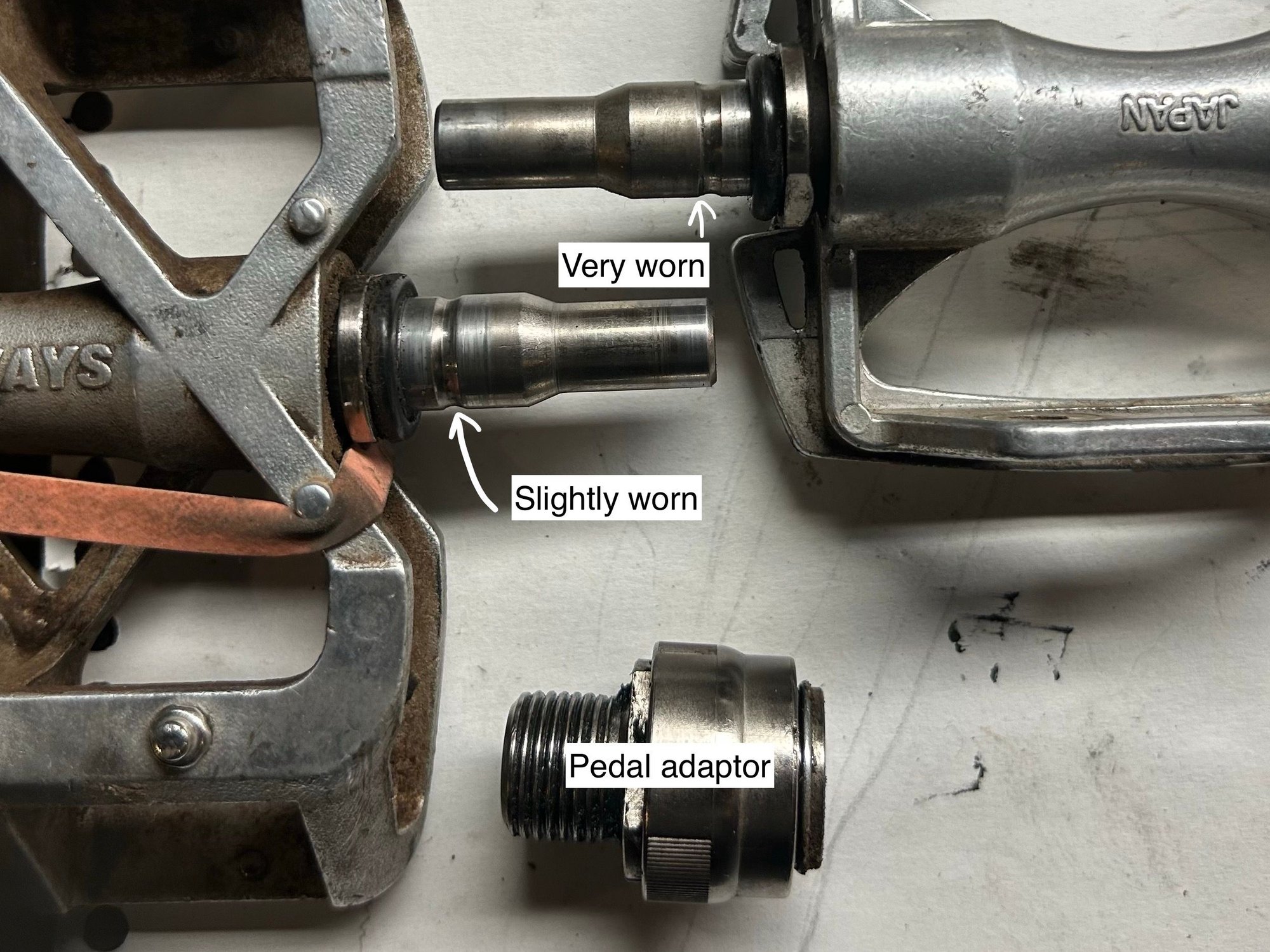
I was able to buy some replacement pedal adaptors (the part that screws into the crankarm) for $30 on amazon. They came directly from Japan. Looking at the pedal shaft, I could see some wear in the indentation where the ball bearings of the pedal adaptors lock the pedal spindle (see picture). With the new pedal adaptors (and with the old pedal spindle) I found the play was much reduced, almost to like new. So I’m good for another 20K or so.
Next time I buy a set of these pedals, I will get a spare set of pedal adaptors with them.
07-31-25 | 05:55 PM
#7
Thread Starter
Senior Member
Joined: Jan 2017
Posts: 1,251
Likes: 162
I do have minor corrosion on the bearing race of the pedal spindle but I thought it was just from rain and the steel from the bearings in contact with the coating on the spindle.
I'm wondering how you've reduced the play simply by using new quick release adaptors. The outer shell of the adapter pushes the ball bearings into the race on the spindle. The only way for it to develop play is if the outer shell develops an indentation from the balls or it deforms. Or the hole the ball sits on elongates so that the 4 balls aren't position at equal distance from each other.
If you disassemble your old adapter you could look inside the outer shell if you are curious.
I'm wondering how you've reduced the play simply by using new quick release adaptors. The outer shell of the adapter pushes the ball bearings into the race on the spindle. The only way for it to develop play is if the outer shell develops an indentation from the balls or it deforms. Or the hole the ball sits on elongates so that the 4 balls aren't position at equal distance from each other.
If you disassemble your old adapter you could look inside the outer shell if you are curious.
07-31-25 | 08:20 PM
#8

Senior Member

Joined: Sep 2004
Posts: 3,320
Likes: 1,060
From: Chicago area
Bikes: Airborne "Carpe Diem", Motobecane "Mirage", Trek 6000, Strida 2, Dahon "Helios XL", Dahon "Mu XL", Tern "Verge S11i"
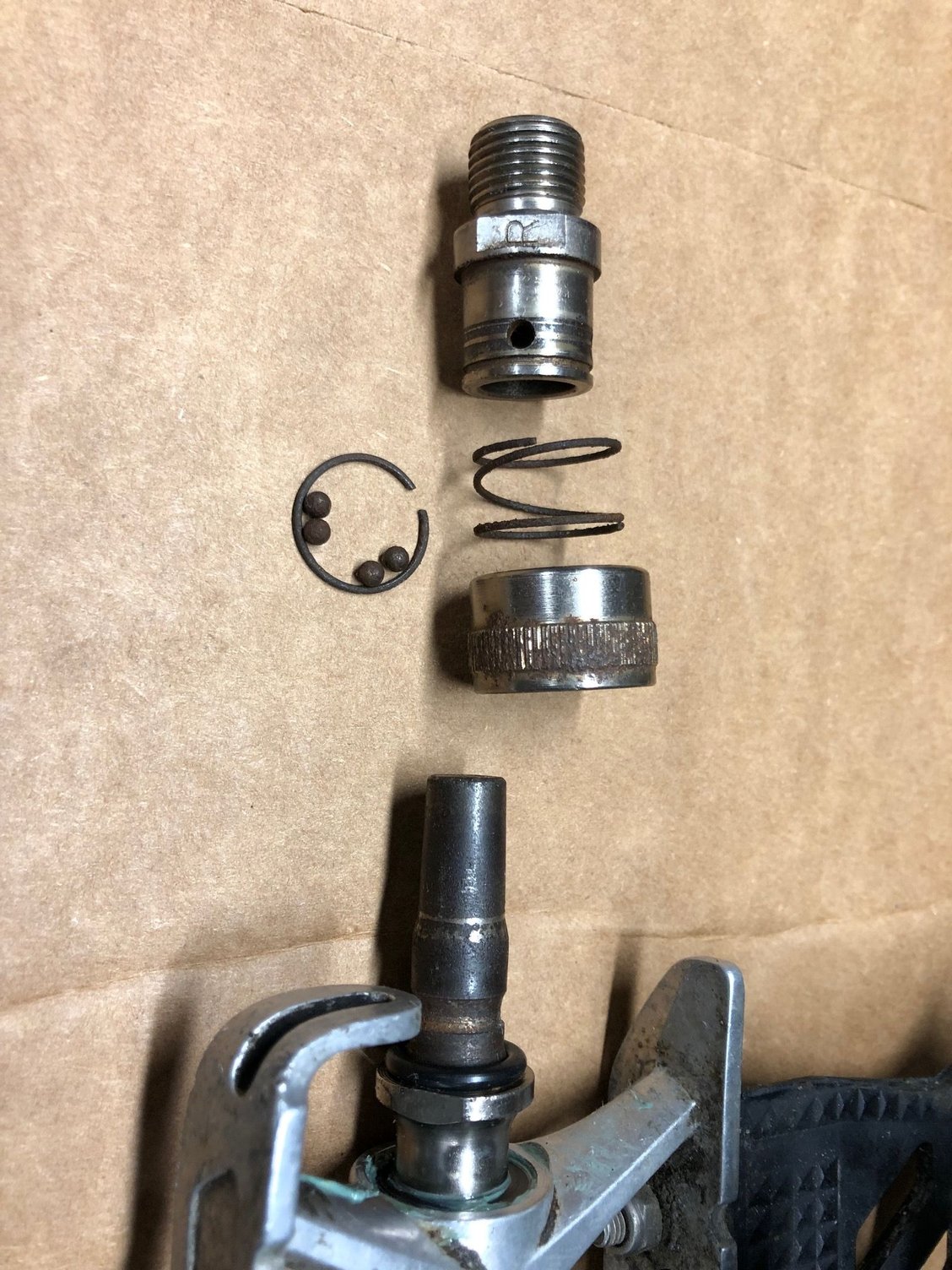
Here's a coupler disassembled. This is easy to do by removing a circlip (seen here enclosing the 4 retaining ball bearings). If the balls get too rusty, they can be replaced.
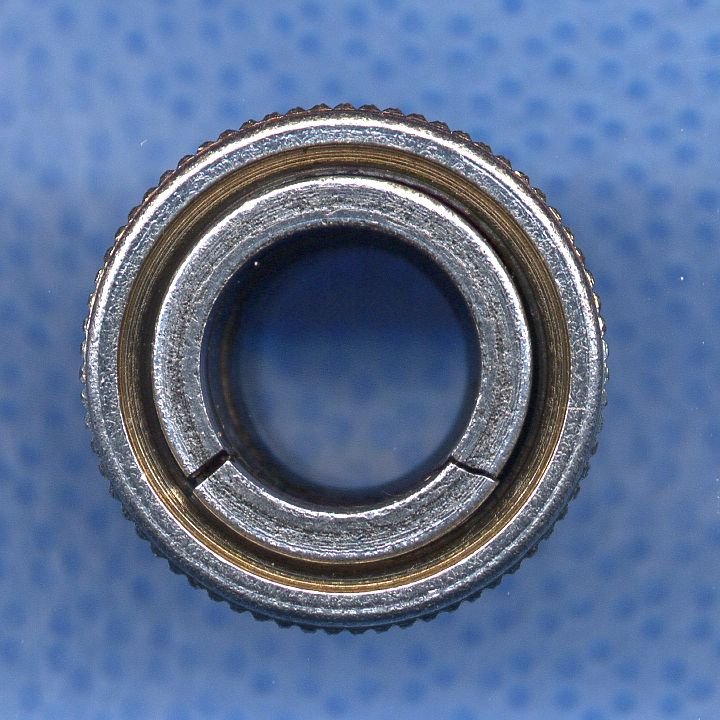
This coupler developed a couple cracks. There was a *lot* of radial play. There's no fix for this.
07-31-25 | 08:30 PM
#9
Newbie
Joined: Jan 2015
Posts: 61
Likes: 35
If you look carefully at the very worn/slightly worn spots the arrows point to you will notice increased wear on the inner part of the channel, towards the crank arm. That could contribute to some play.
I think most of the play is with the spindle/adaptor interface. For me, the new adaptors reduced the play dramatically.
While this pedal does require more maintenance, keeping them clean and lubed will make them last a long time. I use a chain lube on the pedal spindle and in the adaptor mechanism. Whenever I lube the chain, I clean and lube the pedal connection parts as well.
I think most of the play is with the spindle/adaptor interface. For me, the new adaptors reduced the play dramatically.
While this pedal does require more maintenance, keeping them clean and lubed will make them last a long time. I use a chain lube on the pedal spindle and in the adaptor mechanism. Whenever I lube the chain, I clean and lube the pedal connection parts as well.
08-01-25 | 04:53 AM
#10
Thread Starter
Senior Member
Joined: Jan 2017
Posts: 1,251
Likes: 162
I wonder if I put some 0.05mm shims or aluminum tape either around the spindle or on the inside of the coupler, if that would work to reduce play or if it will just get stuck or shred.
The thing I don't like about lubricating the spindle is that I frequently remove them and whatever I use to temporarily store them get greasy.
I did grease the coupler the last time I overhauled it.
Are the parts not stainless? I thought only the balls, spring and retaining ring were not but I could be wrong.
The thing I don't like about lubricating the spindle is that I frequently remove them and whatever I use to temporarily store them get greasy.
I did grease the coupler the last time I overhauled it.
Are the parts not stainless? I thought only the balls, spring and retaining ring were not but I could be wrong.
Last edited by tomtomtom123; 08-01-25 at 05:40 AM.
