The jig is up

 05-04-16 | 09:38 AM
#3
Banned
Joined: Jun 2010
Posts: 43,586
Likes: 1,380
From: NW,Oregon Coast
Bikes: 8
Not to quash the above jig sales opportunity ..
Years ago I spent time with a well repected British Frame Builder .. No Jig . sharp files and a bench vise was most of the Shop,
Other than the brazing torch.. in the basement of an Elizabethan house.
in '75 I built a frame,(years earlier) I bought the Tube set Cut and mitered, (from a small local Eugene Builder)
and built a lugged frame my self without jigs .. torches, shop space borrowed & at Community college~
Years ago I spent time with a well repected British Frame Builder .. No Jig . sharp files and a bench vise was most of the Shop,
Other than the brazing torch.. in the basement of an Elizabethan house.
in '75 I built a frame,(years earlier) I bought the Tube set Cut and mitered, (from a small local Eugene Builder)
and built a lugged frame my self without jigs .. torches, shop space borrowed & at Community college~
05-04-16 | 09:58 AM
#4

Senior Member
Joined: Sep 2009
Posts: 689
Likes: 1
From: new york
Bikes: cuevas
Not to quash the above jig sales opportunity ..
Years ago I spent time with a well repected British Frame Builder .. No Jig . sharp files and a bench vise was most of the Shop,
Other than the brazing torch.. in the basement of an Elizabethan house.
in '75 I built a frame,(years earlier) I bought the Tube set Cut and mitered, (from a small local Eugene Builder)
and built a lugged frame my self without jigs .. torches, shop space borrowed & at Community college~
Years ago I spent time with a well repected British Frame Builder .. No Jig . sharp files and a bench vise was most of the Shop,
Other than the brazing torch.. in the basement of an Elizabethan house.
in '75 I built a frame,(years earlier) I bought the Tube set Cut and mitered, (from a small local Eugene Builder)
and built a lugged frame my self without jigs .. torches, shop space borrowed & at Community college~
05-04-16 | 10:06 AM
#5
Banned
Joined: Jun 2010
Posts: 43,586
Likes: 1,380
From: NW,Oregon Coast
Bikes: 8
I forget.. it was 40 years ago.. I Think the blades were bent in the carton. or I just asked another builder in town to do it for me .
then I went back & put the cantilever bosses on it.
(only un conventional thing was Canti Bosses were put on the front of the seat stay, & a 60 top tube on a 58 seat tube)
Ship me a digital camera? or negative/slide scanner? pictures on film is all I have.
then I went back & put the cantilever bosses on it.
(only un conventional thing was Canti Bosses were put on the front of the seat stay, & a 60 top tube on a 58 seat tube)
Ship me a digital camera? or negative/slide scanner? pictures on film is all I have.
Last edited by fietsbob; 05-04-16 at 10:12 AM.
05-04-16 | 10:32 AM
#6

Senior Member


Joined: Feb 2012
Posts: 19,360
Likes: 5,492
From: Rochester, NY
Bikes: Stewart S&S coupled sport tourer, Stewart Sunday light, Stewart Commuting, Stewart Touring, Co Motion Tandem, Stewart 3-Spd, Stewart Track, Fuji Finest, Mongoose Tomac ATB, GT Bravado ATB, JCP Folder, Stewart 650B ATB
The builder still need to know how to control heat distortions, not overheat the joint or braze a cold one, how to set up tube/joint fit up properly, how to design a frame to fit the rider and their needs, how to develop a business model which creates good products, happy customers and a profit.
Jigs are only one small part of this and totally un needed for some builders.
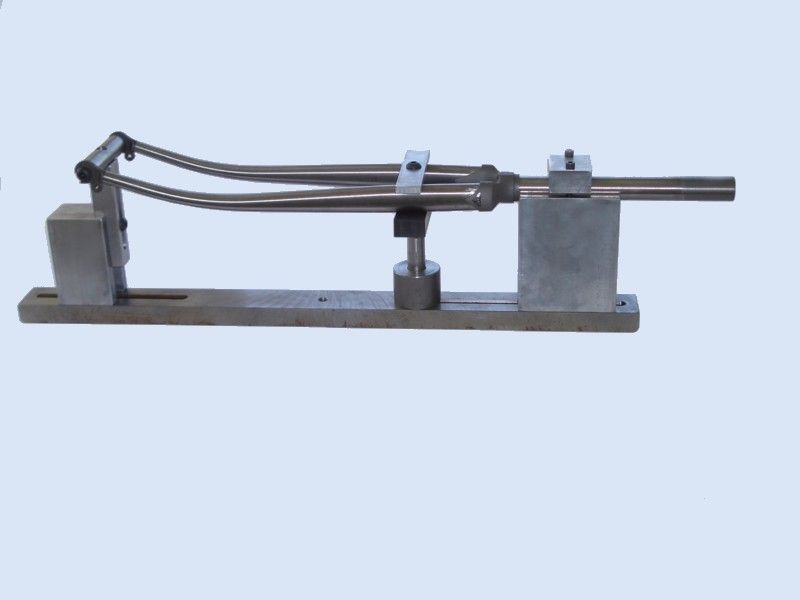
Here's a shot of my early blade raking set up. All self made. Andy
05-04-16 | 12:26 PM
#7
Randomhead
Joined: Aug 2008
Posts: 25,930
Likes: 4,825
From: Happy Valley, Pennsylvania
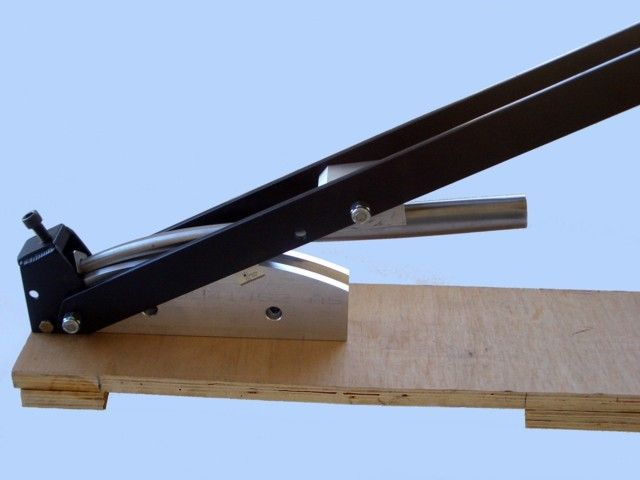
one of the best looking forks I have made was bent on a piece of 2x4 bandsawn to the correct radius. Didn't work with really thin blades though, it needs a v-groove for that. Going without a fixture for the frame is pretty tricky. Maybe if you had a flat surface and pinned the joints it would work better. My tandem was made without a fixture for obvious reasons, although I brazed the BB shells to the seat tube with a simple fixture. The rest of it was done by laborious measuring.
05-04-16 | 01:06 PM
#8
framebuilder

Joined: Dec 2009
Posts: 1,790
Likes: 2,712
From: Niles, Michigan
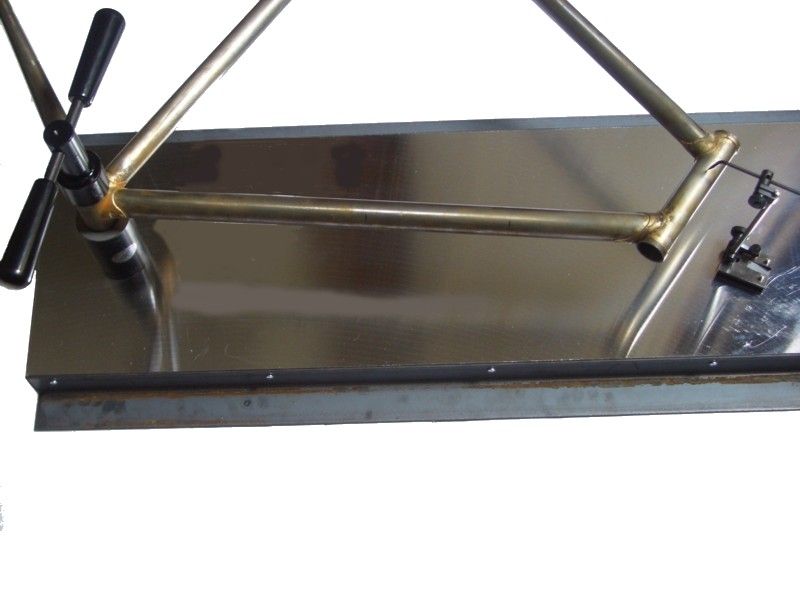
Jig philosophy and design is an interesting subject for endless discussion. What is preferred will depend on the building methods used and probably how one is taught. I’ve thought a lot of fixture design and manufacturer and have some pretty strong opinions that are based on my history and the way I put a frame together. Of course there are other good ways to do it too as well as poor ways. Not all methods are equally good. I do have a horse in this race as I have fixtures I’ve designed laser cut and etched out of stainless steel plate for the convenience of those that might want to do things the same way. My philosophy is that the fixture holds the design and a flat table provides the alignment accuracy. And my fixture is like a full scale drawing that allows me to create the design on the fixture itself. It can hold the rider’s seat/seatpost and stem in their preferred position and then the pieces that represent the tubes can be slide around to match those components. And adjusted for its purpose.
Don’t include me as a fan of jigless building – especially for beginners. That doesn’t mean it can’t be done well if one has patience, it just isn’t convenient. Somehow the tubes have to be held in a position that match's the design. And they also have to end up in alignment.
My fixture design has it origins in the UK. F.W. Evans in London credits himself with the idea in the late 30’s. I saw variations of them when I was visiting different builders when I was apprenticing in England in the 70’s. In fact there was one at Ellis Briggs where I learned but it had been replaced with cast iron iron table model. I’ve added a lot of bells and whistles to my version for ease of set up but a cheaper basic version is available too. I can set/read lengths and angles and rake and drop directly on the fixture. And with the accessories know the straddle height of the top tube and how much set back the saddle has and make sure the top tube is level or slopped to a specific degree.
At the present time I’m having them made in Ukraine where things are cheaper. They are designed so it can come apart to fit in a round 3.5” tube less than 36” long. Just for reference I’ve got other very expensive professional fixtures in my shop. I just like mine better for the way I do things. This picture is of the most basic version.
Don’t include me as a fan of jigless building – especially for beginners. That doesn’t mean it can’t be done well if one has patience, it just isn’t convenient. Somehow the tubes have to be held in a position that match's the design. And they also have to end up in alignment.
My fixture design has it origins in the UK. F.W. Evans in London credits himself with the idea in the late 30’s. I saw variations of them when I was visiting different builders when I was apprenticing in England in the 70’s. In fact there was one at Ellis Briggs where I learned but it had been replaced with cast iron iron table model. I’ve added a lot of bells and whistles to my version for ease of set up but a cheaper basic version is available too. I can set/read lengths and angles and rake and drop directly on the fixture. And with the accessories know the straddle height of the top tube and how much set back the saddle has and make sure the top tube is level or slopped to a specific degree.
At the present time I’m having them made in Ukraine where things are cheaper. They are designed so it can come apart to fit in a round 3.5” tube less than 36” long. Just for reference I’ve got other very expensive professional fixtures in my shop. I just like mine better for the way I do things. This picture is of the most basic version.
05-04-16 | 03:59 PM
#9
Senior Member
Joined: Jan 2013
Posts: 2,390
Likes: 958
From: South Jersey
My apologies, if that came across as a sales pitch. Before I owned any machine tools, another builder helped me out by machining some parts for my first frame jig. I now own some machine tools and have taught myself how to use them, so I like to make things and post pictures of them on various social media platforms. Occasionally people will contact me and ask me to make something for them. I don't do it as a business, but I enjoy paying it forward to help someone else get started in framebuilding.
05-04-16 | 08:26 PM
#10
Senior Member
Joined: Sep 2009
Posts: 689
Likes: 1
From: new york
Bikes: cuevas
Not to quash the above jig sales opportunity ..
Years ago I spent time with a well repected British Frame Builder .. No Jig . sharp files and a bench vise was most of the Shop,
Other than the brazing torch.. in the basement of an Elizabethan house.
in '75 I built a frame,(years earlier) I bought the Tube set Cut and mitered, (from a small local Eugene Builder)
and built a lugged frame my self without jigs .. torches, shop space borrowed & at Community college~
Years ago I spent time with a well repected British Frame Builder .. No Jig . sharp files and a bench vise was most of the Shop,
Other than the brazing torch.. in the basement of an Elizabethan house.
in '75 I built a frame,(years earlier) I bought the Tube set Cut and mitered, (from a small local Eugene Builder)
and built a lugged frame my self without jigs .. torches, shop space borrowed & at Community college~
05-05-16 | 08:24 AM
#12


Decrepit Member
Joined: Aug 2005
Posts: 10,488
Likes: 92
From: Santa Rosa, California
Bikes: Waterford 953 RS-22, several Paramounts
I use Bringheli frame and fork jigs, and Hammill Engineering fork blade bender.