


Dynafile!
 10-28-12 | 06:25 AM
#1

Thread Starter
Senior Member
Joined: Apr 2010
Posts: 3,081
Likes: 10
From: vermont
Bikes: Many
Dynafile!
I just got a new Dynafile hand held belt sander (not the smallest one) . It is something I have wanted or for a long time and finally had the $500+ needed to get in the game. It came with some additional arms and belts as well as a weighty accessory catalog.
I have no idea what I am doing. I have used it a lot in place of a emery belts and die grinder on non-bike stuff but surprisingly little on bike stuff.
I have no idea what I am doing. I have used it a lot in place of a emery belts and die grinder on non-bike stuff but surprisingly little on bike stuff.
 10-28-12 | 08:43 AM
#2

Senior Member

Joined: Mar 2012
Posts: 1,104
Likes: 48
From: santa barbara CA
I'm sure you have more of an "idea what you're doing" that almost everyone on the entire BF. Isn't the dynafile primarily used to clean up fillet brazing when used for frame building. From what I've read/heard the biggest issue is control of it's fast/aggressive material removal, right?
10-28-12 | 09:27 AM
#3
Framebuilder
Joined: Dec 2007
Posts: 570
Likes: 0
I know what you mean Frank! You get a Dynafile to use on one thing and you end up using it for all kinds of stuff- I don't even use mine on fillets.
Its a great tool.
Its a great tool.
10-28-12 | 10:58 AM
#4
Randomhead
Joined: Aug 2008
Posts: 25,930
Likes: 4,825
From: Happy Valley, Pennsylvania
It's really an awesome tool. However, you have to be careful. I think there were more vintage Treks ruined with a dynafile than cleaned up with one. Next time you see a really old Trek look at the dropouts and you'll probably see what I mean. I always wanted one, but now that I have it I almost never use it. This is mostly because I didn't get the right contact arms for a lot of jobs, but I've never really been motivated to do that either.
it's not easy to clean up a fillet with one, you can undercut the tube pretty easily. Best bet is to make a clean fillet in the first place
I'm sure you have more of an "idea what you're doing" that almost everyone on the entire BF. Isn't the dynafile primarily used to clean up fillet brazing when used for frame building. From what I've read/heard the biggest issue is control of it's fast/aggressive material removal, right?
10-28-12 | 06:12 PM
#5
Senior Member
Joined: Apr 2011
Posts: 73
Likes: 2
I have the older 1/2" x 18" electric model and use it extensively. I'm looking to get a 1/4" belt version to compliment it, but need to stay electric. Don't go with the air tool version unless you've go lots of air. I'm looking if anyone knows of a good setup. Variable speed would be great. I've seen Makita makes one, but need to research it. These things can really do a lot of damage quickly, but they are soooooo useful.
__________________
cforestryan.com
cforestryan.com
10-28-12 | 06:34 PM
#6
Randomhead
Joined: Aug 2008
Posts: 25,930
Likes: 4,825
From: Happy Valley, Pennsylvania
since the motive power for a dynafile is essentially a die grinder, I've always wondered if you could modify one to use an electric die grinder. Not that those are all that great. The big advantage to the dynafile is the availability of contact arms. If you get an off brand, it should come with everything you need since aftermarket is probably not going to happen.
10-28-12 | 09:53 PM
#7

Senior Member
Joined: Oct 2009
Posts: 644
Likes: 1
From: Willy, VIC
It's a fantastic tool for my specific use which is externally "butting" tubes in pattern which varies radially as well as axially. I need the narrow arm to achieve the required tolerances.
10-29-12 | 09:30 PM
#8
Senior Member
Joined: Mar 2012
Posts: 1,104
Likes: 48
From: santa barbara CA
Here's what a Dynafile looks like(current new model) for anyone not familiar with the tool; click the vid to see it working.
https://www.jamestowndistributors.com...t.do?pid=11711
https://www.jamestowndistributors.com...t.do?pid=11711
10-30-12 | 02:05 AM
#9
Thread Starter
Senior Member
Joined: Apr 2010
Posts: 3,081
Likes: 10
From: vermont
Bikes: Many
on my air tools the first thing I do is remove that stupid trigger catch. When I use the tools, I put one fat finger under the trigger to control the speed.
I removed some cable guides from a paper-thin aluminum frame yesterday. Using the finger-under-trigger technique I was able to "idle" the grinder at a very low speed for the last part, I used a manual file to the major work. My kit also came with some interesting "wavy" belts that look like they do neat things.
I haven't been this excited about a tool in a long time.
I removed some cable guides from a paper-thin aluminum frame yesterday. Using the finger-under-trigger technique I was able to "idle" the grinder at a very low speed for the last part, I used a manual file to the major work. My kit also came with some interesting "wavy" belts that look like they do neat things.
I haven't been this excited about a tool in a long time.
10-30-12 | 02:07 AM
#10
Thread Starter
Senior Member
Joined: Apr 2010
Posts: 3,081
Likes: 10
From: vermont
Bikes: Many
10-30-12 | 04:53 AM
#11
Senior Member
Joined: Oct 2009
Posts: 644
Likes: 1
From: Willy, VIC
Not so much.
In a standard butted tube the wall thickness changes from end to end but is uniform around the circumference. The stresses on the tube, particularly those that correspond to vibrational modes, don't follow that same pattern. Considering the top tube for instance, it is supported differently in the vertical and horizontal planes so the vibrational modes in those planes are also different.
Thinking that might be important, I bought a plain gauge Ti frame and "butted" the tubes in a pattern governed by my understanding of the more important vibrational modes: the wall thicknesses changed along the length and around the circumference. This made what was to me a very perceptible difference to the ride quality of the frame, leading me to believe that much of what we perceive as ride quality is analogous to a signal to noise problem in audio (an area where I have a little experience).
That was in 2009, I'm still experimenting. I've moved away from Ti and am playing with composites of several materials. I'm expecting delivery of some boron fibre prepreg this week, I think this will be very interesting when combined with the three dimensional butting of a stainless steel tube and with some other bits and bobs.
In a standard butted tube the wall thickness changes from end to end but is uniform around the circumference. The stresses on the tube, particularly those that correspond to vibrational modes, don't follow that same pattern. Considering the top tube for instance, it is supported differently in the vertical and horizontal planes so the vibrational modes in those planes are also different.
Thinking that might be important, I bought a plain gauge Ti frame and "butted" the tubes in a pattern governed by my understanding of the more important vibrational modes: the wall thicknesses changed along the length and around the circumference. This made what was to me a very perceptible difference to the ride quality of the frame, leading me to believe that much of what we perceive as ride quality is analogous to a signal to noise problem in audio (an area where I have a little experience).
That was in 2009, I'm still experimenting. I've moved away from Ti and am playing with composites of several materials. I'm expecting delivery of some boron fibre prepreg this week, I think this will be very interesting when combined with the three dimensional butting of a stainless steel tube and with some other bits and bobs.
Last edited by Mark Kelly; 10-30-12 at 04:58 AM.
10-30-12 | 07:41 AM
#12
Randomhead
Joined: Aug 2008
Posts: 25,930
Likes: 4,825
From: Happy Valley, Pennsylvania
Here's what a Dynafile looks like(current new model) for anyone not familiar with the tool; click the vid to see it working.
https://www.jamestowndistributors.com...t.do?pid=11711
https://www.jamestowndistributors.com...t.do?pid=11711
on edit: I don't know what bizarre programming error made my link go to an inflatable boat kit, but I changed it to one on amazon
Last edited by unterhausen; 10-30-12 at 10:50 AM.
10-31-12 | 02:22 AM
#13
Thread Starter
Senior Member
Joined: Apr 2010
Posts: 3,081
Likes: 10
From: vermont
Bikes: Many
I don't know what FTW got, but this is the most useful one for bikes:
on edit: I don't know what bizarre programming error made my link go to an inflatable boat kit, but I changed it to one on amazon
on edit: I don't know what bizarre programming error made my link go to an inflatable boat kit, but I changed it to one on amazon
That is the one. I went directly through dynabrade and they brought the machine to my shop within a couple of days with a hand-full of air fittings so I could work NOW. I got the feeling that Dynabrade will be at my service for many years to come.
10-31-12 | 02:39 AM
#14
Thread Starter
Senior Member
Joined: Apr 2010
Posts: 3,081
Likes: 10
From: vermont
Bikes: Many
Not so much.
In a standard butted tube the wall thickness changes from end to end but is uniform around the circumference. The stresses on the tube, particularly those that correspond to vibrational modes, don't follow that same pattern. Considering the top tube for instance, it is supported differently in the vertical and horizontal planes so the vibrational modes in those planes are also different.
Thinking that might be important, I bought a plain gauge Ti frame and "butted" the tubes in a pattern governed by my understanding of the more important vibrational modes: the wall thicknesses changed along the length and around the circumference. This made what was to me a very perceptible difference to the ride quality of the frame, leading me to believe that much of what we perceive as ride quality is analogous to a signal to noise problem in audio (an area where I have a little experience).
That was in 2009, I'm still experimenting. I've moved away from Ti and am playing with composites of several materials. I'm expecting delivery of some boron fibre prepreg this week, I think this will be very interesting when combined with the three dimensional butting of a stainless steel tube and with some other bits and bobs.
In a standard butted tube the wall thickness changes from end to end but is uniform around the circumference. The stresses on the tube, particularly those that correspond to vibrational modes, don't follow that same pattern. Considering the top tube for instance, it is supported differently in the vertical and horizontal planes so the vibrational modes in those planes are also different.
Thinking that might be important, I bought a plain gauge Ti frame and "butted" the tubes in a pattern governed by my understanding of the more important vibrational modes: the wall thicknesses changed along the length and around the circumference. This made what was to me a very perceptible difference to the ride quality of the frame, leading me to believe that much of what we perceive as ride quality is analogous to a signal to noise problem in audio (an area where I have a little experience).
That was in 2009, I'm still experimenting. I've moved away from Ti and am playing with composites of several materials. I'm expecting delivery of some boron fibre prepreg this week, I think this will be very interesting when combined with the three dimensional butting of a stainless steel tube and with some other bits and bobs.
When Tom Ritchey started flattening the seat pillar tube before turning the outside round, I spoke to some engineering types regarding the interesting design. It was realized that doing what you are doing provided additional strength/stiffness with no weight gain. The other perhaps more interesting thing is that it didn't matter where the thicker area was regarding the rotation of the tube (I hope this makes sense to the reader) just adding a bit of thickness all the way down the length did the trick.
I mashed the tubes like crazy on this bike. There is seven forming opps on the seat stays before a cut was made. I think my new tool would have been a big help on this project.
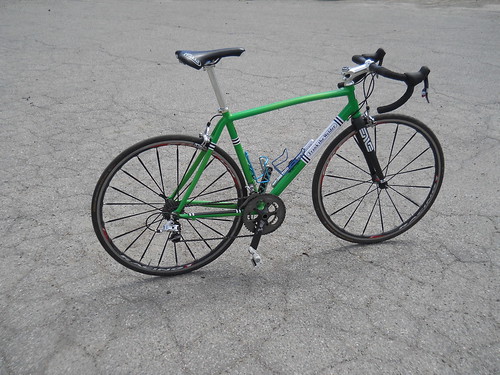
29 781 by frankthewelder, on Flickr
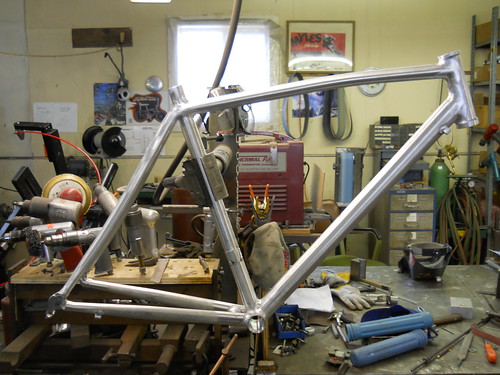
29 680 by frankthewelder, on Flickr

