


Geometry and lengths
 11-03-13 | 05:07 AM
#1
Thread Starter
Junior Member
Joined: Aug 2012
Posts: 15
Likes: 0
Geometry and lengths
Heya,
I'm completely new to frame building. So new in fact, that I've never actually built a frame!
I'm about to buy a fairly inexpensive set of tubes with their appropriate lugs, and braze em all together. The first hurdle I've seemed to have hit is seat tube length. While reading the Paterek Manual, a formula is given to help find an approx. seat tube length. I'm completely confused and not sure how to get a result which seems about right.
So for myself:
A= 85cm
B=6cm
C=6cm
D=73cm
E=72 degrees
F=18 degrees
So using the formula:
73 [sec (18)] = seat tube length.
My result = 76.76
This is wayyyy too large for a seat tube. Not sure where I'm going wrong.
Any suggestions?
I'm completely new to frame building. So new in fact, that I've never actually built a frame!
I'm about to buy a fairly inexpensive set of tubes with their appropriate lugs, and braze em all together. The first hurdle I've seemed to have hit is seat tube length. While reading the Paterek Manual, a formula is given to help find an approx. seat tube length. I'm completely confused and not sure how to get a result which seems about right.
A = Inseam length in centimeters with stocking feet
B = Bottom bracket height in centimeters
C = Crotch Clearance 4 centimeters for touring and 6 centimeters for racing
D = A-(B+C)
E = Seat tube angle
F = Complement of angle E
After measuring the rider's inseam and finding the other variables (B & E will be covered later), 2 sides and three angles will be known. With that knowledge, the Pythagorean theorum can be applied to find the seat tube length. The following formula will give the seat tube length. All that is needed is a hand held scientific calculator:
D [sec (F)] = Seat Tube Length
B = Bottom bracket height in centimeters
C = Crotch Clearance 4 centimeters for touring and 6 centimeters for racing
D = A-(B+C)
E = Seat tube angle
F = Complement of angle E
After measuring the rider's inseam and finding the other variables (B & E will be covered later), 2 sides and three angles will be known. With that knowledge, the Pythagorean theorum can be applied to find the seat tube length. The following formula will give the seat tube length. All that is needed is a hand held scientific calculator:
D [sec (F)] = Seat Tube Length
A= 85cm
B=6cm
C=6cm
D=73cm
E=72 degrees
F=18 degrees
So using the formula:
73 [sec (18)] = seat tube length.
My result = 76.76
This is wayyyy too large for a seat tube. Not sure where I'm going wrong.
Any suggestions?
 11-03-13 | 07:14 AM
#3

Senior Member
Joined: Aug 2013
Posts: 1,200
Likes: 6
From: Vermont
Bikes: Pinarello Montello, Merckx MX Leader, Merckx Corsa Extra, Pinarello Prologo, Tredici Magia Nera, Tredici Cross
What are you riding now? What would you change about it? Example: I built my frame based on the specs of my Pinarello. It was the best frame I had ridden. I am a little long in the torso so, I adjusted the TT & DT lengths. My choices in tubing were limited but, the bike turned out great. Fits me better & handles like a dream.
Calculators are great, don't get me wrong. Fitting to an actual device or bike is like measuring twice/cutting once.
Calculators are great, don't get me wrong. Fitting to an actual device or bike is like measuring twice/cutting once.
11-03-13 | 11:44 AM
#4
Senior Member
Joined: Jul 2011
Posts: 2,441
Likes: 4
If you are reading Paterek, which is a mixed blessing, you know about drawing out the frame. A good starting point is the frame size. So if you are building say a 56 cm, that is from center of BB to top of top tube. By looking at bikes you have ridden, and hardware you have seen (and best case will source before you start building), you can take a stab at how far above the horizontal top tube you will trim the tube. If you are going to make the tube slope, then just make those adjustments in your drawing. A build drawing can be very sketchy, you just need the build info. When addressing a client there is a marketing function to the drawing, and that is where the fancier computer graphics come in.
I fully agree with the idea of modifying frames you have actual experience riding to get to the base numbers rather than pursuing some system. Obviously to fit clients a broader grasp of theory is necessary, but for one's own frame, I think modelling from known frames and making obvious changes that would improve fit, is a better method.
I fully agree with the idea of modifying frames you have actual experience riding to get to the base numbers rather than pursuing some system. Obviously to fit clients a broader grasp of theory is necessary, but for one's own frame, I think modelling from known frames and making obvious changes that would improve fit, is a better method.
11-03-13 | 12:19 PM
#5


Decrepit Member
Joined: Aug 2005
Posts: 10,488
Likes: 92
From: Santa Rosa, California
Bikes: Waterford 953 RS-22, several Paramounts
Wheel radius should include an inflated tire of the size that's going to be used.
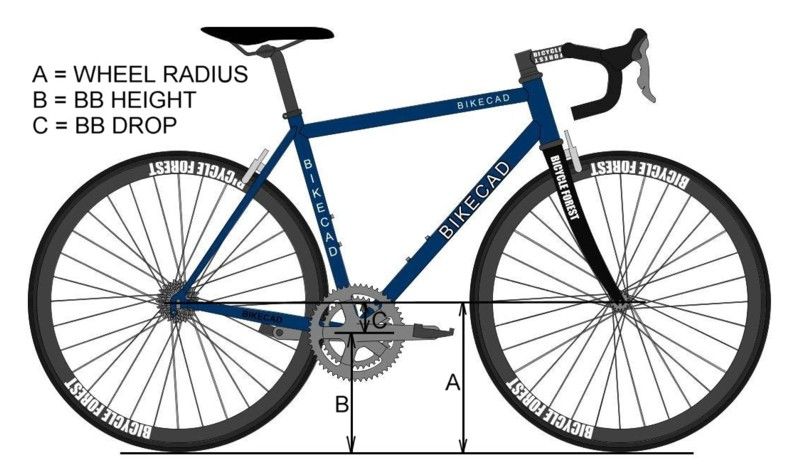
Common sense and practice would suggest a frame with ~58cm-60cm seat tube for a rider with an 85cm (33.5") leg length.

Last edited by Scooper; 11-03-13 at 01:42 PM. Reason: added picture
11-04-13 | 12:37 PM
#6
Senior Member
Joined: Jul 2011
Posts: 2,441
Likes: 4
Good catch. And this is one of those cases where having actual parts on hand to measure, in this case wheels, is nice. You can get variations in tire size that while not that great, lead to discrepancies that are at the physically tangible level (not thous).
12-10-13 | 08:23 PM
#8

Senior Member

Joined: Apr 2005
Posts: 17,195
Likes: 761
From: Ann Arbor, MI
Bikes: 1980 Masi, 1984 Mondonico, 1984 Trek 610, 1980 Woodrup Giro, 2005 Mondonico Futura Leggera ELOS, 1967 PX10E, 1971 Peugeot UO-8
As a check, I just got a bike with a 54 cm frame and 7.5 cm BB drop, and I like the fit a lot on 700c tubulars (about 670 mm diameter). I have another one 56 cm and 8 cm drop, and it is marginally large with Hetre tires (about 678 mm diameter).
Last edited by Road Fan; 12-10-13 at 08:28 PM.

Thread
Thread Starter
Forum
Replies
Last Post
Carson Dyle
Fitting Your Bike
5
12-09-14 12:28 PM


