


Cold setting necessary with a jig?

 03-19-14 | 01:03 PM
#2


Decrepit Member
Joined: Aug 2005
Posts: 10,488
Likes: 92
From: Santa Rosa, California
Bikes: Waterford 953 RS-22, several Paramounts
I tack braze in the jig, then remove the frame from the jig to fully braze the joints. After brazing each joint, I cold set the frame on an alignment table before brazing the next joint. This way, there isn't any cumulative stress built into the frame.
Heat from the brazing will slightly distort alignment, so it's best to cold set as each joint is brazed.
My $.02.
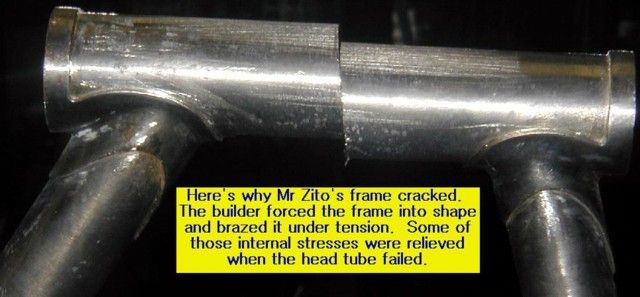
These photos are from a Yellow Jersey repair of a frame brazed in the jig without cold setting after brazing each joint. The stress built into the frame eventually caused the head tube to fail at the lower lug. Notice the displacement of the top and bottom halves of the head tube when it was sawed in half, showing the stress built into the frame during brazing in the jig.


Last edited by Scooper; 03-19-14 at 02:25 PM. Reason: added Yellow Jersey photos
03-19-14 | 07:56 PM
#3

Senior Member


Joined: Feb 2012
Posts: 19,351
Likes: 5,467
From: Rochester, NY
Bikes: Stewart S&S coupled sport tourer, Stewart Sunday light, Stewart Commuting, Stewart Touring, Co Motion Tandem, Stewart 3-Spd, Stewart Track, Fuji Finest, Mongoose Tomac ATB, GT Bravado ATB, JCP Folder, Stewart 650B ATB
Since after brazing frame alignment is somewhat dependent on how much heat is applied where and that many jigs don't allow for unrestricted access to all parts of the joints it's easier to braze a joint in the jig with unevenly applied heat then with the frame out of the jig (after pinning or tacking to hold the design alignment).
I also build with the jig tack, align on a surface plate then finish brazing out of the jig. Andy.
I also build with the jig tack, align on a surface plate then finish brazing out of the jig. Andy.
03-20-14 | 12:20 AM
#4
Senior Member
Joined: Jul 2011
Posts: 2,441
Likes: 4
In theory it is possible to weld frames in a jig and not need to cold set them. But you can't have just any kind of jig. If your welding is out of whack, the jig won't hold it in check, and even if it did it would pop out on you when you took it out of the jig. Anyway, less distortion is still better than more, setting is a way of getting key parts aligned, while drawing other parts out of alignment.
My welding is not good enough to put this theory to a test. But others like Don Ferris seem to be up to it.
My welding is not good enough to put this theory to a test. But others like Don Ferris seem to be up to it.
03-20-14 | 04:14 PM
#5
Banned
Joined: Jun 2010
Posts: 43,586
Likes: 1,380
From: NW,Oregon Coast
Bikes: 8
FWIW, '88 I dropped by the Gazelle home office/shop in Dieren NL ..at the time they were building 531 race frames in batches .
I was only shown the low production shop , on the quick tour, wouldn't call it cold alignment ..
the main triangles , lugged, were brazed on torch array jigs , then moved to a 'push until the indicator light comes on'
alignment Jug , then .. they were left to cool..
I was only shown the low production shop , on the quick tour, wouldn't call it cold alignment ..
the main triangles , lugged, were brazed on torch array jigs , then moved to a 'push until the indicator light comes on'
alignment Jug , then .. they were left to cool..
Last edited by fietsbob; 03-20-14 at 04:18 PM.
03-20-14 | 05:04 PM
#6
Senior Member
Joined: Feb 2013
Posts: 66
Likes: 0
I don't normally cold-set anything - tack in the jig, then fillet-braze each joint in a sequence that evens out how the frame moves. Occasionally I need to tweak the dropout spacing slightly after brazing in the bridges - that's a simple job to do by hand.
04-15-14 | 07:58 PM
#8
Senior Member

Joined: Dec 2009
Posts: 507
Likes: 13
Be interesting to cut a few "properly" built frames through the center of all the tubes and see how much they spring apart.
I've cut up many old frames and all of them have had the freshly cut section move to some degree.
I've cut up many old frames and all of them have had the freshly cut section move to some degree.
04-15-14 | 10:53 PM
#9
Senior Member
Joined: Feb 2012
Posts: 19,351
Likes: 5,467
From: Rochester, NY
Bikes: Stewart S&S coupled sport tourer, Stewart Sunday light, Stewart Commuting, Stewart Touring, Co Motion Tandem, Stewart 3-Spd, Stewart Track, Fuji Finest, Mongoose Tomac ATB, GT Bravado ATB, JCP Folder, Stewart 650B ATB
I'm in the middle of a top tube replacement (of a frame I've had kicking around for a long while. My own project.) and the Tt offset by a few MMs with the first cut through. The frame was made by a well respected builder during the 1990s with no crashes (rust holes in the TT). Unless a frame really has a LOT of built in stresses AND has seriously poor brazings (including prep) I doubt there will be much long term issues.
I'll be posting more after i get done. Andy.
I'll be posting more after i get done. Andy.
04-16-14 | 10:59 AM
#10
Randomhead
Joined: Aug 2008
Posts: 25,930
Likes: 4,825
From: Happy Valley, Pennsylvania
I speculate that most front triangles have some at least some stress built in. It doesn't actually take much force to move an individual tube a fairly large displacement. That's one reason why I try to avoid stress risers if I can
04-16-14 | 10:25 PM
#12
Senior Member
Joined: Jul 2011
Posts: 2,441
Likes: 4
Now that is an interesting point. So when one makes an S&S bike from scratch, one pre-assembles the fittings to the tubes, and everything should be pretty cool. So then one makes the bike, and cold sets it as required to make it a well aligned bike. Then one undoes the S&S couplers and everything jumps out of alignment. So then what do you do to ensure the individual tube segments are aligned with the global tube alignment? You could end up chasing two different states of alignment and if the work created enough distortion, it could become rather frustrating?
04-17-14 | 01:21 AM
#13
Senior Member
Joined: Feb 2013
Posts: 66
Likes: 0
Building a frame, there are different ways of doing it - some people put the couplings in a plain tube first, others (like me) build the frame, then cut it in half to fit the couplings. I suppose you could end up chasing your tail, but really only if your temperature control is way off or you're being obsessive.
The offset is almost always vertical - if it wasn't, there would be a torque on the frame putting the HT and ST out of alignment. The offset, if there is any, is usually a small pull inwards - the two HT joints tighten the front triangle up a bit. If it's only a few mm I just leave it, if it's more I do a gentle cold-set, really to make it easier for the owner to assemble and dismantle the frame. With my own frames, there's not usually any offset.
The offset is almost always vertical - if it wasn't, there would be a torque on the frame putting the HT and ST out of alignment. The offset, if there is any, is usually a small pull inwards - the two HT joints tighten the front triangle up a bit. If it's only a few mm I just leave it, if it's more I do a gentle cold-set, really to make it easier for the owner to assemble and dismantle the frame. With my own frames, there's not usually any offset.
05-08-14 | 08:07 PM
#14

Newbie
Joined: May 2014
Posts: 32
Likes: 11
From: Colorado Springs
Bikes: Bottecchia (Carnielli) & Bianchi
A number of years ago I recall making remark (in another forum and ever so frequented by so many know-it-alls) about a European frame builder whom I had known for over three decades whose method at time of brazing (following classic pinning) was to always do so outside (or free from) any jig. He would even fractionally offset by a mm knowing that typically a given tube might notoriously go off in one direction and by doing so cold setting might not be required more often than not......... His work more than spoke for itself and while he would occasionally (have to) cold set, his building method substantially reduced same. His design and workmanship was off the charts and several riders of renown road his frames with numerous accomplishment. My remarks were met with vitriolic refusal and impossibility by an American "frame builder" (in Denver, Colorado) who claimed as per his "expertise" that it was not possible to braze joints if they were not in a jig. Typical Coloradoan.
I always laugh at the reflection of that.
I always laugh at the reflection of that.

