


opinions on frame geometry
 06-07-14 | 09:19 AM
#1
Thread Starter
Member
Joined: Dec 2013
Posts: 32
Likes: 0
opinions on frame geometry
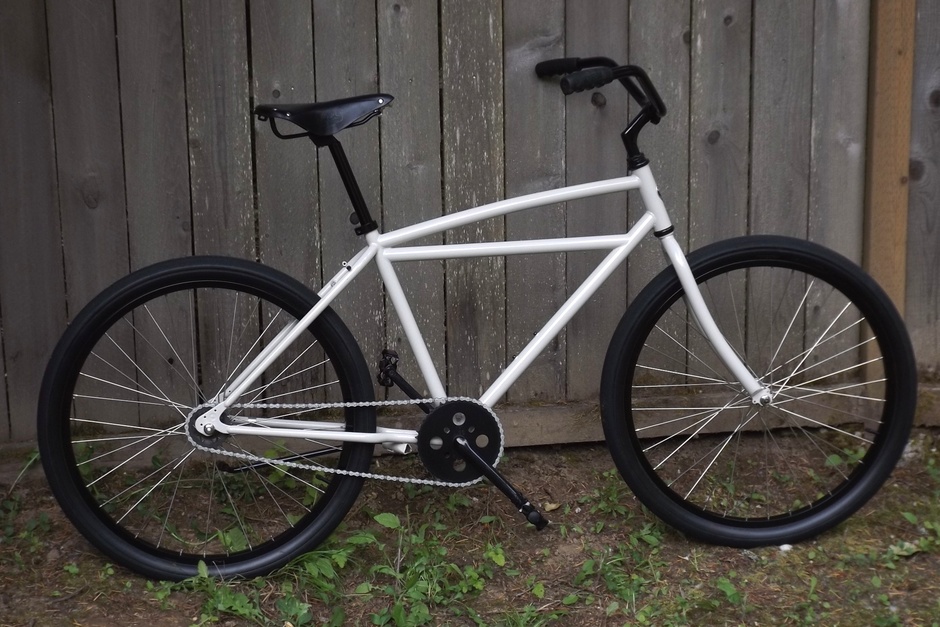
here is what i want to build, don´t ask why.
wheelbase 1250mm
head angle 66
seat angle 66
effective top tube 675mm
trail 75mm
bb hight (not drop) 275 mm
front-centre 725mm
chainstay 530ish mm
upright riding position and a front rack for heavy loads.
any guesses on how it´s going to behave?
wheelbase 1250mm
head angle 66
seat angle 66
effective top tube 675mm
trail 75mm
bb hight (not drop) 275 mm
front-centre 725mm
chainstay 530ish mm
upright riding position and a front rack for heavy loads.
any guesses on how it´s going to behave?
 06-07-14 | 10:07 AM
#2
Banned
Joined: Jun 2010
Posts: 43,586
Likes: 1,380
From: NW,Oregon Coast
Bikes: 8
No.
< wild Guess>steering likely flop like The Stretched Chopper fork ala Easy Rider Film.
heavy front load? you would likely want less trail (see Porteur bike builds)
perhaps even adopt a 20" wheel ?
< wild Guess>steering likely flop like The Stretched Chopper fork ala Easy Rider Film.
heavy front load? you would likely want less trail (see Porteur bike builds)
perhaps even adopt a 20" wheel ?
Last edited by fietsbob; 07-08-14 at 01:20 PM.
06-07-14 | 02:11 PM
#3
Framebuilder
Joined: Dec 2007
Posts: 570
Likes: 0
Gonna be crappy....don't ask why.
 06-07-14 | 03:22 PM
#5

Senior Member


Joined: Feb 2012
Posts: 19,381
Likes: 5,527
From: Rochester, NY
Bikes: Stewart S&S coupled sport tourer, Stewart Sunday light, Stewart Commuting, Stewart Touring, Co Motion Tandem, Stewart 3-Spd, Stewart Track, Fuji Finest, Mongoose Tomac ATB, GT Bravado ATB, JCP Folder, Stewart 650B ATB
Wheel/tire OD is missing. As is any semblance to normal bikes. Andy.


 06-07-14 | 06:17 PM
#8
Thread Starter
Member
Joined: Dec 2013
Posts: 32
Likes: 0
06-07-14 | 06:26 PM
#9
~>~
Joined: Mar 2013
Posts: 5,929
Likes: 188
From: TX Hill Country
Someone might ask "Why"?
And you can't tell......no,no, no, not anyway, nope your lips (keyboard) are sealed.
Wait.....Eric Snotdown is revealing THE SECRET via NSA surveillance..... mmmm, no guess not No One Cares.

-Bandera
06-07-14 | 07:02 PM
#13
Senior Member
Joined: Feb 2012
Posts: 19,381
Likes: 5,527
From: Rochester, NY
Bikes: Stewart S&S coupled sport tourer, Stewart Sunday light, Stewart Commuting, Stewart Touring, Co Motion Tandem, Stewart 3-Spd, Stewart Track, Fuji Finest, Mongoose Tomac ATB, GT Bravado ATB, JCP Folder, Stewart 650B ATB
But by choosing to design an uncommon geometry the Op is taking on the task of ploughing that field for the first time. Not that there's anything wrong about this. This is how discoveries are made, for better or worse. But i do take issue with the OP taking issue with others expressing their questions, that they're not "allowed" to ask. Whether the Op's design has any merit or benefit is now off the table. So the Op asked for advise, but only the positive kind. Not in this forum. Andy (who should know that trying to limit replies to only the right ones doesn't fly).
06-07-14 | 07:22 PM
#14
Thread Starter
Member
Joined: Dec 2013
Posts: 32
Likes: 0
But i do take issue with the OP taking issue with others expressing their questions, that they're not "allowed" to ask. Whether the Op's design has any merit or benefit is now off the table. So the Op asked for advise, but only the positive kind. Not in this forum. Andy (who should know that trying to limit replies to only the right ones doesn't fly).
06-07-14 | 08:24 PM
#15
Senior Member
Joined: Jul 2011
Posts: 2,441
Likes: 4
You really can't get any kind of an answer without a service description. How would it ride as what? Criteriums, third world work bike? Might be somewhere close to a recumbent of the easy rider kind, or it could be a bit like 1920s bike but with a really long rear end on it. Probably drive OK.
One of these:

Crossed with one of these:

Or one of these:

One of these:
Crossed with one of these:
Or one of these:
06-08-14 | 05:20 PM
#17
Senior Member

Joined: Dec 2006
Posts: 1,221
Likes: 24
From: Toronto/Montréal
Bikes: Eight homemade, three very dusty
So it's a roadster with a long TT it seems. Nothing wrong with roadsters, they are still being ridden and produced in millions. The main problem is that there will be a lot of wheel flop, and this will be exacerbated with the load. Might be hard to control.
BTW you'll need about 80 mm of rake to acheive that trail figure. You'll need long blades and not all bending mandrels will work.
BTW you'll need about 80 mm of rake to acheive that trail figure. You'll need long blades and not all bending mandrels will work.
Last edited by tuz; 06-08-14 at 05:37 PM.
06-09-14 | 03:14 PM
#18
Thread Starter
Member
Joined: Dec 2013
Posts: 32
Likes: 0
There are bikes with same steering angle but less trail. How are those forks bent?
06-09-14 | 09:18 PM
#19
Senior Member
Joined: Feb 2012
Posts: 19,381
Likes: 5,527
From: Rochester, NY
Bikes: Stewart S&S coupled sport tourer, Stewart Sunday light, Stewart Commuting, Stewart Touring, Co Motion Tandem, Stewart 3-Spd, Stewart Track, Fuji Finest, Mongoose Tomac ATB, GT Bravado ATB, JCP Folder, Stewart 650B ATB
No trolling here but some understanding that when you go outside of the bell curve the advise will be far less based on large numbers of well received results. So don't be surprised if you go through a few iterations to find your sweet spot. Please do post your results to help those who try to stand on your shoulders. Andy.
06-10-14 | 09:29 AM
#20
Senior Member
Joined: Dec 2006
Posts: 1,221
Likes: 24
From: Toronto/Montréal
Bikes: Eight homemade, three very dusty
Wheel flop is something you get used to and a wide handlebar makes it easier to control, even with a heavy front load. This bike bike will have a long wheelbase and a larger turning radius, this makes wheel flop affect steering less, right? Or did i miss some science here?
There are bikes with same steering angle but less trail. How are those forks bent?
There are bikes with same steering angle but less trail. How are those forks bent?
Common mandrels have a wide 12'' radius curve on a short chord and that will limit the amount of rake. You will need something tighter over a quarter circle, probably 6'' rad.
Last edited by tuz; 06-10-14 at 10:45 AM.
07-07-14 | 07:46 PM
#21

Senior Member

Joined: Apr 2005
Posts: 17,197
Likes: 761
From: Ann Arbor, MI
Bikes: 1980 Masi, 1984 Mondonico, 1984 Trek 610, 1980 Woodrup Giro, 2005 Mondonico Futura Leggera ELOS, 1967 PX10E, 1971 Peugeot UO-8
One real guess is that it might be like a laid-back Raleigh-like sportster. A shot in the dark, but better than I could do.
What else would you like, holmund?
07-07-14 | 08:23 PM
#22
Senior Member
Joined: Apr 2005
Posts: 17,197
Likes: 761
From: Ann Arbor, MI
Bikes: 1980 Masi, 1984 Mondonico, 1984 Trek 610, 1980 Woodrup Giro, 2005 Mondonico Futura Leggera ELOS, 1967 PX10E, 1971 Peugeot UO-8
Wheel flop is something you get used to and a wide handlebar makes it easier to control, even with a heavy front load. This bike bike will have a long wheelbase and a larger turning radius, this makes wheel flop affect steering less, right? Or did i miss some science here?
There are bikes with same steering angle but less trail. How are those forks bent?
There are bikes with same steering angle but less trail. How are those forks bent?
Large turning circle may be caused by a super-stable design, but it is its own limitation in use. Skilled riders (who can track-stand or nearly so) will often want to do a u-turn in a driveway or something similarly small.
Just some thoughts, echoing the comment about how more standard bikes stand on the shoulders of those who have pedaled up before.
Compare your idea to a standard Raleigh 3-speed, like a '70s Sport or Superbe. It seems like it might be intended for similar service. Are you making an improvement? Are you familiar with how one of those rides?
Another idea: Today bikes for high front platform loads (not with low-riders, like the porteurs) and their Gallic predecessors use(d) low trail and low flop, born of a lot of offset - target seems to be about 35 mm trail. That's a principle that has stood up to decades of competitive innovation. Are you making an improvement over that?
More generally, is your value proposition something that the consumer will pay for? I can't say that it is or isn't, but when in the corporate world I have suggested that we design something weird, I am held to answer such questions.
I can't go much deeper into the single-track-vehicle side of bicycle engineering, as an EE and non-framebuilder. I just ride. I also don't know what your product goals or vision are beyond what you've shared. But some principles of product design are essential.
07-16-14 | 02:45 PM
#23

Calamari Marionette Ph.D
Joined: Dec 2013
Posts: 7,861
Likes: 41
From: Coeur d' Alene
Bikes: 3 Chinese Gas Pipe Nerdcycles and 2 Chicago Electroforged Boat Anchors
here is what i want to build, don´t ask why.
wheelbase 1250mm
head angle 66
seat angle 66
effective top tube 675mm
trail 75mm
bb hight (not drop) 275 mm
front-centre 725mm
chainstay 530ish mm
upright riding position and a front rack for heavy loads.
any guesses on how it´s going to behave?
wheelbase 1250mm
head angle 66
seat angle 66
effective top tube 675mm
trail 75mm
bb hight (not drop) 275 mm
front-centre 725mm
chainstay 530ish mm
upright riding position and a front rack for heavy loads.
any guesses on how it´s going to behave?

 [/QUOTE]
08-11-14 | 03:48 PM
[/QUOTE]
08-11-14 | 03:48 PM
#24
Thread Starter
Member
Joined: Dec 2013
Posts: 32
Likes: 0
Compare your idea to a standard Raleigh 3-speed, like a '70s Sport or Superbe. It seems like it might be intended for similar service. Are you making an improvement? Are you familiar with how one of those rides?
Another idea: Today bikes for high front platform loads (not with low-riders, like the porteurs) and their Gallic predecessors use(d) low trail and low flop, born of a lot of offset - target seems to be about 35 mm trail. That's a principle that has stood up to decades of competitive innovation. Are you making an improvement over that?
More generally, is your value proposition something that the consumer will pay for? I can't say that it is or isn't, but when in the corporate world I have suggested that we design something weird, I am held to answer such questions.
I can't go much deeper into the single-track-vehicle side of bicycle engineering, as an EE and non-framebuilder. I just ride. I also don't know what your product goals or vision are beyond what you've shared. But some principles of product design are essential.
Another idea: Today bikes for high front platform loads (not with low-riders, like the porteurs) and their Gallic predecessors use(d) low trail and low flop, born of a lot of offset - target seems to be about 35 mm trail. That's a principle that has stood up to decades of competitive innovation. Are you making an improvement over that?
More generally, is your value proposition something that the consumer will pay for? I can't say that it is or isn't, but when in the corporate world I have suggested that we design something weird, I am held to answer such questions.
I can't go much deeper into the single-track-vehicle side of bicycle engineering, as an EE and non-framebuilder. I just ride. I also don't know what your product goals or vision are beyond what you've shared. But some principles of product design are essential.
This project was "maybe" until i got distracted by another thing i have been sketching that i will hopefully start building soon. More on that in another thread.
08-11-14 | 04:50 PM
#25
~>~
Joined: Mar 2013
Posts: 5,929
Likes: 188
From: TX Hill Country
So since this thread was for a dead end pipe dream that never got beyond "I wish, I wish...but I'm not capable of fabrication due to "distraction"...will "another" get off the sketch page? And can we ask: "Why?"
Also, what are the odds "another" will also never be hardware? And Why?
-Bandera
Also, what are the odds "another" will also never be hardware? And Why?
-Bandera
Last edited by Bandera; 08-11-14 at 05:16 PM.