


What do you do with your bike while repairing flat?
 08-09-16 | 01:16 PM
#1
Thread Starter
Senior Member
Joined: Jul 2016
Posts: 749
Likes: 62
Bikes: '17 Colnago C-RS (Full 5800); '16 Specialized Sirrus Elite
What do you do with your bike while repairing flat?
Curious here, as a noob to the sport with a new Sirrus Elite and a penchant for auto detailing and general cosmetic perfection, I got to wondering what you do with your bike while fixing a flat, particularly a rear flat? Just lay it on the ground? Try to find a grassy spot where scratches are less likely? Turn the bike upside down on it's handlebars and saddle? Carry something in your saddlebag like a couple garbage bags to lay the bike down on so it won't get scratched? I imagine for a front flat, most people just set the bike down on the ends of its fork in the normal upright position, but a rear flat might be a little more complicated.
So what do you do with the bike when repairing a flat?
So what do you do with the bike when repairing a flat?
 08-09-16 | 01:19 PM
#3

Senior Member

Joined: Sep 2009
Posts: 4,697
Likes: 2,039
From: Up
Bikes: Masi, Giant TCR, Eisentraut (retired), Jamis Aurora Elite, Zullo, Cannondale, 84 & 93 Stumpjumpers, Waterford, Tern D8, Bianchi, Gunner Roadie, Serotta, Serotta Duette, was gifted a Diamond Back
Lay it on the ground or upside down, wheels up.
08-09-16 | 01:22 PM
#4

Senior Member
Joined: Jan 2015
Posts: 4,120
Likes: 3
From: Porter, Texas
Bikes: Trek Domane 5.2, Ridley Xfire, Giant Propel, KHS AeroComp
yep, just lay it on the ground...scratches are going to happen, but they are much more likely to happen from a rock coming up off the road, or something of that nature than from just laying it down...
I once fixed a flat for a lady riding with us... she did not want her bike laid down... so she held my sons bike and he held hers up while I fixed the flat...a bit silly in my opinion, but she was a fox...and my son is in his 40's so he pays attention to stuff like that...
I once fixed a flat for a lady riding with us... she did not want her bike laid down... so she held my sons bike and he held hers up while I fixed the flat...a bit silly in my opinion, but she was a fox...and my son is in his 40's so he pays attention to stuff like that...
08-09-16 | 01:41 PM
#5

Senior Member
Joined: Sep 2010
Posts: 8,974
Likes: 397
From: NE Indiana
Bikes: 2020 Masi Giramondo 700c; 2013 Lynskey Peloton; 1992 Giant Rincon; 1989 Dawes needs parts; 1985 Trek 660; 1985 Fuji Club; 1984 Schwinn Voyager; 1984 Miyata 612; 1977 Raleigh Competition GS
Throw the bike off to the side of the road and leave it there, call my mommy to come get and take me to an LBS to buy another bike with fresh tires.
08-09-16 | 01:43 PM
#6

Senior Member

Joined: Jun 2004
Posts: 1,933
Likes: 81
From: Tucson, AZ
Bikes: 2025 Enve Fray with SRAM Rival, 1984 Trek 720 with a Nexus hub, 2016 Cannondale Synapse
 08-09-16 | 01:54 PM
#8
Senior Member
Joined: Jun 2013
Posts: 4,094
Likes: 2
From: Bozeman
Bikes: 199? Landshark Roadshark, 198? Mondonico Diamond, 1987 Panasonic DX-5000, 1987 Bianchi Limited, Univega... Chrome..., 1989 Schwinn Woodlands, Motobecane USA Record, Raleigh Tokul 2
I find the nearest dirt/grass patch and flip it upside down. Better than struggling with the bike when it's time to put the wheel back in. (Not that it's THAT hard, it's just easier with the bike upside down.) The rules have no control over me.
 08-09-16 | 10:03 PM
#12
Senior Member
Joined: Sep 2010
Posts: 8,974
Likes: 397
From: NE Indiana
Bikes: 2020 Masi Giramondo 700c; 2013 Lynskey Peloton; 1992 Giant Rincon; 1989 Dawes needs parts; 1985 Trek 660; 1985 Fuji Club; 1984 Schwinn Voyager; 1984 Miyata 612; 1977 Raleigh Competition GS
See this:
I sort of disagree with some of things he says but that doesn't mean he's wrong and I'm right it's just that I do it differently. For example he says to carry two tubes, I don't think that necessary because I can fix a flat on the side of the road and patch the flatted tube almost as fast as I can replacing the tube. Also he puts on gloves, ok fine, I use little towelettes and wipe my hands afterwards, no big deal either, but the last thing I want on my hands on a hot day is gloves that don't breath.
Note on the film he sets the bike down, that's fine, that's how I do it, just don't set it down on the derailleur side, and make sure as you set it down the chain doesn't do something weird. Also pulling a tube out in the matter shown is ok as long as the tube is made of butyl, a latex tube could rip apart if pulled like that. He also uses a CO2 inflator which I don't like at all due to the limited amount of air you can carry, I don't like paying for air, and I don't like doing things twice, with CO2 when I get home I have to drain the CO out and replace it with normal air because CO bleeds out of the tube and can be flat in 36 hours, and if you pump it up the next day without first flatting it to get all the CO out then in about 48 hours the tire could be flat again! Also with CO2 you have to contend with the waste of the cart, some riders just throw on the side of the road and ride away...PLEASE don't do that!!!! The pressure he talks about should correlate with his weight, the other guy shouldn't even ask that unless he weighs exactly the same. I also didn't notice if he ran his hand along the inside of the tire feeling for a protruding object nor look on the outside for one (though I did speed through it so I may have missed it), you need to do that before you put the new tube back in or else the object that flatted you could still be in there and flat you again.
Now as far as me being able to fix a flat as fast as replacing a tube and probably faster is a technique I used for years that an old man taught me. Most holes where the flat occured can be found quickly with just a visual inspection of the tire, if you find the hole then simply leave the wheel on the bike! And remove about 1/2 of one side of the tire with the middle of the half where the hole was, next pull out about a 1/4th to a 1/3rd of the tube with the hole again in the middle section. Check to make sure no objects are sticking out of the tire on the outside nor on the inside. Patch the tube, I use glueless tubes from Park, they hold up forever and i don't have to wait for the glue to dry. Restuff the tube and install the tire, inflate and ride away. If I can't find the hole initially I still prefer to find the hole before I replace the tube. In that case off goes the wheel, pull the tube and inflate the tube to about triple it's normal size when in the tire and move the tube slowly past my lips till I feel the air, deflate and patch. If I still can't find the hole then I'll go to the backup tube and wait till I get home to fix the old tube. But about 75% of the time I can find the hole without ever removing the tube, and then about 95% of the time after I removed the tube I can find the hole. This way when I get home I don't have to worry about fixing a tube. So about only 5% of my flats I have to use the spare tube.
If you like the idea of CO2 you can get a hybrid pump which is a pump and CO2 inflater in one, so you can use the CO2 to fill your tire but if you get more flats than you have CO2 for you can use the pump. I l like the Lezyne Hybrid, it seems to be built better than others I've seen.
Note on the film he sets the bike down, that's fine, that's how I do it, just don't set it down on the derailleur side, and make sure as you set it down the chain doesn't do something weird. Also pulling a tube out in the matter shown is ok as long as the tube is made of butyl, a latex tube could rip apart if pulled like that. He also uses a CO2 inflator which I don't like at all due to the limited amount of air you can carry, I don't like paying for air, and I don't like doing things twice, with CO2 when I get home I have to drain the CO out and replace it with normal air because CO bleeds out of the tube and can be flat in 36 hours, and if you pump it up the next day without first flatting it to get all the CO out then in about 48 hours the tire could be flat again! Also with CO2 you have to contend with the waste of the cart, some riders just throw on the side of the road and ride away...PLEASE don't do that!!!! The pressure he talks about should correlate with his weight, the other guy shouldn't even ask that unless he weighs exactly the same. I also didn't notice if he ran his hand along the inside of the tire feeling for a protruding object nor look on the outside for one (though I did speed through it so I may have missed it), you need to do that before you put the new tube back in or else the object that flatted you could still be in there and flat you again.
Now as far as me being able to fix a flat as fast as replacing a tube and probably faster is a technique I used for years that an old man taught me. Most holes where the flat occured can be found quickly with just a visual inspection of the tire, if you find the hole then simply leave the wheel on the bike! And remove about 1/2 of one side of the tire with the middle of the half where the hole was, next pull out about a 1/4th to a 1/3rd of the tube with the hole again in the middle section. Check to make sure no objects are sticking out of the tire on the outside nor on the inside. Patch the tube, I use glueless tubes from Park, they hold up forever and i don't have to wait for the glue to dry. Restuff the tube and install the tire, inflate and ride away. If I can't find the hole initially I still prefer to find the hole before I replace the tube. In that case off goes the wheel, pull the tube and inflate the tube to about triple it's normal size when in the tire and move the tube slowly past my lips till I feel the air, deflate and patch. If I still can't find the hole then I'll go to the backup tube and wait till I get home to fix the old tube. But about 75% of the time I can find the hole without ever removing the tube, and then about 95% of the time after I removed the tube I can find the hole. This way when I get home I don't have to worry about fixing a tube. So about only 5% of my flats I have to use the spare tube.
If you like the idea of CO2 you can get a hybrid pump which is a pump and CO2 inflater in one, so you can use the CO2 to fill your tire but if you get more flats than you have CO2 for you can use the pump. I l like the Lezyne Hybrid, it seems to be built better than others I've seen.


 08-10-16 | 06:10 AM
#14

Senior Member
Joined: Dec 2004
Posts: 12,560
Likes: 799
From: Middle of da Mitten
Bikes: Trek 7500, RANS V-Rex, Optima Baron, Velokraft NoCom, M-5 Carbon Highracer, Bacchetta Quattro, Catrike Speed
 08-10-16 | 07:16 AM
#16

Senior Member
Joined: Jul 2002
Posts: 40,863
Likes: 3,116
From: Sacramento, California, USA
Bikes: Specialized Tarmac, Canyon Exceed, Specialized Transition, Ellsworth Roots, Ridley Excalibur
08-10-16 | 07:18 AM
#17

Galveston County Texas
Joined: Nov 2007
Posts: 33,335
Likes: 1,286
From: In The Wind
Bikes: 02 GTO, 2011 Magnum


 08-10-16 | 08:31 AM
#19

Administrator
Joined: Feb 2005
Posts: 13,655
Likes: 2,703
From: Delaware shore
Bikes: Cervelo C5, Guru Photon, Waterford, Specialized CX
08-10-16 | 09:31 AM
#20

Senior Member

Joined: Jul 2008
Posts: 30,500
Likes: 4,571
From: 25 miles northwest of Boston
Bikes: Bottecchia Sprint, GT Timberline 29r, Marin Muirwoods 29er, Trek FX Alpha 7.0
nah, but do it enough & have enough different experiences & I start looking back & thinking about if it was a big deal for me or not. I've had epic failures messing w/ broken valves & incorrectly dis-assembling my pump on the side of the rd, yadda yadda yadda, so if I can maintain a modest 15 minutes per tube swap, I'm happy
same thing w/ stats from computers, they don't matter so much to me, but looking at a history to start to reflect on what was good/easy & what was a challenge
same thing w/ stats from computers, they don't matter so much to me, but looking at a history to start to reflect on what was good/easy & what was a challenge
08-10-16 | 09:58 AM
#21
Senior Member
Joined: Apr 2015
Posts: 192
Likes: 3
From: East Bay CA
Bikes: 2016 Cannondale Synapse Carbon Disc Di2, Cannondale F1000 SL
If you're on a group ride someone is usually kind enough to hold it up my the saddle. When you're on a $5,000 Fred Sled you try to minimize dings and scrateches as best you can. If out solo I always lay it down on the non-drive side.
I always carry two tubes, even on a group ride, because I have deep-section rims and there's a good chance that if I need to borrow a tube the valve won't be long enough. I also carry a CO2 cartridge and a ridiculously small pump. The pump is in case of a second flat and/or if the CO2 inflator breaks (yes, it's happened to me). It's a fail-safe more than anything else. I've only had to pump a tire with the pump once and it's a terrible task given how small and inefficient the pump is, but it's tiny, weighs next to nothing and fits in a jersey pocket without sticking out. It's also useful for partially inflating a new tube so you can mount it before blast it with CO2.
I always carry two tubes, even on a group ride, because I have deep-section rims and there's a good chance that if I need to borrow a tube the valve won't be long enough. I also carry a CO2 cartridge and a ridiculously small pump. The pump is in case of a second flat and/or if the CO2 inflator breaks (yes, it's happened to me). It's a fail-safe more than anything else. I've only had to pump a tire with the pump once and it's a terrible task given how small and inefficient the pump is, but it's tiny, weighs next to nothing and fits in a jersey pocket without sticking out. It's also useful for partially inflating a new tube so you can mount it before blast it with CO2.
08-10-16 | 11:08 AM
#22

Heck on Wheels


Joined: Sep 2015
Posts: 1,055
Likes: 3
From: USA Midwest
Bikes: In Signature
To steal from Mark Twain, you were "gitting knowledge that was always going to be useful to him, and warn't ever going to grow dim or doubtful."
__________________
"I had a great ride this morning, except for that part about winding up at work."
Bikes so far: 2011 Felt Z85, 80's Raleigh Sovereign (USA), 91 Bianchi Peregrine, 91 Austro-Daimler Pathfinder, 90's Trek 730 Multitrack, STOLEN: 80 Schwinn Voyageur (Japan)

"I had a great ride this morning, except for that part about winding up at work."
Bikes so far: 2011 Felt Z85, 80's Raleigh Sovereign (USA), 91 Bianchi Peregrine, 91 Austro-Daimler Pathfinder, 90's Trek 730 Multitrack, STOLEN: 80 Schwinn Voyageur (Japan)
 08-10-16 | 11:23 AM
#24

Senior Member
Joined: Aug 2011
Posts: 22,676
Likes: 2,643
From: CID
Bikes: 1991 Bianchi Eros, 1964 Armstrong, 1988 Diamondback Ascent, 1988 Bianchi Premio, 1987 Bianchi Sport SX, 1980s Raleigh mixte (hers), All-City Space Horse (hers)
Sure feels like it when you accumulate a peanut gallery advising that this would all go faster with tire levers, saying "this is why you should be using Gatorskins!", wondering why you want to take the old tube home with you, etc etc.
08-10-16 | 11:50 AM
#25
Banned.
Joined: Jul 2016
Posts: 2,717
Likes: 10
From: downtown Bulverde, Texas
Bikes: '74 Raleigh International utility; '98 Moser Forma road; '92 Viner Pro CX upright
answer to Gatorskins: "I want to keep my teeth"
A load-hauler with double kickstand is easy - just drop the wheel out (if it's the front, first move all the weight to the rear rack)
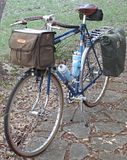
on the other bikes, I usually have a saddle cover and a couple of rags in a bag, so I flip the bike and put the contact points on the soft stuff.
A pinch flat is the only time I will go to the trouble to drop a wheel. For a puncture, I usually just repair with 2-oz Stans, a valve-core tool, and a pump - it's always gotten me home, and the repair lasts as long as the tire tread.
I like this organic repair stand, though
A load-hauler with double kickstand is easy - just drop the wheel out (if it's the front, first move all the weight to the rear rack)

on the other bikes, I usually have a saddle cover and a couple of rags in a bag, so I flip the bike and put the contact points on the soft stuff.
A pinch flat is the only time I will go to the trouble to drop a wheel. For a puncture, I usually just repair with 2-oz Stans, a valve-core tool, and a pump - it's always gotten me home, and the repair lasts as long as the tire tread.
I like this organic repair stand, though
Last edited by bulldog1935; 08-10-16 at 11:56 AM.