


Tires and Tubes?
 03-15-17 | 07:39 PM
#26
Banned
Joined: Apr 2010
Posts: 9,923
Likes: 1,066
From: Lincoln Ne
Bikes: RANS Stratus TerraTrike Tour II
One fact:
The most reliable way to increase a bicycle tire's puncture resistance is to just use lots of thick tread rubber. That was true 100 years ago and it's still true today. The two tires with the best puncture resistance are probably the Schwalbe Marathon Plus and the CST Salvo, and (in the 26" x 1.75" size) they both use tread rubber that's around 7mm thick.
Various opinions:
Tire companies today have tried to create the impression that you can pave paper-thin bicycle tires that weigh mere grams and that still won't get punctures--and that's not true, of any brand or casing material.
If you want less flats, get wider tires that have thicker tread rubber and run them at lower pressures.
Also it sounds silly, but don't ride in the gutter of the street.... I've seen a lot of people who aren't regular riders do this, beause they're trying to stay as far away from passing cars as possible. And they're constantly riding in the gutter where all the glass and nails end up. You have to try to keep your bicycle tires on CLEAN pavement if you want them to live long lives....
The most reliable way to increase a bicycle tire's puncture resistance is to just use lots of thick tread rubber. That was true 100 years ago and it's still true today. The two tires with the best puncture resistance are probably the Schwalbe Marathon Plus and the CST Salvo, and (in the 26" x 1.75" size) they both use tread rubber that's around 7mm thick.
Various opinions:
Tire companies today have tried to create the impression that you can pave paper-thin bicycle tires that weigh mere grams and that still won't get punctures--and that's not true, of any brand or casing material.
If you want less flats, get wider tires that have thicker tread rubber and run them at lower pressures.
Also it sounds silly, but don't ride in the gutter of the street.... I've seen a lot of people who aren't regular riders do this, beause they're trying to stay as far away from passing cars as possible. And they're constantly riding in the gutter where all the glass and nails end up. You have to try to keep your bicycle tires on CLEAN pavement if you want them to live long lives....
 03-16-17 | 10:43 AM
#28

Senior Member


Joined: May 2016
Posts: 4,214
Likes: 1,948
Bikes: Trek 1100, Raleigh R-500, Cannondale R800, Roadmaster gravel/beater mountain bike
Yes, I remember the old pull tabs. Which TPTB decided to do something about all the pull tab litter so they came up with the style of soda can we have now with the tabs which don't come off... which when they first came out I remember people bending the tab back & forth until it came off, then discarding it, thus defeating the purpose.
03-22-17 | 05:47 PM
#29


Back in those days, we just stopped off at the local gas station and they patched the tube for free and we used their air hose to fill our bicycle tires.
__________________
Land of the Free, Because of the Brave.
Land of the Free, Because of the Brave.
03-22-17 | 06:29 PM
#30

Senior Member


Joined: Feb 2004
Posts: 30,225
Likes: 649
From: St Peters, Missouri
Bikes: Catrike 559 I own some others but they don't get ridden very much.
Started getting popular in the middle 60's. I bought a set of steel belted radial tires for my '65 Cutlass. They lasted 40,000 miles which was around double conventional tire wear. These days I'd consider a tire with 40,000 miles on it just nicely scuffed in.
__________________
My greatest fear is all of my kids standing around my coffin and talking about "how sensible" dad was.
My greatest fear is all of my kids standing around my coffin and talking about "how sensible" dad was.
03-22-17 | 06:43 PM
#31

Senior Member


Joined: Nov 2014
Posts: 27,576
Likes: 5,451
From: Eugene, Oregon, USA
I think I can remember bias tires being an option in the 70's, but you may be right, I don't ever remember driving on them in a small car.
Nonetheless, it is possible those little wires have gotten worse over time as nearly 100% of the vehicles on the road today use radials, except for a few trailer tires.
03-22-17 | 08:01 PM
#32

Senior Member
Joined: Nov 2003
Posts: 5,366
Likes: 628
From: Soviet of Oregon or Pensacola FL
Bikes: Still have a few left!
In the late 40's-early 50's we did get flats, but not that many. Our favorite type of patch involved buffing the tube, applying the patch, then lighting it on fire with a match! Heat must have melted glue for a good seal I think, but we naturally looked forward to having a flat to fix under our father's watchful eye. Don
03-22-17 | 08:38 PM
#33

Senior Member
Joined: Jan 2006
Posts: 2,308
Likes: 10
From: Farmington, NM
Bikes: Giant Cypress SX
No glue. The rubber patch was vulcanized to the tube.
__________________
Some people are like a Slinky ... not really good for anything, but you still can't help but smile when you shove them down the stairs.
Some people are like a Slinky ... not really good for anything, but you still can't help but smile when you shove them down the stairs.
03-23-17 | 07:29 AM
#34

Senior Member
Joined: Jun 2007
Posts: 6,319
Likes: 209
From: Wisconsin
Bikes: 2012 Salsa Casseroll, 2009 Kona Blast
Dumb question. When I started riding bikes 48 years ago were tires and tubes that much better than today? From about the age of 8 till I was 17 I road my bikes and never had a flat or leaky tire. I rode on road and off every day (3 speed stingrays and 10 speed road bikes which I rode off road) I was doing cyclocross before it was a thing lol. Fast forward to today I'm 56 now and read where people are constantly having leaks /flat tires and actually carry spare tubes with them along with patch kits . What gives folks?
03-23-17 | 07:38 AM
#35
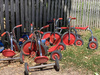
Yep, flats 55 years ago with my 24"-wheel Columbia coaster-brake bike. Patches came in those cardboard canisters with the cheese-grater top.
The OP's take is skewed by the fact that almost all of us in the U.S. rode around in those days on middleweight bikes (as they used to be called) with wide, thick, low-pressure tires. Ride one of those today, and you'll enjoy mostly flat-free cycling at the expense of reduced speed.
The OP's take is skewed by the fact that almost all of us in the U.S. rode around in those days on middleweight bikes (as they used to be called) with wide, thick, low-pressure tires. Ride one of those today, and you'll enjoy mostly flat-free cycling at the expense of reduced speed.
 03-23-17 | 08:17 AM
#37
Banned
Joined: Jun 2010
Posts: 43,586
Likes: 1,380
From: NW,Oregon Coast
Bikes: 8
For my 1997 cycle tour i used some reversal adaptation ..
622-40 utility tires , Suomi-Nokian, and thorn resistant inner tubes..
9 months , no punctures, touring west of Ireland & Scotland..
....
622-40 utility tires , Suomi-Nokian, and thorn resistant inner tubes..
9 months , no punctures, touring west of Ireland & Scotland..
....
03-23-17 | 08:27 AM
#38
Senior Member

Joined: Jun 2010
Posts: 2,611
Likes: 478
IMO, there are lots of misconceptions in this thread:
1. Most flats are caused by compressing the tire down to the rim and pinch flatting the tube. Punctures do cause some flats but it's less common. Pinch flats are much less common with high volume tires, thicker carcassed tires like BMX or MTB. It's really all about volume, for example I've used Compass tires that have paper thin sidewalls without flatting for a while now despite using them on fairly rough gravel.
2. I started racing USCF in 1986. Back then, everyone trained with a frame pump and several tubes. I'm not sure what the OP is talking about. Flats happened all the time.
3. Tubeless technology is really good and didn't exist a few years ago. I've personally never flatted any tubeless setup and I have it on three bikes ranging from 23mm road to a fat bike.
4. Tires are sooo much better in every way these days. Even cheap tires ride much better and are much less flat prone than the Avocets I used to race on. Tires are much more confidence inspiring.
1. Most flats are caused by compressing the tire down to the rim and pinch flatting the tube. Punctures do cause some flats but it's less common. Pinch flats are much less common with high volume tires, thicker carcassed tires like BMX or MTB. It's really all about volume, for example I've used Compass tires that have paper thin sidewalls without flatting for a while now despite using them on fairly rough gravel.
2. I started racing USCF in 1986. Back then, everyone trained with a frame pump and several tubes. I'm not sure what the OP is talking about. Flats happened all the time.
3. Tubeless technology is really good and didn't exist a few years ago. I've personally never flatted any tubeless setup and I have it on three bikes ranging from 23mm road to a fat bike.
4. Tires are sooo much better in every way these days. Even cheap tires ride much better and are much less flat prone than the Avocets I used to race on. Tires are much more confidence inspiring.

Thread
Thread Starter
Forum
Replies
Last Post
asiamj
Cyclocross and Gravelbiking (Recreational)
7
09-19-10 04:18 PM
thenomad
Commuting
22
09-17-10 02:18 PM
