


Injection-molded bikes
 01-03-18 | 07:01 AM
#1

Thread Starter
Senior Member


Joined: Apr 2007
Posts: 4,129
Likes: 56
From: Munising, Michigan, USA
Bikes: Priority 600, Priority Continuum, Devinci Dexter
Injection-molded bikes
This is interesting:
https://e-bikerumor.com/2017/12/14/p...ike-in-europe/
Could injection-molded bicycles be the future? It would sure be interesting to try one.
https://e-bikerumor.com/2017/12/14/p...ike-in-europe/
Could injection-molded bicycles be the future? It would sure be interesting to try one.
 01-03-18 | 07:52 AM
#2

Senior Member
Joined: Jan 2009
Posts: 6,667
Likes: 2,411
From: Colorado Springs, CO
Bikes: 2015 Charge Plug, 2007 Dahon Boardwalk, 1997 Specialized Rockhopper, 1984 Nishiki International, 2006 Felt F65, 1989 Dahon Getaway V
Been there, done that.
https://en.wikipedia.org/wiki/Plastic_bicycle
Not to dampen your enthusiasm...but unless there is a major breakthrough in strengths or price, I don't see this happening.
https://en.wikipedia.org/wiki/Plastic_bicycle
Not to dampen your enthusiasm...but unless there is a major breakthrough in strengths or price, I don't see this happening.
01-03-18 | 02:55 PM
#3

Senior Member

Joined: Feb 2004
Posts: 30,225
Likes: 649
From: St Peters, Missouri
Bikes: Catrike 559 I own some others but they don't get ridden very much.
Of course there will be. "Impossible" just means nobody has figured out how to do it - yet.
__________________
My greatest fear is all of my kids standing around my coffin and talking about "how sensible" dad was.
My greatest fear is all of my kids standing around my coffin and talking about "how sensible" dad was.
01-03-18 | 03:25 PM
#6

Senior Member


Joined: Apr 2011
Posts: 12,782
Likes: 4,886
Mass-produced, injection molded bike production itself isn’t new.
"Reinforced" polymide is what most people call reinforced nylon. It is that tough but flexible stuff that the base of your bicycle saddle or Look cleats are made of.
I imagine the reason that they are looking at the Ebike market is because it is such a rubbery, inefficient material that only when used in a motorized bike would anyone find it acceptable. This is not a material that is even used to make ladders because it doesn't have the strength to weight ratio or rigidity necessary for longish spans.
01-03-18 | 03:52 PM
#7

Senior Member
Joined: Oct 2011
Posts: 2,714
Likes: 13
From: Normal, Illinois
Bikes: Trek 600 ,1980Raleigh Competition G.S., 1986 Schwinn Passage, Facet Biotour 2000, Falcon San Remo 531,Schwinn Sierra, Sun Seeker tricycle recumbent,1985 Bianchi Squadra
01-03-18 | 06:54 PM
#8

Cycleway town
Joined: Jul 2014
Posts: 1,397
Likes: 169
From: Milton Keynes, England
Bikes: 2.6kw GT LTS e-tandem, 250w Voodoo, 250w solar recumbent trike, 3-speed shopper, Merlin ol/skl mtb, 80cc Ellswick
Beat me to it.
It wasn't the future then, and it isn't the future now.
It wasn't the future then, and it isn't the future now.
 01-03-18 | 10:00 PM
#10


Weight won't matter for some types of e-bikes, so a plastic frame could be quite heavy so that it was stiff enough.
This wouldn't work for an e-assist road bike with a lightweight motor and battery. But to replace something like a 40-50 pound bike share bike, it might be fine. Graceful? no. But functional? could be.
This wouldn't work for an e-assist road bike with a lightweight motor and battery. But to replace something like a 40-50 pound bike share bike, it might be fine. Graceful? no. But functional? could be.
Last edited by rm -rf; 01-03-18 at 10:03 PM.
01-03-18 | 11:22 PM
#11

Senior Member


Joined: Sep 2014
Posts: 3,902
Likes: 681
Personally, I see no reason to dismiss the concept. Fabrication technologies advance at different rates, and it's certainly possible for plastic to catch up with metal or carbon fiber for bike production. But those technologies keep improving too.
Another thing to consider is that the cost picture for fabrication depends on where you're located. In my own work, I've made assumptions about what technology is the most cost-effective based on my familiarity with industry in the US, only to have those ideas turned upside down when production is taken to China.
At the same time, a new "bike of the future" concept is introduced by a design student or studio, roughly every 15 minutes.
Another thing to consider is that the cost picture for fabrication depends on where you're located. In my own work, I've made assumptions about what technology is the most cost-effective based on my familiarity with industry in the US, only to have those ideas turned upside down when production is taken to China.
At the same time, a new "bike of the future" concept is introduced by a design student or studio, roughly every 15 minutes.
01-03-18 | 11:34 PM
#12
Senior Member
Joined: Oct 2016
Posts: 289
Likes: 19
Bikes: Masi Giramondo, Trek 830 monstercross build, Raleigh Gran Sport, Lemond Tourmalet
1) It is arguable that carbon fiber frames are plastic. They certainly are in the sense that fiberglass body panels are - thermoset resin over layers of chop or fiber. But they have to be hand fabbed, which is expensive and time consuming. The also have the limitation of being one-sided in that the finished exterior surface will be dimension but the interior won't.
2) Injection molded thermoplastics often have limited stiffness, and in order to achieve real stiffness, must be "filled" with some sort of fiber (often glass fibers) to achieve truly rigid parts. Plus you get a 2 sided part with intentional features on both sides.
I know Lemond has been in partnership with several entities on a next gen carbon fiber technology. If I were betting on what it is, I'd think they're close to commercializing an injection molding process for carbon fiber components, which would make a molded plastic bike both a reality, and just as light/strong as existing CF frames, with a potentially lower cost.
2) Injection molded thermoplastics often have limited stiffness, and in order to achieve real stiffness, must be "filled" with some sort of fiber (often glass fibers) to achieve truly rigid parts. Plus you get a 2 sided part with intentional features on both sides.
I know Lemond has been in partnership with several entities on a next gen carbon fiber technology. If I were betting on what it is, I'd think they're close to commercializing an injection molding process for carbon fiber components, which would make a molded plastic bike both a reality, and just as light/strong as existing CF frames, with a potentially lower cost.
01-04-18 | 12:55 AM
#13

Disco Infiltrator
Joined: May 2013
Posts: 15,350
Likes: 3,551
From: Folsom CA
Bikes: Stormchaser, Paramount, Tilt, Samba tandem
Technical details at the link are pretty slim. "Polyamide fiber" = nylon.
There are a couple of ways you could do it. Some plastic parts are made sort of like I-beams of fiberglass reinforced plastic. That seems like it would be a natural for kids bikes. It's pretty easy to imagine something like cafeteria trays, too. You could also probably make a bike frame about the same way they do big plastic kiddie toys like Cozy Coupes, in which plastic is rolled around in a mold until the whole inside surface of the mold is coated.
There are a couple of ways you could do it. Some plastic parts are made sort of like I-beams of fiberglass reinforced plastic. That seems like it would be a natural for kids bikes. It's pretty easy to imagine something like cafeteria trays, too. You could also probably make a bike frame about the same way they do big plastic kiddie toys like Cozy Coupes, in which plastic is rolled around in a mold until the whole inside surface of the mold is coated.
__________________
Genesis 49:16-17
"Well, well!" said Holmes, impatiently. "A good cyclist does not need a high road. The moor is intersected with paths and the moon is at the full."
Genesis 49:16-17
"Well, well!" said Holmes, impatiently. "A good cyclist does not need a high road. The moor is intersected with paths and the moon is at the full."
01-04-18 | 04:52 AM
#14
Senior Member
Joined: Mar 2008
Posts: 8,687
Likes: 301
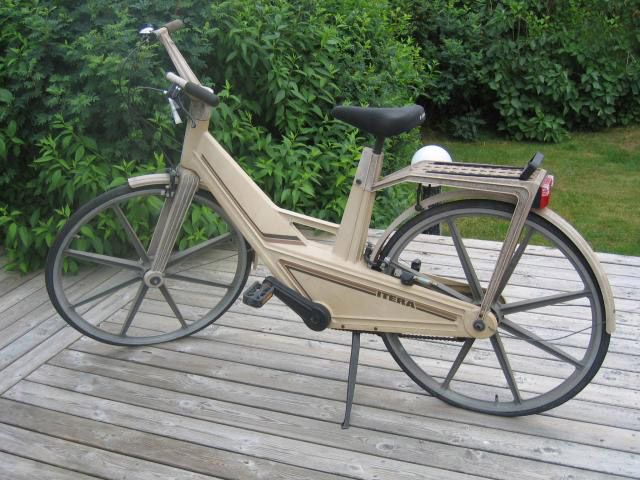
Comparison to the Itera is not entirely fair, although relevant in a roundabout way.
It failed as much - if not more - due to poor marketing judgement as it did to poor engineering. And some of that engineering could easily have been addressed had there been anyone with cycling experience in the management team.
Due to the fewer number of parts, absence of paint etc Iteras were first meant to sell at 1/3 of the price for what counted as the ”average” Swedish bicycle BITD.
However, someone decided that instead of going cheap, the Iteras should sell for 25% MORE than the ”average” bike, due to the radical design.
And faced with a bike that was heavier, flexier and more expensive than average - on top of odd-looking - customers mostly ignored it.
Today, looking at the price for department store bikes, it seems unlikely that savings in frame production would have a huge impact on the overall price on an ”average” bike.
There’d have to be something more thrown into the mix.
Lower price for a high-performance frame for instance.
Or easier to integrate a battery compartment, etc.
Technically, what would have helped the Itera would have been some understanding of riding dynamics.
It is a flexy frame, but perfectly functional for seated riding. Unfortunately it’s geared so high that riding standing is frequently required.
With a lower overall gearing, Iteras make very comfortable bikes for cruiser-type riding.
It failed as much - if not more - due to poor marketing judgement as it did to poor engineering. And some of that engineering could easily have been addressed had there been anyone with cycling experience in the management team.
Due to the fewer number of parts, absence of paint etc Iteras were first meant to sell at 1/3 of the price for what counted as the ”average” Swedish bicycle BITD.
However, someone decided that instead of going cheap, the Iteras should sell for 25% MORE than the ”average” bike, due to the radical design.
And faced with a bike that was heavier, flexier and more expensive than average - on top of odd-looking - customers mostly ignored it.
Today, looking at the price for department store bikes, it seems unlikely that savings in frame production would have a huge impact on the overall price on an ”average” bike.
There’d have to be something more thrown into the mix.
Lower price for a high-performance frame for instance.
Or easier to integrate a battery compartment, etc.
Technically, what would have helped the Itera would have been some understanding of riding dynamics.
It is a flexy frame, but perfectly functional for seated riding. Unfortunately it’s geared so high that riding standing is frequently required.
With a lower overall gearing, Iteras make very comfortable bikes for cruiser-type riding.
01-04-18 | 04:53 AM
#15
Senior Member
Joined: Apr 2011
Posts: 12,782
Likes: 4,886
1) It is arguable that carbon fiber frames are plastic. They certainly are in the sense that fiberglass body panels are - thermoset resin over layers of chop or fiber. But they have to be hand fabbed, which is expensive and time consuming. The also have the limitation of being one-sided in that the finished exterior surface will be dimension but the interior won't.
2) Injection molded thermoplastics often have limited stiffness, and in order to achieve real stiffness, must be "filled" with some sort of fiber (often glass fibers) to achieve truly rigid parts. Plus you get a 2 sided part with intentional features on both sides.
I know Lemond has been in partnership with several entities on a next gen carbon fiber technology. If I were betting on what it is, I'd think they're close to commercializing an injection molding process for carbon fiber components, which would make a molded plastic bike both a reality, and just as light/strong as existing CF frames, with a potentially lower cost.
2) Injection molded thermoplastics often have limited stiffness, and in order to achieve real stiffness, must be "filled" with some sort of fiber (often glass fibers) to achieve truly rigid parts. Plus you get a 2 sided part with intentional features on both sides.
I know Lemond has been in partnership with several entities on a next gen carbon fiber technology. If I were betting on what it is, I'd think they're close to commercializing an injection molding process for carbon fiber components, which would make a molded plastic bike both a reality, and just as light/strong as existing CF frames, with a potentially lower cost.
The reason CF is strong is not because of the plastic, but the fibers. The plastic resin keeps the fibers oriented and provides some shock absorbency, but the plastic part is barely structural. The resin is more like hard candy than aluminum.
I think you could make a decent bike out of good fiber and fairly "weak" resin, but you'd have an awful hard time making a decent bike out of great plastic and poor fibers.
Last edited by Kontact; 01-04-18 at 05:04 AM.
01-04-18 | 06:38 AM
#16
Thread Starter
Senior Member
Joined: Apr 2007
Posts: 4,129
Likes: 56
From: Munising, Michigan, USA
Bikes: Priority 600, Priority Continuum, Devinci Dexter
I'm not sure I had ever seen the Itera before. Interesting, the history of it.
(I also love the video showing how the Crazy Coupe is made).
The Itera's wheels are spoked with plastic, and I'm surmising not under tension. What about that? Does the design suffer over that of a metal spoked wheel?
(I also love the video showing how the Crazy Coupe is made).
The Itera's wheels are spoked with plastic, and I'm surmising not under tension. What about that? Does the design suffer over that of a metal spoked wheel?
01-04-18 | 07:05 AM
#17
Banned
Joined: Apr 2010
Posts: 9,923
Likes: 1,066
From: Lincoln Ne
Bikes: RANS Stratus TerraTrike Tour II
01-04-18 | 09:00 AM
#18
Senior Member
Joined: Mar 2008
Posts: 8,687
Likes: 301
One drawback to the particular plastic used was that wheels could go out of true if the bike was left carrying some weight somewhere really warm.
And truing them is quite a production.
OTOH if true, they’d take huge amounts of abuse w/o damage.
One kinda-sorta drawback is how the rims interact with brake pads.
Regular brake pads mostly smear. And wear like you wouldn’t believe.
Took awhile to find some that worked.
What I’d consider general, unavoidable drawbacks are weight and air drag.
I’d be ready to accept that on a utility bike. Heck, I even commuted on Itera wheels for awhile. But I can’t see myself using wheels like that on a performance oriented bike w/o some significant changes.
Last edited by dabac; 01-04-18 at 09:09 AM.
01-04-18 | 09:12 AM
#19
Senior Member
Joined: Oct 2016
Posts: 289
Likes: 19
Bikes: Masi Giramondo, Trek 830 monstercross build, Raleigh Gran Sport, Lemond Tourmalet
CF composites are long fibers in a plastic matrix. But that process always involves a "lay up" because you can't "inject" fibers into a mold and expect them to orient correctly to greatly change the structural rigidity. Mainly what you get by adding short fibers to injected thermoplastics is increased shear strength rather than greatly increased stiffness. It will still act like nylon, just not break when pushed past its elastic modulus as easily.
The reason CF is strong is not because of the plastic, but the fibers. The plastic resin keeps the fibers oriented and provides some shock absorbency, but the plastic part is barely structural. The resin is more like hard candy than aluminum.
I think you could make a decent bike out of good fiber and fairly "weak" resin, but you'd have an awful hard time making a decent bike out of great plastic and poor fibers.
The reason CF is strong is not because of the plastic, but the fibers. The plastic resin keeps the fibers oriented and provides some shock absorbency, but the plastic part is barely structural. The resin is more like hard candy than aluminum.
I think you could make a decent bike out of good fiber and fairly "weak" resin, but you'd have an awful hard time making a decent bike out of great plastic and poor fibers.
01-04-18 | 04:14 PM
#20

Lopsided biped

Joined: Nov 2017
Posts: 742
Likes: 167
From: NE Ohio
Bikes: 2017 Day 6 Cyclone (the Buick); 2015 Simcoe Deluxe (the Xebec); Street Strider 3i (the not-a-bike); GreenSpeed Anura (the Black Swan)
If that can be done, I'd love to see how. I just can't imagine it, though. I know CF layup can be automated for fairly simple shapes, but it's still a layup process. I think they'd have better luck combining long fiber with 3-D printing; the printer head could include a feed mechanism like the wire-feed welding machines. That would give good control over where the fibers went. Stuffing a bunch of long fibers into an injection mold ... the molten plastic coming into the mold under high pressure could push the fibers who-knows-where, and may not evenly coat the surfaces of the fibers. Sounds like a nightmare.
01-04-18 | 05:39 PM
#21
Banned
Joined: Jun 2010
Posts: 43,586
Likes: 1,380
From: NW,Oregon Coast
Bikes: 8
In smaller parts I expect any carbon fiber is chopped up, and thus able to be injection molded, within a molten poly-carbonate plastic..
Seems the old Trabant DDR cars uses a Phenol and Cotton composite body..
Seems the old Trabant DDR cars uses a Phenol and Cotton composite body..
01-04-18 | 07:05 PM
#22
Cycleway town
Joined: Jul 2014
Posts: 1,397
Likes: 169
From: Milton Keynes, England
Bikes: 2.6kw GT LTS e-tandem, 250w Voodoo, 250w solar recumbent trike, 3-speed shopper, Merlin ol/skl mtb, 80cc Ellswick
Weight won't matter for some types of e-bikes, so a plastic frame could be quite heavy so that it was stiff enough.
This wouldn't work for an e-assist road bike with a lightweight motor and battery. But to replace something like a 40-50 pound bike share bike, it might be fine. Graceful? no. But functional? could be.
This wouldn't work for an e-assist road bike with a lightweight motor and battery. But to replace something like a 40-50 pound bike share bike, it might be fine. Graceful? no. But functional? could be.
I started off with a Claud Butler Glide 1, and it was the wobbliest, most flexible step-through frame ever welded together. The handlebars and seat moves sideways independently! They might as well have been hinged!. Made from mild aluminium, i think.. But i quickly realised that it didn't really matter, because you don't really pull on the handlebars of an e-bike.
Weight though, yeah. I've got my latest one down from 100 lbs to 90 lbs by using all lightweight stuff. Great frame, costly components (even the square taper BB is hollow) but with 182 cells and a huge hub motor on board it's money for nothing. Lightweight e-bike? They're getting better. But my rigid ally Voodoo is a small-hub 250w, with 10ah, and it still weighs 64 lbs.
They can get them to about 50 i think, but my 90 lb one is all sprung weight apart from the hub, and it floats like no bicycle can. I just don't see it's worth chasing the same goals with an e-bike you would with a manual one.
As i carry a kid on the back, i'm probably not best qualified to say if plastic would be strong enough. It's probably more forgiving than a hard-tail in ally or steel, but i can't see it lasting if i had a plastic one.
Last edited by MikeyMK; 01-04-18 at 07:15 PM.
01-04-18 | 08:49 PM
#23
Senior Member
Joined: Oct 2016
Posts: 289
Likes: 19
Bikes: Masi Giramondo, Trek 830 monstercross build, Raleigh Gran Sport, Lemond Tourmalet
https://en.wikipedia.org/wiki/Sheet_moulding_compound
Sheet Molding Compound | Compression Molding Process - Romeo RIM
I've seen this process (compression, not injection, based) in use on very large enclosures and auto body panels (think the giant hoods on a Freightliner or a Mack). The parts that it produces, though, can still require some secondary ops to create ribs and fastener bosses and so forth, although you do get some of that depending on how the part is designed - within limits. I'm assuming the process/product Lemond calls "grail" takes some of these long fiber characteristics (long fibers of some kind of woven embedded into some kind of parison or other premolded part) and marries it to injection molding, or maybe a compression process that starts with a thicker sheet and incorporates cams or other tool actions to approximate injection molded parts. The info on the website is slim, and I haven't bothered to call them to find out more.
As for 3D printing, it sounds cool, and it can make great cosmetic samples without a lot of hand fab, but small parts (like a pen cap) still cost $15 and take forever to print. It's just additive CNC'ing without the robustness, always a one-off, and prohibitively expensive for mass-produced items for the foreseeable future. The 3D printing resins don't have any structural advantages at all, and FDM has **** for surface quality, as well as the structural disadvantage of having a "grain". And none of them have a remotely competitive cycle time. Since they are touting cost as one advantage, I highly doubt whatever Lemond is up to has anything at all to do with 3D printing.
Sheet Molding Compound | Compression Molding Process - Romeo RIM
I've seen this process (compression, not injection, based) in use on very large enclosures and auto body panels (think the giant hoods on a Freightliner or a Mack). The parts that it produces, though, can still require some secondary ops to create ribs and fastener bosses and so forth, although you do get some of that depending on how the part is designed - within limits. I'm assuming the process/product Lemond calls "grail" takes some of these long fiber characteristics (long fibers of some kind of woven embedded into some kind of parison or other premolded part) and marries it to injection molding, or maybe a compression process that starts with a thicker sheet and incorporates cams or other tool actions to approximate injection molded parts. The info on the website is slim, and I haven't bothered to call them to find out more.
As for 3D printing, it sounds cool, and it can make great cosmetic samples without a lot of hand fab, but small parts (like a pen cap) still cost $15 and take forever to print. It's just additive CNC'ing without the robustness, always a one-off, and prohibitively expensive for mass-produced items for the foreseeable future. The 3D printing resins don't have any structural advantages at all, and FDM has **** for surface quality, as well as the structural disadvantage of having a "grain". And none of them have a remotely competitive cycle time. Since they are touting cost as one advantage, I highly doubt whatever Lemond is up to has anything at all to do with 3D printing.
Last edited by bcpriess; 01-04-18 at 08:58 PM.
01-05-18 | 09:06 AM
#24

Senior Member
Joined: Dec 2004
Posts: 15,427
Likes: 8,345
From: Seattle area
Bikes: Bikes??? Thought this was social media?!?
As a basic transportation vehicle with electric motor expect 2 wheeled conveyances to evolve differently than bicycles ridden for simple exercise and as a sport with product designed for ride quality and superior handling characteristics.
Mopeds, scooters, ebikes will take off next time the price of oil goes way up.
If it has any motor, I suggest it be called 'moped', not e-bike.
E-bike terminology will ultimately be detrimental to non-motorized cyclists.
Please stop confusing motorized and non-motorized transportation and sport, let's keep them separate as well in the minds of the larger population. Especially with people who regulate us.
Mopeds, scooters, ebikes will take off next time the price of oil goes way up.
If it has any motor, I suggest it be called 'moped', not e-bike.
E-bike terminology will ultimately be detrimental to non-motorized cyclists.
Please stop confusing motorized and non-motorized transportation and sport, let's keep them separate as well in the minds of the larger population. Especially with people who regulate us.
__________________
Vintage, modern, e-road. It is a big cycling universe.
Vintage, modern, e-road. It is a big cycling universe.
01-05-18 | 09:14 AM
#25
Thread Starter
Senior Member
Joined: Apr 2007
Posts: 4,129
Likes: 56
From: Munising, Michigan, USA
Bikes: Priority 600, Priority Continuum, Devinci Dexter