


Doing a dumb experiment...
 11-02-19 | 12:40 PM
#1

Thread Starter
"Broke College Student"
Joined: Dec 2017
Posts: 180
Likes: 8
From: Mid-Missouri, USA
Bikes: 2016 Giant Sedona, 1987 Free Spirit Pinnacle
Doing a dumb experiment...
This is probably one of those things that get you ridiculed on BikeForums and among bicyclists for the rest of your life...
One day I was on YouTube and came across this video where someone turned their tire inside out. It was a really interesting concept, so I’ve decided to try it myself...
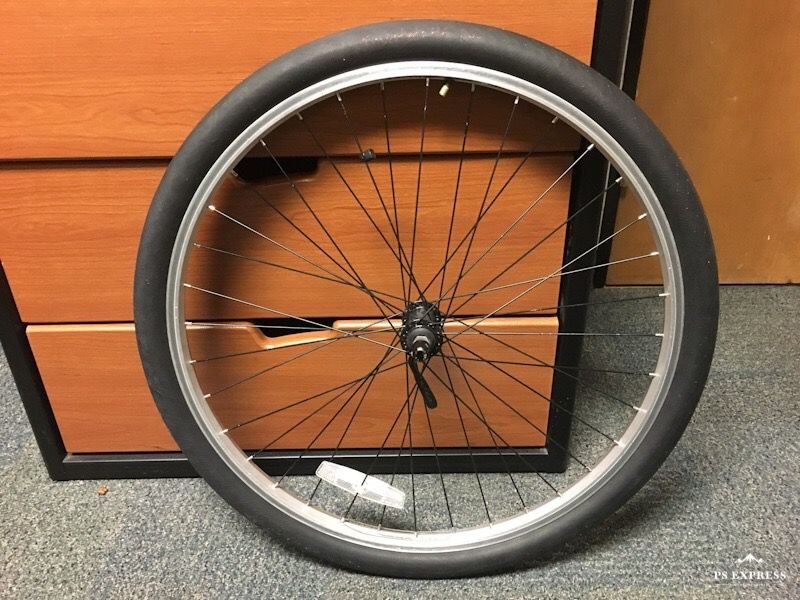
I flipped the stock 26x1.95 Kenda tire that came with my bike inside-out, so the tread is on the inside. I mounted the tire and inflated it to 45 PSI.
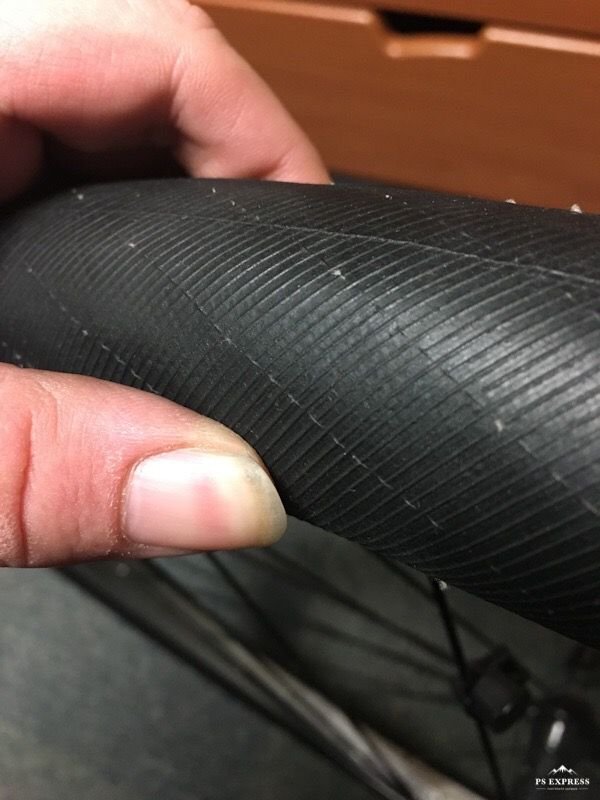
Proof that the tire is really inside-out.
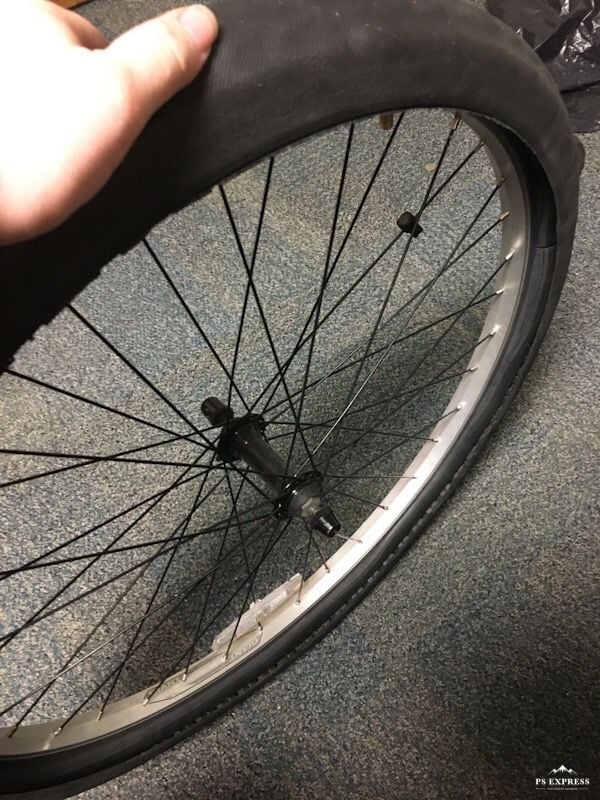
I originally tested the concept with a tire I’m replacing due to a gash in it. Installation was really tricky, but not nearly as tricky with the good, undamaged tire.
Because of the really tight fit between the rim and tire, I had to slide the rim with its deflated tube through the tire and center it. Then inflate slightly, mount one bead, inflate some more and mount the other bead. When the tube was deflated the beads would instantly pop right back off the rim, and with too much pressure they’d also pop off. So it was really tricky finding that perfect pressure to mount the beads at.
Another thing- to get the tube to work I had to shove part of the tube in on itself to make a “smaller” tube, as the tube at its original size would not work.

More proof that the tire is really inside out. It’s a really tight fit.
I did this yesterday and managed to inflate it to 45 PSI. A day later, it’s held perfectly fine. I had lots of concerns and even went outside to inflate it in case it did decide to pop. I was worried the tread may pop the tube, or one of the beads may not hold while being inverted. But it held.
I’m currently waiting for a replacement to the other tire. When it arrives, I may even take the inverted tire for a spin and see how it handles.
Any hypotheses on what may happen? Obviously I have way too much time on my hands...
One day I was on YouTube and came across this video where someone turned their tire inside out. It was a really interesting concept, so I’ve decided to try it myself...
I flipped the stock 26x1.95 Kenda tire that came with my bike inside-out, so the tread is on the inside. I mounted the tire and inflated it to 45 PSI.
Proof that the tire is really inside-out.
I originally tested the concept with a tire I’m replacing due to a gash in it. Installation was really tricky, but not nearly as tricky with the good, undamaged tire.
Because of the really tight fit between the rim and tire, I had to slide the rim with its deflated tube through the tire and center it. Then inflate slightly, mount one bead, inflate some more and mount the other bead. When the tube was deflated the beads would instantly pop right back off the rim, and with too much pressure they’d also pop off. So it was really tricky finding that perfect pressure to mount the beads at.
Another thing- to get the tube to work I had to shove part of the tube in on itself to make a “smaller” tube, as the tube at its original size would not work.
More proof that the tire is really inside out. It’s a really tight fit.
I did this yesterday and managed to inflate it to 45 PSI. A day later, it’s held perfectly fine. I had lots of concerns and even went outside to inflate it in case it did decide to pop. I was worried the tread may pop the tube, or one of the beads may not hold while being inverted. But it held.
I’m currently waiting for a replacement to the other tire. When it arrives, I may even take the inverted tire for a spin and see how it handles.
Any hypotheses on what may happen? Obviously I have way too much time on my hands...
 11-02-19 | 12:58 PM
#3
Thread Starter
"Broke College Student"
Joined: Dec 2017
Posts: 180
Likes: 8
From: Mid-Missouri, USA
Bikes: 2016 Giant Sedona, 1987 Free Spirit Pinnacle
2. I agree - I should've installed it on the rear wheel. Because I'm planning on putting the new tire on the front and moving the tire currently on the front (the one that's inverted) to the rear. But it was a PITA to install and it's already mounted and at pressure. I also hate changing the rear tire. I plan on taking it really slow and not going far.
I'm also concerned whether or not the inverted tire in this experiment will be usable when it's flipped back to its normal condition, because I'm planning on putting this tire on the rear after the experiment.
11-02-19 | 01:10 PM
#4
I'm the anecdote.
Joined: Apr 2019
Posts: 1,820
Likes: 1,177
From: S.E. Texas
Bikes: '12 Schwinn, '13 Norco
I wonder how long the reversed bead of the tire will hold?
Hmmm, having a thin bicycle innertube against a fairly aggressive tread pattern, and the fact that the cord of the tire is only a thin layer away from the new "tread", you now have a short tread life tire. Which I guess is good as the inner tube may outlast the new "tread".
Of course, tire manufacturers make slicks to overcome anyone needing to make a homemade slick.
Hmmm, having a thin bicycle innertube against a fairly aggressive tread pattern, and the fact that the cord of the tire is only a thin layer away from the new "tread", you now have a short tread life tire. Which I guess is good as the inner tube may outlast the new "tread".
Of course, tire manufacturers make slicks to overcome anyone needing to make a homemade slick.
Last edited by FiftySix; 11-02-19 at 01:13 PM.
 11-02-19 | 01:12 PM
#5
Banned
Joined: Feb 2008
Posts: 8,701
Likes: 2,506
From: Mississauga/Toronto, Ontario canada
Bikes: I have 3 singlespeed/fixed gear bikes
I can't stand people who tinker around trying to re-invent a wheel and make things worse....What's the point, why would anybody do such a dumb thing ??...You've done absolutely nothing to improve the tires handling, traction, wear and safety.
11-02-19 | 01:13 PM
#6

Senior Member
Joined: Apr 2011
Posts: 15,278
Likes: 342
From: Alpharetta, GA
Bikes: Nashbar Road
1. Mostly because I'm curious. I'm curious to see how well an inverted tire will handle on pavement. I'm also curious to see how it will handle when turning/cornering.
2. I agree - I should've installed it on the rear wheel. Because I'm planning on putting the new tire on the front and moving the tire currently on the front (the one that's inverted) to the rear. But it was a PITA to install and it's already mounted and at pressure. I also hate changing the rear tire. I plan on taking it really slow and not going far.
I'm also concerned whether or not the inverted tire in this experiment will be usable when it's flipped back to its normal condition, because I'm planning on putting this tire on the rear after the experiment.
2. I agree - I should've installed it on the rear wheel. Because I'm planning on putting the new tire on the front and moving the tire currently on the front (the one that's inverted) to the rear. But it was a PITA to install and it's already mounted and at pressure. I also hate changing the rear tire. I plan on taking it really slow and not going far.
I'm also concerned whether or not the inverted tire in this experiment will be usable when it's flipped back to its normal condition, because I'm planning on putting this tire on the rear after the experiment.
We already know that the inside rubber won't last very long (much thinner & no reason to use more durable materials). Doubtful that the bead will hold up as well. So I think at best we're looking at a temporary emergency fix.
11-02-19 | 01:23 PM
#7
Senior Member
Joined: Mar 2014
Posts: 109
Likes: 10
Bikes: Giant Cypress
Yeah, I had similar concerns about this, like others mentioned.
I'd also like to warn about using that tire in the rain (i.e. I don't expect the traction to be good for handling that type of weather).
I'd also like to warn about using that tire in the rain (i.e. I don't expect the traction to be good for handling that type of weather).


 11-02-19 | 02:26 PM
#9

Senior Member


Joined: Aug 2018
Posts: 2,924
Likes: 4,828
From: Allen, TX
Bikes: 2021 S-Works Turbo Creo SL, 2020 Specialized Roubaix Expert
Yes, how dare the OP tinker with their own belongings! (Sarcasm)


 11-02-19 | 02:56 PM
#13

Senior Member


Joined: Nov 2014
Posts: 27,576
Likes: 5,476
From: Eugene, Oregon, USA
I'm not sure why it shouldn't work as long as you've taken the time to get all the glass, thorns, radial wires, etc out of the road surface of the tire.
The center of your tire tread doesn't appear to be bad, although the edges have some aggressive tread. The problem with that is that the tube can get some uneven stretching and potentially pop due to being over-stretched. But, that may not be immediate. It could do permanent damage to the tube, but overall not a big loss.
You likely will have enough rubber for a couple hundred miles of riding. Then it may take some time to chew through the threads.
Overall, it may be a fun experiment, but I don't foresee any earth changing revelations.
The center of your tire tread doesn't appear to be bad, although the edges have some aggressive tread. The problem with that is that the tube can get some uneven stretching and potentially pop due to being over-stretched. But, that may not be immediate. It could do permanent damage to the tube, but overall not a big loss.
You likely will have enough rubber for a couple hundred miles of riding. Then it may take some time to chew through the threads.
Overall, it may be a fun experiment, but I don't foresee any earth changing revelations.

 11-02-19 | 04:06 PM
#15
Senior Member
Joined: Apr 2011
Posts: 15,278
Likes: 342
From: Alpharetta, GA
Bikes: Nashbar Road
I'm not sure why it shouldn't work as long as you've taken the time to get all the glass, thorns, radial wires, etc out of the road surface of the tire.
The center of your tire tread doesn't appear to be bad, although the edges have some aggressive tread. The problem with that is that the tube can get some uneven stretching and potentially pop due to being over-stretched. But, that may not be immediate. It could do permanent damage to the tube, but overall not a big loss.
You likely will have enough rubber for a couple hundred miles of riding. Then it may take some time to chew through the threads.
Overall, it may be a fun experiment, but I don't foresee any earth changing revelations.
The center of your tire tread doesn't appear to be bad, although the edges have some aggressive tread. The problem with that is that the tube can get some uneven stretching and potentially pop due to being over-stretched. But, that may not be immediate. It could do permanent damage to the tube, but overall not a big loss.
You likely will have enough rubber for a couple hundred miles of riding. Then it may take some time to chew through the threads.
Overall, it may be a fun experiment, but I don't foresee any earth changing revelations.
11-02-19 | 04:19 PM
#17
Senior Member
Joined: Mar 2008
Posts: 8,687
Likes: 300
My major concern would be how well embedded the casing is when seen from the inside. My experience, mainly based on failing studded tires, suggests that the cord is very close to the inside face of the tire. I’d expect it to wear through quite soon compared to the tread side.
The theory that it’d prolong the usesable life of a tire with a cut in it is new to me. Can’t quite understand it. Either a cut is only through the tread layer, in which case it’s mainly unimportant (unless a piece of grit manages to hit just ”right”), or it’s through the cord, and large enough to allow the tube to herniate, at which point it needs to be booted immediately to keep the tire useful.
But ar moderate pressures and frequent inspections, I don’t think the experiment is particularly suicidal. The worst that can happen is a bad flat, and that’s always a possibility anyhow.
The theory that it’d prolong the usesable life of a tire with a cut in it is new to me. Can’t quite understand it. Either a cut is only through the tread layer, in which case it’s mainly unimportant (unless a piece of grit manages to hit just ”right”), or it’s through the cord, and large enough to allow the tube to herniate, at which point it needs to be booted immediately to keep the tire useful.
But ar moderate pressures and frequent inspections, I don’t think the experiment is particularly suicidal. The worst that can happen is a bad flat, and that’s always a possibility anyhow.
11-02-19 | 04:56 PM
#18
Senior Member
Joined: Sep 2012
Posts: 2,318
Likes: 2,535
From: Orange County, California
Bikes: Yes
What could happen?
1. A flat from the tube rubbing against the aggressive tread
2. Damage to the tire's casing material. You've flipped it backwards, which is probably stretching the casing threads in an unnatural way, and there's also just s thin rubber layer between it and the nastiness of your local roads. Damage might not cause an immediate problem, but something in the future after you've returned the tire to its normal-side-out and when you least expect it to happen.
3. Tire comes off the rim. There's usually a bead on the tire that catches a 'channel' on the wheel's metal rim for a secure fit, but an inside-out tire won't have that bead to make it secure. I'd think any bump, turn, or object you hit when you start riding will cause the tire to come off the rim and possibly cause a #1 above.
1. A flat from the tube rubbing against the aggressive tread
2. Damage to the tire's casing material. You've flipped it backwards, which is probably stretching the casing threads in an unnatural way, and there's also just s thin rubber layer between it and the nastiness of your local roads. Damage might not cause an immediate problem, but something in the future after you've returned the tire to its normal-side-out and when you least expect it to happen.
3. Tire comes off the rim. There's usually a bead on the tire that catches a 'channel' on the wheel's metal rim for a secure fit, but an inside-out tire won't have that bead to make it secure. I'd think any bump, turn, or object you hit when you start riding will cause the tire to come off the rim and possibly cause a #1 above.
 11-02-19 | 05:38 PM
#20
I'm the anecdote.
Joined: Apr 2019
Posts: 1,820
Likes: 1,177
From: S.E. Texas
Bikes: '12 Schwinn, '13 Norco
 11-02-19 | 05:45 PM
#22

I AM AI
Joined: Aug 2013
Posts: 4,288
Likes: 1,170
From: Tucson, AZ
Bikes: 2008 S-Works Roubaix SL, 1979 Raleigh Comp GS, 1978 Schwinn Volare
Do please make sure video is rolling when you do the test ride. Then when the next guy says "why shouldn't I do this?" we can just post a link instead of typing.
__________________
A race bike in any era is a highly personal choice that at its "best" balances the requirements of fit, weight, handling, durability and cost tempered by the willingness to toss it and oneself down the pavement at considerable speed. ~Bandera
A race bike in any era is a highly personal choice that at its "best" balances the requirements of fit, weight, handling, durability and cost tempered by the willingness to toss it and oneself down the pavement at considerable speed. ~Bandera
11-02-19 | 07:00 PM
#24
Thread Starter
"Broke College Student"
Joined: Dec 2017
Posts: 180
Likes: 8
From: Mid-Missouri, USA
Bikes: 2016 Giant Sedona, 1987 Free Spirit Pinnacle
This isn't a "fix" for the tear in the tire. That tire is done for and is being replaced, because the tube bulges out it. A proper but temporary fix for that would be a tire boot.
This "experiment" really is just to see what would happen. This isn't meant to be an attempt at a "redneck repair" or anything. I would not expect this to be a fix for anything, or solve any problem - no matter how temporary. It's just one of those "let's see what would happen if I did x because I'm just curious" type things.
A couple disclaimers here... I do not mean to ride it for long or very fast in the "test." Doing so would just be asking to get hurt. I'm moving the tire from the front to the rear because, as previously mentioned, I'm getting a new tire and its going on the front and the tire used in this experiment (the one that's inverted) is going on the rear. In
With that said, I already unmounted the tire. The tube actually doesn't look nearly as badly "damaged" as I thought it might. I thought that anything past 30 PSI would surely pop the tube, but no. It held fine, and they're the cheap "standard thickness" Kenda tubes - no thorn-resistant or heavy-duty tubes here. But then again it was pressurized for just over 24 hours.
As for the tire itself, it seemed to be pretty solid on the rim. I even bounced it a few times on the ground (fairly harshly) and it didn't have any issues. As skidder mentioned, it does have that hook. But I have a 1980s Free Spirit Pinnacle road bike (27x1 1/4") that has old steel rims without the hook where the tires are held in place solely by the pressure. Unless you're inflating to ridiculously high pressures, or riding on a trail or doing some serious cornering, I think it shouldn't have a problem. (In my case, 45 is the max pressure.) The main concern would be the damage to the nylon cords (which is the "structure" of the tire) or the lack of traction.
I may delay this experiment until this tire is worn or it gets replaced in the future, because I'm unsure if I'm going to replace it now and make a matching set. If I do delay, I'll definitely report back to this thread when it happens.
This "experiment" really is just to see what would happen. This isn't meant to be an attempt at a "redneck repair" or anything. I would not expect this to be a fix for anything, or solve any problem - no matter how temporary. It's just one of those "let's see what would happen if I did x because I'm just curious" type things.
A couple disclaimers here... I do not mean to ride it for long or very fast in the "test." Doing so would just be asking to get hurt. I'm moving the tire from the front to the rear because, as previously mentioned, I'm getting a new tire and its going on the front and the tire used in this experiment (the one that's inverted) is going on the rear. In
With that said, I already unmounted the tire. The tube actually doesn't look nearly as badly "damaged" as I thought it might. I thought that anything past 30 PSI would surely pop the tube, but no. It held fine, and they're the cheap "standard thickness" Kenda tubes - no thorn-resistant or heavy-duty tubes here. But then again it was pressurized for just over 24 hours.
As for the tire itself, it seemed to be pretty solid on the rim. I even bounced it a few times on the ground (fairly harshly) and it didn't have any issues. As skidder mentioned, it does have that hook. But I have a 1980s Free Spirit Pinnacle road bike (27x1 1/4") that has old steel rims without the hook where the tires are held in place solely by the pressure. Unless you're inflating to ridiculously high pressures, or riding on a trail or doing some serious cornering, I think it shouldn't have a problem. (In my case, 45 is the max pressure.) The main concern would be the damage to the nylon cords (which is the "structure" of the tire) or the lack of traction.
I may delay this experiment until this tire is worn or it gets replaced in the future, because I'm unsure if I'm going to replace it now and make a matching set. If I do delay, I'll definitely report back to this thread when it happens.
