


Running a smaller rim up front?
 01-09-21 | 09:48 PM
#1

Thread Starter
Drip, Drip.

Joined: Oct 2020
Posts: 1,575
Likes: 194
From: Southern Ontario
Bikes: Trek Verve E bike, Felt Doctrine 4 XC, Opus Horizon Apex 1
Running a smaller rim up front?
Do you think there could be any benefit in doing so with the correct size fork?
My idea is that this could aid in front end agility while keeping the rear end more stable. However, I think that anything more than 1cm in overall rim diameter might not work quite so optimally. Or is it best to simply refer to making tweaks to the geometry of the frame itself?,
My idea is that this could aid in front end agility while keeping the rear end more stable. However, I think that anything more than 1cm in overall rim diameter might not work quite so optimally. Or is it best to simply refer to making tweaks to the geometry of the frame itself?,
 01-09-21 | 10:08 PM
#2

Senior Member

Joined: Jun 2015
Posts: 3,379
Likes: 2,020
From: Pacific Northwest
Bikes: Yes.
We used to do this sort of mix & match as kids screwin' around the neighborhood. I even had a tiny scooter wheel on my BMX bike for awhile.
As for usefulness? I don't think there is really much benefit to doing so randomly. But practicality aside, & assuming disc brakes, there are cases where it could theoretically make sense. One example would be installing a suspension fork on a 29'er/700c rigid. 54x559 is really close to 700x23c. In theory you could swap in a suspension fork & 26x2.1 tire & not terribly disturb headtube angle/rake too terribly...not that it would make sense for most bikes though--The rear wheel would need frame clearance. I wouldn't take such a bike over more than a generically rough road with potholes, though.
Usually people just keep their rigid as a rigid & go with 27.5/650b for the additional tire volume.
As for usefulness? I don't think there is really much benefit to doing so randomly. But practicality aside, & assuming disc brakes, there are cases where it could theoretically make sense. One example would be installing a suspension fork on a 29'er/700c rigid. 54x559 is really close to 700x23c. In theory you could swap in a suspension fork & 26x2.1 tire & not terribly disturb headtube angle/rake too terribly...not that it would make sense for most bikes though--The rear wheel would need frame clearance. I wouldn't take such a bike over more than a generically rough road with potholes, though.
Usually people just keep their rigid as a rigid & go with 27.5/650b for the additional tire volume.
Last edited by base2; 01-09-21 at 10:17 PM.
01-10-21 | 04:32 AM
#3

Me duelen las nalgas
Joined: Aug 2015
Posts: 13,519
Likes: 2,832
From: Texas
Bikes: Centurion Ironman, Trek 5900, Univega Via Carisma, Globe Carmel
Check out the 1980s time trial bikes (and a few track bikes) with smaller diameter front wheels and drastically raked geometry, an attempt to get more aero -- before aero bars made that style obsolete while retaining more traditional frame geometry. Handling on those goofy bikes of the 1980s was probably sketchy and demanding of rider skill and attention.
Terry, Centurion and maybe one other maker offered smaller frames for women with a smaller diameter front wheel but a more traditional looking frame geometry. But those are for folks around 5'2" or shorter. Handling was said to feel like any traditional diamond frame bike.
Many recumbent and low slung foot-forward bike designs use smaller diameter front wheels. I've tried one and could not get the hang of it. Due more to the recumbent design than the wheel.
Terry, Centurion and maybe one other maker offered smaller frames for women with a smaller diameter front wheel but a more traditional looking frame geometry. But those are for folks around 5'2" or shorter. Handling was said to feel like any traditional diamond frame bike.
Many recumbent and low slung foot-forward bike designs use smaller diameter front wheels. I've tried one and could not get the hang of it. Due more to the recumbent design than the wheel.
01-10-21 | 08:16 AM
#5
Senior Member


Joined: Sep 2012
Posts: 2,317
Likes: 2,534
From: Orange County, California
Bikes: Yes
Seeing how particular front fork rake/wheel size is related, any changes in size would put the steering and frame geometry out of whack. I replaced a rigid fork on an early 90s MTB with a suspension-corrected fork (80mm larger) and it made the front end really floppy, definitely could not ride it 'no-hands' (the bike's frame was small so I was trying to get more height on the front end). Not sure how it would work if you wanted to change it only 1-2 cm. And if you're changing wheel size you 're going to have to account for that in your roadside repair kit (larger/smaller tube(s) for a flat).
01-10-21 | 08:23 AM
#6

SE Wis

Joined: Apr 2005
Posts: 11,555
Likes: 4,331
From: Milwaukee, WI
Bikes: '68 Raleigh Sprite, '02 Raleigh C500, '84 Raleigh Gran Prix, '91 Trek 400, 2013 Novara Randonee, 1990 Trek 970
Common enough design in the past for small riders. Georgina Terry, Shogun among others.
These bikes were designed from the bottom up to run a smaller front wheel. Good luck having brakes reach.
St Tropez Terry knockoff
New bike, a Georgina Terry Symmetry
These bikes were designed from the bottom up to run a smaller front wheel. Good luck having brakes reach.
St Tropez Terry knockoff
New bike, a Georgina Terry Symmetry


 01-10-21 | 08:58 AM
#8

Senior Member
Joined: Dec 2004
Posts: 12,560
Likes: 799
From: Middle of da Mitten
Bikes: Trek 7500, RANS V-Rex, Optima Baron, Velokraft NoCom, M-5 Carbon Highracer, Bacchetta Quattro, Catrike Speed
Going to a smaller front wheel will make the bike twitchier by increasing the head tube angle, if that's your goal. You can also accomplish it by getting a fork with more rake. Do you have a disc brake on the front, or are you planning on losing a front brake?
01-10-21 | 09:02 AM
#9
With a mighty wind
Joined: May 2015
Posts: 3,484
Likes: 1,534
It's not uncommon to run a larger size front wheel than the rear. On mountain bikes.
It's almost like riders prefer a stable front end over some twitchy thing that jumps all over with the slightest bump.
See also, the gradual increase in handlebar width and the once ubiquitous 26" wheel becoming essentially obsolete.
It's almost like riders prefer a stable front end over some twitchy thing that jumps all over with the slightest bump.
See also, the gradual increase in handlebar width and the once ubiquitous 26" wheel becoming essentially obsolete.
01-10-21 | 09:57 AM
#10

Senior Member
Joined: Jul 2013
Posts: 3,767
Likes: 2,940
From: Nor-Cal
Bikes: lots
People actually think about lots of different things when they design bicycles. Many of them have to do w/ handling, and safety. Sure, you could design a frame w/ say a 700c rear and a 650c front but to put a smaller front wheel on a bike that was designed to have the same size wheels front and rear is just stupid. Seriously OP...think about these things for minute before making these posts. Do a little research.
 01-10-21 | 10:30 AM
#12

Senior Member
Joined: Jun 2002
Posts: 6,655
Likes: 2,253
From: Montreal, Quebec
I have a friend who bought a bike with a smaller front wheel years ago. He is very short, just 5 feet tall. The bike in question was custom built with a 650c front wheel and a 700c rear wheel, both with tubular tires. A year later he had ditched that bike for a Giant with 2 700c wheels. He told me that having 2 different tire sizes was a real nuisance having to carry 2 different tires on rides in case of flats. As well, 650c tubulars are hard to find
01-10-21 | 11:34 AM
#13

Senior Member
Joined: Sep 2015
Posts: 5,126
Likes: 1,324
From: Left Coast, Canada
Way to not confuse the issue.
OP, as noted some manufacturers have used a smaller wheel to improve aerodynamics (now an obsolete idea) or prevent toe strikes. I can't think of any who have done so to improve handling.
01-10-21 | 12:32 PM
#14

Broken neck Ken

Joined: Oct 2008
Posts: 5,221
Likes: 3,519
From: Portland, OR
Bikes: Trek Domane SL6 Gen 3, Soma Fog Cutter, Detroit Bikes Sparrow FG, Trek Mt Track XCNimbus MUni
I have a friend who bought a bike with a smaller front wheel years ago. He is very short, just 5 feet tall. The bike in question was custom built with a 650c front wheel and a 700c rear wheel, both with tubular tires. A year later he had ditched that bike for a Giant with 2 700c wheels. He told me that having 2 different tire sizes was a real nuisance having to carry 2 different tires on rides in case of flats. As well, 650c tubulars are hard to find
Changing fork and wheel on a bike designed for symmetric wheel sizes is going to alter handling, and probably not in a good way. Head tube angle is changed. You could use fork rake to try minimizing that effect. You've also changed seat tube angle, which affects CG fore/aft. To compensate for that you may need to adjust saddle fore/aft and stem length. Those changes have their effects.
Having said all that, if the OP wants to fool around with this, go for it. It's just time and money. Nothing ventured nothing gained. Too bad most bike co-ops are closed, because that would be a good source of cheap parts and people who like to screw around with bikes.
01-10-21 | 02:45 PM
#15
Full Member
Joined: Feb 2019
Posts: 213
Likes: 254
From: Connecticut
Bikes: Cannondale Topstone 3L (2024) Cannondale Synapse Carbon 105 (2021) Cannondale Cujo 2 (2018) Cannondale Quick Carbon 1 (2017) Giant Sedona (2006) Cannondale R1000 (2001)
I purchased the Raleigh for my girlfriend, now my wife, around 1988. 27" rear, 24" front. I believe it was called a proportional bike. My wife is a little over 5' tall and it fit her but she only rode it a few times. I held on to it until last year and it ended up as part of a swap/purchase for an older Cannondale for my trainer.


01-10-21 | 02:55 PM
#16
Thread Starter
Drip, Drip.
Joined: Oct 2020
Posts: 1,575
Likes: 194
From: Southern Ontario
Bikes: Trek Verve E bike, Felt Doctrine 4 XC, Opus Horizon Apex 1
My seat tube and head tube ate fairly slack, so the smaller front rim would probably be good for the handling of the bike. I'll take off the front brake sometime and try a 5 minute ride with it setup rjis way for fun.
 01-10-21 | 03:15 PM
#18
Thread Starter
Drip, Drip.
Joined: Oct 2020
Posts: 1,575
Likes: 194
From: Southern Ontario
Bikes: Trek Verve E bike, Felt Doctrine 4 XC, Opus Horizon Apex 1
There is the impracticality of having to deal with two sizes of tubes and tires. Not to offend with bringing up recumbents, but my reason for going from a 26/20 to 26/26 format was to avoid this particular issue.
Changing fork and wheel on a bike designed for symmetric wheel sizes is going to alter handling, and probably not in a good way. Head tube angle is changed. You could use fork rake to try minimizing that effect. You've also changed seat tube angle, which affects CG fore/aft. To compensate for that you may need to adjust saddle fore/aft and stem length. Those changes have their effects.
Having said all that, if the OP wants to fool around with this, go for it. It's just time and money. Nothing ventured nothing gained. Too bad most bike co-ops are closed, because that would be a good source of cheap parts and people who like to screw around with bikes.
Changing fork and wheel on a bike designed for symmetric wheel sizes is going to alter handling, and probably not in a good way. Head tube angle is changed. You could use fork rake to try minimizing that effect. You've also changed seat tube angle, which affects CG fore/aft. To compensate for that you may need to adjust saddle fore/aft and stem length. Those changes have their effects.
Having said all that, if the OP wants to fool around with this, go for it. It's just time and money. Nothing ventured nothing gained. Too bad most bike co-ops are closed, because that would be a good source of cheap parts and people who like to screw around with bikes.
My local,bikehub is still open and has been a great place to obtain bike parts and fix stuff up .
01-10-21 | 03:48 PM
#19
Banned
Joined: Apr 2010
Posts: 9,923
Likes: 1,066
From: Lincoln Ne
Bikes: RANS Stratus TerraTrike Tour II
There is the impracticality of having to deal with two sizes of tubes and tires. Not to offend with bringing up recumbents, but my reason for going from a 26/20 to 26/26 format was to avoid this particular issue.
Changing fork and wheel on a bike designed for symmetric wheel sizes is going to alter handling, and probably not in a good way. Head tube angle is changed. You could use fork rake to try minimizing that effect. You've also changed seat tube angle, which affects CG fore/aft. To compensate for that you may need to adjust saddle fore/aft and stem length. Those changes have their effects.
Having said all that, if the OP wants to fool around with this, go for it. It's just time and money. Nothing ventured nothing gained. Too bad most bike co-ops are closed, because that would be a good source of cheap parts and people who like to screw around with bikes.
Changing fork and wheel on a bike designed for symmetric wheel sizes is going to alter handling, and probably not in a good way. Head tube angle is changed. You could use fork rake to try minimizing that effect. You've also changed seat tube angle, which affects CG fore/aft. To compensate for that you may need to adjust saddle fore/aft and stem length. Those changes have their effects.
Having said all that, if the OP wants to fool around with this, go for it. It's just time and money. Nothing ventured nothing gained. Too bad most bike co-ops are closed, because that would be a good source of cheap parts and people who like to screw around with bikes.
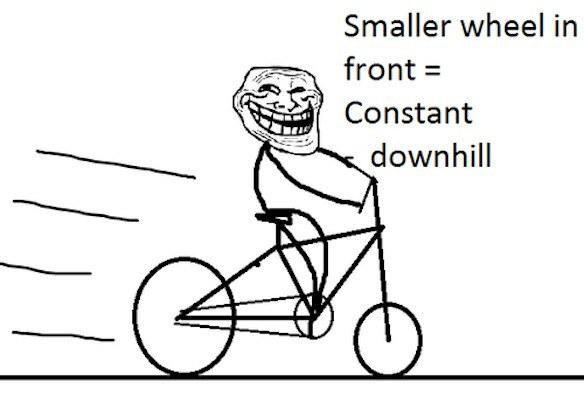
BTW if your bike has 20 inch wheels in front and 26 inch wheels in back, you are faster since you are alway riding down hill!!!
 01-10-21 | 05:05 PM
#21
Broken neck Ken
Joined: Oct 2008
Posts: 5,221
Likes: 3,519
From: Portland, OR
Bikes: Trek Domane SL6 Gen 3, Soma Fog Cutter, Detroit Bikes Sparrow FG, Trek Mt Track XCNimbus MUni
Not really a big deal. Both my bike and trike have 20/26 wheels. I carry several stick in boots, and have yet to use one, and have never walked home. I carry patchs, and two boxes of appropriate size tubes in my trunk pack.
BTW if your bike has 20 inch wheels in front and 26 inch wheels in back, you are faster since you are alway riding down hill!!!
BTW if your bike has 20 inch wheels in front and 26 inch wheels in back, you are faster since you are alway riding down hill!!!
Now on the longest events I carry 4 tubes and 1 tire. It's better. On my upright, I'm giving tubeless a go, but that's another story.
My experience isn't typical, I realize; most people don't ride stupidly long distances in remote places.
01-10-21 | 05:10 PM
#22
With a mighty wind
Joined: May 2015
Posts: 3,484
Likes: 1,534
Not really a big deal. Both my bike and trike have 20/26 wheels. I carry several stick in boots, and have yet to use one, and have never walked home. I carry patchs, and two boxes of appropriate size tubes in my trunk pack.
BTW if your bike has 20 inch wheels in front and 26 inch wheels in back, you are faster since you are alway riding down hill!!!
BTW if your bike has 20 inch wheels in front and 26 inch wheels in back, you are faster since you are alway riding down hill!!!
01-11-21 | 09:31 AM
#23
Senior Member
Joined: Sep 2015
Posts: 5,126
Likes: 1,324
From: Left Coast, Canada
 01-24-21 | 10:27 PM
#25
Clark W. Griswold

Joined: Mar 2014
Posts: 18,376
Likes: 6,702
From: ,location, location
Bikes: Foundry Chilkoot Ti W/Ultegra Di2, Salsa Timberjack Ti, Cinelli Mash Work RandoCross Fun Time Machine, 1x9 XT Parts Hybrid, Co-Motion Cascadia, Specialized Langster, Phil Wood Apple VeloXS Frame (w/DA 7400), R+M Supercharger2 Rohloff, Habanero Ti 26