


Tips for Packing A Bike for Air Travel
 02-24-21 | 02:53 PM
#1
Thread Starter
Junior Member
Joined: May 2017
Posts: 104
Likes: 14
Tips for Packing A Bike for Air Travel
Hi Folks,
I am cutting and pasting an in depth discussion on 'Packing a Bike for Air Travel' that got started organically from another thread that I had started with a completely different title and subject matter.
The information that I received specially from DJB and Tourist in MSN was so informative and helpful that I thought others might appreciate this information as well should they need to go through this process.
DJB: If you do plan to fly overseas, really take the time to read up and watch you tube vids of boxing your own bike. I've flown with my bike quite a number of times and I've picked up better techniques over the years.
the ideal thing is to become friendly with a bike shop mechanic and ask well ahead of time that when they receive and unbox a bike similar to your bike size, that they keep all the foam stuff, all the plastic bits like disc protector for front wheel, fork spacer, rear derailleur cover thingee etc and throw this all in the box as they go.
ideally if you can watch them take out a new bike this is great, take a photo cuz the dropbar and front wheel position will be the best way for you to get close to.
I shift to the largest rear sprocket to move the rd as far inward a possible, some people remove rd, others remove front rotor also but I just use the hard circular protector.
I put some foam under the fork brace also to absorb an impact. Tape it on. nearly always jam my sleeping bag in near fork area to hold bike in place, too big a bike box length wise isn't good, too much movement. You want bike well held, no big fore aft movement if possible.
I always reinforce the cut out hand openings with tape, they tend to rip from a fast and hard grab, and I reinforce the bottom corners too w tape.
first time boxing will take hours, figuring it out, making mistakes. Normal
I really do think it's worth doing it on your own, this way you'll be familiar with the process for return.
safe and smart packing is the key to reducing chances of damage if Angry Don't Give a Ratsass baggage handler is having a crappy day.....
we all love our bikes, so it's worth the time getting the techniques right.
oh, I use a marker to put UP arrows, can help too keep it right way up.
we do our best , then just hope for the best once it disappears out of sight down the conveyer belt........
PS, always arrive early for check in, and a friendly smile and all that tends to help also (at least at the check-in, Mr DGARatsass is out of our control!)
Also, if possible, no connecting flights just reduces the risk of damage simply from less times being handled.
and of course, various airlines have hugely different rules and fees, so do your research before buying a good deal of a ticket--"oh and yes Ma'am, that will be $200 each way to take your bike" sort of surprise....
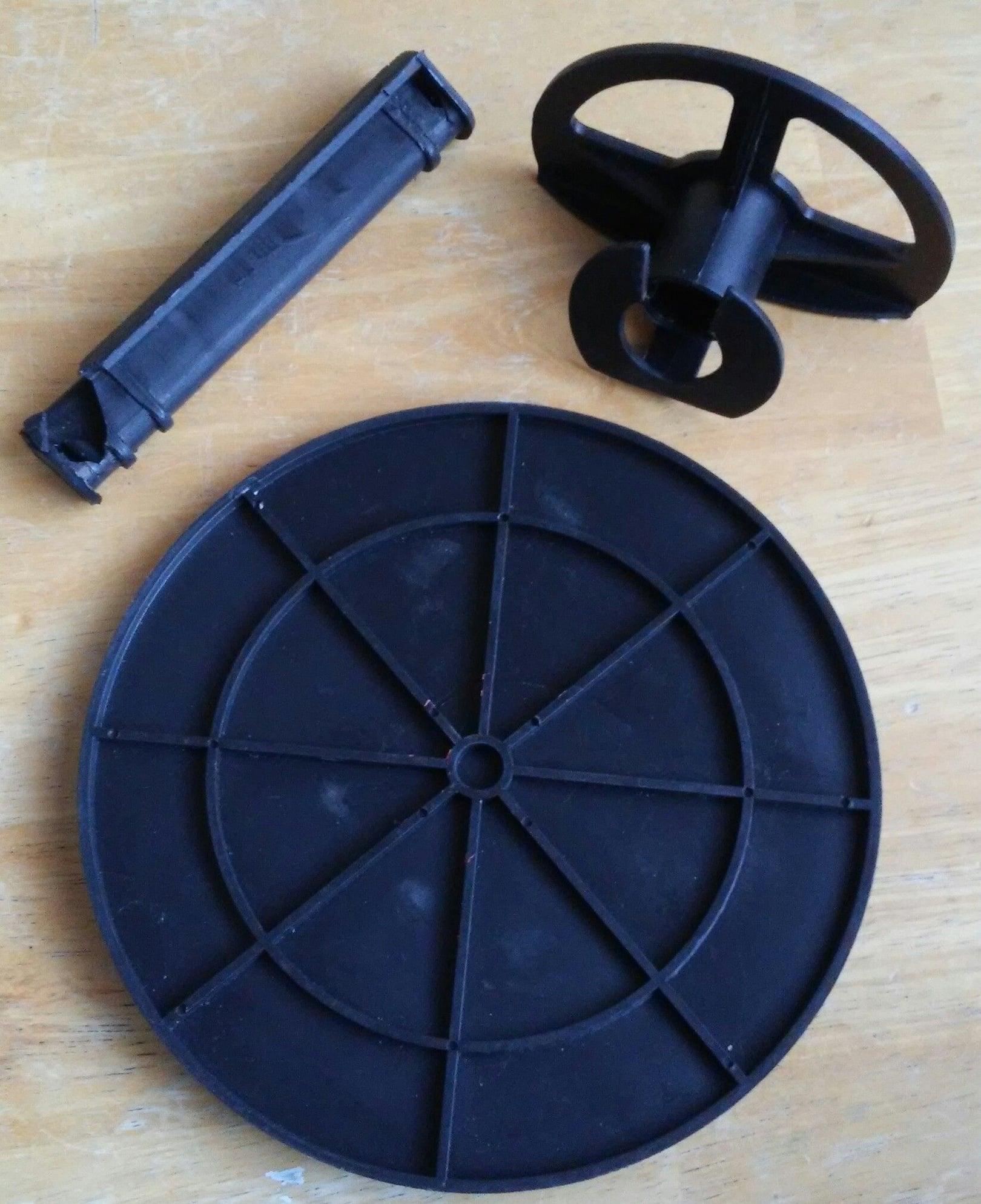
disc protector thingee, tape it on (no tape directly on disc though)
rd protector thingee, it slides on
fork spacer, super important. look at this one, last trip it got a bang good enough that it cracked it. Im glad I had put some foam under it and taped the foam to it and the fork.
and zip ties to hold wheel up against frame, with hub in open triangle of frame. to hold bars in place, hold foam bits in place too.
I take spare zip ties for return, again, no weight really and I dont have to source them. I buy new tape on location for return boxing.
These plastic doohickies and doodads and thingees come on new bikes inside the box. The store employee takes all the foam and these plastic things and chuck them in the garbage or recycling, and flattens the big cardboard box and chucks it out too.
So don't buy something, just ask at a bike store that hopefully has some new bikes......I write this and I hope there are some new arriving bikes.....
I was given this stuff and a bunch of similar ones a few years back at a bike store, when I was prepping my first disc bike for a trip. It's all recycling garbage to the store guys, so it shouldn't be that hard to get some. The disc protector things come in different sizes as diff bikes have various sized rotors. The rd one is a neat design, as the flat part goes up against the inside of the box.
I think these things are pretty standard bits though.
re zip ties, they are great, and I just use a small knive to cut them off.
good point about using two of you don't have a long enough one.
Tourist in MSN: Unless you have a steel frame, pull the rear derailleur off the bike to ship it. Much less chance of a hanger getting bent out of alignment. I was on a ACA bike trip three years ago, of the dozen or so people, three had bent rear derailleur hangers. Since I had worked in a bike shop, they all came to me for fixes, but I refused to try to reallign any bent replaceable hangers because if I broke one, the trip would have ended for that person.
And, if you pull the rear derailleur, might as well pull the chain off too and put that in a ziplock. If a quick link was used, be careful to not lose part of the quick link.
But steel frames, only once have I seen a steel frame bike with a replaceable hanger, typically the hanger that is part of the frame can be bent back without fear of breaking a hanger.
Pre-covid, I often asked at the Dr or dentist office if I could get a few extra pair of disposable gloves for bike repair, they were always happy to give me a few. But right now, that stuff is worth gold, so I probably will not be asking for any for another year. But those gloves come in handy to pack and reassemble a bike.
Pick up a bag of zip ties, they are only a buck at Dollar Tree. Useful for tying parts of a bike together for packing. A side cutter pliers or toe nail cliper is good for quick removal. Bring enough on your trip for the return flight home. If they are too short, put two together to make them twice as long.
When I pack a bike for airline travel I like to document the condition before I give it to the airlines with my camera, that includes the bike as packed together in a bundle before I close up the case or before I put the bike into the box. I have not needed to pull out my camera to argue about condition, fortunately, but documentation never hurts. I have shown an airline employee what my bag looked like on my camera screen when they were trying to locate my lost bag, it was useful for that purpose too.
From the photo of your bike, that is a very small frame size. Thus, should easily be able to get a bike box. But once you get one that fits like a glove, keep notes on the exact size so you can request a box that fits your needs in the future. Asking a bike shop in advance means that they can put a note on a bike box for their mechanics, so when that bike is built up they can call you and say your box is ready. And ask them to keep all of the packing materials with the box as Djb noted.
I do not know what the finish on your titanium bike is like but if it is the kind of finish you need to be careful to avoid scratching, I have heard that food cling wrap (example: saran wrap or glad cling wrap) is a good way to protect bike surfaces for shipping. I have not used it, only commenting on what I have heard. I have only shipped my S&S bike and that is an expedition bike, it is expected to have some nicks and scrapes. And my titanium bike has a finish that hides scratches quite well.
Looks like a carbon fork. I do not know if they need any special care when packing or not, I have never owned a carbon bike or fork. (I put a steel fork on my titanium touring bike.) But at a minimum I would wrap that with something so that nothing can abrade it.
When I bought my road bike, I am the one that took it out of the bike box from the factory. Took photos of it as it came out of the box, photos are below. Thus, this represents the way a bike manufacturer packs bikes.

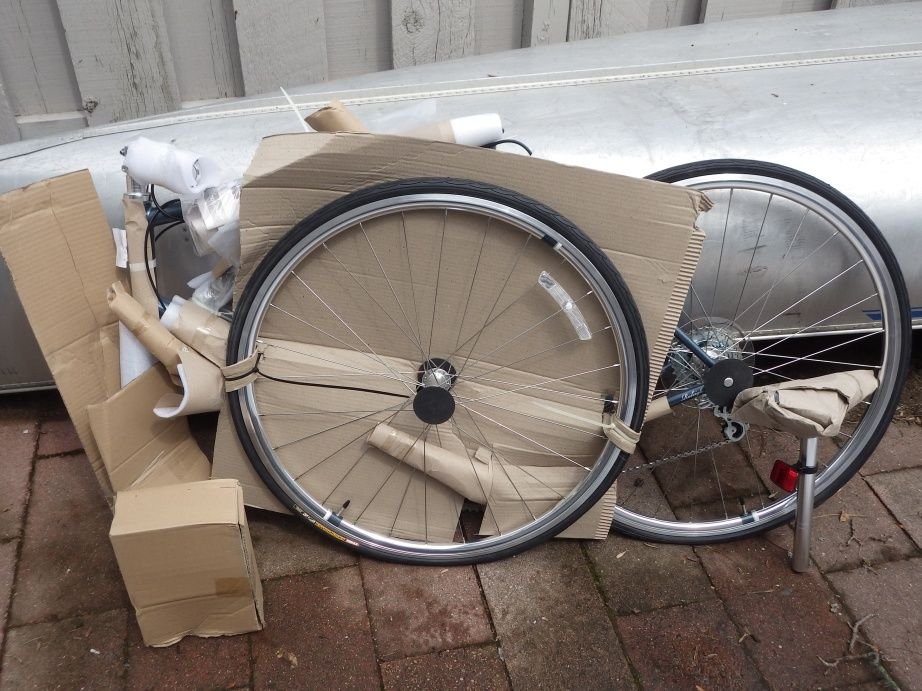
Looks like they just used a plastic protector over the skewer to protect rear derailleur. I bought this three years ago, do not remember the details, but this bike has a steel frame, thus no replaceable hanger, the hanger is part of the frame.
Second photo, small box had a lot of parts like the front skewer, etc. You can see they used zip ties to hold the front wheel to the frame. In this case, seat and seatpost were packed separate, not in the frame and not zip tied to it.
Or just pay a bike shop to box it for you. But it is a good idea to know how to do it yourself in case you need to pack it in a foreign country to come home.
Keep the rear rack on. If you put a front rack on, that you might want to remove to make sure that the fork is not damaged, being a carbon fork.
Leave the derailleur attached to the cables and wrap it really well. Removed means that it does not stick out where an impact could bend the hanger, that is the main point of removing it, to protect the hanger. Reassembling means that you have to thread the chain through it the right way. I often get my chain on the wrong side of a tab on the derailleur cage and have to re-do it.
Remove the front skewer. I met a couple of Italians in Iceland that had just arrived, they must have packed their bikes together, both left the skewers in the front wheels and both of them had bent skewers, hard to replace a skewer in Reykjavik on a Sunday.
Djb mentioned the plastic fork protector that goes in the dropouts. That also is intended to make sure that the dropouts do not punch holes in the box and stick out the bottom.
When I travel somewhere with my bike packed in the S&S case, on my phone is a series of six or eight photos showing the sequence of how I pack the bike so I can remember. This is what my travel bike looks like packed, the frame can be split to fit in a smaller case, fork removed (and I have a photo on my phone with all the headset parts in the correct order on the fork), it is a tight fit.

If you had any concerns about getting your chain through the derailleur cage correctly, take a photo so you can see how the chain loops through it first.
DJB: seems to me there always is a weight limit, I don’t recall what it tends to be, but usually I’ve checked the specific airlines "sports equipment or bike" info webpage and it’s usually fairly clear.
‘possibly 50 lbs often?
ive always made sure the bike box is a bit under their number.
so yes, the total weight thing could be an issue, but your bike is probably quite light. My touring bike with both racks, fenders is about 30lbs, a bit over maybe.
the next obvious issue is flying back from another city or country, so not ideal one of these hard cases. I’ve done numerous trips like this,so a hard case just wouldn’t work unless one arranged to ship it somewhere, but that’s either an added cost or even just not practical, like when I did a few trips in central America and Mexico.
Tourist in MSN: Airlines always have weight limits. I think most common are 50 pound or 23 kg. But, a few low budget airlines use 20 kg, so unless you have traveled that airline before, check the exact numbers. Also, some airlines allow 70 pounds for an extra weight fee which can be waived for high mileage customers, my sister used to travel a lot and her weight limit was 70 instead of 50 pounds. But many airlines do not allow any package over the weight limit. Check the airline website.
A good luggage scale is the travelers best friend, you do not want to be standing at ticketing trying to remove a few pounds that you do not have room for elsewhere when there is a long line. I try to aim for 49 pounds since you never know when the luggage scale and airline scale will not exactly agree. Add up the weight of the Thule case and your bike to see if it works. My bike that is packed in my S&S Backpack in the photo posted above, that bike and case exceed the weight limits. My pedals, saddle, rear rack and a few other things have to be packed in my other carry on bag. I find that I am weighing the bag several times before I hand it over to the airline.
Being small, I can certainly understand why you want a wheeled case, and that case might be small enough to fit in the back seat of a small car since both wheels have to come off the bike to fit.
But that means that all trips must be loops, or use mass transit to get back to where your case is stored. Some people have shipped cases to their tour destination without a problem but that adds more logistics and costs. My trips where I flew with my bike, I stored the case in a motel storage room where they stored other bike boxes. I showed a photo above of my bike in my S&S backpack case, I have taken the side panels out of that to make that only a couple inches thick when I left other stuff in the case and stored that in hostel luggage rooms a couple times. But hostels want luggage that is stored there for very long to be smaller than that Thule case, they might say no. I always try to make sure that there will be a place for my luggage storage before I buy my plane ticket. As a general rule, I would expect that a mid-range to higher priced hotel would store the Thule case for several weeks where a hostel would refuse to do so. That said, you have more travel experience than me so maybe you know better on that, as I am guessing on that. I have had budget motels tell me on the phone that they do not have any luggage storage room at all.
The photo is my S&S backpack case as I stored it at a hostel for five weeks. Inside I also had my backpack that I used as my other piece of checked luggage. It is much thinner because I removed the side pieces that give it structure. I added 26 X 26 inch corroplastic sheets in top and bottom, if I had not done that it could be folded much smaller, but if that was a deal breaker, I could crease the corroplast and make it smaller if I had to. With my other stuff in it, I think it is about 2 to 3 inches thick in the photo.

Back to your size question, most USA airlines use the same 62 inch criteria, and then there are other larger criteriia that might trigger higher fees or be an absolute no-travel point, I think I have seen a 115 inch number for one airline, but each airline has different criteria, that Thule case likely can fly on all airlines, but airlines that have a oversize fee for exceeding the 62 inch criteria would likely charge for that Thule case.
EXCEPT: some flights use very small aircraft and on those flights they might not allow anything bigger than 62 inches. But it is unlikely you would travel on such plans for a bike trip, but you need to be aware of that to avoid the smallest planes. Years ago for work I did have to travel on such small planes, so I know they exist.
That Thule case, racks would come off, water bottle cages might come off, etc.
Since you are storing the case somewhere, it makes sense to store some shop sized tools with it instead of trying to do everything with a tiny little multi-tool.
I use blue (removable) threadlocker on all rack bolts. There are a variety of brands, last time I bought any, this is what I bought.
https://www.truevalue.com/6-ml-remov...hread-locker-1
Not everybody uses threadlocker, some bike shops do not have a bottle anywhere in the shop. But I recommend it on rack bolts, shoe cleat bolts, On my Lynskey, I wished that the manufacturer had used it on the replaceable dropout screws, they did not and to make a long story short, I had to add it myself.
I should have said this earlier but forgot. Sometimes pedals are threaded on REALLY tight. I often check my pedals a few days before I flew to make sure that they were loose enough that I could remove them with the tools I had, so I was not in a crisis at the last minute unable to get a pedal off. But they do need to be wrenched tight enough on the bike to use them. A friend of mine had to have a bike shop unthread his pedals. I assume you know that one pedal is left hand thread. I loaned my pedal wrench to a couple other cyclists at the campground in Reykjavik when they had trouble getting their pedals off at the end of a trip.
I assume you have flown with camping gear before, so I assume you are aware of camp stoves and airport security. But if not:
https://www.msrgear.com/blog/flying-...camping-stove/
In Halifax NS, a Canadian security inspector asked me to remove my stove that she saw on the X ray, she said if she could smell any fuel she had to confiscate it, it was a butane mix type of stove. I dug it out, handed it to her, she sniffed it and handed it back to me to repack.
DJB: re moving a cardboard bike box around.
I'm a slight guy, 135 tops, so I'm not the Hulk, but here's what has worked for me.
I can carry my bike box a short distance, but usually we're talking just putting it into a car. Other than that, its putting it onto an airport luggage cart, unloading it at the desk, or for the line and just sliding it easily along the smooth airport floor.
Upon arrival at an airport, I grab a cart right away and pick it up from the oversize area, putting it back on cart, again so no carrying for more than a few seconds.
One time I had to physically move it farther was flying into Oaxaca, Mexico where for once I was going directly to a hotel with it still in box. The carts were not allowed past a certain point at the airport, so I just slid it along the floor 20 ft, went back, got my panniers, repeat, until I got to the front doors where taxi dudes were.
Other than that, on other trips, airport carts were both available and able to be taken out to close to cars were, but I have also done the "put bike together and ride away" thing at airports. This is why its generally a good idea to practice the whole boxing, unboxing thing a bunch of times so you are familiar with this, so at least its a bit less stressful.
Doing this for the first time when you are tired and maybe jet lagged can easily be a frustrating, drawn out experience.
**One plus for you is that you aren't dealing with a front rack and front fender, so less brain work needed
I would say that if possible, its nice to be able to do this after a sleep and not rushed, so it just makes sense to look into taxi transport possibilities and expect a bit of a workout getting the bike box into a hotel room.
anyway, just more food for thought.
Dmeans2anend: Few things I sort of learned from Youtube videos but not sure if I am explaining properly though:
1) Deflate tires a little bit so they don't pop in flight
2) Water bottle are good containers of multi-tools and odd bits that are put in ziplocks bags and put back into cage of bike
3) Take handlebar off from stem faceplate instead of taking off the entire stem to prevent headset bearings from coming loose and fork coming loose. Turn the handlebar towards the frame and zip tie.
4) Hydraulic disc brakes should have plastic disc brake spacers to prevent pads from getting stuck together. Not sure if I have hydraulic disc brakes?
5) If using cardboard box, try to zip tie all of it as 'one unit' so that it can be lifted out together in case TSA wants to inspect. Wheels through the crank, steering turned close to the frame.
6) Anything taken off. Make sure the all bolts are tighten back so they aren't lost in transit in the box.
7) Do not pack helmet and cycling shoes with bike in case bike is lost in transit. You still have what you need to rent a bike to ride.
8) Mark the box with contact info on the outside. In the inside attached to the bike, add name, address, and contact information at arrival destination (hotel, phone, etc) in case box is damaged all your information is still on the bike.
9) If you can, leave the seat on the bike and adjust the height at the end so that it is butted to the height of the box to prevent shifting of bike.
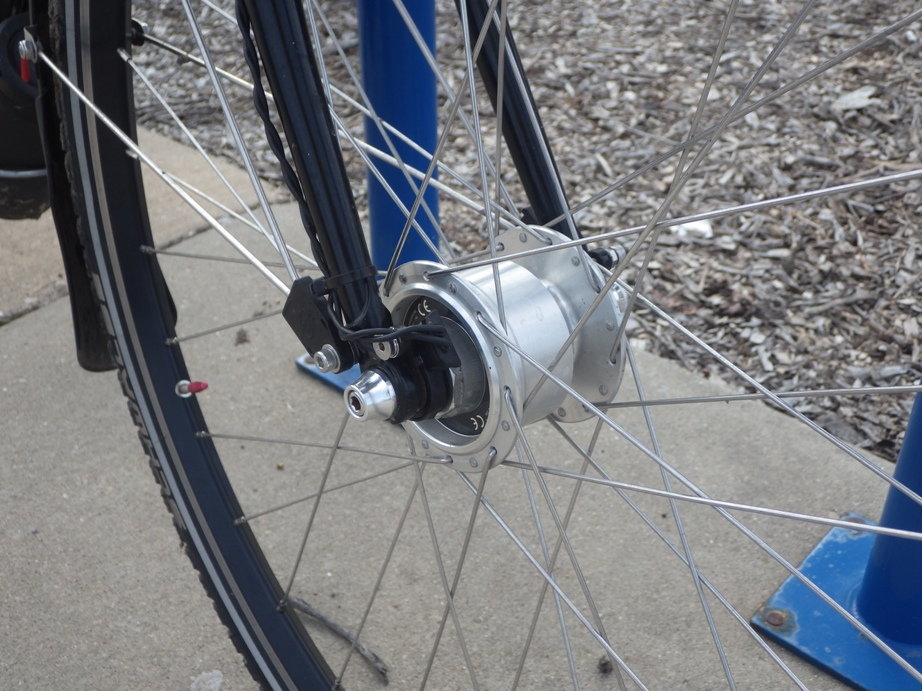
Tourist in MSN: Yeah, I lost a cleat bolt a couple years ago, even when I check them on a regular basis. When new, the cleats press on the shoe sole, that sole is plastic and gives a little so the bolts loosen up. I store spare bolts on my bike frame, on the photo the bolt on the right side fork dropout is a cleat bolt, the bolt being tapered has a couple washers under it.
When you ask a bike shop for a box, if you tell them your frame size, the box might still be a bit short. Road bikes have short chainstays, touring bikes have longer chainstays. I do not recall if your titanium bike was built as a touring bike or not. My point is that a road bike box is likely shorter in length than a touring bike box.
Other points:
1 - This is controversial, air safety rules specify no compressed gasses, some air security personnel will consider aired up tires to be full of an illegal substance and they will deflate them. Many others do not care. I have to deflate my tires to fit in the small case. I do not think a tire is at risk of blowing off, and I would leave some pressure in the tires so if baggage handlers drop teh box, there is some cushioning from the pressure.
9 - Put something soft over your saddle, I have had one of my leather saddles show a bit of wear from the saddle rubbing on the cardboard. Maybe a paper towel or bandana and a plastic bag over that.
DJB: super nice of them to give you the pedal wrench. I used to carry a small one on trips, but if you always put grease on the threads, and don't overtighten them, I can use a hex key, allen key, to remove my pedals now. The allen key is lighter than my wrench, and my spd pedals have the allen key shape on the inside back of the pedal axle. I give the allen key a good whack with my hand , cushioned by some clothes, and they loosen fairly easily.
as for your points
1- yes, always take some air out, they will ask you at security or oversize security, so I always say " yes they are deflated" , although I too leave some in for cushion.
2-I'd be a bit hesitant of losing all this important stuff if the box gets ripped and a bike bottle comes loose and falls out......but thats me.
3- absolutely the best way. My bikes have had Ortlieb handlebar mounts on them, which complicates things, and I decided to leave mount on, so I had to deal with the stem being on the bars for packing, not ideal....
4-yes on the spacers, I've even put clean cardboard jammed in my mechanical discs , so that the pads dont get squeezed out too far if and when the brake levers are pushed....As for your brakes, photos please, and or look for an actual cable.
5- ya, I've taken to zip tieing, tie-ing sp? the front wheel to frame now, but really more for stopping wheel from moving around and hub scratching frame. Being Canadian, Ive found our version of TSA to be a lot less invasive than for you guys south of us.
6- yup, pretty good general advice.
7- yup, and also chances are pretty darn good your helmet will get cracked. And yes, I've had crew and passengers look at me funnily also, but hey.....
8- I've actually never thought of doing this....good tip
9- yup, I've alway left seatpost in, and it has always had this positive side effect of keeping bike in place a bit more. I have put cardboard however on my leather seats so they dont get dinged or scuffed if things go badly.
I'd add one more thing.
Another reason to trying it out on your own with lots of time is that it can be frustrating. You'll probably swear some, and there are moments that it really helps to have someone helping, as two hands are lacking at times. So if you do it and make all kinds of mistakes NOT at midnight when you have to fly the next day, its just easier overall.
I am cutting and pasting an in depth discussion on 'Packing a Bike for Air Travel' that got started organically from another thread that I had started with a completely different title and subject matter.
The information that I received specially from DJB and Tourist in MSN was so informative and helpful that I thought others might appreciate this information as well should they need to go through this process.
DJB: If you do plan to fly overseas, really take the time to read up and watch you tube vids of boxing your own bike. I've flown with my bike quite a number of times and I've picked up better techniques over the years.
the ideal thing is to become friendly with a bike shop mechanic and ask well ahead of time that when they receive and unbox a bike similar to your bike size, that they keep all the foam stuff, all the plastic bits like disc protector for front wheel, fork spacer, rear derailleur cover thingee etc and throw this all in the box as they go.
ideally if you can watch them take out a new bike this is great, take a photo cuz the dropbar and front wheel position will be the best way for you to get close to.
I shift to the largest rear sprocket to move the rd as far inward a possible, some people remove rd, others remove front rotor also but I just use the hard circular protector.
I put some foam under the fork brace also to absorb an impact. Tape it on. nearly always jam my sleeping bag in near fork area to hold bike in place, too big a bike box length wise isn't good, too much movement. You want bike well held, no big fore aft movement if possible.
I always reinforce the cut out hand openings with tape, they tend to rip from a fast and hard grab, and I reinforce the bottom corners too w tape.
first time boxing will take hours, figuring it out, making mistakes. Normal
I really do think it's worth doing it on your own, this way you'll be familiar with the process for return.
safe and smart packing is the key to reducing chances of damage if Angry Don't Give a Ratsass baggage handler is having a crappy day.....
we all love our bikes, so it's worth the time getting the techniques right.
oh, I use a marker to put UP arrows, can help too keep it right way up.
we do our best , then just hope for the best once it disappears out of sight down the conveyer belt........
PS, always arrive early for check in, and a friendly smile and all that tends to help also (at least at the check-in, Mr DGARatsass is out of our control!)
Also, if possible, no connecting flights just reduces the risk of damage simply from less times being handled.
and of course, various airlines have hugely different rules and fees, so do your research before buying a good deal of a ticket--"oh and yes Ma'am, that will be $200 each way to take your bike" sort of surprise....
disc protector thingee, tape it on (no tape directly on disc though)
rd protector thingee, it slides on
fork spacer, super important. look at this one, last trip it got a bang good enough that it cracked it. Im glad I had put some foam under it and taped the foam to it and the fork.
and zip ties to hold wheel up against frame, with hub in open triangle of frame. to hold bars in place, hold foam bits in place too.
I take spare zip ties for return, again, no weight really and I dont have to source them. I buy new tape on location for return boxing.
These plastic doohickies and doodads and thingees come on new bikes inside the box. The store employee takes all the foam and these plastic things and chuck them in the garbage or recycling, and flattens the big cardboard box and chucks it out too.
So don't buy something, just ask at a bike store that hopefully has some new bikes......I write this and I hope there are some new arriving bikes.....
I was given this stuff and a bunch of similar ones a few years back at a bike store, when I was prepping my first disc bike for a trip. It's all recycling garbage to the store guys, so it shouldn't be that hard to get some. The disc protector things come in different sizes as diff bikes have various sized rotors. The rd one is a neat design, as the flat part goes up against the inside of the box.
I think these things are pretty standard bits though.
re zip ties, they are great, and I just use a small knive to cut them off.
good point about using two of you don't have a long enough one.
Tourist in MSN: Unless you have a steel frame, pull the rear derailleur off the bike to ship it. Much less chance of a hanger getting bent out of alignment. I was on a ACA bike trip three years ago, of the dozen or so people, three had bent rear derailleur hangers. Since I had worked in a bike shop, they all came to me for fixes, but I refused to try to reallign any bent replaceable hangers because if I broke one, the trip would have ended for that person.
And, if you pull the rear derailleur, might as well pull the chain off too and put that in a ziplock. If a quick link was used, be careful to not lose part of the quick link.
But steel frames, only once have I seen a steel frame bike with a replaceable hanger, typically the hanger that is part of the frame can be bent back without fear of breaking a hanger.
Pre-covid, I often asked at the Dr or dentist office if I could get a few extra pair of disposable gloves for bike repair, they were always happy to give me a few. But right now, that stuff is worth gold, so I probably will not be asking for any for another year. But those gloves come in handy to pack and reassemble a bike.
Pick up a bag of zip ties, they are only a buck at Dollar Tree. Useful for tying parts of a bike together for packing. A side cutter pliers or toe nail cliper is good for quick removal. Bring enough on your trip for the return flight home. If they are too short, put two together to make them twice as long.
When I pack a bike for airline travel I like to document the condition before I give it to the airlines with my camera, that includes the bike as packed together in a bundle before I close up the case or before I put the bike into the box. I have not needed to pull out my camera to argue about condition, fortunately, but documentation never hurts. I have shown an airline employee what my bag looked like on my camera screen when they were trying to locate my lost bag, it was useful for that purpose too.
From the photo of your bike, that is a very small frame size. Thus, should easily be able to get a bike box. But once you get one that fits like a glove, keep notes on the exact size so you can request a box that fits your needs in the future. Asking a bike shop in advance means that they can put a note on a bike box for their mechanics, so when that bike is built up they can call you and say your box is ready. And ask them to keep all of the packing materials with the box as Djb noted.
I do not know what the finish on your titanium bike is like but if it is the kind of finish you need to be careful to avoid scratching, I have heard that food cling wrap (example: saran wrap or glad cling wrap) is a good way to protect bike surfaces for shipping. I have not used it, only commenting on what I have heard. I have only shipped my S&S bike and that is an expedition bike, it is expected to have some nicks and scrapes. And my titanium bike has a finish that hides scratches quite well.
Looks like a carbon fork. I do not know if they need any special care when packing or not, I have never owned a carbon bike or fork. (I put a steel fork on my titanium touring bike.) But at a minimum I would wrap that with something so that nothing can abrade it.
When I bought my road bike, I am the one that took it out of the bike box from the factory. Took photos of it as it came out of the box, photos are below. Thus, this represents the way a bike manufacturer packs bikes.
Looks like they just used a plastic protector over the skewer to protect rear derailleur. I bought this three years ago, do not remember the details, but this bike has a steel frame, thus no replaceable hanger, the hanger is part of the frame.
Second photo, small box had a lot of parts like the front skewer, etc. You can see they used zip ties to hold the front wheel to the frame. In this case, seat and seatpost were packed separate, not in the frame and not zip tied to it.
Or just pay a bike shop to box it for you. But it is a good idea to know how to do it yourself in case you need to pack it in a foreign country to come home.
Keep the rear rack on. If you put a front rack on, that you might want to remove to make sure that the fork is not damaged, being a carbon fork.
Leave the derailleur attached to the cables and wrap it really well. Removed means that it does not stick out where an impact could bend the hanger, that is the main point of removing it, to protect the hanger. Reassembling means that you have to thread the chain through it the right way. I often get my chain on the wrong side of a tab on the derailleur cage and have to re-do it.
Remove the front skewer. I met a couple of Italians in Iceland that had just arrived, they must have packed their bikes together, both left the skewers in the front wheels and both of them had bent skewers, hard to replace a skewer in Reykjavik on a Sunday.
Djb mentioned the plastic fork protector that goes in the dropouts. That also is intended to make sure that the dropouts do not punch holes in the box and stick out the bottom.
When I travel somewhere with my bike packed in the S&S case, on my phone is a series of six or eight photos showing the sequence of how I pack the bike so I can remember. This is what my travel bike looks like packed, the frame can be split to fit in a smaller case, fork removed (and I have a photo on my phone with all the headset parts in the correct order on the fork), it is a tight fit.
If you had any concerns about getting your chain through the derailleur cage correctly, take a photo so you can see how the chain loops through it first.
DJB: seems to me there always is a weight limit, I don’t recall what it tends to be, but usually I’ve checked the specific airlines "sports equipment or bike" info webpage and it’s usually fairly clear.
‘possibly 50 lbs often?
ive always made sure the bike box is a bit under their number.
so yes, the total weight thing could be an issue, but your bike is probably quite light. My touring bike with both racks, fenders is about 30lbs, a bit over maybe.
the next obvious issue is flying back from another city or country, so not ideal one of these hard cases. I’ve done numerous trips like this,so a hard case just wouldn’t work unless one arranged to ship it somewhere, but that’s either an added cost or even just not practical, like when I did a few trips in central America and Mexico.
Tourist in MSN: Airlines always have weight limits. I think most common are 50 pound or 23 kg. But, a few low budget airlines use 20 kg, so unless you have traveled that airline before, check the exact numbers. Also, some airlines allow 70 pounds for an extra weight fee which can be waived for high mileage customers, my sister used to travel a lot and her weight limit was 70 instead of 50 pounds. But many airlines do not allow any package over the weight limit. Check the airline website.
A good luggage scale is the travelers best friend, you do not want to be standing at ticketing trying to remove a few pounds that you do not have room for elsewhere when there is a long line. I try to aim for 49 pounds since you never know when the luggage scale and airline scale will not exactly agree. Add up the weight of the Thule case and your bike to see if it works. My bike that is packed in my S&S Backpack in the photo posted above, that bike and case exceed the weight limits. My pedals, saddle, rear rack and a few other things have to be packed in my other carry on bag. I find that I am weighing the bag several times before I hand it over to the airline.
Being small, I can certainly understand why you want a wheeled case, and that case might be small enough to fit in the back seat of a small car since both wheels have to come off the bike to fit.
But that means that all trips must be loops, or use mass transit to get back to where your case is stored. Some people have shipped cases to their tour destination without a problem but that adds more logistics and costs. My trips where I flew with my bike, I stored the case in a motel storage room where they stored other bike boxes. I showed a photo above of my bike in my S&S backpack case, I have taken the side panels out of that to make that only a couple inches thick when I left other stuff in the case and stored that in hostel luggage rooms a couple times. But hostels want luggage that is stored there for very long to be smaller than that Thule case, they might say no. I always try to make sure that there will be a place for my luggage storage before I buy my plane ticket. As a general rule, I would expect that a mid-range to higher priced hotel would store the Thule case for several weeks where a hostel would refuse to do so. That said, you have more travel experience than me so maybe you know better on that, as I am guessing on that. I have had budget motels tell me on the phone that they do not have any luggage storage room at all.
The photo is my S&S backpack case as I stored it at a hostel for five weeks. Inside I also had my backpack that I used as my other piece of checked luggage. It is much thinner because I removed the side pieces that give it structure. I added 26 X 26 inch corroplastic sheets in top and bottom, if I had not done that it could be folded much smaller, but if that was a deal breaker, I could crease the corroplast and make it smaller if I had to. With my other stuff in it, I think it is about 2 to 3 inches thick in the photo.
Back to your size question, most USA airlines use the same 62 inch criteria, and then there are other larger criteriia that might trigger higher fees or be an absolute no-travel point, I think I have seen a 115 inch number for one airline, but each airline has different criteria, that Thule case likely can fly on all airlines, but airlines that have a oversize fee for exceeding the 62 inch criteria would likely charge for that Thule case.
EXCEPT: some flights use very small aircraft and on those flights they might not allow anything bigger than 62 inches. But it is unlikely you would travel on such plans for a bike trip, but you need to be aware of that to avoid the smallest planes. Years ago for work I did have to travel on such small planes, so I know they exist.
That Thule case, racks would come off, water bottle cages might come off, etc.
Since you are storing the case somewhere, it makes sense to store some shop sized tools with it instead of trying to do everything with a tiny little multi-tool.
I use blue (removable) threadlocker on all rack bolts. There are a variety of brands, last time I bought any, this is what I bought.
https://www.truevalue.com/6-ml-remov...hread-locker-1
Not everybody uses threadlocker, some bike shops do not have a bottle anywhere in the shop. But I recommend it on rack bolts, shoe cleat bolts, On my Lynskey, I wished that the manufacturer had used it on the replaceable dropout screws, they did not and to make a long story short, I had to add it myself.
I should have said this earlier but forgot. Sometimes pedals are threaded on REALLY tight. I often check my pedals a few days before I flew to make sure that they were loose enough that I could remove them with the tools I had, so I was not in a crisis at the last minute unable to get a pedal off. But they do need to be wrenched tight enough on the bike to use them. A friend of mine had to have a bike shop unthread his pedals. I assume you know that one pedal is left hand thread. I loaned my pedal wrench to a couple other cyclists at the campground in Reykjavik when they had trouble getting their pedals off at the end of a trip.
I assume you have flown with camping gear before, so I assume you are aware of camp stoves and airport security. But if not:
https://www.msrgear.com/blog/flying-...camping-stove/
In Halifax NS, a Canadian security inspector asked me to remove my stove that she saw on the X ray, she said if she could smell any fuel she had to confiscate it, it was a butane mix type of stove. I dug it out, handed it to her, she sniffed it and handed it back to me to repack.
DJB: re moving a cardboard bike box around.
I'm a slight guy, 135 tops, so I'm not the Hulk, but here's what has worked for me.
I can carry my bike box a short distance, but usually we're talking just putting it into a car. Other than that, its putting it onto an airport luggage cart, unloading it at the desk, or for the line and just sliding it easily along the smooth airport floor.
Upon arrival at an airport, I grab a cart right away and pick it up from the oversize area, putting it back on cart, again so no carrying for more than a few seconds.
One time I had to physically move it farther was flying into Oaxaca, Mexico where for once I was going directly to a hotel with it still in box. The carts were not allowed past a certain point at the airport, so I just slid it along the floor 20 ft, went back, got my panniers, repeat, until I got to the front doors where taxi dudes were.
Other than that, on other trips, airport carts were both available and able to be taken out to close to cars were, but I have also done the "put bike together and ride away" thing at airports. This is why its generally a good idea to practice the whole boxing, unboxing thing a bunch of times so you are familiar with this, so at least its a bit less stressful.
Doing this for the first time when you are tired and maybe jet lagged can easily be a frustrating, drawn out experience.
**One plus for you is that you aren't dealing with a front rack and front fender, so less brain work needed
I would say that if possible, its nice to be able to do this after a sleep and not rushed, so it just makes sense to look into taxi transport possibilities and expect a bit of a workout getting the bike box into a hotel room.
anyway, just more food for thought.
Dmeans2anend: Few things I sort of learned from Youtube videos but not sure if I am explaining properly though:
1) Deflate tires a little bit so they don't pop in flight
2) Water bottle are good containers of multi-tools and odd bits that are put in ziplocks bags and put back into cage of bike
3) Take handlebar off from stem faceplate instead of taking off the entire stem to prevent headset bearings from coming loose and fork coming loose. Turn the handlebar towards the frame and zip tie.
4) Hydraulic disc brakes should have plastic disc brake spacers to prevent pads from getting stuck together. Not sure if I have hydraulic disc brakes?
5) If using cardboard box, try to zip tie all of it as 'one unit' so that it can be lifted out together in case TSA wants to inspect. Wheels through the crank, steering turned close to the frame.
6) Anything taken off. Make sure the all bolts are tighten back so they aren't lost in transit in the box.
7) Do not pack helmet and cycling shoes with bike in case bike is lost in transit. You still have what you need to rent a bike to ride.
8) Mark the box with contact info on the outside. In the inside attached to the bike, add name, address, and contact information at arrival destination (hotel, phone, etc) in case box is damaged all your information is still on the bike.
9) If you can, leave the seat on the bike and adjust the height at the end so that it is butted to the height of the box to prevent shifting of bike.
Tourist in MSN: Yeah, I lost a cleat bolt a couple years ago, even when I check them on a regular basis. When new, the cleats press on the shoe sole, that sole is plastic and gives a little so the bolts loosen up. I store spare bolts on my bike frame, on the photo the bolt on the right side fork dropout is a cleat bolt, the bolt being tapered has a couple washers under it.
When you ask a bike shop for a box, if you tell them your frame size, the box might still be a bit short. Road bikes have short chainstays, touring bikes have longer chainstays. I do not recall if your titanium bike was built as a touring bike or not. My point is that a road bike box is likely shorter in length than a touring bike box.
Other points:
1 - This is controversial, air safety rules specify no compressed gasses, some air security personnel will consider aired up tires to be full of an illegal substance and they will deflate them. Many others do not care. I have to deflate my tires to fit in the small case. I do not think a tire is at risk of blowing off, and I would leave some pressure in the tires so if baggage handlers drop teh box, there is some cushioning from the pressure.
9 - Put something soft over your saddle, I have had one of my leather saddles show a bit of wear from the saddle rubbing on the cardboard. Maybe a paper towel or bandana and a plastic bag over that.
DJB: super nice of them to give you the pedal wrench. I used to carry a small one on trips, but if you always put grease on the threads, and don't overtighten them, I can use a hex key, allen key, to remove my pedals now. The allen key is lighter than my wrench, and my spd pedals have the allen key shape on the inside back of the pedal axle. I give the allen key a good whack with my hand , cushioned by some clothes, and they loosen fairly easily.
as for your points
1- yes, always take some air out, they will ask you at security or oversize security, so I always say " yes they are deflated" , although I too leave some in for cushion.
2-I'd be a bit hesitant of losing all this important stuff if the box gets ripped and a bike bottle comes loose and falls out......but thats me.
3- absolutely the best way. My bikes have had Ortlieb handlebar mounts on them, which complicates things, and I decided to leave mount on, so I had to deal with the stem being on the bars for packing, not ideal....
4-yes on the spacers, I've even put clean cardboard jammed in my mechanical discs , so that the pads dont get squeezed out too far if and when the brake levers are pushed....As for your brakes, photos please, and or look for an actual cable.
5- ya, I've taken to zip tieing, tie-ing sp? the front wheel to frame now, but really more for stopping wheel from moving around and hub scratching frame. Being Canadian, Ive found our version of TSA to be a lot less invasive than for you guys south of us.
6- yup, pretty good general advice.
7- yup, and also chances are pretty darn good your helmet will get cracked. And yes, I've had crew and passengers look at me funnily also, but hey.....
8- I've actually never thought of doing this....good tip
9- yup, I've alway left seatpost in, and it has always had this positive side effect of keeping bike in place a bit more. I have put cardboard however on my leather seats so they dont get dinged or scuffed if things go badly.
I'd add one more thing.
Another reason to trying it out on your own with lots of time is that it can be frustrating. You'll probably swear some, and there are moments that it really helps to have someone helping, as two hands are lacking at times. So if you do it and make all kinds of mistakes NOT at midnight when you have to fly the next day, its just easier overall.


 07-14-22 | 12:50 PM
#2
Junior Member

Joined: Oct 2014
Posts: 176
Likes: 2
From: Milwaukee
Bikes: Trek Domane SL7 83 Cannondale, 70s Raleigh International, 70s Bob Jackson, 70s Gitane tandem, 2018 Trek Domane SL7, Giant Yukon MTB
super info - thanks. So, shop bike boxes are ok?
I'm wondering how a shop box compares to the $100 box from bike flights..
Any reason to use theirs? I have a 1983 Cannondale aluminum bike with fenders, rear rack, trunk bag and aerobars - How would I decide what size box to use? Front fender off I'm guessing.. Remove aerobars too.. Any thoughts are gratefully received.

BikeFlights Bike Box
Any reason to use theirs? I have a 1983 Cannondale aluminum bike with fenders, rear rack, trunk bag and aerobars - How would I decide what size box to use? Front fender off I'm guessing.. Remove aerobars too.. Any thoughts are gratefully received.


 POTD!
07-18-22 | 12:11 PM
POTD!
07-18-22 | 12:11 PM
#7
Senior Member

Joined: Nov 2018
Posts: 726
Likes: 512
From: Redmond, WA & Bangkok, Thailand
Bikes: 1999 Giant ATX MTB, 2002 Lemond Zurich, 2018 Fuji Transonic 2.3, 2019 Specialized Tarmac Disc Expert
I have flown internationally with bikes numerous times over the last 30 years at least twice a year. It is a lot easier now because it is becoming more common with the airlines. First, American airline carriers are some of the worst as far as fees and extra charges. I prefer non-US airlines for international flights as the service is better and the fees are much less. Sometimes no extra charge. They are also no worse or better than handling your luggage than other foreign airline companies.
I have used both soft sided, hard case, and bike boxes for packing my bikes. For soft sided bike cases I reinforced the case by cutting up a TV cardboard box and custom fitting it to the soft sided bike case. Works really well. The downside is that a lot of sift sided cases don't have wheels. This means lugging a bike case around which gets real old very fast if you have much of a hike between terminal counters. Try to find a trolley if that happens! An upside is it doesn't weigh as much so you can pack more gear into the case.
Hard sided cases work really well but are heavier which after you put the bike in plus the weight of the case puts you near the weight limit. Most come with wheels. Get one with four wheels with the rear wheels being stationary and the front wheels able to pivot or "steer". It is a lot easier to pull through the terminal and other places. With only two rear wheels you are stuck picking up the front and leading it but the weight is on you while you stll have other luggage, a carry on, and who knows what else.
Wheels. They are great for transporting your bike in the case. Unfortunately, they are the first thing to break many times. A broken wheel is almost always unreplaceable or too difficult to repair. Best to get a case where the wheels are somewhat recessed into the case. This leaves less exposure to getting banged up.
Packing. Duct tape is your friend! I use lots of bubble wrap and pipe insulation tubes. This works great for keeping the bike frame and components protected. For me, I never remove the RD and I've never had a problem. I use bubble wrap and split open a pipe insulation tube for added protection. I also duct tape the RD to the frame that is already wrapped in pipe insulation and bubblewrap over the pipe insulation. This has served me really well. I also leave the chain on, wrapped in newspaper and then bubblewrapped, but put it in the smallest ring up front and in the middle for the rear cassette. I use card board underneath the large ring if the ring rests on the bottom of the case. Don't need to do this if you have a case with interior frame hangers. I also recommend bubblewrapping or putting newspaper around the big ring up front and bubblewrapping the derailleur. I do this for any bike no matter if it is packed in a soft side or hard sided case.
Anyway, this is what I do and it works well for me. YMMV.
I have used both soft sided, hard case, and bike boxes for packing my bikes. For soft sided bike cases I reinforced the case by cutting up a TV cardboard box and custom fitting it to the soft sided bike case. Works really well. The downside is that a lot of sift sided cases don't have wheels. This means lugging a bike case around which gets real old very fast if you have much of a hike between terminal counters. Try to find a trolley if that happens! An upside is it doesn't weigh as much so you can pack more gear into the case.
Hard sided cases work really well but are heavier which after you put the bike in plus the weight of the case puts you near the weight limit. Most come with wheels. Get one with four wheels with the rear wheels being stationary and the front wheels able to pivot or "steer". It is a lot easier to pull through the terminal and other places. With only two rear wheels you are stuck picking up the front and leading it but the weight is on you while you stll have other luggage, a carry on, and who knows what else.
Wheels. They are great for transporting your bike in the case. Unfortunately, they are the first thing to break many times. A broken wheel is almost always unreplaceable or too difficult to repair. Best to get a case where the wheels are somewhat recessed into the case. This leaves less exposure to getting banged up.
Packing. Duct tape is your friend! I use lots of bubble wrap and pipe insulation tubes. This works great for keeping the bike frame and components protected. For me, I never remove the RD and I've never had a problem. I use bubble wrap and split open a pipe insulation tube for added protection. I also duct tape the RD to the frame that is already wrapped in pipe insulation and bubblewrap over the pipe insulation. This has served me really well. I also leave the chain on, wrapped in newspaper and then bubblewrapped, but put it in the smallest ring up front and in the middle for the rear cassette. I use card board underneath the large ring if the ring rests on the bottom of the case. Don't need to do this if you have a case with interior frame hangers. I also recommend bubblewrapping or putting newspaper around the big ring up front and bubblewrapping the derailleur. I do this for any bike no matter if it is packed in a soft side or hard sided case.
Anyway, this is what I do and it works well for me. YMMV.
07-18-22 | 04:54 PM
#8
Senior Member

Joined: Apr 2007
Posts: 7,765
Likes: 1,744
I like the idea of cardboard reinforcement. Our Pika packworks cases use sleeves on the sides to put the wheels in, which does provide protection for the frame. I'm going to see if I can slide some cardboard in there too.
The downside is that a lot of soft sided cases don't have wheels. This means lugging a bike case around which gets real old very fast if you have much of a hike between terminal counters. Try to find a trolley if that happens! An upside is it doesn't weigh as much so you can pack more gear into the case....
...Hard sided cases work really well but are heavier which after you put the bike in plus the weight of the case puts you near the weight limit. Most come with wheels. Get one with four wheels with the rear wheels being stationary and the front wheels able to pivot or "steer". It is a lot easier to pull through the terminal and other places. With only two rear wheels you are stuck picking up the front and leading it but the weight is on you while you stll have other luggage, a carry on, and who knows what else.
Wheels. They are great for transporting your bike in the case. Unfortunately, they are the first thing to break many times. A broken wheel is almost always unreplaceable or too difficult to repair. Best to get a case where the wheels are somewhat recessed into the case. This leaves less exposure to getting banged up.
...
...Hard sided cases work really well but are heavier which after you put the bike in plus the weight of the case puts you near the weight limit. Most come with wheels. Get one with four wheels with the rear wheels being stationary and the front wheels able to pivot or "steer". It is a lot easier to pull through the terminal and other places. With only two rear wheels you are stuck picking up the front and leading it but the weight is on you while you stll have other luggage, a carry on, and who knows what else.
Wheels. They are great for transporting your bike in the case. Unfortunately, they are the first thing to break many times. A broken wheel is almost always unreplaceable or too difficult to repair. Best to get a case where the wheels are somewhat recessed into the case. This leaves less exposure to getting banged up.
...
Bicycle traveling case - Bike Forums
02-10-26 | 11:38 PM
#10

Senior Member


Joined: Jan 2010
Posts: 45,388
Likes: 23,560
02-11-26 | 08:17 AM
#13
Senior Member
Joined: Jan 2023
Posts: 2,433
Likes: 2,155
From: Eastern Shore MD
Bikes: Lemond Zurich/Trek ALR/Giant TCX/Stumpy 15
I had a question about using a bike bag with QR mounts for a bike with Thru axles... I got a new in the box, old stock, bike bag for $200 (it was a $800 bag) - nice bag, soft sided with inflatable sides for protection, but I didn't account for the QR mounts.
I found an adapter - Thru hub to QR, will work just fine.
Then I was going to start a thread asking if anyone used these for riding... I have some nice CF wheels that are thru hub, and wanted to use them on my older bike as well... but then I remembered that they are disc brake wheels and my old bike is not. So - no new thread.
I found an adapter - Thru hub to QR, will work just fine.
Then I was going to start a thread asking if anyone used these for riding... I have some nice CF wheels that are thru hub, and wanted to use them on my older bike as well... but then I remembered that they are disc brake wheels and my old bike is not. So - no new thread.
