


Tire Width Myths
 04-25-21 | 07:24 PM
#101

For The Fun of It

Joined: May 2007
Posts: 6,146
Likes: 2,015
From: Louisissippi Coast
Bikes: Lynskey GR300, Lynskey Backroad, Litespeed T6, Lynskey MT29, Burley Duet
 04-25-21 | 07:26 PM
#102
Senior Member

Joined: Sep 2007
Posts: 15,336
Likes: 1,788
From: Far beyond the pale horizon.
 04-25-21 | 07:27 PM
#103
Senior Member

Joined: Apr 2006
Posts: 4,609
Likes: 507
From: Albuquerque, NM
04-25-21 | 07:28 PM
#104
For The Fun of It
Joined: May 2007
Posts: 6,146
Likes: 2,015
From: Louisissippi Coast
Bikes: Lynskey GR300, Lynskey Backroad, Litespeed T6, Lynskey MT29, Burley Duet
04-25-21 | 07:43 PM
#105

Cheerfully low end

Joined: Jun 2020
Posts: 2,229
Likes: 1,298
The choice to use the Contact Speed is based on their advantages: 1) about 1000x easier to get on and off the rim and seated properly, 2) flat protection layer, 3) less than half the price, 4) seem to handle better on pavement, 5) reflective stripe. There isn’t a large difference in rolling resistance. Really not obvious so not enough to outweigh the advantages of the Contact Speed.
So I would still say the RTP is an amazing tire but it happens not to be the best choice for my rides.
Otto
04-25-21 | 08:35 PM
#106
Senior Member
Joined: May 2013
Posts: 660
Likes: 173
if the TT road is smooth (like most), then they're using 23c. Nobody is using 28c. But of course weekend warriors say their fat Rene Herse allow them to dominate strava sphere. So there you have it.
04-26-21 | 05:17 AM
#107
Senior Member
Joined: Sep 2007
Posts: 15,336
Likes: 1,788
From: Far beyond the pale horizon.
04-26-21 | 06:29 AM
#108

Full Member
Joined: Apr 2014
Posts: 474
Likes: 95
From: STL Missouri
Bikes: State Black Label All Road, Univega Gran Premio, Lotus Classique, Terranaut Metro
I'm a new convert to fat tires. After decades of 25s, then maybe 5+ year s of 28s on some bikes, I now have 38s on new gravel bike. I can't tell the difference speed/effort wise, but the comfort on crappy urban roads and MUPs with uneven transitions is night and day. Also loving the 1x. 11 cogs with a 40 is way more than enough for me in the area I live. Finally embracing reality over fantasy (my abilities, needs), may lose the drop bars next.
04-26-21 | 06:45 AM
#109
Cheerfully low end
Joined: Jun 2020
Posts: 2,229
Likes: 1,298
I mostly rode drop bars for the last 50 years but last year’s experiment with the touring bars seems to work better for me. Particularly helpful since I’ve been back to riding single speed for almost a year now, because they give a better range of positions for riding while standing than drop bars do. YMMV.
Oh, yeah. You will probably want a long stem with this type of bar. Mine puts the center of the stem clamp almost 120mm forward from the steering axis.
Otto
Last edited by ofajen; 04-26-21 at 11:41 AM.
04-26-21 | 08:59 AM
#110
Airplanes, bikes, beer.
Joined: Jan 2020
Posts: 763
Likes: 788
From: Off the front
Bikes: Road bikes, mountain bikes, a cx bike, a gravel bike…
05-01-21 | 08:20 AM
#111

Senior Member
Joined: Jun 2008
Posts: 1,145
Likes: 780
From: Shanghai, China
Bikes: Waltly Custom Ti // Seaboard CX01 // Dahon Boardwalk
I personally think that 28s are perfect for road cycling. And as that's the only kind of cycling I do, that's the size of tire I've used on my bike for years.
05-01-21 | 08:46 AM
#112
Senior Member
Joined: Apr 2021
Posts: 4,081
Likes: 2,104
I have spent thousands on his tires and have tested tires in many ways. I currently use a coast down somewhat similar to Jan's method and I also use Rchung application to tease out the real world Crr. One aspect of Jan's testing clearly biases his results towards fat tires-the speed of his tests. The fastest that he tests is 18 mph and usually much slower around 15 mph. Most of my riding is closer to 30 mph. This data is a full year of riding including PBP, posted for those who will call BS. I mount a 23 mm on the front wheel and a 25 mm on the rear, GP5000 with latex tubes.
One myth is the assumption that Crr is a constant. It is not. If anyone does careful testing at higher speeds, it becomes quite apparent.
Another myth is the rolling resistance tests on a drum are close to real world values, although at 20 mph the relative rankings match my testing. In other words, if tire A is better than tire B on the drum, those results are consistent but these rankings can swap at higher speeds.
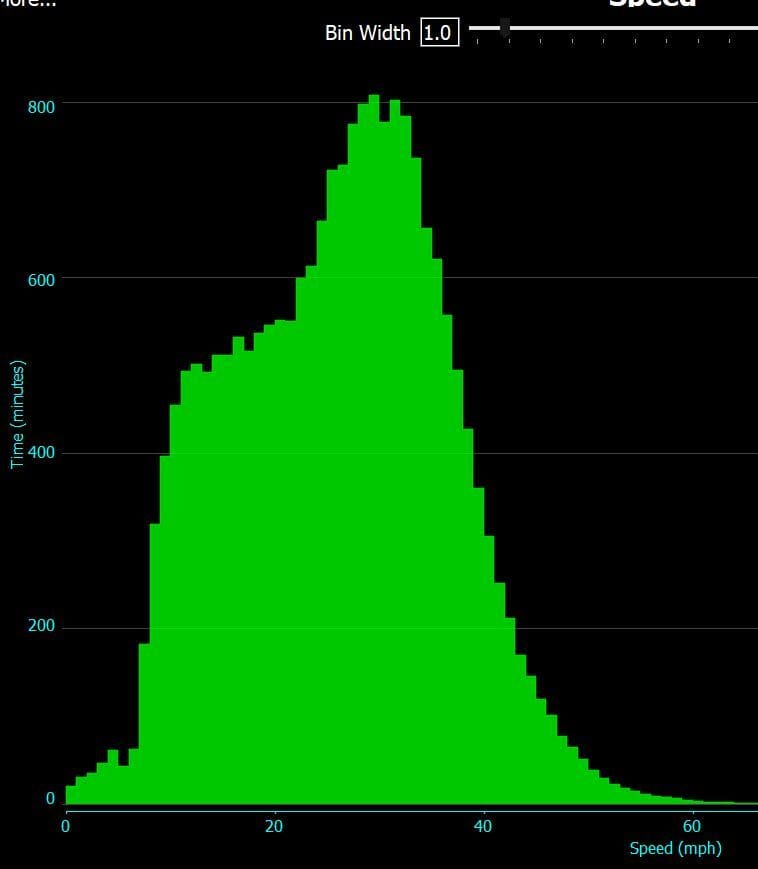
One myth is the assumption that Crr is a constant. It is not. If anyone does careful testing at higher speeds, it becomes quite apparent.
Another myth is the rolling resistance tests on a drum are close to real world values, although at 20 mph the relative rankings match my testing. In other words, if tire A is better than tire B on the drum, those results are consistent but these rankings can swap at higher speeds.
05-01-21 | 12:23 PM
#113
Senior Member
Joined: Mar 2010
Posts: 2,703
Likes: 2,290
I have spent thousands on his tires and have tested tires in many ways. I currently use a coast down somewhat similar to Jan's method and I also use Rchung application to tease out the real world Crr. One aspect of Jan's testing clearly biases his results towards fat tires-the speed of his tests. The fastest that he tests is 18 mph and usually much slower around 15 mph. Most of my riding is closer to 30 mph. This data is a full year of riding including PBP, posted for those who will call BS. I mount a 23 mm on the front wheel and a 25 mm on the rear, GP5000 with latex tubes.
One myth is the assumption that Crr is a constant. It is not. If anyone does careful testing at higher speeds, it becomes quite apparent.
Another myth is the rolling resistance tests on a drum are close to real world values, although at 20 mph the relative rankings match my testing. In other words, if tire A is better than tire B on the drum, those results are consistent but these rankings can swap at higher speeds.
One myth is the assumption that Crr is a constant. It is not. If anyone does careful testing at higher speeds, it becomes quite apparent.
Another myth is the rolling resistance tests on a drum are close to real world values, although at 20 mph the relative rankings match my testing. In other words, if tire A is better than tire B on the drum, those results are consistent but these rankings can swap at higher speeds.
Last edited by Atlas Shrugged; 05-01-21 at 01:49 PM.
05-01-21 | 02:07 PM
#114
Senior Member
Joined: Apr 2006
Posts: 4,609
Likes: 507
From: Albuquerque, NM
Is there really enjoyment to be had making up straw man arguments just to knock them down? No knowledable person believes rollers replicate on-road Crr values. Further, how could they given Crr depends on road surface roughness and the range seen in that? It's like saying I'm correcting the myth that a stopped watch tells the correct time.
05-01-21 | 02:39 PM
#115

Senior Member
Joined: Jun 2010
Posts: 642
Likes: 145
From: Kanagawa JP
Bikes: Soma ES
Is there really enjoyment to be had making up straw man arguments just to knock them down? No knowledable person believes rollers replicate on-road Crr values. Further, how could they given Crr depends on road surface roughness and the range seen in that? It's like saying I'm correcting the myth that a stopped watch tells the correct time.
