


Is this normal?
 06-30-23 | 12:35 PM
#1
Thread Starter
Newbie
Joined: Mar 2020
Posts: 14
Likes: 0
Is this normal?
Hello. I was cleaning up my new bike and while I was lubing the chain I noticed some play in the cassette. Only happens when it's coasting. Not sure if it happens while riding. Is this normal?
https://streamable.com/cikcii
https://streamable.com/cikcii
 06-30-23 | 01:03 PM
#2

Senior Member
Joined: May 2021
Posts: 11,620
Likes: 7,015
Hello. I was cleaning up my new bike and while I was lubing the chain I noticed some play in the cassette. Only happens when it's coasting. Not sure if it happens while riding. Is this normal?
https://streamable.com/cikcii
https://streamable.com/cikcii
Anyway, lateral play is not normal but it is quite common. The hub/cassette splines are probably worn. Or the end cap is loose. Or there is a spacer missing.
 06-30-23 | 02:41 PM
#4

Facts just confuse people


Joined: Jul 2017
Posts: 19,288
Likes: 7,035
From: Mississippi
Bikes: Tarmac Disc Comp Di2 - 2020
Yep, it's normal.
It's also normal that people that notice it for the first time think it's not normal. People post about this once or twice a year.
Bikes aren't precision pieces of machinery that we want to believe they are.
It's also normal that people that notice it for the first time think it's not normal. People post about this once or twice a year.
Bikes aren't precision pieces of machinery that we want to believe they are.


 07-01-23 | 11:09 AM
#6
Full Member
Joined: Jul 2015
Posts: 309
Likes: 209
From: Chicago
Bikes: nothing to brag about
 07-02-23 | 07:41 AM
#8
Banned
Joined: Feb 2014
Posts: 676
Likes: 348
Saying that a wobbling freewheel is not a problem is irresponsible. Of course all of your bicycle sprockets should be operating exactly parallel to each other for maximum reliability and efficiency. It is easily and entirely possible to manufacture components that will perform as designed, but it is the nature of corporations to get away with whatever they can to maximize profits for shareholders at the expense of functionality and reliability of consumer goods.
I have seen bicycle freewheels wobble so bad they would be much more likely to not only throw chains, but wear them out prematurely. If they are that bad I get rid of them and find another hub which the manufacturer's workers or machinery accidentally produced closer to ideal. This is a common practice for mechanics and tuners looking for performance and reliability. For instance in motor-racing classes which have rules demanding the use of standard un-modified components, a top team will buy up a number of off-the-shelf cylinder heads and test them all on a flow-bench to cherry-pick the parts with the best performance because they were accidentally machined and/or cast closest to their ideal form.
Of course high-end cycle parts will generally be manufactured to a more consistently high standard than low-end or department-store bicycles. So the lower the quality of your bicycle or other consumer goods, the better a mechanic you have to be to get them into and keep them operating to their maximum potential. Good luck.
I have seen bicycle freewheels wobble so bad they would be much more likely to not only throw chains, but wear them out prematurely. If they are that bad I get rid of them and find another hub which the manufacturer's workers or machinery accidentally produced closer to ideal. This is a common practice for mechanics and tuners looking for performance and reliability. For instance in motor-racing classes which have rules demanding the use of standard un-modified components, a top team will buy up a number of off-the-shelf cylinder heads and test them all on a flow-bench to cherry-pick the parts with the best performance because they were accidentally machined and/or cast closest to their ideal form.
Of course high-end cycle parts will generally be manufactured to a more consistently high standard than low-end or department-store bicycles. So the lower the quality of your bicycle or other consumer goods, the better a mechanic you have to be to get them into and keep them operating to their maximum potential. Good luck.
07-02-23 | 07:57 AM
#9

Senior Member
Joined: Feb 2022
Posts: 1,027
Likes: 467
From: GMT-5
I see BSO freewheels wobble slightly all the time, mostly because the lube has dried up and things at the cone/race are opening up, but nothing to concern over, afterall, it's a BSO that will be used a total of 3 hours a year.
As long as the RD still works, the FW is fine for the BSO. Afterall, it's a BSO that will be used a total of 3 hours a year.
By the time the FW is totally shot and rear shifting goes wonky, no owner will bring this to a LBS for repair. The BSO at this point has a whole lot of other problems like loose cone nuts, bent rims, missing spokes, seized seatpost, seized quill stem, seized brake/shift cables, totally rusted chain, loose headset.
It goes to the curb for the next lucky DIY that can learn how to restore it.
As long as the RD still works, the FW is fine for the BSO. Afterall, it's a BSO that will be used a total of 3 hours a year.
By the time the FW is totally shot and rear shifting goes wonky, no owner will bring this to a LBS for repair. The BSO at this point has a whole lot of other problems like loose cone nuts, bent rims, missing spokes, seized seatpost, seized quill stem, seized brake/shift cables, totally rusted chain, loose headset.
It goes to the curb for the next lucky DIY that can learn how to restore it.
07-02-23 | 08:41 AM
#10
Senior Member

Joined: Mar 2012
Posts: 1,438
Likes: 974
Wow. Not in touch with reality much? The OP didn't say how much it wobbled, and that makes all the difference. A little visible wobble is within normal experience and often triggers concern among new riders. This will have no effect on chain wear, shifting, or any performance issue for the bike.
07-02-23 | 06:46 PM
#11

Senior Member

Joined: Jun 2002
Posts: 6,655
Likes: 2,253
From: Montreal, Quebec
Wow. Not in touch with reality much? The OP didn't say how much it wobbled, and that makes all the difference. A little visible wobble is within normal experience and often triggers concern among new riders. This will have no effect on chain wear, shifting, or any performance issue for the bike.
07-03-23 | 06:00 PM
#12
Senior Member
Joined: Apr 2019
Posts: 556
Likes: 128
From: Windsor Ontario, Canada
Bikes: 2018 Giant Sedona
I'm not to sure what the OP means by "play" either. But if he's talking about a wobbling cassette as suggested in other post's.
I have read about instances where a freewheel has fallen apart while riding, Its tiny ball bearings and perhaps other parts spewing out all over the roadway. While some wobbling of the free wheel's cassette is normal, Perhaps excessive wobbling might be an indication of a potential problem in that regard. I didn't know that was possible for the free wheel/cassette to just fall apart on the road until I read about it.
I was concerned because in the reviews of the cheap SunRun 7 speed cassette the bike shop installed on my bike had fallen apart on a customer. I'm going to pay more attention to its operation on my next ride.
I have read about instances where a freewheel has fallen apart while riding, Its tiny ball bearings and perhaps other parts spewing out all over the roadway. While some wobbling of the free wheel's cassette is normal, Perhaps excessive wobbling might be an indication of a potential problem in that regard. I didn't know that was possible for the free wheel/cassette to just fall apart on the road until I read about it.
I was concerned because in the reviews of the cheap SunRun 7 speed cassette the bike shop installed on my bike had fallen apart on a customer. I'm going to pay more attention to its operation on my next ride.
Last edited by xroadcharlie; 07-03-23 at 06:12 PM.
07-03-23 | 07:01 PM
#13
Senior Member
Joined: Feb 2022
Posts: 1,027
Likes: 467
From: GMT-5
As I said above, once lube in those tiny bearings dry/hardens up, the cone/races grind wider to the point where many if not all of the bearings fall out and left with nothing. The FW will still remain threaded, but now you have other directional forces that will further warp and deform the entire assembly.
I posted a photo of an open FW earlier:
Disassembled and reassembled a shimano MF-TZ20freewheel
I posted a photo of an open FW earlier:
Disassembled and reassembled a shimano MF-TZ20freewheel
07-03-23 | 10:22 PM
#14
Senior Member
Joined: Feb 2022
Posts: 1,027
Likes: 467
From: GMT-5
As you can see, there are two races, one on each end of the "cylinder".
From the size of the bearings, I believe only light oil is needed for the bearings, same light oil used on pawls. A lot of folks mistakenly use grease on pawls and that glues them up.
I don't know how these are assembled from factory, I have to use grease to hold in the bottom bearings.
The top bearings actually don't need to be held in by grease as seen on the cogs. They can be dropped into the race right before the locknut is put back.
And for the heaters that think rebuilding freewheels are a waste of time, I can do it in about 30 minutes including the ultrasonic, and is much faster that going to a friend's LBS to buy one. From the quantity of bikes I flip, I do about two dozen of these each season. I love using my profits on beer and old cheese.
07-03-23 | 11:25 PM
#15
Senior Member
Joined: Sep 2021
Posts: 1,596
Likes: 864
From: SW Florida, USA
Bikes: Yes
Your take on this as one of our resident freewheel experts and rehab specialists, [MENTION=42162]pastorbobnlnh[/MENTION] ?
Last edited by Hondo6; 07-03-23 at 11:30 PM.
07-04-23 | 02:27 AM
#16


Unfortunately, New Haven winters get to be cold enough to cause grease to thicken to the point where the tiny springs are unable to push the freewheel pawls through the now-gummy grease, rendering the freewheel inoperative. All it took was a few unhappy customers with damaged freewheel pawls for us to figure out that using grease in freewheels was a bad idea.
In other words, don't grease freewheel innards. The exception, as noted earlier in this thread, is the use of a small amount of grease during freewheel overhauls, to glue the inner set of bearings in place and to glue the pawls down to facilitate reassembly. Once it's reassembled, best practice is to drip light oil in until the grease is gone or at least thoroughly diluted.
Edit:
Thinking back, I remember that the thickened-grease problem was not initially obvious. Customers would drop off their bikes, complaining about the freewheel no longer working after we'd injected the grease, but then the bikes would sit around for hours or even a day or two before we'd take a look at them. By that time, the bikes had been stored at room temperature long enough that the grease had ceased to be gluey and the freewheels were working perfectly.
Last edited by Trakhak; 07-04-23 at 02:40 AM.
07-04-23 | 04:08 AM
#17
Senior Member
Joined: Sep 2021
Posts: 1,596
Likes: 864
From: SW Florida, USA
Bikes: Yes
You'll never find a new freewheel that comes from the factory packed with grease. Working in a bike shop in the '70's, we used a Stein grease injector tool on a few freewheels, having made the common mistake of thinking that, since all the other ball bearing assemblies on bikes require grease, therefore, freewheels require grease. And, after all, the tool exists to enable the injection of grease, so it must be a good idea, right?
Unfortunately, New Haven winters get to be cold enough to cause grease to thicken to the point where the tiny springs are unable to push the freewheel pawls through the now-gummy grease, rendering the freewheel inoperative. All it took was a few unhappy customers with damaged freewheel pawls for us to figure out that using grease in freewheels was a bad idea..
Unfortunately, New Haven winters get to be cold enough to cause grease to thicken to the point where the tiny springs are unable to push the freewheel pawls through the now-gummy grease, rendering the freewheel inoperative. All it took was a few unhappy customers with damaged freewheel pawls for us to figure out that using grease in freewheels was a bad idea..
07-04-23 | 04:56 AM
#18
Note that, again, (i) freewheels never come greased from the factory; (ii) if there's a downside to using light oil as intended by the manufacturers, I've never encountered it or heard of it; and (iii) for some reason, people who advocate greasing freewheels on the basis that every other bearing assembly on the bike uses grease never mention, e.g., Sturmey-Archer internal-gear hubs, whose manufacturer has always specified the use of oil for maintenance for over 100 years.
S-A hubs use heavier-weight oil, of course, since the forces involved are higher. All a freewheel has to to is freewheel, so lighter oil is appropriate, as demonstrated by the fact that that's what the manufacturers of freewheels have always used.
07-04-23 | 07:12 AM
#19

Freewheel Medic

Joined: Oct 2005
Posts: 13,551
Likes: 3,292
From: An Island on the Coast of GA!
Bikes: Snazzy* Schwinns, Classy Cannondales & a Super Pro Aero Lotus (* Ed.)
And that's fine, as long as the bike is never ridden under frigid conditions.
Note that, again, (i) freewheels never come greased from the factory; (ii) if there's a downside to using light oil as intended by the manufacturers, I've never encountered it or heard of it; and (iii) for some reason, people who advocate greasing freewheels on the basis that every other bearing assembly on the bike uses grease never mention, e.g., Sturmey-Archer internal-gear hubs, whose manufacturer has always specified the use of oil for maintenance for over 100 years.
S-A hubs use heavier-weight oil, of course, since the forces involved are higher. All a freewheel has to to is freewheel, so lighter oil is appropriate, as demonstrated by the fact that that's what the manufacturers of freewheels have always used.
Note that, again, (i) freewheels never come greased from the factory; (ii) if there's a downside to using light oil as intended by the manufacturers, I've never encountered it or heard of it; and (iii) for some reason, people who advocate greasing freewheels on the basis that every other bearing assembly on the bike uses grease never mention, e.g., Sturmey-Archer internal-gear hubs, whose manufacturer has always specified the use of oil for maintenance for over 100 years.
S-A hubs use heavier-weight oil, of course, since the forces involved are higher. All a freewheel has to to is freewheel, so lighter oil is appropriate, as demonstrated by the fact that that's what the manufacturers of freewheels have always used.
Injecting grease in the backside of freewheel (aka the Stein Tool) is a no-no. It floods the internals of the freewheel with way too much grease, especially on the pawls. Sachs used a similar method (there is a port hole under the sprockets) and flooded the internals of their Aris models. The grease eventually turned into a thick and sticky peanut butter.
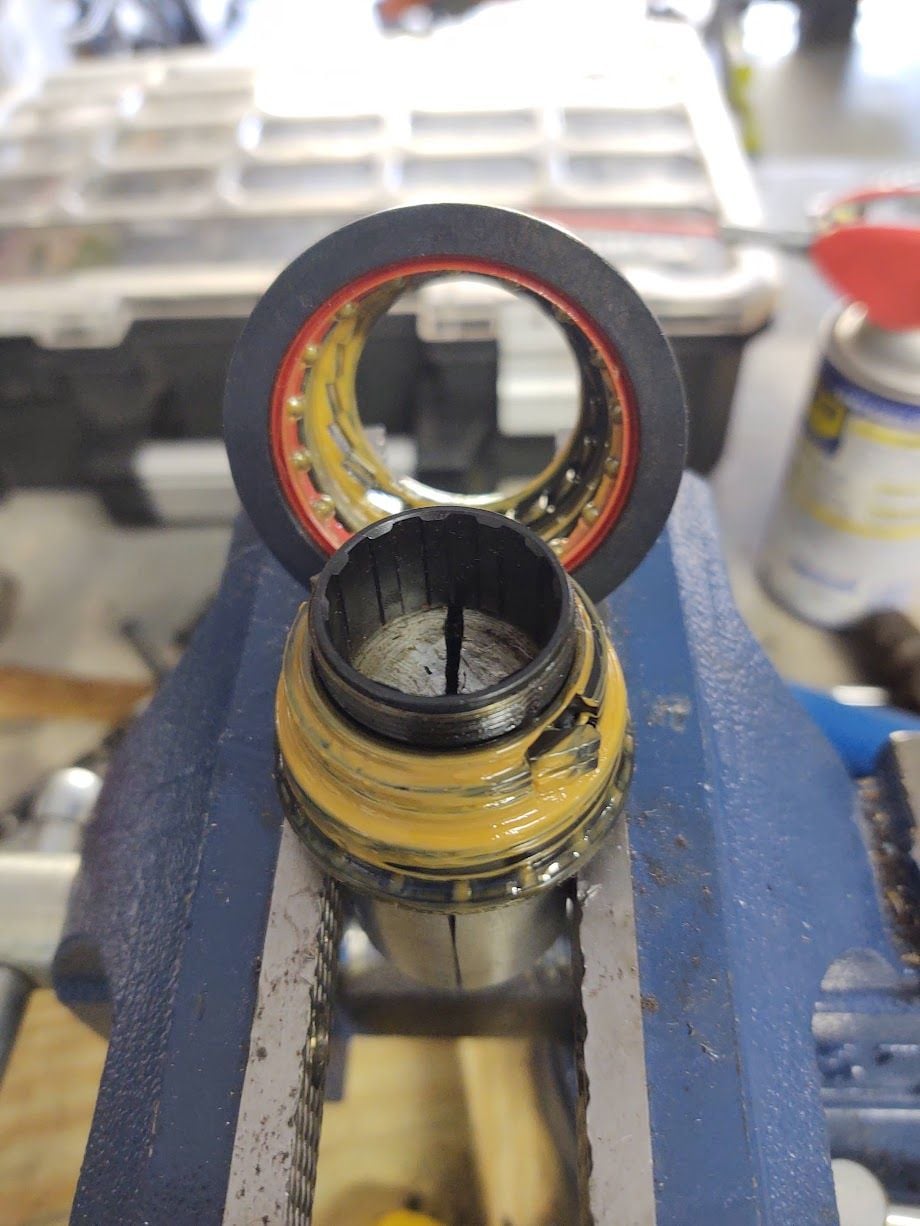
While not all Sachs look this way, the majority do.
While this is not proof that freewheel manufacturers do use grease, it's pretty convincing. You will find some NIB freewheel boxes with writing to the effect that says, "Do not Grease." I've seen this on Regina and Suntour freewheel boxes. I believe this was in response to LBS mechanics using the Stein injector tool. In the case of the Sachs Aris, Suntour Winner Pro, and Shimano DA, 600 and Sante models, the incorporated seals would prevent the tool from working or the pressure of the grease gun might damage the seals.
I've examined a number of new freewheels, both modern and NOS, and all had grease or had signs of old dried out grease.
Recently I serviced a brand new Huffy purchased at TJMaxx for a friend. The noise created by the new, Made in China freewheel was horrific. I decided to service it. When I opened it up, I found:
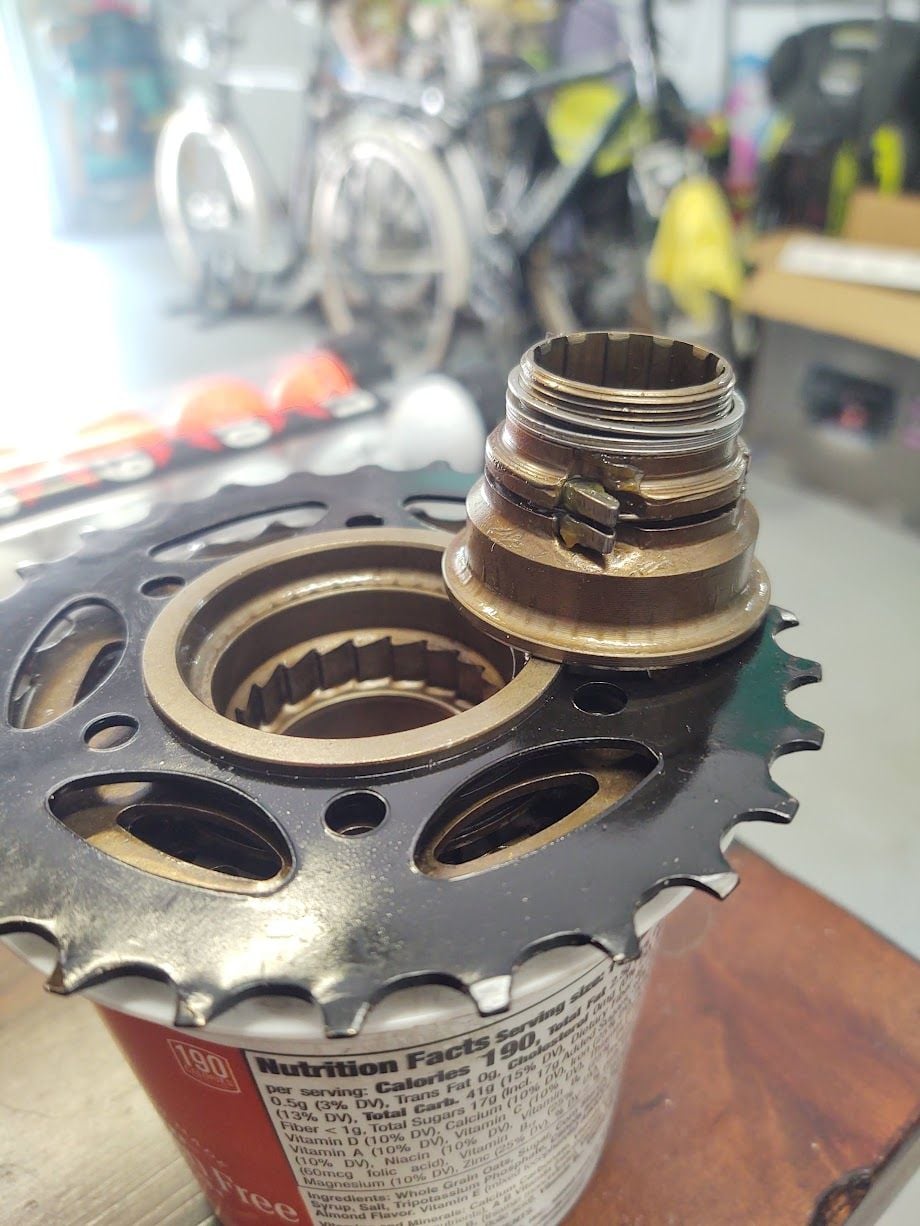
Yes, the bearings fell out, but there was a tiny amount of grease in the races and more on the pawls.
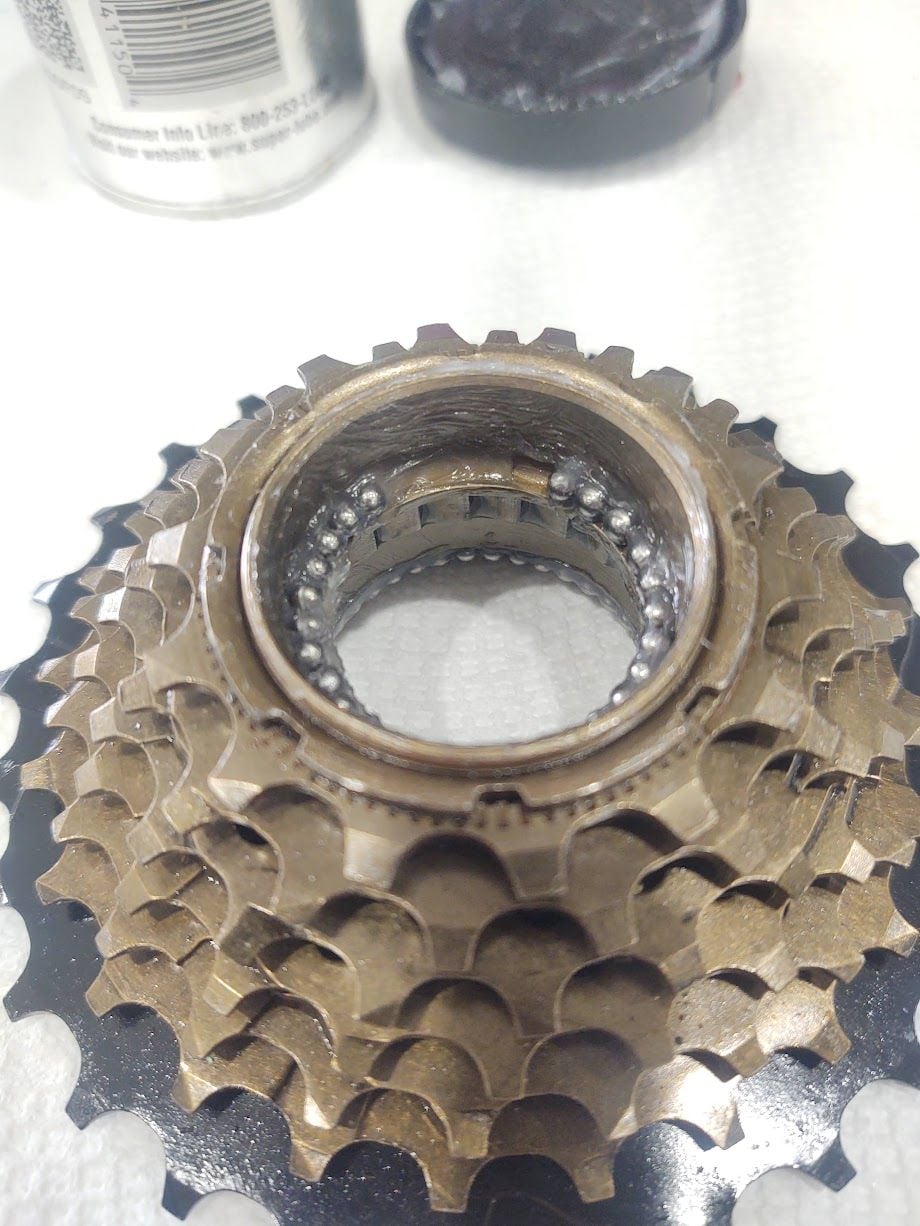
As I serviced it, I discovered it was missing a significant number of bearings. I added more to fill the race. I did use more grease than usual (in the races, not on the pawls or the ratchet teeth) in order quiet this noisy piece of junk. I also removed a thin shim spacer to better tune the bearings.
I place a small drop or two of quality machine oil on the pawl pivots and wipe the ratchet teeth with the same oil.
I use Super Lube synthetic grease in the races for the bearings for several reasons. It is not impacted by temperatures until below -50F and above +500F. It is very water and salt resistant. Contaminants tend to not penetrate the bearings. I've open my serviced freewheels after 1000s of miles of mixed pavement and gravel riding and the grease looks similar to the above.
I don't believe in the Flush and/or Dunk and Dribble method of freewheel service. It will not remove the contaminants and the oil quickly runs out of the freewheel making a mess of the sprockets, RD, etc.
Hope this is helpful.
__________________
Bob
Enjoying the GA coast all year long!
Thanks for visiting my website: www.freewheelspa.com
Bob
Enjoying the GA coast all year long!
Thanks for visiting my website: www.freewheelspa.com
07-04-23 | 08:32 AM
#20
Senior Member
Joined: Sep 2021
Posts: 1,596
Likes: 864
From: SW Florida, USA
Bikes: Yes
. . . . I place a small drop or two of quality machine oil on the pawl pivots and wipe the ratchet teeth with the same oil.
I use Super Lube synthetic grease in the races for the bearings for several reasons. It is not impacted by temperatures until below -50F and above +500F. It is very water and salt resistant. Contaminants tend to not penetrate the bearings. I've open my serviced freewheels after 1000s of miles of mixed pavement and gravel riding and the grease looks similar to the above.
I don't believe in the Flush and/or Dunk and Dribble method of freewheel service. It will not remove the contaminants and the oil quickly runs out of the freewheel making a mess of the sprockets, RD, etc.
Hope this is helpful.
I use Super Lube synthetic grease in the races for the bearings for several reasons. It is not impacted by temperatures until below -50F and above +500F. It is very water and salt resistant. Contaminants tend to not penetrate the bearings. I've open my serviced freewheels after 1000s of miles of mixed pavement and gravel riding and the grease looks similar to the above.
I don't believe in the Flush and/or Dunk and Dribble method of freewheel service. It will not remove the contaminants and the oil quickly runs out of the freewheel making a mess of the sprockets, RD, etc.
Hope this is helpful.
07-04-23 | 09:25 AM
#21

Senior Member
Joined: May 2016
Posts: 4,214
Likes: 1,948
Bikes: Trek 1100, Raleigh R-500, Cannondale R800, Roadmaster gravel/beater mountain bike
