
njkayaker
Senior Member
close


04-28-26
- Join DateSep 2007
- LocationFar beyond the pale horizon.
- Posts:15,210
-
iTrader Positive Feedback0
-
iTrader Feedback Score(0)
-
Likes:580
-
Liked:1,741 Times in 1,216 Posts
Quote:
But you aren't translating the top of the pedal "the same amount in the same direction" relative to the center of the crank. Originally Posted by tomato coupe
Nope. 13ollocks explained it. If you translate every point of an object by the same amount in the same direction, the result is the same object translated by that distance.
tomato coupe
Senior Member
close
04-28-26
- Join DateJul 2009
- Posts:8,105
-
iTrader Positive Feedback0
-
iTrader Feedback Score(0)
-
Likes:2,674
-
Liked:11,049 Times in 4,360 Posts
Quote:
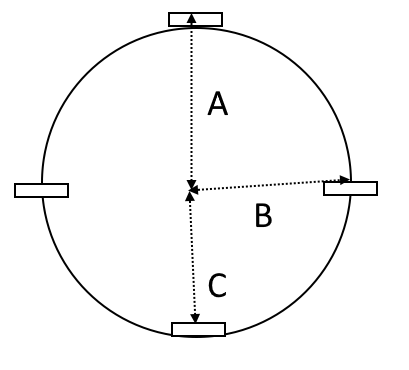
Again, you're measuring from the wrong point. The center of the circular path is not the crank spindle -- it's located above the spindle by an amount equal to the stack height.Originally Posted by njkayaker
I drew a diagram that shows what happens. The distances from the crank axis vary.
njkayaker
Senior Member
close
04-28-26
- Join DateSep 2007
- LocationFar beyond the pale horizon.
- Posts:15,210
-
iTrader Positive Feedback0
-
iTrader Feedback Score(0)
-
Likes:580
-
Liked:1,741 Times in 1,216 Posts
Quote:
The center of the crank is the right point. (Well, it's certainly not "wrong".) I was clear about what point I was using/considering. Other people were less clear.Originally Posted by tomato coupe
Again, you're measuring from the wrong point. The center of the circular path is not the crank spindle -- it's located above the spindle by an amount equal to the stack height.
tomato coupe
Senior Member
close
04-28-26
- Join DateJul 2009
- Posts:8,105
-
iTrader Positive Feedback0
-
iTrader Feedback Score(0)
-
Likes:2,674
-
Liked:11,049 Times in 4,360 Posts
Quote:
Nope.Originally Posted by njkayaker
The center of the crank is the right point.
On edit: this is such a trivial math problem that it's really not worth spending anymore time on it.
njkayaker
Senior Member
close
04-28-26
- Join DateSep 2007
- LocationFar beyond the pale horizon.
- Posts:15,210
-
iTrader Positive Feedback0
-
iTrader Feedback Score(0)
-
Likes:580
-
Liked:1,741 Times in 1,216 Posts
Quote:
That's a useless "argument". Originally Posted by tomato coupe
Nope.

The interaction is through the center of the crank. Not through some imaginary point chosen to try to make an argument.

I AM AI
Fahrenheit531
I AM AI
close
04-28-26
- Join DateAug 2013
- LocationTucson, AZ
- Posts:4,284
-
iTrader Positive Feedback0
-
iTrader Feedback Score(0)
-
Likes:1,211
-
Liked:1,160 Times in 565 Posts
Quote:
A circle is most definitely not an ellipse.Originally Posted by tomato coupe
You can always say the pedal path is an ellipse, because a circle is an ellipse.
Circle: All points equidistant from a single point.
Ellipse: All points equidistant from two points.
Put those two points close enough together and your ellipse may look like a circle, but it won't be. They are never, ever the same thing.
tomato coupe
Senior Member
close
04-28-26
- Join DateJul 2009
- Posts:8,105
-
iTrader Positive Feedback0
-
iTrader Feedback Score(0)
-
Likes:2,674
-
Liked:11,049 Times in 4,360 Posts
Quote:
Circle: All points equidistant from a single point.
Ellipse: All points equidistant from two points.
Put those two points close enough together and your ellipse may look like a circle, but it won't be. They are never, ever the same thing.
A circle is just an ellipse where the two foci are coincident. It's analogous to the statement "a square is a rectangle", because a square is just a rectangle with four equal sides. Originally Posted by Fahrenheit531
A circle is most definitely not an ellipse.Circle: All points equidistant from a single point.
Ellipse: All points equidistant from two points.
Put those two points close enough together and your ellipse may look like a circle, but it won't be. They are never, ever the same thing.
njkayaker
Senior Member
close
04-28-26
- Join DateSep 2007
- LocationFar beyond the pale horizon.
- Posts:15,210
-
iTrader Positive Feedback0
-
iTrader Feedback Score(0)
-
Likes:580
-
Liked:1,741 Times in 1,216 Posts
Quote:
Circle: All points equidistant from a single point.
Ellipse: All points equidistant from two points.
This doesn't appear to be correct. (Not sure why you didn't look it up before committing yourself.)Originally Posted by Fahrenheit531
A circle is most definitely not an ellipse.Circle: All points equidistant from a single point.
Ellipse: All points equidistant from two points.
tomato coupe
Senior Member
close
04-28-26
- Join DateJul 2009
- Posts:8,105
-
iTrader Positive Feedback0
-
iTrader Feedback Score(0)
-
Likes:2,674
-
Liked:11,049 Times in 4,360 Posts
Quote:
Several people have given you the correct explanation of why the path is circular, but you haven't listened to anyone. "Nope" is all that's left.Originally Posted by njkayaker
That's a useless "argument".
njkayaker
Senior Member
close
04-28-26
- Join DateSep 2007
- LocationFar beyond the pale horizon.
- Posts:15,210
-
iTrader Positive Feedback0
-
iTrader Feedback Score(0)
-
Likes:580
-
Liked:1,741 Times in 1,216 Posts
Quote:
Originally Posted by tomato coupe
Several people have given you the correct explanation of why the path is circular, but you haven't listened to anyone. "Nope" is all that's left.
No, they aren't convincing.Using the center of the crank isn't "wrong".
(Using the imaginary point is a "circular" argument.)
Senior Member
13ollocks
Senior Member
close
- Join DateOct 2023
- Posts:1,106
-
iTrader Positive Feedback0
-
iTrader Feedback Score(0)
-
Likes:513
-
Liked:985 Times in 526 Posts
Quote:
No, they aren't convincing.
Using the center of the crank isn't "wrong".
(Using the imaginary point is a "circular" argument.)
graph paper. Draw it out 🙄Originally Posted by njkayaker
No, they aren't convincing.Using the center of the crank isn't "wrong".
(Using the imaginary point is a "circular" argument.)
njkayaker
Senior Member
close
04-28-26
- Join DateSep 2007
- LocationFar beyond the pale horizon.
- Posts:15,210
-
iTrader Positive Feedback0
-
iTrader Feedback Score(0)
-
Likes:580
-
Liked:1,741 Times in 1,216 Posts
Quote:
You don't need graph paper. The distance to the center of the crank obviously varies.Originally Posted by 13ollocks
graph paper. Draw it out 🙄
(The distance to some imaginary point doesn't vary but that point is not doing anything physically.)
One might be able to argue that using the imaginary point is equally valid to using the center of the crank but using the center of the crank isn't wrong.
I don't think the imaginary point is equally (or more) valid than the center of the crank.
You really have to make the argument that the imaginary point is the only valid point and that the center of the crank can just be dismissed.

genejockey
Klaatu..Verata..Necktie?
close


04-28-26
- Join DateMay 2007
- LocationSF Bay Area
- Posts:23,532
-
iTrader Positive Feedback0
-
iTrader Feedback Score(0)
-
Likes:8,083
-
Liked:17,023 Times in 8,792 Posts
Quote:
This is exactly it. The center of the circle is the center of the circle, not the center of the BB spindle.Originally Posted by tomato coupe
Again, you're measuring from the wrong point. The center of the circular path is not the crank spindle -- it's located above the spindle by an amount equal to the stack height.
njkayaker
Senior Member
close
04-28-26
- Join DateSep 2007
- LocationFar beyond the pale horizon.
- Posts:15,210
-
iTrader Positive Feedback0
-
iTrader Feedback Score(0)
-
Likes:580
-
Liked:1,741 Times in 1,216 Posts
Quote:
It's an imaginary point. Using the center of the crank is (at least) equally valid.Originally Posted by genejockey
This is exactly it. The center of the circle is the center of the circle, not the center of the BB spindle.
tomato coupe
Senior Member
close
04-28-26
- Join DateJul 2009
- Posts:8,105
-
iTrader Positive Feedback0
-
iTrader Feedback Score(0)
-
Likes:2,674
-
Liked:11,049 Times in 4,360 Posts
Quote:
Originally Posted by 13ollocks
graph paper. Draw it out 🙄
Quote:
Then start with the general equation for a circle and introduce a translation -- the resulting equation is still a circle.Originally Posted by njkayaker
You don't need graph paper.
njkayaker
Senior Member
close
04-28-26
- Join DateSep 2007
- LocationFar beyond the pale horizon.
- Posts:15,210
-
iTrader Positive Feedback0
-
iTrader Feedback Score(0)
-
Likes:580
-
Liked:1,741 Times in 1,216 Posts
Quote:
Around an imaginary point. The physical point of rotation is still the center of the crank.Originally Posted by tomato coupe
Then start with the general equation for a circle and introduce a translation -- the resulting equation is still a circle.
genejockey
Klaatu..Verata..Necktie?
close
04-28-26
- Join DateMay 2007
- LocationSF Bay Area
- Posts:23,532
-
iTrader Positive Feedback0
-
iTrader Feedback Score(0)
-
Likes:8,083
-
Liked:17,023 Times in 8,792 Posts
Quote:
(The distance to some imaginary point doesn't vary but that point is not doing anything physically.)
One might be able to argue that using the imaginary point is equally valid to using the center of the crank but using the center of the crank isn't wrong.
I don't think the imaginary point is equally (or more) valid than the center of the crank.
No, you're looking at it wrong. Do your drawing again, but this time, make the stack height equal to the crank length. That would mean that as the crank spindle passes through Bottom Dead Center, the pedal top will be in line with the BB center, yes? So the BB center CANNOT BE the center of the path described by the pedal top.Originally Posted by njkayaker
You don't need graph paper. The distance to the center of the crank obviously varies.(The distance to some imaginary point doesn't vary but that point is not doing anything physically.)
One might be able to argue that using the imaginary point is equally valid to using the center of the crank but using the center of the crank isn't wrong.
I don't think the imaginary point is equally (or more) valid than the center of the crank.
tomato coupe
Senior Member
close
04-28-26
- Join DateJul 2009
- Posts:8,105
-
iTrader Positive Feedback0
-
iTrader Feedback Score(0)
-
Likes:2,674
-
Liked:11,049 Times in 4,360 Posts
Quote:
A circle is a circle. It doesn't matter if the center of the circle is an imaginary point in space or the Rock of Gibraltar -- it's still a circle. You're out of your depth on this one.Originally Posted by njkayaker
Around an imaginary point. The physical point of rotation is still the center of the crank.
genejockey
Klaatu..Verata..Necktie?
close
04-28-26
- Join DateMay 2007
- LocationSF Bay Area
- Posts:23,532
-
iTrader Positive Feedback0
-
iTrader Feedback Score(0)
-
Likes:8,083
-
Liked:17,023 Times in 8,792 Posts
Quote:
No, it's not. The center of a circle is a defined point, defined by being equidistant from all points of the circle. You are choosing an arbitrary point and then trying to bend the geometry around it. That ain't how it works.Originally Posted by njkayaker
It's an imaginary point. Using the center of the crank is (at least) equally valid.
njkayaker
Senior Member
close
04-28-26
- Join DateSep 2007
- LocationFar beyond the pale horizon.
- Posts:15,210
-
iTrader Positive Feedback0
-
iTrader Feedback Score(0)
-
Likes:580
-
Liked:1,741 Times in 1,216 Posts
Quote:
A tautology.Originally Posted by genejockey
No, it's not. The center of a circle is a defined point, defined by being equidistant from all points of the circle. You are choosing an arbitrary point and then trying to bend the geometry around it. That ain't how it works.
The crank center isn't "arbitrary". (Calling it "arbitrary" is bizarre.)
This is a "frame of reference" issue. The imaginary point is one frame of reference. The center of the crank is another.
njkayaker
Senior Member
close
04-28-26
- Join DateSep 2007
- LocationFar beyond the pale horizon.
- Posts:15,210
-
iTrader Positive Feedback0
-
iTrader Feedback Score(0)
-
Likes:580
-
Liked:1,741 Times in 1,216 Posts
Quote:
A tautology.Originally Posted by tomato coupe
A circle is a circle. It doesn't matter if the center of the circle is an imaginary point in space or the Rock of Gibraltar -- it's still a circle. You're out of your depth on this one.
This is a frame of reference issue. You and others think the imaginary point is the only correct frame of reference for some reason.
It's really only valid to make to make the argument that "it's a circle". It's a tautological argument.
Koyote
Senior Member
close

04-28-26
- Join DateSep 2017
- Posts:10,285
-
iTrader Positive Feedback0
-
iTrader Feedback Score(0)
-
Likes:11,269
-
Liked:14,739 Times in 6,235 Posts
Quote:
You are most definitely wrong on this point.Originally Posted by Fahrenheit531
A circle is most definitely not an ellipse.

datlas
Should Be More Popular
close
04-28-26
- Join DateDec 2007
- LocationMalvern, PA (20 miles West of Philly)
- Posts:46,105
-
iTrader Positive Feedback0
-
iTrader Feedback Score(0)
-
Likes:6,139
-
Liked:11,709 Times in 5,425 Posts
Quote:
This.Originally Posted by genejockey
This is exactly it. The center of the circle is the center of the circle, not the center of the BB spindle.
genejockey
Klaatu..Verata..Necktie?
close
04-28-26
- Join DateMay 2007
- LocationSF Bay Area
- Posts:23,532
-
iTrader Positive Feedback0
-
iTrader Feedback Score(0)
-
Likes:8,083
-
Liked:17,023 Times in 8,792 Posts
Quote:
The crank center isn't "arbitrary".
This is a "frame of reference" issue. The imaginary point is one frame of reference. The center of the crank is another.
*sigh*Originally Posted by njkayaker
A tautology.The crank center isn't "arbitrary".
This is a "frame of reference" issue. The imaginary point is one frame of reference. The center of the crank is another.
It's not a tautology, it's inherent in the definition of a circle - "A circle is a perfectly round, two-dimensional shape where all points on its edge are the same distance from a center point." So the center is ALWAYS AND BY DEFINITION the point in space equidistant from all the points on the edge.
tomato coupe
Senior Member
close
04-28-26
- Join DateJul 2009
- Posts:8,105
-
iTrader Positive Feedback0
-
iTrader Feedback Score(0)
-
Likes:2,674
-
Liked:11,049 Times in 4,360 Posts
Quote:
It's not a tautology, it's inherent in the definition of a circle - "A circle is a perfectly round, two-dimensional shape where all points on its edge are the same distance from a center point." So the center is ALWAYS AND BY DEFINITION the point in space equidistant from all the points on the edge.
It's mind boggling that you have to explain what a circle is. It's depressing that your effort will be in vain.Originally Posted by genejockey
*sigh*It's not a tautology, it's inherent in the definition of a circle - "A circle is a perfectly round, two-dimensional shape where all points on its edge are the same distance from a center point." So the center is ALWAYS AND BY DEFINITION the point in space equidistant from all the points on the edge.