

genejockey
Klaatu..Verata..Necktie?
close


04-28-26
- Join DateMay 2007
- LocationSF Bay Area
- Posts:23,532
-
iTrader Positive Feedback0
-
iTrader Feedback Score(0)
-
Likes:8,083
-
Liked:17,023 Times in 8,792 Posts
Quote:
This is a frame of reference issue. You and others think the imaginary point is the only correct frame of reference for some reason.
It's really only valid to make to make the argument that "it's a circle". It's a tautological argument.
Dude. Seriously. Leave aside your obsession with the BB center, and just imagine the pedal spindle in rotation. It makes a circle, yes? The top of the pedal is always the same distance above the pedal spindle, right? So no matter where in the spindle's circle you are, the pedal top is always exactly the same distance above, which means it CAN ONLY describe a circle, right?Originally Posted by njkayaker
A tautology.This is a frame of reference issue. You and others think the imaginary point is the only correct frame of reference for some reason.
It's really only valid to make to make the argument that "it's a circle". It's a tautological argument.

terrymorse
climber has-been
close

04-28-26
- Join DateDec 2004
- LocationPalo Alto, CA
- Posts:9,131
-
iTrader Positive Feedback0
-
iTrader Feedback Score(0)
-
Likes:5,440
-
Liked:6,027 Times in 2,849 Posts
Quote:
There it is. The path that the top of the pedal traverses is exactly the same as the path that the pedal spindle traverses, a circle, but the top-of-pedal circle is shifted upwards by the amount of the stack height.Originally Posted by genejockey
This is exactly it. The center of the circle is the center of the circle, not the center of the BB spindle.
Two circles of identical size, with one shifted upwards from the other.
/thread
tomato coupe
Senior Member
close
04-28-26
- Join DateJul 2009
- Posts:8,105
-
iTrader Positive Feedback0
-
iTrader Feedback Score(0)
-
Likes:2,674
-
Liked:11,049 Times in 4,360 Posts
This is the shape of the path that the end of the crank arms follow, with the center located at the crank spindle:
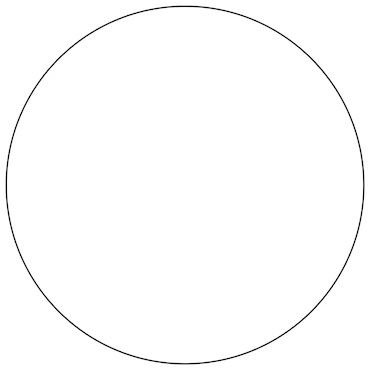
This is the shape of the path that the pedals follow, with the center located slightly above the crank spindle:
Both paths are circles. It doesn't matter that the centers are in different places.
This is the shape of the path that the pedals follow, with the center located slightly above the crank spindle:
Both paths are circles. It doesn't matter that the centers are in different places.
wheelreason
Senior Member
close
04-28-26
- Join DateAug 2009
- Posts:3,110
-
iTrader Positive Feedback0
-
iTrader Feedback Score(0)
-
Likes:328
-
Liked:1,615 Times in 910 Posts
Put a cleat in the pedal and spin it around, and you will soon see that the only way for any point of reference that stacks over the spindle to be a circle is if your foot points straight down at 3 o'clock, and straight up at 9 o'clock (or somehow maintains the same attitude). Good luck with that....

indyfabz
Senior Member
close

04-28-26
- Join DateJan 2010
- Posts:45,118
-
iTrader Positive Feedback0
-
iTrader Feedback Score(0)
-
Likes:28,808
-
Liked:23,317 Times in 10,839 Posts
Quote:
Uncorrect:Originally Posted by Fahrenheit531
A circle is most definitely not an ellipse.
https://math.stackexchange.com/quest...-as-an-ellipse
son_of_clyde
Junior Member
close

04-28-26
- Join DateDec 2017
- LocationBerkeley, CA
- Posts:88
-
iTrader Positive Feedback0
-
iTrader Feedback Score(0)
-
Likes:161
-
Liked:91 Times in 37 Posts
theta = angle of crank to horizontal
r1 = crank length
r2 = pedal height (pedal axis to top of pedal)
R = distance from top of pedal to crank axis
assume pedal only translates relative to ground with r2 remaining vertical (i.e. no rotation relative to ground)
then R = [(r2 + r1*sin(theta))^2 + (r1*cos(theta))^2}^1/2
R varies with theta, no circle
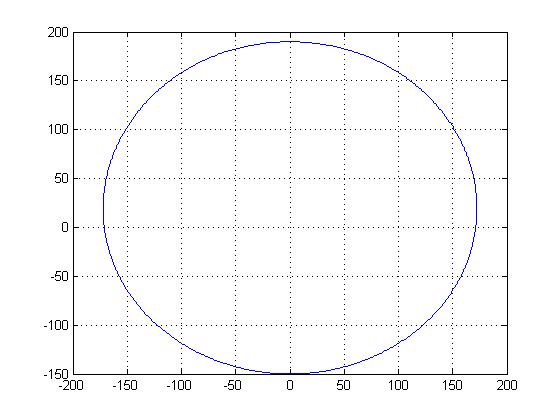
plot above shows "top of pedal" path with 170 mm crank, 20 mm "stack height"
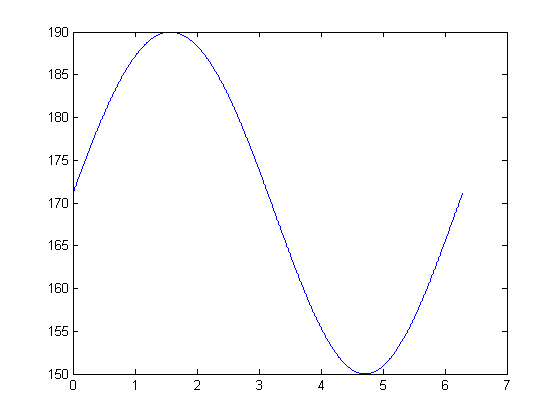
plot above shows R (r1 = 170mm, r2 = 20mm) vs theta (0 - 2*pi)
r1 = crank length
r2 = pedal height (pedal axis to top of pedal)
R = distance from top of pedal to crank axis
assume pedal only translates relative to ground with r2 remaining vertical (i.e. no rotation relative to ground)
then R = [(r2 + r1*sin(theta))^2 + (r1*cos(theta))^2}^1/2
R varies with theta, no circle
plot above shows "top of pedal" path with 170 mm crank, 20 mm "stack height"
plot above shows R (r1 = 170mm, r2 = 20mm) vs theta (0 - 2*pi)

datlas
Should Be More Popular
close
04-28-26
- Join DateDec 2007
- LocationMalvern, PA (20 miles West of Philly)
- Posts:46,105
-
iTrader Positive Feedback0
-
iTrader Feedback Score(0)
-
Likes:6,139
-
Liked:11,710 Times in 5,425 Posts
Quote:
Nope. If pedal is horizontal then stack is the same (directly over spindle) the whole 360 degrees.Originally Posted by wheelreason
Put a cleat in the pedal and spin it around, and you will soon see that the only way for any point of reference that stacks over the spindle to be a circle is if your foot points straight down at 3 o'clock, and straight up at 9 o'clock (or somehow maintains the same attitude). Good luck with that....
Sigh.
“We don’t need no badges”
Barry2
“We don’t need no badges”
close
- Join DateSep 2019
- LocationSF Bay Area
- Posts:2,599
-
iTrader Positive Feedback0
-
iTrader Feedback Score(0)
-
Likes:1,186
-
Liked:1,625 Times in 903 Posts
In your head, try replacing the pedal with a 6 foot rod that remains vertical during the rotation.
it’s a circle, elevated by the length of the rod.
Barry
it’s a circle, elevated by the length of the rod.
Barry
genejockey
Klaatu..Verata..Necktie?
close
04-28-26
- Join DateMay 2007
- LocationSF Bay Area
- Posts:23,532
-
iTrader Positive Feedback0
-
iTrader Feedback Score(0)
-
Likes:8,083
-
Liked:17,023 Times in 8,792 Posts
The formula for a circle is (X - H)^2 + (Y - K)^2 = R^2, where R is the radius, H,K are the coordinates of the center of the circle - the BB center in our example, and X,Y are the coordinates of any point on the circle - the position of the pedal spindle. So, if we set H and K to 0, that puts the BB center at the origin. Here's what you get with an R of 170:
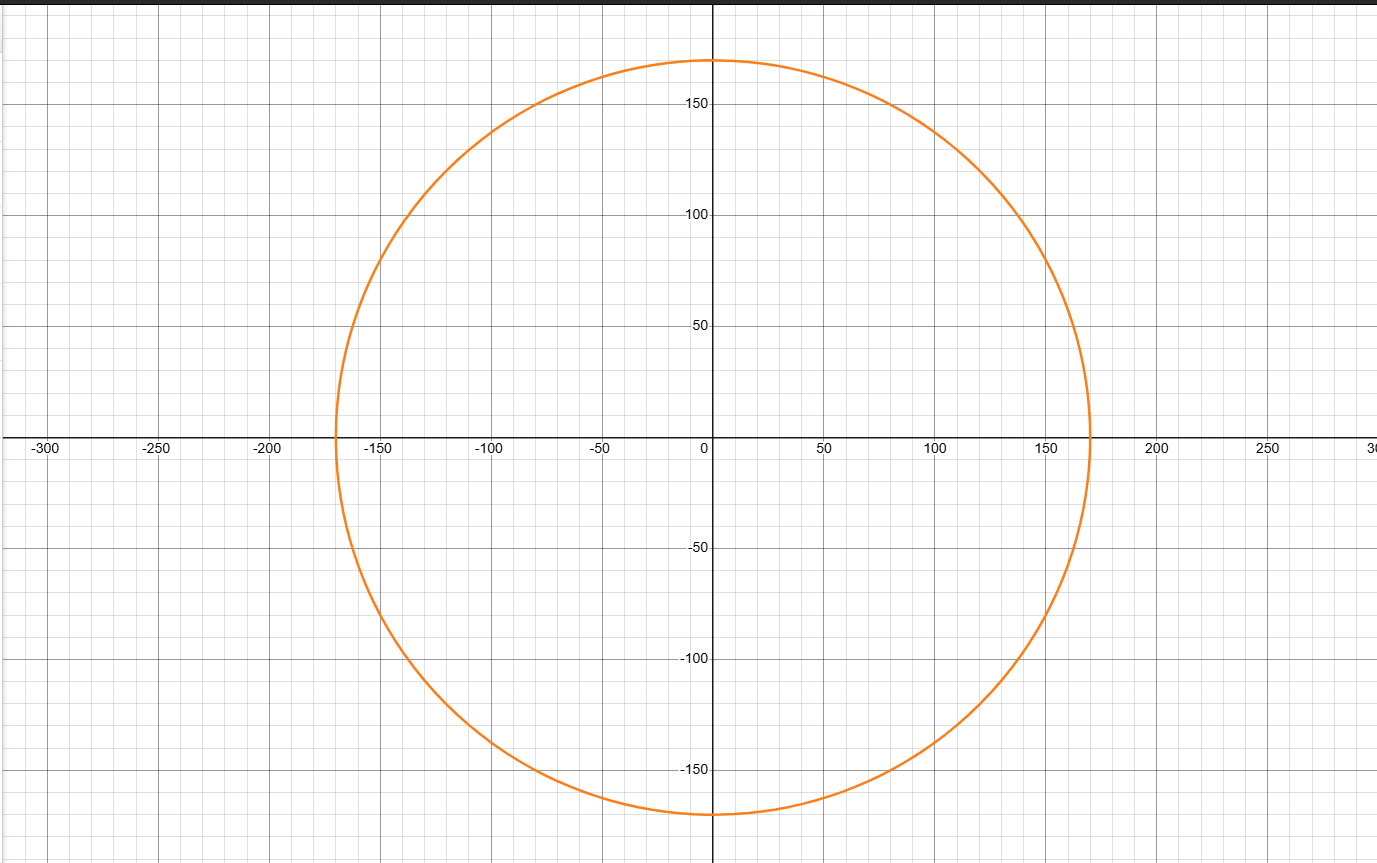
And here's what you get if you make Y into (Y - 5), to reflect a 5mm pedal stack, so we're following the path of the pedal top, rather than the spindle
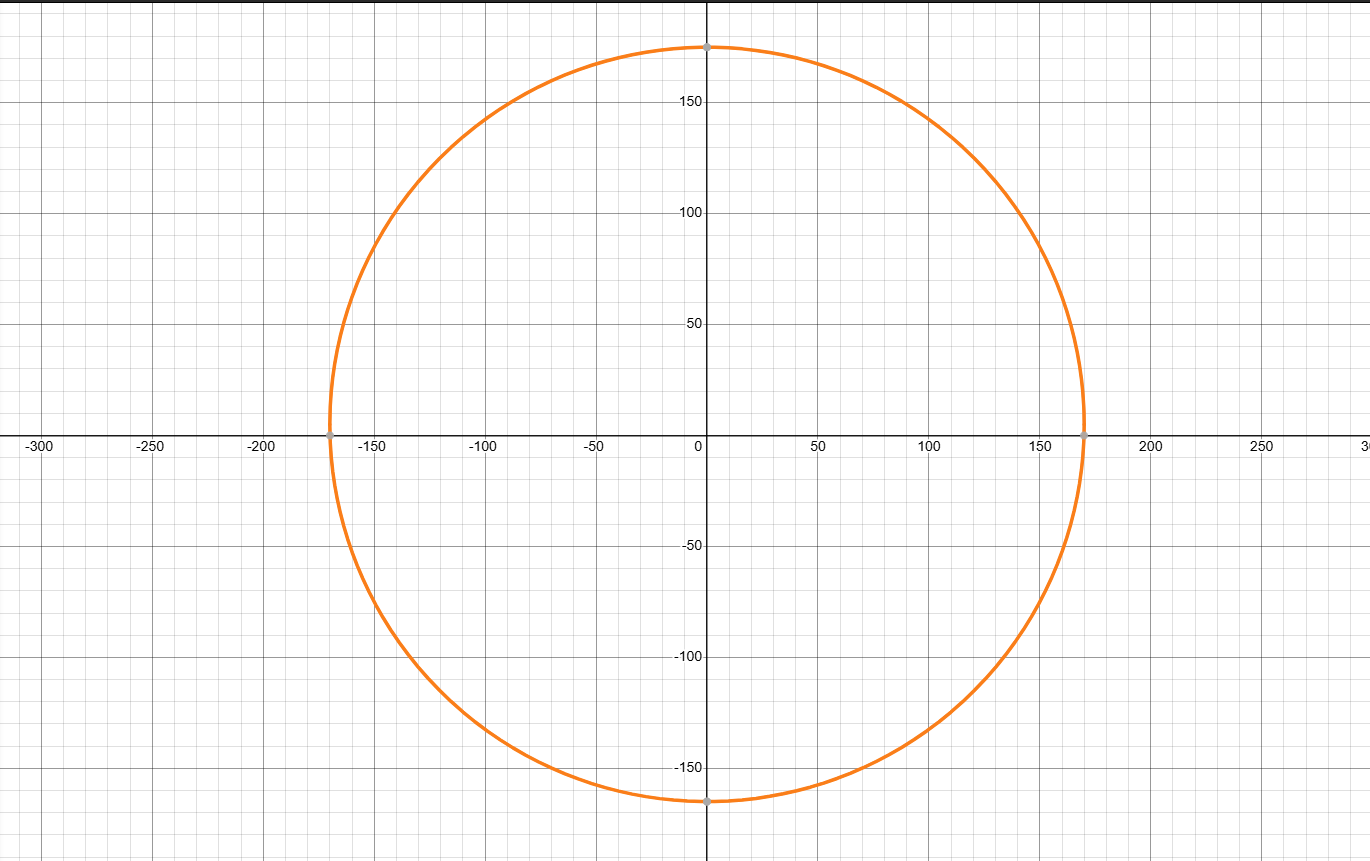
Same circle, offset vertically by 5mm.
Edit: In case you don't believe it:
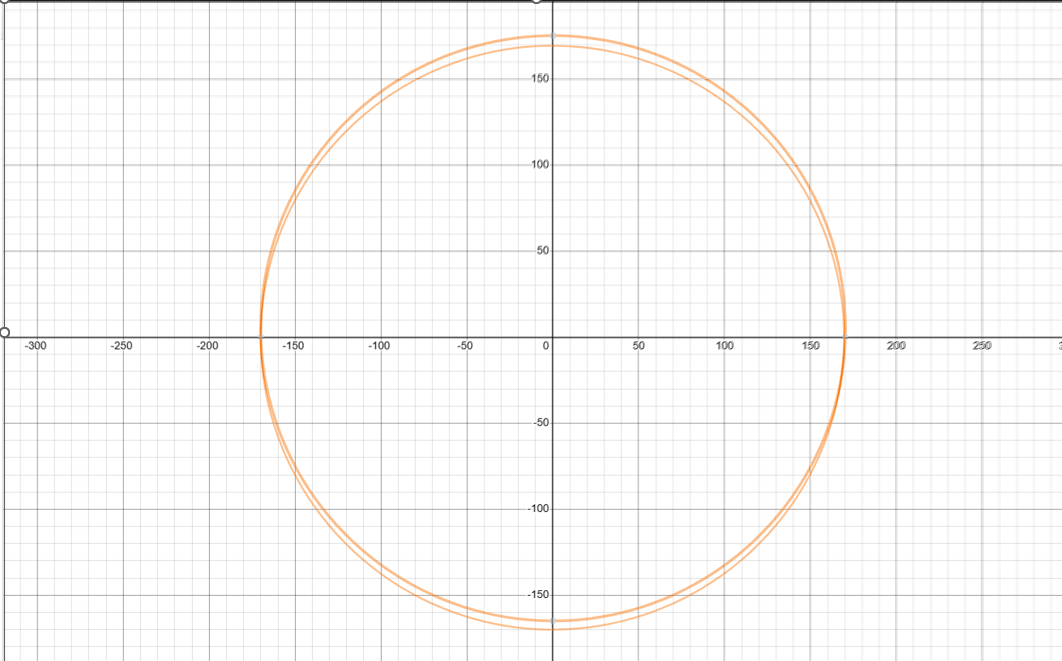
And here's what you get if you make Y into (Y - 5), to reflect a 5mm pedal stack, so we're following the path of the pedal top, rather than the spindle
Same circle, offset vertically by 5mm.
Edit: In case you don't believe it:
tomato coupe
Senior Member
close
04-28-26
- Join DateJul 2009
- Posts:8,105
-
iTrader Positive Feedback0
-
iTrader Feedback Score(0)
-
Likes:2,674
-
Liked:11,049 Times in 4,360 Posts
Quote:
r1 = crank length
r2 = pedal height (pedal axis to top of pedal)
R = distance from top of pedal to crank axis
assume pedal only translates relative to ground with r2 remaining vertical (i.e. no rotation relative to ground)
then R = [(r2 + r1*sin(theta))^2 + (r1*cos(theta))^2}^1/2
R varies with theta, no circle
Your calculation is not relevant, because the path of the pedal is not centered on the crank axis. The path of the pedal is circular, centered on a point a distance r2 above the crank axis.Originally Posted by son_of_clyde
theta = angle of crank to horizontalr1 = crank length
r2 = pedal height (pedal axis to top of pedal)
R = distance from top of pedal to crank axis
assume pedal only translates relative to ground with r2 remaining vertical (i.e. no rotation relative to ground)
then R = [(r2 + r1*sin(theta))^2 + (r1*cos(theta))^2}^1/2
R varies with theta, no circle
son_of_clyde
Junior Member
close
04-28-26
- Join DateDec 2017
- LocationBerkeley, CA
- Posts:88
-
iTrader Positive Feedback0
-
iTrader Feedback Score(0)
-
Likes:161
-
Liked:91 Times in 37 Posts
Quote:
I should have specified relative to the crank axis. It's relevant in that an extreme crank length to pedal height ratio can definitely affect pedaling dynamics.Originally Posted by tomato coupe
Your calculation is not relevant, because the path of the pedal is not centered on the crank axis. The path of the pedal is circular, centered on a point a distance r2 above the crank axis.
tomato coupe
Senior Member
close
04-28-26
- Join DateJul 2009
- Posts:8,105
-
iTrader Positive Feedback0
-
iTrader Feedback Score(0)
-
Likes:2,674
-
Liked:11,049 Times in 4,360 Posts
Quote:
I have no idea what that's supposed to mean -- it makes no sense. Originally Posted by son_of_clyde
I should have specified relative to the crank axis. It's relevant in that an extreme crank length to pedal height ratio can definitely affect pedaling dynamics.
Senior Member
Mtracer
Senior Member
close
- Join DateJan 2022
- LocationAlbuquerque NM USA
- Posts:1,067
-
iTrader Positive Feedback0
-
iTrader Feedback Score(0)
-
Likes:618
-
Liked:706 Times in 444 Posts
Assuming the pedal stays at the same angle relative to the bike frame, for example stays horizontal, I agree with the OP that anything above the pedal will still define a circle and the center of that circle will be correspondingly offset.
Imagine something long like a broom stick. The top end of it would clearly trace out a circle if the bottom end of it were moving in a circle. Again, assuming the stick remains at the same angle, I.E. straight up and down. Imagine tying two wheels together a with rod much like the coupling rods on drive wheels of steam locomotives.
As has been mentioned, since most of us will change our foot angle throughout the stroke, the contact point of the foot to the pedal, will not make a perfect circle.
Imagine something long like a broom stick. The top end of it would clearly trace out a circle if the bottom end of it were moving in a circle. Again, assuming the stick remains at the same angle, I.E. straight up and down. Imagine tying two wheels together a with rod much like the coupling rods on drive wheels of steam locomotives.
As has been mentioned, since most of us will change our foot angle throughout the stroke, the contact point of the foot to the pedal, will not make a perfect circle.
genejockey
Klaatu..Verata..Necktie?
close
04-28-26
- Join DateMay 2007
- LocationSF Bay Area
- Posts:23,532
-
iTrader Positive Feedback0
-
iTrader Feedback Score(0)
-
Likes:8,083
-
Liked:17,023 Times in 8,792 Posts
Quote:
Imagine something long like a broom stick. The top end of it would clearly trace out a circle if the bottom end of it were moving in a circle. Again, assuming the stick remains at the same angle, I.E. straight up and down. Imagine tying two wheels together a with rod much like the coupling rods on drive wheels of steam locomotives.
As has been mentioned, since most of us will change our foot angle throughout the stroke, the contact point of the foot to the pedal, will not make a perfect circle.
But what if a spherical cow is pedaling in a vacuum?Originally Posted by Mtracer
Assuming the pedal stays at the same angle relative to the bike frame, for example stays horizontal, I agree with the OP that anything above the pedal will still define a circle and the center of that circle will be correspondingly offset.Imagine something long like a broom stick. The top end of it would clearly trace out a circle if the bottom end of it were moving in a circle. Again, assuming the stick remains at the same angle, I.E. straight up and down. Imagine tying two wheels together a with rod much like the coupling rods on drive wheels of steam locomotives.
As has been mentioned, since most of us will change our foot angle throughout the stroke, the contact point of the foot to the pedal, will not make a perfect circle.
son_of_clyde
Junior Member
close
04-28-26
- Join DateDec 2017
- LocationBerkeley, CA
- Posts:88
-
iTrader Positive Feedback0
-
iTrader Feedback Score(0)
-
Likes:161
-
Liked:91 Times in 37 Posts
Quote:
not my problemOriginally Posted by tomato coupe
I have no idea what that's supposed to mean -- it makes no sense.

urbanknight
Over the hill
close
04-28-26
- Join DateMar 2006
- LocationLos Angeles, CA
- Posts:24,587
-
iTrader Positive Feedback0
-
iTrader Feedback Score(0)
-
Likes:2,524
-
Liked:1,356 Times in 784 Posts
Quote:
Remember the top of the pedal is attached to two foci: the BB spindle and the pedal spindle. The latter serves to offset the point of rotation (assuming the pedal maintains its level orientation). genejockey 's graphs show it correctly.Originally Posted by njkayaker
Around an imaginary point. The physical point of rotation is still the center of the crank.

bruce19
Senior Member
close
04-02-26
- Join DateJul 2006
- LocationLebanon (Liberty Hill), CT
- Posts:9,158
-
iTrader Positive Feedback0
-
iTrader Feedback Score(0)
-
Likes:1,082
-
Liked:1,743 Times in 1,000 Posts
I've always been curious about the crank arm as a first class lever. Particularly..."Give me a lever long enough and a place to stand and I will move the world," is famously attributed to the ancient Greek mathematician and physicist Archimedes." How much does it matter re: cycling?
tomato coupe
Senior Member
close
04-28-26
- Join DateJul 2009
- Posts:8,105
-
iTrader Positive Feedback0
-
iTrader Feedback Score(0)
-
Likes:2,674
-
Liked:11,049 Times in 4,360 Posts
Quote:
The crank arm is not a first class lever, so you’re starting off on the wrong foot here. Originally Posted by bruce19
I've always been curious about the crank arm as a first class lever…

I AM AI
Fahrenheit531
I AM AI
close
04-28-26
- Join DateAug 2013
- LocationTucson, AZ
- Posts:4,284
-
iTrader Positive Feedback0
-
iTrader Feedback Score(0)
-
Likes:1,211
-
Liked:1,160 Times in 565 Posts
Quote:
Originally Posted by njkayaker
This doesn't appear to be correct. (Not sure why you didn't look it up before committing yourself.)
Quote:
You're right, I didn't look it up. I was remembering high school geometry.Originally Posted by Koyote
You are most definitely wrong on this point.
From wikipedia: In mathematics, an ellipse is a plane curve surrounding two focal points, such that for all points on the curve, the sum of the two distances to the focal points is a constant. It generalizes a circle, which is the special type of ellipse in which the two focal points are the same.
Not being a mathematician myself, I will die on the hill that says if two points are the same, they are one point.

tomato coupe
Senior Member
close
04-28-26
- Join DateJul 2009
- Posts:8,105
-
iTrader Positive Feedback0
-
iTrader Feedback Score(0)
-
Likes:2,674
-
Liked:11,049 Times in 4,360 Posts
Quote:
This is something about online forums that puzzles me. Why do people with high school level understanding of a subject so often tell people with advanced degrees in those subjects that they're wrong? Originally Posted by Fahrenheit531
You're right, I didn't look it up. I was remembering high school geometry.
Koyote
Senior Member
close
04-28-26
- Join DateSep 2017
- Posts:10,286
-
iTrader Positive Feedback0
-
iTrader Feedback Score(0)
-
Likes:11,270
-
Liked:14,739 Times in 6,235 Posts
Quote:
The more fundamental question: before arguing that a circle is not an ellipse, why doesn't a relatively uninformed poster at least Google it? Originally Posted by tomato coupe
This is something about online forums that puzzles me. Why do people with high school level understanding of a subject so often tell people with advanced degrees in those subjects that they're wrong?
bruce19
Senior Member
close
04-02-26
- Join DateJul 2006
- LocationLebanon (Liberty Hill), CT
- Posts:9,158
-
iTrader Positive Feedback0
-
iTrader Feedback Score(0)
-
Likes:1,082
-
Liked:1,743 Times in 1,000 Posts
Quote:
Thank you for the correction. It's a 2nd class lever. Does it have a similar effect of the pedal requiring less force the farther it is from the BB? That's what I was trying to get at. Originally Posted by tomato coupe
The crank arm is not a first class lever, so you’re starting off on the wrong foot here.
skidder
Senior Member
close

04-28-26
- Join DateSep 2012
- LocationOrange County, California
- Posts:2,299
-
iTrader Positive Feedback0
-
iTrader Feedback Score(0)
-
Likes:1,043
-
Liked:2,508 Times in 1,674 Posts
The pedals/crank go round in a circle, that's pretty much a 'gimmie', Other than that I don't think there is a "one-size-fits-perfectly" formula or definition for everyone. But if you ride with the balls of your feet on the pedals, and you trace out your ankle's path as it goes around, then it probably has a slight elliptical pattern. I couldn't tell you about shorter crank arms and their relation to saddle adjustments, but I did put shorter cranks (170 from 175) on my bicycles and it relieved a lot of joint 'aches' (not pain) in my knees, and it reduced the amount of saddle adjustments I was always making in search of the 'holy grail' spot for comfort. I still adjust my saddle occasionally, but not near as much as before. It really is dependent on the individual person's bio-geometry and bio-mechanics, you just have to fiddle with it to find a comfortable zone of crank arm length and saddle height/position. .
tomato coupe
Senior Member
close
04-28-26
- Join DateJul 2009
- Posts:8,105
-
iTrader Positive Feedback0
-
iTrader Feedback Score(0)
-
Likes:2,674
-
Liked:11,049 Times in 4,360 Posts
Quote:
There are several recent threads on crank arm length. It's probably easiest to just search for one of those than re-hash the discussion.Originally Posted by bruce19
Thank you for the correction. It's a 2nd class lever. Does it have a similar effect of the pedal requiring less force the farther it is from the BB? That's what I was trying to get at.
I AM AI
Fahrenheit531
I AM AI
close
04-28-26
- Join DateAug 2013
- LocationTucson, AZ
- Posts:4,284
-
iTrader Positive Feedback0
-
iTrader Feedback Score(0)
-
Likes:1,211
-
Liked:1,160 Times in 565 Posts
Quote:
I can't see your wall o' degrees from here, so you could well have been working from a high-school level understanding too. But hey, you padded my knowledge so its win-win. You get the feeling of superiority you so love; I get refreshed on the proper definition of an ellipse.Originally Posted by tomato coupe
This is something about online forums that puzzles me. Why do people with high school level understanding of a subject so often tell people with advanced degrees in those subjects that they're wrong?