


Braking- help a sister out!
 05-23-18 | 12:36 PM
#1

Thread Starter
Senior Member
Joined: Apr 2018
Posts: 61
Likes: 0
Bikes: 2018 Scott Aspect 950, 2018 Trek Hybrid, 1971 Raleigh Twenty
Braking- help a sister out!
Hello to all. I'm new to mountain biking, and I've been watching countless YouTube videos trying to learn. I don't do anything extreme, but I am curious about how to use my brakes effectively. If I'm on a steep hill going downward for example, do I use only the back brake lightly as needed (I've been told to do this so that I don't grab the front brake too quick and go over). Then I've read not to use the back brake only, as that can make me skid. I know it'll probably all fall into place with ride time and gaining experience, but are there basic rules for braking that make the most sense? I know it's better to brake before a sharp turn and then ride through it, for example.
Thanks!
Thanks!
 05-23-18 | 12:44 PM
#2
Occam's Rotor
Joined: Jul 2013
Posts: 7,248
Likes: 2,334
Most of the braking power will be in the front, so equal application of both brakes is probably the best starting point. The trick is not to make the front brake too grabby, so brakes that are good at modulation tend to be the easiest to use (eg: Shimano SLX, XT, XTR hydraulics). You also want to try to shift your weight backward on a steep hill going downward, ideally lowering your saddle (either manually with a stem-lock quick release, or automatically with a dropper post). In any case, you want to shove your center of mass toward the back of the bike, and use both brakes roughly equivalently.
05-23-18 | 01:35 PM
#3
Thread Starter
Senior Member
Joined: Apr 2018
Posts: 61
Likes: 0
Bikes: 2018 Scott Aspect 950, 2018 Trek Hybrid, 1971 Raleigh Twenty
Most of the braking power will be in the front, so equal application of both brakes is probably the best starting point. The trick is not to make the front brake too grabby, so brakes that are good at modulation tend to be the easiest to use (eg: Shimano SLX, XT, XTR hydraulics). You also want to try to shift your weight backward on a steep hill going downward, ideally lowering your saddle (either manually with a stem-lock quick release, or automatically with a dropper post). In any case, you want to shove your center of mass toward the back of the bike, and use both brakes roughly equivalently.
05-23-18 | 02:07 PM
#4

Advanced Slacker

Joined: Feb 2017
Posts: 6,286
Likes: 2,602
Bikes: Soma Fog Cutter, Surly Wednesday, Canfielld Tilt
Hello to all. I'm new to mountain biking, and I've been watching countless YouTube videos trying to learn. I don't do anything extreme, but I am curious about how to use my brakes effectively. If I'm on a steep hill going downward for example, do I use only the back brake lightly as needed (I've been told to do this so that I don't grab the front brake too quick and go over). Then I've read not to use the back brake only, as that can make me skid. I know it'll probably all fall into place with ride time and gaining experience, but are there basic rules for braking that make the most sense? I know it's better to brake before a sharp turn and then ride through it, for example.
Thanks!
Thanks!
Two things to keep in mind:
1- you can get a whole lot more braking from the front than the back. When you brake, your weight shifts forward, pushes the front wheel into the ground, so you can brake harder before losing traction. In the back, the opposite happens... the rear un-weights, and is loses traction easier. So in ideal circumstances, you usually go harder on the front if you want to stop fast. This is why you often see larger rotors (more powerful) in the front than in the rear on mountain bikes.
However....
2- The consequences of losing traction in the front is usually a lot worse than losing it in the rear. So if you are in a situation where losing traction is highly likely (like coming down something steep and loose), go light (if at all) on the front, and be more bold with the rear. Accidentally locking the rear might kick the rear out to the side if you leave it locked too long, but locking the front can wipe you out very quickly.
One of the most important skills you develop as you ride more is to learn when to hit the brakes, and when to let off. For example, you may be in a rough section where you need to scrub some speed, but you don't want to be braking over the bigger bumps (that is a good way to go over the bars), and you also don't want to be front braking in the loose stuff. So what you end up doing is letting the brakes go over the bumps and loose stuff, and looking for places you can hit the front brake hard to scrub speed. Sometimes that is just a 2' patch of dirt, or a loose section that is at least straight so your front end does not slide out to one side as easily. I guess what I am getting at is that the better you get at knowing when you can brake and when not, the more you can use your front brake safely, and the more braking you will have available to you.
So, what I think is a good idea is to go a little heavier on the rear brake as you are learning how traction varies on different surfaces and features, but try to work towards having the front as where you do the majority of braking (when there is traction..... otherwise, you are sometimes just stuck with using the rear).
Regarding the advice you got about going down a steep hill: it really depends on the traction. If it is very loose, sure, go easy on the front and favor the rear.... fact is, there is not going to be a lot of braking force available to you no matter what you do. But if the surface is relatively clean and smooth (or if you find even a small section of it that is) go harder with the front as well.
The advice a previous poster gave regarding the need to shift your weight back when braking is spot on.
Last edited by Kapusta; 05-23-18 at 02:11 PM.
05-23-18 | 02:31 PM
#5
Occam's Rotor
Joined: Jul 2013
Posts: 7,248
Likes: 2,334
The other thing is that if the bike (or brake pads or rotors) is new, you want to bed the brakes in first. The way I do this is just pedal as hard as I can on a level surface with either the front or the rear brake applied for a few 100 feet. You will feel them transition fairly quickly. It is a good idea to get a feel for each brake applied separately on level ground under safe conditions before you set out on your first major outing.
05-23-18 | 04:34 PM
#6

Senior Member
Joined: Oct 2016
Posts: 4,179
Likes: 1,294
From: San Mateo,Ca.
Bikes: TRIMMED DOWN THE HERD
Take it slowly first and play around with brake modulation between front and rear. I favor my rears more as I've been doing that all my life. Also like others have said, weight transfer. At most times downhill, I'm usually almost off my saddle and behind it.
05-24-18 | 08:50 AM
#7

Senior Member
Joined: Oct 2013
Posts: 207
Likes: 0
From: Grand Junction, CO
Bikes: 2017 Specialized Camber FSR
I doubt there are many generally accepted rules, but here is my take on it:
Two things to keep in mind:
1- you can get a whole lot more braking from the front than the back. When you brake, your weight shifts forward, pushes the front wheel into the ground, so you can brake harder before losing traction. In the back, the opposite happens... the rear un-weights, and is loses traction easier. So in ideal circumstances, you usually go harder on the front if you want to stop fast. This is why you often see larger rotors (more powerful) in the front than in the rear on mountain bikes.
However....
2- The consequences of losing traction in the front is usually a lot worse than losing it in the rear. So if you are in a situation where losing traction is highly likely (like coming down something steep and loose), go light (if at all) on the front, and be more bold with the rear. Accidentally locking the rear might kick the rear out to the side if you leave it locked too long, but locking the front can wipe you out very quickly.
One of the most important skills you develop as you ride more is to learn when to hit the brakes, and when to let off. For example, you may be in a rough section where you need to scrub some speed, but you don't want to be braking over the bigger bumps (that is a good way to go over the bars), and you also don't want to be front braking in the loose stuff. So what you end up doing is letting the brakes go over the bumps and loose stuff, and looking for places you can hit the front brake hard to scrub speed. Sometimes that is just a 2' patch of dirt, or a loose section that is at least straight so your front end does not slide out to one side as easily. I guess what I am getting at is that the better you get at knowing when you can brake and when not, the more you can use your front brake safely, and the more braking you will have available to you.
So, what I think is a good idea is to go a little heavier on the rear brake as you are learning how traction varies on different surfaces and features, but try to work towards having the front as where you do the majority of braking (when there is traction..... otherwise, you are sometimes just stuck with using the rear).
Regarding the advice you got about going down a steep hill: it really depends on the traction. If it is very loose, sure, go easy on the front and favor the rear.... fact is, there is not going to be a lot of braking force available to you no matter what you do. But if the surface is relatively clean and smooth (or if you find even a small section of it that is) go harder with the front as well.
The advice a previous poster gave regarding the need to shift your weight back when braking is spot on.
Two things to keep in mind:
1- you can get a whole lot more braking from the front than the back. When you brake, your weight shifts forward, pushes the front wheel into the ground, so you can brake harder before losing traction. In the back, the opposite happens... the rear un-weights, and is loses traction easier. So in ideal circumstances, you usually go harder on the front if you want to stop fast. This is why you often see larger rotors (more powerful) in the front than in the rear on mountain bikes.
However....
2- The consequences of losing traction in the front is usually a lot worse than losing it in the rear. So if you are in a situation where losing traction is highly likely (like coming down something steep and loose), go light (if at all) on the front, and be more bold with the rear. Accidentally locking the rear might kick the rear out to the side if you leave it locked too long, but locking the front can wipe you out very quickly.
One of the most important skills you develop as you ride more is to learn when to hit the brakes, and when to let off. For example, you may be in a rough section where you need to scrub some speed, but you don't want to be braking over the bigger bumps (that is a good way to go over the bars), and you also don't want to be front braking in the loose stuff. So what you end up doing is letting the brakes go over the bumps and loose stuff, and looking for places you can hit the front brake hard to scrub speed. Sometimes that is just a 2' patch of dirt, or a loose section that is at least straight so your front end does not slide out to one side as easily. I guess what I am getting at is that the better you get at knowing when you can brake and when not, the more you can use your front brake safely, and the more braking you will have available to you.
So, what I think is a good idea is to go a little heavier on the rear brake as you are learning how traction varies on different surfaces and features, but try to work towards having the front as where you do the majority of braking (when there is traction..... otherwise, you are sometimes just stuck with using the rear).
Regarding the advice you got about going down a steep hill: it really depends on the traction. If it is very loose, sure, go easy on the front and favor the rear.... fact is, there is not going to be a lot of braking force available to you no matter what you do. But if the surface is relatively clean and smooth (or if you find even a small section of it that is) go harder with the front as well.
The advice a previous poster gave regarding the need to shift your weight back when braking is spot on.
05-24-18 | 09:34 AM
#8
Thread Starter
Senior Member
Joined: Apr 2018
Posts: 61
Likes: 0
Bikes: 2018 Scott Aspect 950, 2018 Trek Hybrid, 1971 Raleigh Twenty
I doubt there are many generally accepted rules, but here is my take on it:
Two things to keep in mind:
1- you can get a whole lot more braking from the front than the back. When you brake, your weight shifts forward, pushes the front wheel into the ground, so you can brake harder before losing traction. In the back, the opposite happens... the rear un-weights, and is loses traction easier. So in ideal circumstances, you usually go harder on the front if you want to stop fast. This is why you often see larger rotors (more powerful) in the front than in the rear on mountain bikes.
However....
2- The consequences of losing traction in the front is usually a lot worse than losing it in the rear. So if you are in a situation where losing traction is highly likely (like coming down something steep and loose), go light (if at all) on the front, and be more bold with the rear. Accidentally locking the rear might kick the rear out to the side if you leave it locked too long, but locking the front can wipe you out very quickly.
One of the most important skills you develop as you ride more is to learn when to hit the brakes, and when to let off. For example, you may be in a rough section where you need to scrub some speed, but you don't want to be braking over the bigger bumps (that is a good way to go over the bars), and you also don't want to be front braking in the loose stuff. So what you end up doing is letting the brakes go over the bumps and loose stuff, and looking for places you can hit the front brake hard to scrub speed. Sometimes that is just a 2' patch of dirt, or a loose section that is at least straight so your front end does not slide out to one side as easily. I guess what I am getting at is that the better you get at knowing when you can brake and when not, the more you can use your front brake safely, and the more braking you will have available to you.
So, what I think is a good idea is to go a little heavier on the rear brake as you are learning how traction varies on different surfaces and features, but try to work towards having the front as where you do the majority of braking (when there is traction..... otherwise, you are sometimes just stuck with using the rear).
Regarding the advice you got about going down a steep hill: it really depends on the traction. If it is very loose, sure, go easy on the front and favor the rear.... fact is, there is not going to be a lot of braking force available to you no matter what you do. But if the surface is relatively clean and smooth (or if you find even a small section of it that is) go harder with the front as well.
The advice a previous poster gave regarding the need to shift your weight back when braking is spot on.
Two things to keep in mind:
1- you can get a whole lot more braking from the front than the back. When you brake, your weight shifts forward, pushes the front wheel into the ground, so you can brake harder before losing traction. In the back, the opposite happens... the rear un-weights, and is loses traction easier. So in ideal circumstances, you usually go harder on the front if you want to stop fast. This is why you often see larger rotors (more powerful) in the front than in the rear on mountain bikes.
However....
2- The consequences of losing traction in the front is usually a lot worse than losing it in the rear. So if you are in a situation where losing traction is highly likely (like coming down something steep and loose), go light (if at all) on the front, and be more bold with the rear. Accidentally locking the rear might kick the rear out to the side if you leave it locked too long, but locking the front can wipe you out very quickly.
One of the most important skills you develop as you ride more is to learn when to hit the brakes, and when to let off. For example, you may be in a rough section where you need to scrub some speed, but you don't want to be braking over the bigger bumps (that is a good way to go over the bars), and you also don't want to be front braking in the loose stuff. So what you end up doing is letting the brakes go over the bumps and loose stuff, and looking for places you can hit the front brake hard to scrub speed. Sometimes that is just a 2' patch of dirt, or a loose section that is at least straight so your front end does not slide out to one side as easily. I guess what I am getting at is that the better you get at knowing when you can brake and when not, the more you can use your front brake safely, and the more braking you will have available to you.
So, what I think is a good idea is to go a little heavier on the rear brake as you are learning how traction varies on different surfaces and features, but try to work towards having the front as where you do the majority of braking (when there is traction..... otherwise, you are sometimes just stuck with using the rear).
Regarding the advice you got about going down a steep hill: it really depends on the traction. If it is very loose, sure, go easy on the front and favor the rear.... fact is, there is not going to be a lot of braking force available to you no matter what you do. But if the surface is relatively clean and smooth (or if you find even a small section of it that is) go harder with the front as well.
The advice a previous poster gave regarding the need to shift your weight back when braking is spot on.
The other thing is that if the bike (or brake pads or rotors) is new, you want to bed the brakes in first. The way I do this is just pedal as hard as I can on a level surface with either the front or the rear brake applied for a few 100 feet. You will feel them transition fairly quickly. It is a good idea to get a feel for each brake applied separately on level ground under safe conditions before you set out on your first major outing.
Okay thanks so much! I'm going to try to be super conscious about my weight transfer and distribution.
05-24-18 | 10:07 AM
#9
Thread Starter
Senior Member
Joined: Apr 2018
Posts: 61
Likes: 0
Bikes: 2018 Scott Aspect 950, 2018 Trek Hybrid, 1971 Raleigh Twenty
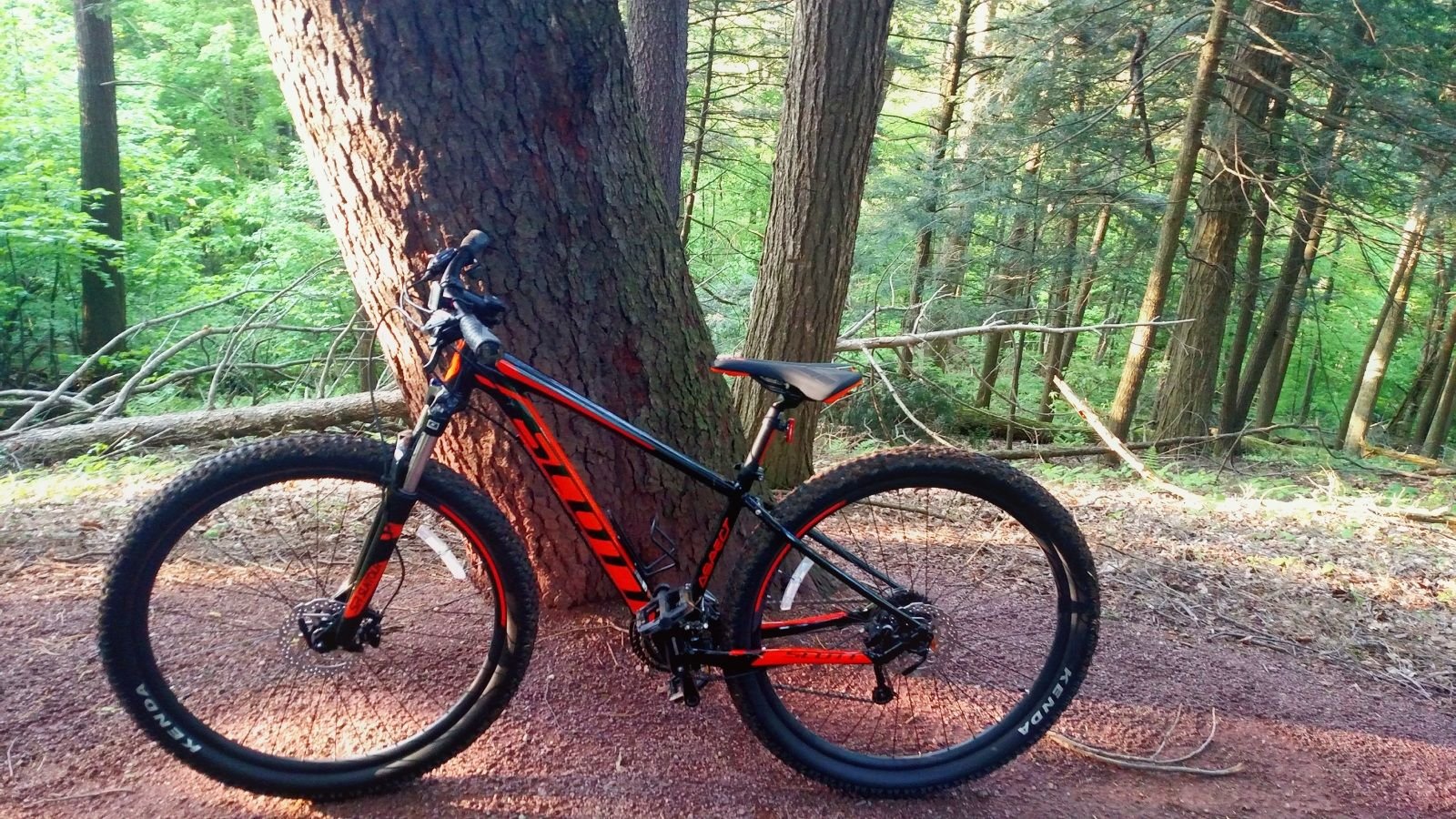
A couple pictures of my bike from my ride last night. These trails have wider flat areas that lead in and out to the singletracks. This is my first mountain bike. I put new grips on it, this weekend will be a pedal upgrade. 
05-24-18 | 10:37 AM
#10

aka Tom Reingold


Joined: Jan 2009
Posts: 44,338
Likes: 6,636
From: New York, NY, and High Falls, NY, USA
Bikes: 1962 Rudge Sports, 1971 Raleigh Super Course, 1971 Raleigh Pro Track, 1974 Raleigh International, 1975 Viscount Fixie, 1982 McLean, 1996 Lemond (Ti), 2002 Burley Zydeco tandem
The danger of flipping over from applying the front brake too hard is real but small. Two things cause it: applying the brake too hard and not bracing your arms with bent elbows. Practice braking with your front brake. Roll at a moderate pace and then brake gently with your front brake. Then do the same, but brake a little harder. Then again and a little harder. You do not have to practice at full braking to get the skill you need.
Now understand that by not using the front brake (adequately), you are robbing yourself of maximum braking power. This can be a very bad thing in an emergency. So build your skill with your front brake as much as possible. Practice so you can be ready for the unexpected.
Skidding the rear wheel reduces your control, and it is not a fast way to stop.
So clearly, I'm a front brake advocate. In fact, I rarely use my rear brake at all.
Now understand that by not using the front brake (adequately), you are robbing yourself of maximum braking power. This can be a very bad thing in an emergency. So build your skill with your front brake as much as possible. Practice so you can be ready for the unexpected.
Skidding the rear wheel reduces your control, and it is not a fast way to stop.
So clearly, I'm a front brake advocate. In fact, I rarely use my rear brake at all.
__________________
Tom Reingold, tom@noglider.com
New York City and High Falls, NY
Blogs: The Experienced Cyclist; noglider's ride blog
“When man invented the bicycle he reached the peak of his attainments.” — Elizabeth West, US author
Please email me rather than PM'ing me. Thanks.
Tom Reingold, tom@noglider.com
New York City and High Falls, NY
Blogs: The Experienced Cyclist; noglider's ride blog
“When man invented the bicycle he reached the peak of his attainments.” — Elizabeth West, US author
Please email me rather than PM'ing me. Thanks.
05-28-18 | 06:15 PM
#11
Junior Member
Joined: May 2018
Posts: 21
Likes: 1
Bikes: 1980s Cannondale Touring, 2017 YT Jeffsy CF One, 2011 Cannondale Carbon Synapse
My gf is currently working on the same thing. She comes from a road bike background and never really used her front brake until MTBing. One of the things that's helped her has been improving her awkward body positioning in steep terrain. We started on flat terrain and just practiced positioning her chest over the saddle and butt as far back over the rear tire as possible. Once you get more comfortable with that start throwing in some front brake stops. Start light and work your way up until you can almost skid the front tire.
Back brakes will also be more effective with more weight over the rear tire, but like many have said, the majority of your stopping power comes from the front brakes, hence why some bikes have larger front rotor.
I've also really loved watching GMBN videos on YouTube for skill lessons. Not sure if there is one for this though.
Best of luck!
Back brakes will also be more effective with more weight over the rear tire, but like many have said, the majority of your stopping power comes from the front brakes, hence why some bikes have larger front rotor.
I've also really loved watching GMBN videos on YouTube for skill lessons. Not sure if there is one for this though.
Best of luck!

