


Bicycle Aerodynamics Charts and Graphs
 08-20-11 | 09:50 AM
#1

Thread Starter
Senior Member

Joined: Dec 2006
Posts: 3,788
Likes: 109
From: Long Island, New York
Bikes: a lowrider BMX, a mountain bike, a faired recumbent, and a loaded touring bike
Bicycle Aerodynamics Charts and Graphs
Hello People,
I had some trouble finding certain , very interesting, Charts and Graphs, which should be at the website for the International Human Powered Vehicle Association:
https://www.ihpva.org
Maybe I was just having trouble navigating the site. But in the meantime, I got frustrated, and went back to an original copy of the Proceedings of the Second International Human Powered Vehicle Scientific Symposium, and scanned the relevant Charts and Graphs. These were first published back in 1983, when Ronald Reagan was still President! Some of these Charts also appeared in the December 1983 Scientific American magazine:


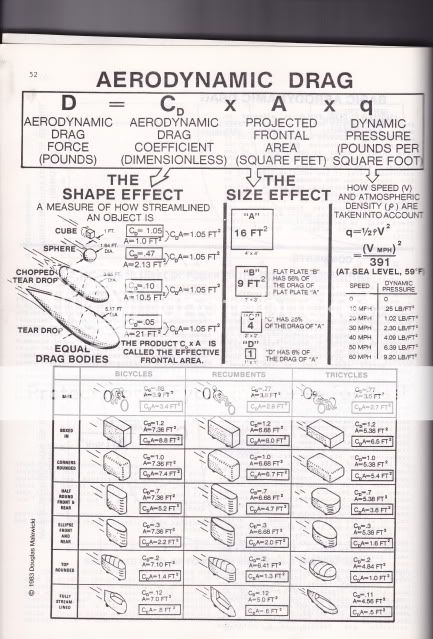
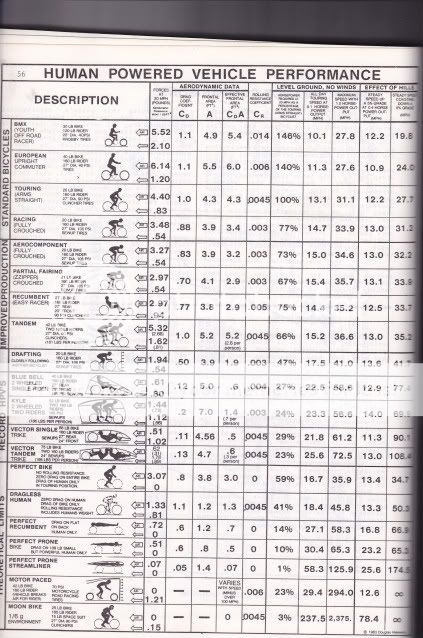
I had some trouble finding certain , very interesting, Charts and Graphs, which should be at the website for the International Human Powered Vehicle Association:
https://www.ihpva.org
Maybe I was just having trouble navigating the site. But in the meantime, I got frustrated, and went back to an original copy of the Proceedings of the Second International Human Powered Vehicle Scientific Symposium, and scanned the relevant Charts and Graphs. These were first published back in 1983, when Ronald Reagan was still President! Some of these Charts also appeared in the December 1983 Scientific American magazine:

 08-21-11 | 07:32 AM
#3
Thread Starter
Senior Member
Joined: Dec 2006
Posts: 3,788
Likes: 109
From: Long Island, New York
Bikes: a lowrider BMX, a mountain bike, a faired recumbent, and a loaded touring bike
Trying to work around the low resolution problem, I've uploaded a pdf of one of the charts:
https://www.easy-share.com/1917622712/IMG.pdf
NOTE: This site deletes anything that doesn't get more than 15 hits a month. Today is 21 August, 2011, so if you are reading this more than a month from this date, and the file is gone, there's nothing I can do about it.
https://www.easy-share.com/1917622712/IMG.pdf
NOTE: This site deletes anything that doesn't get more than 15 hits a month. Today is 21 August, 2011, so if you are reading this more than a month from this date, and the file is gone, there's nothing I can do about it.
08-21-11 | 01:59 PM
#4
Junior Member
Joined: Aug 2008
Posts: 24
Likes: 0
Bikes: Greenspeed SLR
[Visions of youth in engineering school dance through my head . . . ]
The report may be old, but scientific data do not change. Much of the best low-speed aerodynamics research in aviation was done between 1935 and 1955. The NACA charts from the 1950's are still in use. (My aerodynamics text in college was an antique because no textbook written subsequently was as succinct and well-written; I think it was 20 years old at the time.)
In any case, anyone can extrapolate from what you've given us. First, racing DF's have improved with better aero wheels, lower weight (lower rolling resistance) and somewhat better rider position (TT/Tri bars, for example). However, I suspect that the high racer and low racer recumbents have improved even more compared to the old Easy Racer, in terms of frontal area, wheels, and weight. Overall, a light low racer with decent wheels should be the fastest unfaired bike on the road.
It would be a great deal of fun to redo this with today's equipment. My old trike is limited by 1. the engine, 2. the engine, and 3. the weight. Oh, and did I mention the engine?
The report may be old, but scientific data do not change. Much of the best low-speed aerodynamics research in aviation was done between 1935 and 1955. The NACA charts from the 1950's are still in use. (My aerodynamics text in college was an antique because no textbook written subsequently was as succinct and well-written; I think it was 20 years old at the time.)
In any case, anyone can extrapolate from what you've given us. First, racing DF's have improved with better aero wheels, lower weight (lower rolling resistance) and somewhat better rider position (TT/Tri bars, for example). However, I suspect that the high racer and low racer recumbents have improved even more compared to the old Easy Racer, in terms of frontal area, wheels, and weight. Overall, a light low racer with decent wheels should be the fastest unfaired bike on the road.
It would be a great deal of fun to redo this with today's equipment. My old trike is limited by 1. the engine, 2. the engine, and 3. the weight. Oh, and did I mention the engine?
08-21-11 | 02:11 PM
#5
Thread Starter
Senior Member
Joined: Dec 2006
Posts: 3,788
Likes: 109
From: Long Island, New York
Bikes: a lowrider BMX, a mountain bike, a faired recumbent, and a loaded touring bike
[Visions of youth in engineering school dance through my head . . . ]
The report may be old, but scientific data do not change. Much of the best low-speed aerodynamics research in aviation was done between 1935 and 1955. The NACA charts from the 1950's are still in use. (My aerodynamics text in college was an antique because no textbook written subsequently was as succinct and well-written; I think it was 20 years old at the time.)
In any case, anyone can extrapolate from what you've given us. First, racing DF's have improved with better aero wheels, lower weight (lower rolling resistance) and somewhat better rider position (TT/Tri bars, for example). However, I suspect that the high racer and low racer recumbents have improved even more compared to the old Easy Racer, in terms of frontal area, wheels, and weight. Overall, a light low racer with decent wheels should be the fastest unfaired bike on the road.
It would be a great deal of fun to redo this with today's equipment. My old trike is limited by 1. the engine, 2. the engine, and 3. the weight. Oh, and did I mention the engine?
The report may be old, but scientific data do not change. Much of the best low-speed aerodynamics research in aviation was done between 1935 and 1955. The NACA charts from the 1950's are still in use. (My aerodynamics text in college was an antique because no textbook written subsequently was as succinct and well-written; I think it was 20 years old at the time.)
In any case, anyone can extrapolate from what you've given us. First, racing DF's have improved with better aero wheels, lower weight (lower rolling resistance) and somewhat better rider position (TT/Tri bars, for example). However, I suspect that the high racer and low racer recumbents have improved even more compared to the old Easy Racer, in terms of frontal area, wheels, and weight. Overall, a light low racer with decent wheels should be the fastest unfaired bike on the road.
It would be a great deal of fun to redo this with today's equipment. My old trike is limited by 1. the engine, 2. the engine, and 3. the weight. Oh, and did I mention the engine?
Yea, my engine is getting old too...
The NACA charts aren't going to be updated until 2014, and it will be the first revision since, as you said, the 1950's.
I hadn't thought of TT/Tri bars.
You should take a closer look at the bottom of the chart, the words are skewed slightly off the page, but it says "THEORETICAL LIMITS" and it shows a "Perfect Recumbent".
My main concern was that these charts can no longer be found on the IHPVA website, apparently, their server crashed , and the new guys running the IHPVA weren't even born yet when these charts were published!

Thread
Thread Starter
Forum
Replies
Last Post
jc650
Clydesdales/Athenas (200+ lb / 91+ kg)
11
06-13-12 10:54 PM
